Tag: awareness

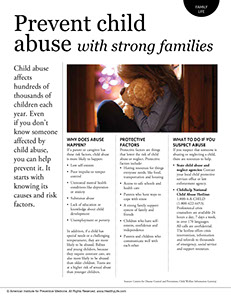
  • Prevent Child Abuse With Strong Families

    FAMILY LIFE

    Young child cuddled up with teddy bear.

    Child abuse affects hundreds of thousands of children each year. Even if you don’t know someone affected by child abuse, you can help prevent it. It starts with knowing its causes and risk factors.

    Why does abuse happen?

    If a parent or caregiver has these risk factors, child abuse is more likely to happen:

    *  Low self-esteem

    *  Poor impulse or temper control

    *  Untreated mental health conditions like depression or anxiety

    *  Substance abuse

    *  Lack of education or knowledge about child development

    *  Unemployment or poverty

    In addition, if a child has special needs or a challenging temperament, they are more likely to be abused. Babies and young children, because they require constant care, are also more likely to be abused than older children. Teens are at a higher risk of sexual abuse than younger children.

    Protective factors

    Protective factors are things that lower the risk of child abuse or neglect. Protective factors include:

    *  Having resources for things everyone needs, like food, transportation and housing

    *  Access to safe schools and health care

    *  Parents who have ways to cope with stress

    *  A strong family support system of family and friends

    *  Children who have self-esteem, confidence and independence

    *  Parents and children who communicate well with each other

    What to do if you suspect abuse

    If you suspect that someone is abusing or neglecting a child, there are resources to help.

    *State child abuse and neglect agencies:Contact your local child protective services office or law enforcement agency.

    *Childhelp National Child Abuse Hotline:1.800-4-A-CHILD  (1-800-422-4453). Professional crisis counselors are available 24 hours a day, 7 days a week, in over 170 languages. All calls are confidential. The hotline offers crisis intervention, information and referrals to thousands of emergency, social service and support resources.

    Sources: Centers for Disease Control and Prevention, Child Welfare Information Gateway
    © American Institute for Preventive Medicine

  • Sepsis: Spot It, Save A Life

    MEDICAL NEWS

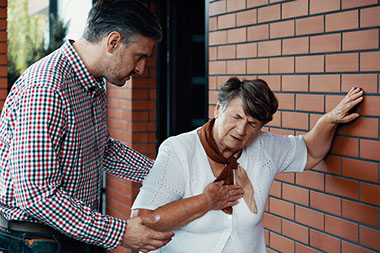
    Women leaning on wall with chest pain and man helping her.

    Sepsis can happen when a person has an infection like pneumonia, an infected cut in the skin or a urinary tract infection. Then, the body’s immune system releases a strong response that can get out of control. This immune response is so powerful that it can damage the body’s organs and cause blood clots.

    Sepsis can cause blood pressure to get extremely low and heart rate to get faster. This can trigger septic shock. With septic shock, the body becomes starved for blood and oxygen. It is a life-threatening emergency.

    Most who get an infection will not get sepsis. But experts don’t know why some people get it and others don’t. It seems to affect older adults, babies and young children the most. People who have a weakened immune system or a long-term illness like diabetes, liver disease or cancer are also more likely to get it.

    Spot sepsis signs

    Sepsis can be hard to spot. At first, symptoms may look like a mild illness. Sometimes a person has an infection and doesn’t know it. Signs include:

    *  Fever or a low body temperature

    *  Chills

    *  Fast heartbeat

    *  Trouble breathing or  fast breathing

    *  Blotchy skin or rash

    *  Being confused

    *  Feeling faint or lightheaded

    Even if you don’t have an infection, or don’t think you have one, ask yourself:

    *  Was I recently around someone who was ill?

    *  Did I recently have surgery or a medical procedure?

    *  Do I have any cuts or breaks in the skin?

    Getting treatment

    If you think a person might have sepsis, it’s important to get them medical care right away. Doctors will look at symptoms and may order blood tests. Sometimes other tests, like an x-ray or CT scan, may be needed.

    Sepsis is serious, so doctors often treat it in the Intensive Care Unit (ICU) of a hospital. Treatment usually includes antibiotics and getting fluids.

    Fortunately, most people who recover from sepsis often contine to have a normal, healthy life.

    Sources: Centers for Disease Control and Prevention, National Institutes of Health, Sepsis Alliance

    © American Institute for Preventive Medicine
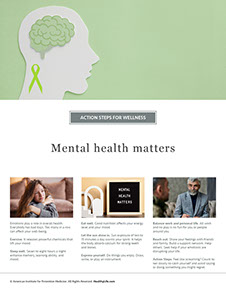
  • Avoiding Stranger Danger Isn’T Just For Kids

    Home Safety

    Image of a person in shadow.

    Always be on alert and aware of your surroundings.

    You don’t have to be paranoid that people are out to get you, but you should be cautious to avoid being robbed, carjacked, raped, and even killed for nothing more than a pair of shoes. Protect yourself and those you love.

    At home:

    *  When you move into a new home or apartment, change all locks right away.

    *  Use deadbolt locks on doors. Secure windows so they can’t be opened more than five inches from the outside.

    *  Keep shades or curtains drawn after dark and turn on outside lights.

    *  Install motion sensor lights that turn on when someone passes by.

    *  Don’t open your door to anyone you don’t know.

    *  Don’t list your first name in the phone book. Keep your name off your mailbox.

    On the go:

    *  Carry a cell phone with you. Make sure it’s charged.

    *  Walk tall on the streets and stay alert. Avoid walking alone at night, dark alleys, and people who look suspicious.

    *  Carry a whistle or stickpin.

    *  Make sure your car has plenty of gas.

    *  If your car breaks down, call for help. Stay inside with the doors locked and the windows up. Turn on your flashers and wait for police or other help to arrive.

    *  If someone approaches your car, crack your window and ask him or her to call for help. Don’t let the person into your car.

    *  Don’t hitchhike or pick up hitchhikers.

    *  If you are going on a date with someone you just met, meet him or her in a public place.

    Action Step

    Use common sense. Don’t jog, bike, or hike alone in secluded areas day or night. Instead, join a club or ask a friend who shares the same interests to join you.

    Ways to Well-Being book by the American Institute for Preventive Medicine. www.HealthyLife.com. All rights reserved.

    © American Institute for Preventive Medicine
  • The Facts About Donating Organs

    MEDICAL NEWS

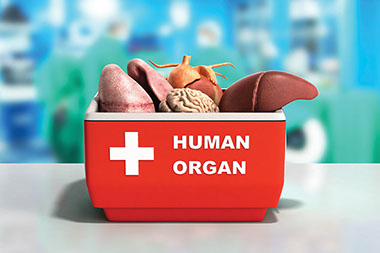
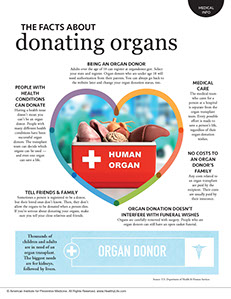
    Illustration of organs.

    Thousands of children and adults are in need of an organ transplant. The biggest needs are for kidneys, followed by livers.

    Being an organ donor

    Adults over the age of 18 can register at organdonor.gov. Select your state and register. Organ donors who are under age 18 will need authorization from their parents. You can always go back to the website later and change your organ donation status, too.

    People with health conditions can donate

    Having a health issue doesn’t mean you can’t be an organ donor. People with many different health conditions have been successful organ donors. The transplant team can decide which organs can be used – and even one organ can save a life.

    Tell friends & family

    Sometimes a person is registered to be a donor, but their loved ones don’t know. Then, they don’t allow the organs to be donated when a person dies. If you’re serious about donating your organs, make sure you tell your close relatives and friends.

    Medical care

    The medical team who cares for a person at a hospital is separate from the organ transplant team. Every possible effort is made to save a person’s life, regardless of their organ donation wishes.

    No costs to an organ donor’s family

    Any costs related to an organ transplant are paid by the recipient. Their costs are usually paid by their insurance.

    Organ donation doesn’t interfere with funeral wishes

    Organs are carefully removed with surgery. People who are organ donors can still have an open casket funeral.

    Source: U.S. Department of Health & Human Services

    © American Institute for Preventive Medicine

  • Mindfulness 2

    Healthylife® QuitWell™

    Part 2

    Image of man walking his dog.

    Mindfulness means you are fully aware of what you are sensing in the current moment. Mindfulness can help you get through a stressful or uncomfortable time without your usual tobacco/nicotine use. It can also:

    *  Give your mind a chance to think creatively and come up with the answers to tough questions.

    *  Help you gently pull yourself back to the present when your mind wants to go somewhere else.

    *  Exercise greater control over your actions and your energy.

    *  Understand yourself more.

    *  Lower inflammation in the body.

    *  Activate areas in the brain that give you feelings of calmness.

    Mindfulness Exercise

    Practice mindfulness while you listen to music, walk, run, eat, or sit in traffic. You can also try this the next time you feel the desire to have a cigarette, dip, or puff from your vape:

    *  Try to physically pause your body. Sit or stand still. Maybe you can lean against the back of a chair or a wall. Get comfortable.

    *  Focus on your breathing or anything in the present, such as the sounds you hear or an object in your sight.

    *  As thoughts pop up in your mind, notice them without judging them. Picture your thoughts like clouds floating by-let them go by. Return your focus to what you see, hear, and feel.

    *  Notice the feelings you have about smoking/your habit and what may be making you feel that way. Be aware of what is helping you do what you want and what is not helping.

    *  When your mind starts to drift, imagine gently guiding it back to the present, as if you’re helping a child that has strayed off the path.

    The craving may have gone away or is now much less. If this is the case, try to do something else while the craving continues to fade.

    © American Institute for Preventive Medicine
  • The Skinny On Processed Foods

    HEALTHY EATING

    Turkey deli on cutting board.

    White bread, packaged cookies and turkey bacon. What do these foods have in common? They are all processed foods. Processed food is the opposite of “whole food,” or food in its natural state.

    What does “processed foods” mean?

    It means the food has been changed from its natural state. White bread, for instance, may contain wheat flour that has been bleached and stripped of some of its nutrients. Packaged cookies may have bleached and stripped flour in addition to added sweeteners, artificial colors, preservatives and flavors. Turkey bacon is cured, processed and packaged.

    Not all processed  foods are bad

    There is a difference between foods that are minimally processed and “junk foods.” Frozen vegetables, for instance, may be considered “minimally processed.” They are not quite the same as picking the vegetables right from a garden. But if they don’t have added sugar or salt, frozen vegetables are a very healthy option.

    In addition, some foods that are considered “processed” can help people eat better. Canned fruit (without added sugar) or bagged salads are a convenient option for many people. They eliminate the extra work of gathering the food, washing it and cutting it.

    Sugar & salt overload

    Many processed “junk” foods contain too much added sugar or salt. Also, they may have little to no fiber or vitamins.

    Processed foods, including crackers and packaged snacks, are a major reason that people get too much sodium in their diets. Too much sodium raises the risk of high blood pressure and heart disease.

    Many processed foods also contain added sugars. The American Heart Association says we should limit added sugars to 6 teaspoons a day for women and 9 teaspoons for men. One 12-ounce soda exceeds that amount. Too much added sugar increases risk for type 2 diabetes and heart disease.

    Processed = weight gain?

    A recent study by the National Institutes of Health suggests that processed foods can cause weight gain. Participants who were given processed foods ate about 500 calories more per day than people who ate unprocessed foods. They also gained weight, while the people who ate unprocessed foods lost weight. You don’t have to cut all processed foods out of your diet. But cutting back on them – and eating more whole foods – will help you work toward a healthier weight.

    Sources: Academy of Nutrition and Dietetics, American Academy of Family Physicians, American Heart Association, National Institutes of Health

    © American Institute for Preventive Medicine
  • Mindfulness 3

    SleepWell® Program

    Week 4

    Image of women sitting out in nature.

    Mindfulness means you are fully aware of all aspects of what you are sensing in the present moment.

    *  You focus on current thoughts without judging them.

    *  You put past thoughts and what the future has in store out of your mind.

    Mindfulness Exercise

    *  Set aside five (or more) minutes. Find a place with no distractions. Get comfortable.

    *  Focus on your breathing or anything in the present, such as the sounds you hear or an object in your sight.

    *  As thoughts pop up in your mind, let them go without judging them. Return your focus to what you see, hear, feel, or are doing in the moment.

    You can also practice mindfulness while you listen to music, walk, run, garden, or with any activity.

    Take a Rest from Your Emotions

    Detach yourself from your thoughts and emotions. Imagine sitting on a hill and viewing your thoughts and feelings at the bottom of the hill. Observe your thoughts as they pass by. Or, you can stop and think about them. Tell yourself: “I have control over when and how I think about a situation.”

    Allow your emotional reactions to a situation or issue take a rest for a bit. This helps your mind use logical thinking.

    © American Institute for Preventive Medicine
  • The Importance Of Portions: Size Matters

    HEALTHY EATING

    Image of 2 bagels.

    If it seems like food portions are bigger today than they were years ago, it’s not your imagination. Health experts say that food sizes – and obesity rates – have grown in the last 20 years. Focusing on healthy foods is important. But portion sizes are also an important factor to think about when you eat. Whether it’s a cookie or a plate of spaghetti, how much you eat is just as important as what you eat. After all, the total calories you consume each day can mean the difference between gaining weight and losing it.

    Reality check: Portions are bigger today

    Take a look at these food comparisons, and find out what you need to do to burn off those extra calories.

    Bagel

    20 years ago: 140 calories, 3-inch diameter

    Today: 350 calories, 6-inch diameter

    Calorie difference: 210 calories

    You have to rake leaves for 50 minutes to burn the extra 210 calories. (Based on 130-pound person)

    Cheeseburger

    20 years ago: 330 calories

    Today: 590 calories

    Calorie difference: 260 calories

    You have to lift weights for 1.5 hours to burn the extra 260 calories. (Based on 130-pound person)

    Soda

    20 years ago: 85 calories, 6.5 ounces

    Today: 250 calories, 20 ounces

    Calorie difference: 165 calories

    You have to work in the garden for 35 minutes to burn 165 calories. (Based on 160-pound person)

    Source: National Heart, Lung, and Blood Institute Obesity Education Initiative

    © American Institute for Preventive Medicine