Tag: diversity

  • Q&A: Diversity In The Workplace

    WORK LIFE

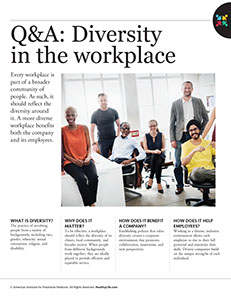
    A diverse group of co-workers sitting around at the office.

    Every workplace is part of a broader community of people. As such, it should reflect the diversity around it. A more diverse workplace benefits both the company and its employees.

    What is diversity?

    The practice of involving people from a variety of backgrounds, including race, gender, ethnicity, sexual orientation, religion, and disability.

    Why does it matter?

    To be effective, a workplace should reflect the diversity of its clients, local community, and broader society. When people from different backgrounds work together, they are ideally placed to provide efficient and equitable service.

    How does it benefit a company?

    Establishing policies that value diversity creates a corporate environment that promotes collaboration, innovation, and new perspectives.

    How does it help employees?

    Working in a diverse, inclusive environment allows each employee to rise to their full potential and maximize their skills. Diverse companies build on the unique strengths of each individual.
    © American Institute for Preventive Medicine

  • Choose A Variety Of Foods

    Healthylife® Weigh

    Part 2

    Group of happy friends preparing food.

    No one food has all the nutrients needed to sustain life and promote well-being. You need to eat a variety of foods to get all of the nutrients your body needs. Some foods provide more nutrients than others. Food can be a source of pleasure, but its main purpose is to provide nutrients that your body cannot make.

    Choose foods that are nutrient dense. This means they give you a lot of nutrients per calorie. Examples are:

    *  Fruits and vegetables

    *  Whole grains

    *  Fat-free or low-fat dairy foods and drinks

    *  Seafood, lean meats, and eggs

    *  Beans, nuts, and seeds

    Some foods contain ingredients that may harm you or are difficult for your body to digest. Limit foods and beverages high in saturated fat, added sugars, or sodium. To do this, choose fewer of these foods:

    *  Sugar-sweetened drinks and desserts

    *  Refined grains (bread, chips, and crackers)

    *  Red meat and high-fat dairy and cheese

    *  Highly processed meats and cheeses

    Everything you eat or drink does not have to be nutrient dense. One meal won’t make or break your health. The trends in your diet are more important.

    © American Institute for Preventive Medicine