Tag: exercise

  • Can You Lower Triglycerides Naturally?

    SELF-CARE CORNER

    Illustration of blood cells.

    Triglycerides are a type of lipid, or fat, in your blood. Everyone has some triglycerides. But high triglycerides, when combined with high “bad” cholesterol and low “good” cholesterol, could be bad for heart health.

    How do I know my triglyceride levels?

    High triglycerides have no signs or symptoms. The only way to know whether you have high triglycerides is through a blood test.

    Ask your doctor how often you should get this test. Most adults need a cholesterol or “lipid” test at least every four to six years. But if you have a family history of heart disease or other risk factors, your doctor may recommend the test more often.

    If your cholesterol tests shows that triglyceride levels are high, you may be able to bring them down by making some lifestyle changes.
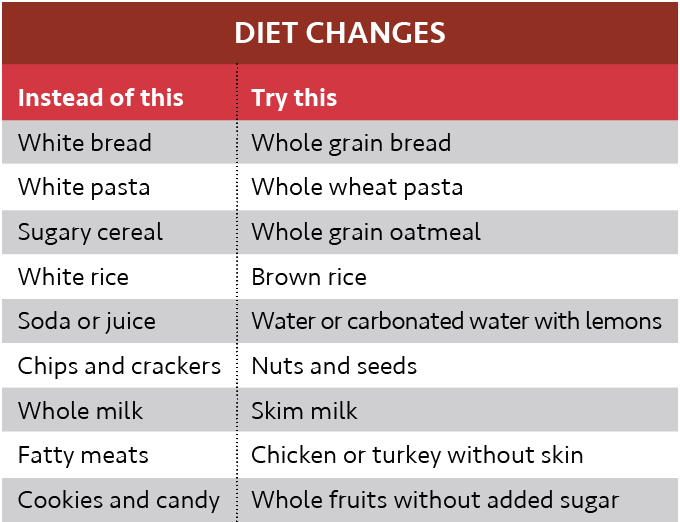
    Chart of Diet Changes - Try this instead of this.

    Heart healthy changes are key

    Talk to your doctor about your triglyceride levels. Your doctor may recommend making certain diet and exercise changes to improve your heart health. If you have diabetes, ask your doctor how you can keep blood sugar levels under good control.

    Exercise and weight loss

    Exercise is great for overall health, and it can lower your triglycerides. Try to walk or do another exercise you enjoy for 30 minutes, five days a week.

    Even a small amount of weight loss can improve triglyceride levels. Losing just 5 percent of your weight can boost your health and lower heart disease risk. Ask your doctor or nutritionist for tips on how to lose excess weight.

    Limit or Avoid Alcohol

    Your doctor may also recommend you limit or avoid alcohol to lower your triglyceride levels.

    Prescription Medicine

    In addition to making lifestyle changes, prescription medicines may also be recommended to bring triglycerides down.

    Sources: Centers for Disease Control and Prevention, National Lipid Association
    © American Institute for Preventive Medicine
  • Get Up & Move After Work

    WORK LIFE

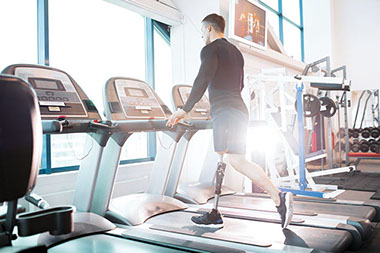
    Man with amputee leg using the treadmill.

    If you’re like many people, you may already be sitting for several hours each day at work. And this could be harming your health. Sitting for long periods is linked to health problems and even a shorter life.

    We can’t always control how much we sit at work. But we can take steps toward better health outside of those hours. Here’s what you can do to get moving in your time away from your job.

    Your prime time

    Been sitting at a desk all day? After work can be a great time to get in some activity. Some people enjoy an exercise class or going to the gym before dinner.

    But if you can’t manage one of these things, don’t give up. Even a short walk is helpful. Go after dinner if you don’t have time before then. Some exercise is always better than not doing any exercise.

    Try using your usual TV or screen time each night to go for a walk or work out to an exercise video.

    Don’t forget lunch

    Want to squeeze in more activity? You can also use your lunch break to break up your sitting time. Try taking a walk throughout your building or head outside.

    You don’t have to do all your exercise at once. Breaking up your exercise into 10-minute chunks offers health benefits. Even 10 minutes a day of activity can add two years to your life expectancy. Thirty minutes of activity a day adds four years or more.

    Try the same thing with any work break. Even a 15-minute break is long enough to get your body moving.

    What if I’m just too tired?

    If you find that you are tired every night after work, it may be time to look at your sleep habits. Are you getting seven to eight hours? If not, try to find ways to make sleep a priority.

    If you’re getting enough sleep but still feel tired, talk with your doctor. Sleep disorders and certain health issues can cause fatigue. Getting your energy back is an important step toward becoming more physically active.

    Source: National Institutes of Health

    © American Institute for Preventive Medicine
  • Kids, Puberty & Sports

    BE FIT

    Adult and teen playing basketball.

    Sports can be a great way for kids to develop social skills, teamwork and resilience. But it’s important to know that athletic ability changes as kids grow.

    Growth affects performance

    During puberty, boys and girls have a growth spurt that can change their athletic ability. After going through puberty:

    *  Boys may notice more muscle strength and overall bigger body size.

    *  Girls often lose some muscle mass. They may temporarily lose some of their speed or agility.

    *  Kids could feel “clumsy” as they adjust to being taller. The brain hasn’t yet adjusted to this new height and may affect balance skills or body control.

    *  It may be harder to throw or hit a ball with longer arms.

    *  Girls may have headaches, mood swings or cramps during menstruation.

    Puberty & knee injuries

    As kids get taller and heavier, they have a higher risk of anterior cruciate ligament (ACL) injury. The ACL is an important ligament that supports the knee.

    ACL injuries can be serious. They may require surgery and can increase the risk of knee arthritis later in life.

    Most ACL injuries happen when a person suddenly stops, changes direction, jumps or lands on the ground. They don’t usually happen from a blow to the knee. Sometimes an ACL injury causes a “popping” sound as it occurs.

    ACL injuries may cause swelling, severe pain, and inability to put weight on the knee. If your child injures their knee, see a doctor right away.

    Positive support is key

    Coaches who know about the effects of puberty can help kids. In addition, parents can help their kids by being positive and supportive. Yelling at kids or being put down may cause them to quit their sport. Remember that changes caused by puberty are only temporary.

    Source: American Academy of Pediatrics

    © American Institute for Preventive Medicine

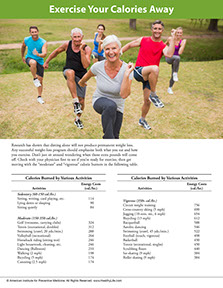
  • Exercise Your Calories Away

    Weight Control

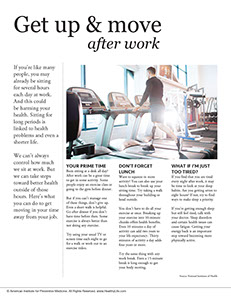
    Research has shown that dieting alone will not produce permanent weight loss. Any successful weight-loss program should emphasize both what you eat and how you exercise. Don’t just sit around wondering when those extra pounds will come off. Check with your physician first to see if you’re ready for exercise, then get moving with the “moderate” and “vigorous” calorie burners in the following table.

    Page from A Year of Health Hints book by the American Institute for Preventive Medicine. www.HealthyLife.com. All rights reserved.

    © American Institute for Preventive Medicine
  • Fitness In Flight

    Healthy Travel

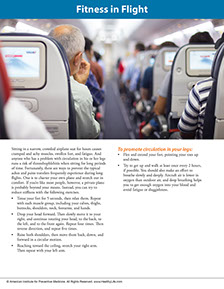
    Passengers aboard an airplane.

    Sitting in a narrow, crowded airplane seat for hours causes cramped and achy muscles, swollen feet, and fatigue. And anyone who has a problem with circulation in his or her legs runs a risk of thrombophlebitis when sitting for long periods of time. Fortunately, there are ways to prevent the typical aches and pains travelers frequently experience during long flights. One is to charter your own plane and stretch out in comfort. If you’re like most people, however, a private plane is probably beyond your means. Instead, you can try to reduce stiffness with the following exercises.

    *  Tense your feet for 5 seconds, then relax them. Repeat with each muscle group, including your calves, thighs, buttocks, shoulders, neck, forearms, and hands.

    *  Drop your head forward. Then slowly move it to your right, and continue rotating your head, to the back, to the left, and to the front again. Repeat four times. Then reverse direction, and repeat five times.

    *  Raise both shoulders, then move them back, down, and forward in a circular motion.

    *  Reaching toward the ceiling, stretch your right arm. Then repeat with your left arm.

    To promote circulation in your legs:

    *  Flex and extend your feet, pointing your toes up and down.

    *  Try to get up and walk at least once every 2 hours, if possible. You should also make an effort to breathe slowly and deeply. Aircraft air is lower in oxygen than outdoor air, and deep breathing helps you to get enough oxygen into your blood and avoid fatigue or sluggishness.

    Page image from A Year of Health Hints book by the American Institute for Preventive Medicine. www.HealthyLife.com. All rights reserved.

    © American Institute for Preventive Medicine

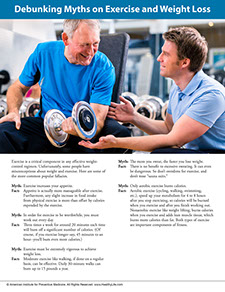
  • Debunking Myths On Exercise And Weight Loss

    Weight Control

    Exercise is a critical component in any effective weight-control regimen. Unfortunately, some people have misconceptions about weight and exercise. Here are some of the more common popular fallacies.

    Myth: Exercise increases your appetite.

    Fact: Appetite is actually more manageable after exercise. Furthermore, any slight increase in food intake from physical exercise is more than offset by calories expended by the exercise.

    Myth: In order for exercise to be worthwhile, you must work out every day.

    Fact: Three times a week for around 20 minutes each time will burn off a significant number of calories. (Of course, if you exercise longer-say, 45 minutes to an hour–you’ll bum even more calories.)

    Myth: Exercise must be extremely vigorous to achieve weight loss.

    Fact: Moderate exercise like walking, if done on a regular basis, can be effective. Daily 30-minute walks can burn up to 15 pounds a year.

    Myth: Only aerobic exercise burns calories.

    Fact: Aerobic exercise (cycling, walking, swimming, etc.), speed up your metabolism for 4 to 8 hours after you stop exercising, so calories will be burned when you exercise and after you finish working out. Nonaerobic exercise like weight lifting, burns calories when you exercise and adds lean muscle tissue, which burns more calories than fat. Both types of exercise are important components of fitness.

    Myth: The more you sweat, the faster you lose weight.

    Fact: There is no benefit to excessive sweating. It can even be dangerous. So don’t overdress for exercise, and don’t wear “sauna suits.”

    Page from A Year of Health Hints book by the American Institute for Preventive Medicine. www.HealthyLife.com. All rights reserved.

    © American Institute for Preventive Medicine
  • Save By Staying Healthy

    Medical Care

    An ounce of prevention is worth more than a pound of cure. The healthier you are, the less you will need to pay for medical care. Also, the state of your health is one of the main factors in setting the cost of health and life insurance.

    Don’t send money up in smoke.

    Cigarette smoking is bad for your health. It’s bad for your wallet, too. A person who smokes two packs a day spends over $3,000 a year just on cigarettes. Hundreds of dollars more are spent on extra dental and medical costs. The cost of health, life, and disability insurance is about 30% higher for persons who smoke.

    Weight does matter.

    Obesity is a leading cause of preventable death. Losing weight can lower the risk for type 2 diabetes, heart disease, and other chronic diseases. These can cost you and your employer a lot of money to treat. Obese persons who buy health insurance on their own may have to pay more. Insurance companies may even turn them down.

    Be fit at little or no cost.

    Take part in fitness programs at work. Join a mall walkers program. Walk with a friend. Follow along with fitness programs on TV. Or, if you have a stationary bike, ride it while you watch TV. Being active every day is a huge investment in your health.

    Look at your genes.

    Find out what health problems both sides of your family have or had. Start with your parents, brothers, and sisters. Then find out about ones your grandparents, uncles, aunts, and first cousins have or had. Once you know what health problems run in your family, talk with your doctor. He/she can suggest ways to lower your risk of getting them.

    Don’t back quacks.

    Find out about products and treatments that don’t work or could cause harm fromwww.quackwatch.organdwww.fda.gov. Don’t waste money on things that don’t help.

    Be savvy about AD-vice.

    Check with your doctor before you follow advice from Web sites and ads that promote products. Many are costly and give little or no benefit.

    Detect to protect.

    Have screening tests and exams that can help detect health problems in early stages when they are easier and less costly to treat. Follow your doctor’s advice.

    Money well spent.

    If you have no health insurance or your health plan does not pay for screening tests or doctor visits, it is still important to have them. Paying for these now could save you thousands in medical costs in the future. Tests may cost less than you think.

    Know thy “health self.”

    The more you know about your health problems, the easier it is to make informed choices about how to take care of them. Find out what you need to do from your doctor. Get reliable facts, too, from trusted sources.

    Follow your doctor’s treatment plan.

    This helps to improve your health. It helps keep problems from getting worse. For example, keeping blood pressure under control can reduce the risk of having a stroke or a heart attack.

    A shot in the arm for your health.

    Get vaccines, as needed, to prevent illnesses. This applies to children, as well as adults. The Centers for Disease Control and Prevention give guidelines for vaccines every year. Find out what they are atwww.cdc.gov/vaccines. Also, if you plan to travel to other countries, find out what vaccines you should get. Find out fromwww.cdc.gov/travel.

    Know about the Vaccines for Children (VFC) Program.

    Your children may be able to get free or low-cost vaccines. Find out fromwww.cdc.gov/vaccines/programs/vfc/default.htm.

    Cover image to the Healthy Savings book by the American Institute for Preventive Medicine. www.HealthyLife.com. All rights reserved.

    © American Institute for Preventive Medicine
  • Simple Steps To Prevent Diabetes

    MEDICAL NEWS

    Image of man with bicycle along the beach.

    The good news is that many cases of type 2 diabetes, which account for between 90 and 95% of all adult cases of the disease, can be prevented by leading a healthy lifestyle, according to the CDC. So whether you’re flirting with pre-diabetes or just want to lower your risk, the American Diabetes Association suggests eating a balanced diet and getting regular exercise.

    Follow these tips on how to fit healthy eating and exercise into your busy day.

    *Sneak some exercise into your day.Being physically fit can lower blood sugar, blood pressure, and cholesterol by helping insulin work better. All of these factors help reduce your risk for diabetes, heart disease, and stroke. Plus, being in shape helps you feel better both physically and mentally.

    *Add exercise to your daily routine.If you don’t currently exercise on a regular basis, start with small amounts of physical activity. For instance, take a brisk 15-minute walk in the morning. Have a walking meeting with co-workers instead of meeting in a conference room.

    *Make exercise fun.Any kind of physical activity is exercise. This includes doing yard work, dancing, or walking the dog. Choose a few activities you enjoy, and take steps to fit them into your schedule. Find a workout buddy to do a few laps around the neighborhood after dinner. Make bike riding or hiking regular family activities.

    *Choose foods with a low glycemic index.The glycemic index is a measure of the effects of carbohydrates on blood sugar levels. These foods include white pasta, cookies, and crackers. They are typically made with processed white flour. When we eat these foods, it causes a spike in blood sugar. Eating these foods also tends to result in weight gain since they are often high in calories. Plus, they are often high in sodium and not very nutritious. Most Americans eat foods with a high glycemic index.

    *Cut back on your sugar intake.If you eat a lot of sugar in your diet, try to reduce sugary foods and beverages. For example, instead of soda and juice, try seltzer or water. When the craving for a cookie or piece of cake hits, try a piece of fruit instead. Some studies have shown that the natural sugar in fruit can help decrease sugar cravings.

    *Incorporate more fresh fruits and vegetables into your diet.Eating more fruits and vegetables keeps your blood pressure stable and gives you much-needed nutrients and fiber. Plus, most fruits and vegetables are low in fat and calories.

    *Choose healthy snacks.Before having a high-sugar or high-fat snack, reach for a handful of nuts, some low-fat popcorn, or whole-wheat crackers. Keep healthy snacks on hand whether you are at home, at work or on the go.

    *Remember these tips when eating out.Think of your plate as a pie chart. You should fill up half of your plate with vegetables, a fourth with protein, and a fourth with a starch or carbohydrate.

    © American Institute for Preventive Medicine

  • Slash Your Cholesterol Levels

    SELF-CARE CORNER

    Illustration of a heart with a pop out illustration of a build up in an artery.

    Many people don’t really know what cholesterol is, or why it matters for your health.

    If your cholesterol levels are too high, you are at an increased risk of heart attack and stroke. This is because too much “bad” LDL cholesterol causes a hard buildup inside your arteries known as plaque. If this buildup breaks loose, it can block an artery to your brain or your heart.

    The good news is there are a number of ways to help lower your cholesterol to a healthy level. Your doctor can help you decide what you need. Medicines can help, but there are also natural ways you can slash your cholesterol. They include:

    *Don’t eat trans fats.Transfats are listed on food labels and are known to raise “bad” LDL cholesterol levels. They are found in processed foods such as doughnuts, cookies, biscuits, pies, crackers and margarines. Be sure to check the Nutrition Facts panel for trans fats and avoid them whenever possible.

    *Cut back on saturated fats.These are found in meat and dairy products. They are okay to eat in small amounts. The American Heart Association recommends up to 6 percent of your daily calories be from saturated fat.

    *Eat “good” fats. Some fats are good for your cholesterol.They include monounsaturated and polyunsaturated fats. These are found in plant foods and oils such as canola, olive, safflower and grapeseed oils. Avocado, seeds and nuts are also great sources. Fatty fish, such as salmon, also include heart-healthy fats known as omega-3s.

    *Eat colorful fruits and vegetables.Brightly colored berries, dark green spinach, orange sweet potatoes and more: colors are good for lowering cholesterol! Eat plenty of bright produce for a boost in cholesterol-lowering nutrients.

    *Cut back on sugar and refined grains.Sweets, white bread, and anything that contains added sugar should be limited. These foods don’t help your heart or your overall health.

    Sources: American Heart Association; Harvard Medical School

    When to check your cholesterol

    Your cholesterol can be checked with a simple blood test. High cholesterol has no symptoms, so you won’t know you have it unless you get checked. The American Heart Association says adults age 20 and older should have their cholesterol checked every four to six years. Some people may need it checked more often. See your doctor for regular checkups to discuss your cholesterol and other heart disease risk factors.

    © American Institute for Preventive Medicine

  • Stay In The Game

    SELF-CARE CORNER

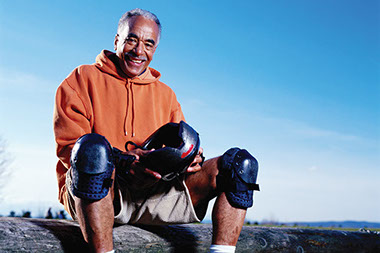
    Image of older man wearing knee pads while holding a helmet.

    Although many athletes understand the importance of keeping their muscles and bones healthy, it’s also important for them to take care of their skin. Sports equipment, especially protective helmets and pads, creates a warm, moist and dark environment for the germs that can cause skin infections to grow.

    “Athletes are at an increased risk of skin infection, which can have serious consequences and may take them-and their teammates-out of the game for days, weeks or months,” said dermatologist Jeffrey V. Benabio. “If athletes notice anything on their skin that itches, burns or may be infected, they should see a board-certified dermatologist or sports medicine doctor.”

    To help prevent skin infections, Dr. Benabio recommends that coaches, athletes, and athletic trainers follow these tips:

    *  Keep cuts and scrapes clean and covered with a bandage until healed. A cut or scrape weakens the skin’s defense and allows germs that cause infections to enter.

    *  Prevent blisters to reduce infections. Apply a pad, gel or spray to areas that routinely blister. To help prevent blisters on the feet, ankles and hands, consider using specialized gloves and socks or wearing two pairs of socks. Athletes should also make sure that their footwear fits properly.

    *  Wear moisture-wicking clothes. This helps keep the athlete’s skin dry and prevents germs from growing.

    *  Wear sandals in the locker room. Wearing sandals or other shoes helps reduce infections on the feet.

    *  Shower after every practice and game. In addition, athletes should use an antimicrobial soap and wash their entire body.

    *  Do not share personal care items. Athletes should always use a clean towel after showering and use their own towels, soaps, razors and other personal care items.

    *  Wash clothes and towels after each use. Sports bags should also be washed, as germs that cause infections can remain in the bags and grow.

    *  Disinfect equipment, including protective gear, daily. For proper disinfection, follow the manufacturers’ instructions.

    *  Perform regular skin checks. Athletes should check their skin daily, especially those in high-risk sports, such as wrestling. Look for any changes, such as cuts, sores, redness, swelling and pus, and report any changes to an athletic trainer or doctor.

    © American Institute for Preventive Medicine