Tag: Financial Wellness

  • Use Credit Cards Carefully

    Financial Health

    Smart use of credit cards can help you control costs and your credit score.

    Using a credit card is safer than carrying cash, makes it easier to track your expenses, and helps you establish credit. And you need a credit card to make purchases online or by phone. But be careful with credit card use to avoid getting into debt.

    Tips to use credit cards wisely:

    *  Make payments on time to avoid: A late fee; a possible increase in your interest rate; having your credit rating go down. According toCreditCards.com, one payment that’s 30 or more days late could lower your score by 60-100 points.

    *  Keep from opening new credit cards. You may save 10 or more percent on a purchase if you sign up for a credit card, but your credit score could go down 10 points for each new card you open.

    *  Limit the number of credit cards you have. Having too many alerts a lender of how much debt you could accrue. But don’t close unused cards, especially ones you have had a long time. A longer credit history helps you have a higher credit score.

    *  Limit individual store and gas cards. These usually have very high interest rates. Opt for two major credit cards (American Express, Discover, Master Card, or VISA). Look for ones with low interest rates and that best meet your needs.

    *  Control credit card use. To avoid interest, only charge what you can pay in full when you get the bill.

    *  To limit interest costs, make more than the minimum payment. Your credit card statements show you how long it will take to pay off your balances if you make only the minimum payments. Aim to keep the balance to less than 25 percent of the total amount you can charge.

    *  Have one or more regular bills billed directly to a credit card. Examples are your monthly electric, gas, and/or cable bill or your mail order prescriptions.

    *  Do not use credit cards for cash advances. You pay a fee for the service and interest rates are very high (often 25 percent or higher).

    *  Read the fine print. Zero-percent interest for balance transfers and purchases can save you money. But you need to pay off the entire balance on the total amount financed by the due date, such as after 6 to 18 months. If not, you may be charged interest on the amount from the original purchase date – not just on the remaining balance. Check for balance transfer fees, too.

    *  Once a year, check your credit score for accuracy. This is a free service from each of the three nationwide credit bureaus – Equifax, Experian and TransUnion. Do this online athttps://annualcreditreport.comor by phone at 1-877-322-8228.

    Credit Scores

    The most common credit score (FICO) range is from 300-850 (the higher the better). Lenders use your payment history on your debts and bills as one of the biggest factors in your credit report and credit score. You are more likely to get lower interest rates and fees for loans, as well as credit cards if you maintain a good credit score – about 700 is good; above 750 is excellent. Lenders consider you a credit risk if your score is below 600.

    Action Step

    If you are an impulse buyer, leave your credit cards at home when you shop. If you are easily tempted to buy items online or while watching shopping channels, switch to a non-shopping website or  TV show, or to a DVD.
    Ways to Well-Being. Published by the American Institute for Preventive Medicine.

    © American Institute for Preventive Medicine

  • Be Smart About Credit Card Offers

    FINANCIAL HEALTH

    Image of man getting mail from mailbox.

    Offers in the mail

    Credit card companies, auto loan companies and other lenders can get a list of names for their credit card offers. They get information from credit reporting agencies about people who have a minimum credit score. Then, they use that list to send out offers for a new card.

    Saying “no” to mail offers

    If you are receiving credit card offers in the mail and don’t want them, there are two things you can do.

    You can opt out of credit card offers for five years. Call 1-888-5-OPTOUT  (1-888-567-8688) or visitoptoutprescreen.com. To opt out forever, you must download and mail a signed paper form. You can get the form on the opt-out website.

    Beware – the opt-out feature only works for certain credit card offers, though. Companies may get your name if they have done business with you before. They may also get your name from other sources that aren’t connected to the credit reporting agencies, such as memberships or subscriptions.

    Why is my child getting a credit card offer?

    Sometimes, a person under 21 years of age gets a credit card offer in the mail. This may happen if the company purchased a list of names and didn’t know that the person was not an adult. But, credit card companies cannot intentionally send their offers to people under 21 years old without permission.

    Phone calls

    Like mail offers, credit card companies can get your name from credit agencies and call you with an offer. You can register your number with the National Do Not Call Registry to stop these calls. Visitwww.donotcall.govor call 1-888-382-1222 to put your phone number on the do not call list.

    What is a prescreened credit card offer?

    Credit card companies can find out if you have a certain credit score. Then, they can offer you a credit card based on that information. This is known as a prescreened offer because they already have some information about your credit. It is not a guarantee that you will get the card. You still have to apply for it and be approved.

    Source: Consumer Financial Protection Bureau

    © American Institute for Preventive Medicine

  • Q&A: Diversity In The Workplace

    WORK LIFE

    A diverse group of co-workers sitting around at the office.

    Every workplace is part of a broader community of people. As such, it should reflect the diversity around it. A more diverse workplace benefits both the company and its employees.

    What is diversity?

    The practice of involving people from a variety of backgrounds, including race, gender, ethnicity, sexual orientation, religion, and disability.

    Why does it matter?

    To be effective, a workplace should reflect the diversity of its clients, local community, and broader society. When people from different backgrounds work together, they are ideally placed to provide efficient and equitable service.

    How does it benefit a company?

    Establishing policies that value diversity creates a corporate environment that promotes collaboration, innovation, and new perspectives.

    How does it help employees?

    Working in a diverse, inclusive environment allows each employee to rise to their full potential and maximize their skills. Diverse companies build on the unique strengths of each individual.

    © American Institute for Preventive Medicine

  • Avoid Holiday Debt

    Financial Health

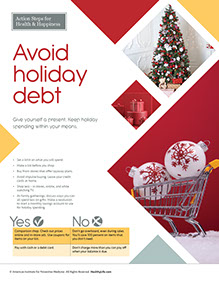
    Small, mini shopping cart with 2 ornaments inside cart.

    Give yourself a present. Keep holiday spending within your means.

    *  Set a limit on what you will spend.

    *  Make a list before you shop.

    *  Buy from stores that offer layaway plans.

    *  Avoid impulse buying. Leave your credit cards at home.

    *  Shop less – in stores, online, and while watching TV.

    *  At family gatherings, discuss ways you can all spend less on gifts. Make a resolution to start a monthly savings account to use for holiday spending.

    *  Comparison shop. Check out prices online and in-store ads. Use coupons for items on your list.

    *  Pay with cash or a debit card.

    *  Don’t go overboard, even during sales. You’ll save 100 percent on items that you don’t need.

    *  Don’t charge more than you can pay off when your balance is due.

    ays to Well-Being book by the American Institute for Preventive Medicine. www.HealthyLife.com. All rights reserved.

    © American Institute for Preventive Medicine

  • Workstation Exercises

    Work Life

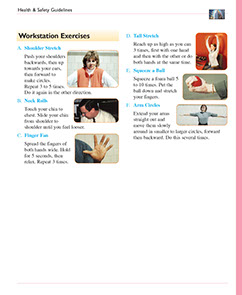
    Shoulder Stretch

    Push your shoulders backwards, then up towards your ears, then forward to make circles. Repeat 3 to 5 times. Do it again in the other direction.

    Neck Rolls

    Touch your chin to chest. Slide your chin from shoulder to shoulder until you feel looser.

    Finger Fan

    Spread the fingers of both hands wide. Hold for 5 seconds, then relax. Repeat 3 times.

    Tall Stretch

    Reach up as high as you can 3 times, first with one hand and then with the other or do both hands at the same time.

    Squeeze a Ball

    Squeeze a foam ball 5 to 10 times. Put the ball down and stretch your fingers.

    Arm Circles

    Extend your arms straight out and move them slowly around in smaller to larger circles, forward then backward. Do this several times.

    Healthier at Home book by the American Institute for Preventive Medicine. www.HealthyLife.com. All rights reserved.

    © American Institute for Preventive Medicine

  • Breastfeeding And Work

    WORK LIFE

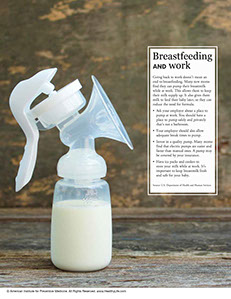
    Breast pump bottle filled with milk.

    Going back to work doesn’t mean an end to breastfeeding. Many new moms find they can pump their breastmilk while at work. This allows them to keep their milk supply up. It also gives them milk to feed their baby later, so they can reduce the need for formula.

    *  Ask your employer about a place to pump at work. You should have a place to pump safely and privately that’s not a bathroom.

    *  Your employer should also allow adequate break times to pump.

    *  Invest in a quality pump. Many moms find that electric pumps are easier and faster than manual ones. A pump may be covered by your insurance.

    *  Have ice packs and coolers to store your milk while at work. It’s important to keep breastmilk fresh and safe for your baby.

    Source: U.S. Department of Health and Human Services

    © American Institute for Preventive Medicine
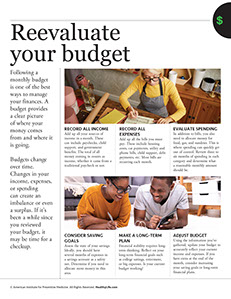
  • Reevaluate Your Budget

    FINANCIAL HEALTH

    Women working on a budget.

    Following a monthly budget is one of the best ways to manage your finances. A budget provides a clear picture of where your money comes from and where it is going.

    Budgets change over time. Changes in your income, expenses, or spending can create an imbalance or even a surplus. If it’s been a while since you reviewed your budget, it may be time for a checkup.

    Record all income

    Add up all your sources of income in a month. These can include paychecks, child support, and government benefits. The total of all money coming in counts as income, whether it came from a traditional paycheck or not.

    Record all expenses

    Add up all the bills you must pay. These include housing costs, car payments, utility and phone bills, child support, debt payments, etc. Most bills are recurring each month.

    Evaluate spending

    In addition to bills, you also need to allocate money for food, gas, and sundries. This is where spending can quickly get out of control. Review three to six months of spending in each category and determine what a reasonable monthly amount should be.

    Consider saving goals

    Assess the state of your savings. Ideally, you should have several months of expenses in a savings account as a safety net. Determine if you need to allocate more money in this area.

    Make a long-term plan

    Financial stability requires long-term thinking. Reflect on your long-term financial goals such as college savings, retirement, or big expenses. Is your current budget working?

    Adjust budget

    Using the information you’ve gathered, update your budget to accurately reflect your current income and expenses. If you have extra at the end of the month, consider increasing your saving goals or long-term financial plans.

    © American Institute for Preventive Medicine
  • Balance It All

    Work Life

    Mother and son sitting while son is writing in a notebook.

    Career, family, and a personal life. You can have it all, can’t you? Absolutely! But when the demands of work overtake the demands of your family and personal life, you can suffer chronic stress and burnout. And miss out on some of the best things in life. Sometimes it takes effort to balance it all.

    The key might be to keep your eye on your values, learn to say no, stop reaching for perfection, and “unplug” regularly.

    ays to Well-Being book by the American Institute for Preventive Medicine. www.HealthyLife.com. All rights reserved.

    © American Institute for Preventive Medicine

  • Collecting Unclaimed Funds

    FINANCIAL HEALTH

    Young couple holding a jar with money in it.

    Could you have money waiting for you? Learn about unclaimed money or property from bank accounts, tax refunds, insurance policies or wages and pensions.

    You can find your unclaimed money for free. Here’s how:

    *  Search in every state where you have lived. Look up each state’s unclaimed property office. You can also try contacting the state treasurer’s office.

    *  Search the FDIC database. If your bank or credit union closed, you could have unclaimed deposits. You can also check out the National Credit Union Administration (NCUA) atwww.ncua.gov/support-services.

    *  Current or former VA life insurance holders can check for unclaimed life insurance funds. Go toinsurance.va.gov/UnclaimedFunds.

    *  Look for tax refunds from an FHA-insured mortgage. If you earned income but your wages were below the tax filing requirement, you might have a refund waiting. Go toirs.gov/refunds to check. If you bought mortgage insurance from the Federal Housing Administration (FHA), you might have a refund. Go toentp.hud.gov/dsrs/refunds.

    *  Do you have unclaimed back wages or pension money from a past employer? Go to the Workers Owed Wages (WOW) website atwebapps.dol.gov/wow. You can also check the Pension Benefit Guaranty Corporation atpbgc.gov.

    Notice that these websites include “gov.” They don’t have a “com” or “org.” The “gov” means it’s an official U.S. Government website. You should never have to pay any money to find or claim your unclaimed money. It’s FREE. Watch out for scammers and people who want to charge you for this service.

    Source: usa.gov

    © American Institute for Preventive Medicine
  • Save At The Supermarket

    FINANCIAL HEALTH

    Couple at the grocery store.

    While the cost of food is out of your control, smart shopping habits will help keep your grocery bill more manageable.

    Tips to save on groceries

    Shop with a list

    Grocery stores know just how to tempt you to make impulse purchases. With eye-catching end cap displays and strategically placed snack foods, it’s easy to end up bringing home more than you intended. Instead, make a detailed list before you go and stick to it.

    Check the cabinets

    How many times have you purchased an item only to find you already have it hidden in the back of your pantry? As you make your shopping list, carefully check your current food supply to make sure you really need the ingredients.

    Buy in bulk

    When possible, purchase family-sized or bulk items for your most commonly used ingredients. This works especially well for meats, beans, rice, grains, and pasta. When you get home, promptly freeze or store the extra. You can also join a wholesale club to get better prices on bulk food.

    Eat seasonally

    Fruits and vegetables are cheapest when in season. For example, berries are more expensive in the winter than during peak berry season in the summer. Oranges and other citrus are usually cheapest during the winter months. Opt for in-season produce whenever possible.

    Stock up

    Buy more than one when your favorite foods go on sale. Dry goods generally keep for a long time, and many fresh foods can be frozen for longer storage. Keep in mind that you should only stock up on ingredients you regularly use.

    Low-cost recipes

    How you choose to eat is a major determinant of your food budget. If you like to cook gourmet, you’ll need fancier ingredients that cost more. Instead, find tasty recipes that use inexpensive ingredients. Examples include beans, rice, frozen vegetables, tuna, potatoes, and eggs.

    © American Institute for Preventive Medicine