Tag: Financial Wellness

  • Protect Yourself From Identity Theft

    Financial Health

    Manage and minimize misuse of your personal information

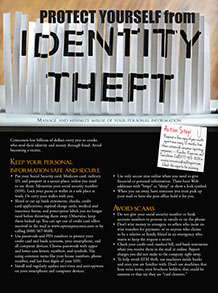
    Consumers lose billions of dollars every year to crooks who steal their identity and money through fraud. Avoid becoming a victim.

    Keep your personal information safe and secure:

    *  Put your Social Security card, Medicare card, military ID, and passport in a secure place, unless you need to use them. Memorize your social security number (SSN). Lock your purse or wallet in a safe place at work. Or carry your wallet with you.

    *  Shred or cut up bank statements, checks, credit card applications, expired charge cards, medical and insurance forms, and prescription labels you no longer need before throwing them away. Otherwise, keep them locked up. You can opt out of credit card offers received in the mail atwww.optoutprescreen.comor by calling (888) 567-8688.

    *  Use passwords and PIN numbers to protect your credit card and bank accounts, your smartphone, and all computer devices. Choose passwords with upper and lower case letters, numbers, and symbols. Nix using common items like your house numbers, phone number, and last four digits of your SSN.

    *  Install and regularly update anti-virus and anti-spyware on your smartphone and computer devices.

    *  Use only secure sites online when you need to give financial or personal information. These have Web addresses with “https” or “shttp” or show a lock symbol.

    *  When you are away, have someone you trust pick up your mail or have the post office hold it for you.

    Avoid scams:

    *  Do not give your social security number or bank account numbers to persons in emails or on the phone.

    *  Don’t wire money to strangers, to sellers who insist on wire transfers for payment, or to anyone who claims to be a relative or family friend in an emergency who wants to keep the request a secret.

    *  Check your credit card, medical bill, and bank statements when you receive them in the mail or online. Report charges you did not make to the company right away.

    *  To help avoid ATM theft, use machines inside banks and ones you are familiar with. Don’t use machines that have extra items, even brochure holders, that could be cameras or that say they are “card cleaners.”

    Action Step

    Request a free copy of your credit report once every 12 months from three nationwide consumer reporting companies – Equifax, Experian, and TransUnion. Call (877) 322-8228. Check the reports for accuracy.
    Ways to Well-Being book by the American Institute for Preventive Medicine. www.HealthyLife.com. All rights reserved.

    © American Institute for Preventive Medicine

  • Avoiding Distractions At Work

    WORK LIFE

    Close up image of laptop with hands and phone.

    We all have days that are more productive than others. But you can be your best each day if you learn how to avoid the biggest distractions at your workplace.

    Put the phone away

    Is your phone frequently dinging with texts or people calling you “just to chat?” Do you find yourself checking social media or playing with apps when you should be working?

    Smart phones are a major cause of work-related distractions. Some employers have policies that prohibit cell phone use on the job. If that’s the case, you’ll need to follow those rules. But if your employer allows cell phones, turn off notifications and put the phone in a place that’s harder to reach. Some phones have an option that filters all calls except those from important or emergency numbers. This is a great way to allow people to reach you when it’s necessary, but to avoid non-essential calls and notifications.

    Use white noise

    If other people’s conversations or office noises are bothering you, consider ways you can soften or filter some of the sound. A white noise machine, fan or even headphones that play white noise or quiet non-distracting music may be helpful.

    Ways to get your focus back

    Everyone needs a mental break once in a while. Instead of checking your phone or social media, try these healthy tips that can energize you and help you get back to your work:

    *  Take a short walk around the building.

    *  Eat a healthy snack, such as fruits, vegetables, or lean protein.

    *  Drink a glass of water. Add a lemon or cucumber slice for more flavor.

    *  Get up from your chair and stretch for 3 minutes.

    *  Clean or organize your workspace. Clutter in your space can make your brain feel cluttered, too.

    © American Institute for Preventive Medicine

  • How To Stop Impulse Buying

    FINANCIAL HEALTH

    Image of women looking at jeans.

    Many people have bought something at the store that they didn’t plan to get. If you buy something simply because you see it and want it, this is called an impulse buy.

    Some estimates show that the average American spends a few thousand dollars a year on impulse buys. These purchases can add up to big spending.

    If you’re trying to save money, take a look at your buying habits. It’s possible that your unplanned impulse purchases are standing in the way of a healthy budget and your long-term financial goals.

    Try not to dwell on past impulse purchases. Instead, look to the future and decide that you will resist the urge to buy things you don’t need.

    Why we impulse buy

    Stores use certain tricks and techniques to make impulse buys happen. Plus, specific things happen in our brains while shopping that can lead to an impulse buy. Some of the reasons we buy things on impulse:

    1.  A love of shopping and new things. Shopping can release feel-good chemicals in the brain. Once we experience this kind of pleasure, it can become a habit that is hard to break.

    2.  Fear of missing a deal. Our desire to save money can lead to impulse buying. We see a deal on something and wonder if we will regret not buying it later.

    3.  Hope that having this item will make our life better. For example, someone may think that buying a new blender means they will make a vegetable smoothie every day. Or, if someone is feeling depressed or angry, they may think this new item will fix their problem.

    How to stop impulse purchases

    If you think impulse buying is affecting you, there are ways to stop. Keep these things in mind when you go shopping:

    *  Stop and think about the price. Ask yourself whether that item is truly worth what it costs. Think about how many hours you would have to work to pay off that item. Is it really worth buying?

    *  Bring a list. Make your shopping list in advance and buy only those items.

    *  Don’t use credit cards. If possible, only shop with cash or a debit card. This means you won’t have seemingly unlimited funds. If that’s not possible, picture next month’s bill with that item on it. That number on your statement may make the item less appealing.

    *  Don’t shop when you’re hungry, stressed, angry or sad. These emotions can prompt you to buy unwanted things.

    © American Institute for Preventive Medicine

  • Save Money On Health Expenses

    FINANCIAL HEALTH

    Image of stethoscope and money on top of paper work.

    Unexpected health care costs can be hard on any budget. To help manage your own health care costs:

    *Get preventive care.Well visits and checkups often cost a lot less than treating a disease or illness. Talk to your doctor and dentist about how often you should be seen, and stick to this schedule.

    *Use generic medicines.Name brand medicines can cost hundreds of dollars more than generic ones. Ask your doctor if a generic medicine is available for your condition. Tell your doctor if you are having trouble paying for medications. Drug makers sometimes offer coupons or savings cards for people who need them.

    *Shop around for your prescriptions.Medicine costs can vary widely among pharmacies. Call pharmacies and ask for the cost of your prescription medicine. Some websites also have prescription medicine costs available for pharmacies in your area. You may also wish to look into mail-order pharmacies.

    *Check your medical bills.Make sure there are no mistakes on your doctor, hospital or prescription bills. And, be sure your insurance covered services it is supposed to cover. If you have questions, or think you may be over-billed, call the number listed on your bill.

    Source: Consumer Federation of America

    Watch those late fees!

    A few dollars here, 20 dollars there… late fees can add up. Whether it’s your credit card bill or a service you received, make an effort to pay your bill on time. Avoid late fees by getting bills set up on automatic payment plans. Or, have a special slot on the wall to place bills that haven’t been paid. Then, they won’t get buried under junk mail or other papers on your desk.

    © American Institute for Preventive Medicine

  • Tips For Work Gift-Giving

    WORK LIFE

    Image of 2 wrapped gifts.

    If you’re considering buying presents for people at your workplace, it’s important to know how to do it right:

    *Be discreet.If you are buying gifts for just a friend or two, consider giving them outside of work so others don’t feel excluded.

    *Keep it professional.Work-related items, such as a nice pen or a coffee mug (if the person drinks coffee), are appropriate options. Personal items, such as perfume or clothing, should generally be avoided.

    *Be careful about supervisors.Many companies frown upon giving gifts to the boss. Although your intentions may be good, co-workers may see it as a way to buy into your boss’s good graces. And, it could make your boss uncomfortable.

    *Don’t go overboard.Spending more than you can afford isn’t necessary and may make the recipient feel uncomfortable.

    *Consider different religions and beliefs.Remember that not everyone celebrates the same holidays.

    Hands-free etiquette

    Whether you’re in a work meeting or at the office holiday party, you may want to put down your smart phone. Checking your email and posting to social media during work activities may give others the impression you are bored or would rather be somewhere else. If you must have it on for emergency calls, silence the dinging emails and text messages to minimize distractions.

    © American Institute for Preventive Medicine

  • Avoid Dubious Debt Collectors

    FINANCIAL HEALTH

    Wife on phone while husband sits besides her.

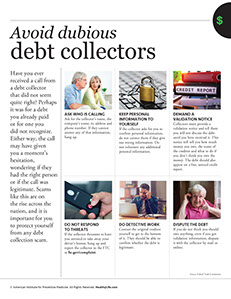
    Have you ever received a call from a debt collector that did not seem quite right? Perhaps it was for a debt you already paid or for one you did not recognize. Either way, the call may have given you a moment’s hesitation, wondering if they had the right person or if the call was legitimate. Scams like this are on the rise across the nation, and it is important for you to protect yourself from any debt collection scam.

    Ask who is calling

    Ask for the collector’s name, the company’s name, its address and phone number. If they cannot answer any of that information, hang up.

    Keep personal information to yourself

    If the collector asks for you to confirm personal information, do not correct them if they give out wrong information. Do not volunteer any additional personal information.

    Demand a validation notice

    Collectors must provide a validation notice and tell them you will not discuss the debt until you have received it. This notice will tell you how much money you owe, the name of the creditor and what to do if you don’t think you owe the money. The debt should also appear on a free, annual credit report.

    Do not respond to threats

    If the collector threatens to have you arrested or take away your driver’s license, hang up and report the collector to the FTC atftc.gov/complaint.

    Do detective work

    Contact the original creditor yourself to get to the bottom of it. They should be able to confirm whether the debt is legitimate.

    Dispute the debt

    If you do not think you should owe anything, even if you got validation information, dispute it with the collector by mail or online.

    Source: Federal Trade Commission

    © American Institute for Preventive Medicine

  • Avoiding The Afternoon Slump

    WORK LIFE

    Image of a group of co-workers smiling and laughing.

    Do you often feel tired and worn out after lunch? It can be hard to stay productive and get through the workday if you’re fighting fatigue and exhaustion. Often times, this afternoon slump can be avoided by making a few simple changes:

    *Use caffeine sparingly.A cup of coffee or tea can give you a boost in the morning, but drinking too much can cause an energy crash after it wears off. Finish your last caffeinated drink before noon, and limit intake to four 8 oz. cups of coffee.

    *Include lean protein and healthy fats in your lunch.This can help stabilize blood sugar levels and fight fatigue. Examples include turkey, low-fat dairy, avocado, nuts and fish.

    *Drink plenty of water.Even mild dehydration can make you tired. Aim for eight 8 oz. glasses per day.

    *Get moving.If you can, walk outside at lunch and get fresh air, even for just 10 minutes. This can energize and relax you. But even walking indoors or stretching in your office can be helpful. Sitting at a desk for hours without getting up can make you feel tired. Do alternative activities and walk around when you can.

    *Having more energy starts the day before.If you find that you’re tired every day despite these tips, you may need more sleep. Aim for 7 to 9 hours a night.

    Sometimes, ongoing fatigue can be a sign of a health issue. If you find that your energy levels are always low despite making healthy choices, talk to your doctor. Problems such as sleep disorders, anemia, depression, diabetes, and many other conditions can cause energy levels to sag. Certain medications can also cause sleepiness. You and your doctor can discuss your health history and make a plan to address any issues to get you feeling better again.

    © American Institute for Preventive Medicine

  • I Love My Cellphone

    WELL-BEING

    Image of a smart phone on a bench.

    You’ve done it: driven back home to search for your forgotten phone. Dug under the car seats. Called yourself to find a lost phone. Or, worse, watched your phone ring silently when you were in a situation where you couldn’t answer it.

    Cellphone use has become a common part of life as mobile devices have become one of the most popular ways to communicate. Research from the University of Missouri has found that cellphone separation can have serious psychological and physiological effects on iPhone users, including poor performance on mental tests.

    The researchers say these findings suggest that iPhone users should avoid parting with their phones during daily situations that involve a great deal of attention, such as taking tests, sitting in conferences or meetings, or completing important work assignments, as it could result in poorer mental performance on those tasks. But use common sense and proper business etiquette about texting, talking, and checking emails in those venues.

    © American Institute for Preventive Medicine

  • Save More, Spend Less

    FINANCIAL HEALTH

    Image of women at kitchen counter with groceries and placing money in a piggy bank.

    According to the American Psychological Association, finances are the number one cause of stress in America. Whether it’s meeting the monthly bills or trying to build a retirement fund, financial worries can be difficult to deal with.

    If you’re looking for ways to stretch your monthly budget, the Federal Trade Commission offers some tips that may help you save more and spend less without feeling the pinch.

    Start with a budget.

    This may not be fun, but it doesn’t have to be long and difficult. You can use something as simple as a two-column sheet of paper. In one column, write your net income for the month. In the other column, record all your expenses: basic monthly bills (mortgage, food, transportation), lifestyle choices (entertainment, eating out, personal care, pets), and other expenses. This will give you a clear idea of how much you need to save or cut back on spending. The FTC website offers a free budget worksheet atwww.consumer.ftc.gov/articles/pdf-1020-make-budget-worksheet.pdf.

    Consider direct deposits into savings accounts.

    Have part of your paycheck go directly into a 401 savings or other type of retirement account. Have additional money put into another savings account for an emergency fund and major expenses as needed.

    Pack lunches.

    A daily $6 spent on lunch adds up to $800 a year. Instead, make extra food for dinner and take leftovers or make your own sandwich. Or, purchase healthy frozen meals when they’re on sale.

    Use free community services.

    Most cities have well-stocked libraries that have books, magazines, music, games, and movies. You can check these items out for free.

    Know that every little bit helps.

    Make small, manageable goals to help you save. Even just $1,000 less on your credit card bill could save you hundreds of dollars in interest each year. Eating out one fewer time each week adds up to big savings in a few months. Rather than being discouraged by a goal that seems impossible, look for small, doable ways to save a few dollars here and there.

    © American Institute for Preventive Medicine

  • Tips To Save On Your Summer Vacation

    FINANCIAL HEALTH

    Image of family about to go on a road trip.

    You want your vacation to be memorable, but you probably don’t want to remember spending a lot of money. With some advanced planning, you can save a good amount of your travel and vacation expenses. Here’s what travel experts recommend:

    *Don’t pick prime times for flights.If you’re flying, you’ll usually pay less for airline tickets during off-peak times. This means flying during the middle of the week, early in the morning or late at night.

    *Be flexible.When booking airline tickets, choose the flexible dates option to find the lowest price for airfare. Sometimes, the savings can be substantial.

    *Visit during the off-season.Many people travel to warm, tropical destinations during the winter months. Try going during the late fall or early spring instead.

    *Check out renting a house.Many destinations offer houses for rent at about the same price per night as hotels but with much more space. When you share with another family, you split the cost for even more savings.

    *Look for online deals & coupons.Look online for local activities you want to do, such as visiting museums or scuba diving excursions. Many places offer deals or coupons if you book in advance. You may also be able to avoid lines for buying tickets.

    *Don’t forget your discounts.Companies like AARP and AAA often have discount rates for members. Some employers have discounts available to employees for car rentals and other vacation items.

    *Pack snacks.Pack healthy snacks in a cooler for a car trip like fresh-cut fruits and vegetables. For flights, bring your own food to the airport and eat before getting on the plane. Keep in mind liquids more than 3.4 ounces can’t be taken through the security checkpoints.

    *Get a kitchen.Look for hotel rooms that have a full kitchen so you can store food and beverages, cook your own meals and avoid the higher costs of eating out.

    *Try camping.Instead of traditional hotels, look for campsites. Camping often costs a fraction of what a hotel costs, as long as you have a tent, mats to sleep on and a few more basic camping supplies.

    *Look nearby.If the prices of airline tickets and hotels aren’t in your budget, look for daytrip options. Destinations within 2 hours of home are often doable for families and can be just as fun as a longer trip.

    © American Institute for Preventive Medicine