Tag: goals

  • Save For More Than Just A Rainy Day

    Financial Health

    Invest in your future.

    Money doesn’t grow on trees, but it can grow when you save and invest it wisely. First, identify what you want to save for:

    *  Emergency funds? (Plan for three to six months of expenses.) Holiday expenses? Vacations? A house? College for your kids? Retirement?

    *  Rank order your goals.

    Invest, but do not put all your eggs in one basket.

    Diversify with stocks, bonds, mutual funds, IRAs, real estate, and commodities, such as gold and silver. Find out more about investing fromwww.mymoney.gov. Things you can do on your own:

    *  If your employer has a retirement plan, such as a 401(k), have as much deducted from your pay as possible, especially if your employer matches some or all of the amount you contribute.

    *  Get resources on planning for retirement and long-term care fromwww.csrees.usda.gov/fsll.

    *  Check out “529” prepaid tuition and savings plans for college fromwww.collegesavings.org. These offer tax-saving advantages.

    *  Get professional investment advice from employer sponsored programs or from your financial planner. Find a certified professional from the Association for Financial Counseling and Planning Education atwww.afcpe.org.

    Revisit your budget:

    *  Pay off credit card or high interest debts first. Then use some or all of the payment money for your savings plan.

    *  Put aside whatever you can in savings accounts, checking accounts, and certificates of deposit.

    *  Look for additional ways to save fromhttp://investor.gov/sites/default/files/Saving-and-Investing.pdf

    *  Decide the best ways you are likely to save money.

    – Have your paycheck automatically deposited in your bank and have some go directly into one or more savings accounts.

    – Save money you get from tax refunds, work bonuses, and extra income.

    Action Step

    Beware of investments that promise high returns with little or no risk. If it sounds too good to be true, it usually is.

    Ways to Well-Being. Published by the American Institute for Preventive Medicine.

    © American Institute for Preventive Medicine

  • Keep Track

    Healthylife® QuitWell™

    Part 3

    Man typing on his phone.

    Use a notebook, or a note in your phone. You can also find a sample scorecard at the end of this program.

    Each time that you use tobacco or nicotine, mark down the time. If you have space to write more, jot down the trigger or what you were doing right beforehand. At the end of each day, add up your total for the day.

    Do this for a few days to get an average. You many not use the same amount every day. Get your average for working days and days you have off. You will likely have different tobacco habits.

    © American Institute for Preventive Medicine

  • Set Goals 2

    SleepWell® Program

    Week 2

    Image of wood blocks with letters spelling "smart."

    View sleep improvement as a long-term project, especially if you have had poor sleep for a long time. First, define small steps you want to take. Continue to reflect on your efforts.

    Small Steps

    Think of the actions you take on a daily basis as small steps towards your bigger goal. This guide has already given you many ideas for small steps. Examples are limiting caffeine and dimming the lights one hour before bedtime. Identify your next change and use the following guidelines to improve your goal. All goals should be:

    Chart on S.M.A.R.T.

    Stay motivated with the small successes you achieve along the way. Use your SleepWell® Tracker every day for feedback on the effect your actions have on your sleep.

    Reminder:If your sleep issues are chronic (last longer than three weeks), your primary goal should be to schedule an appointment with your doctor or a sleep specialist.

    Practice Goal-Setting

    Strengthen your goal using the S.M.A.R.T. tool. Start with a simple statement about what you want to accomplish. Next, write how your goal will be specific, measurable, attainable, relevant, and timely.

    Barriers to Change

    As you think more about your goal, roadblocks may appear. You may need tools or skills to achieve your goal. Identify what is making it difficult for you to change. Barriers do not mean you can’t make the change. Identify challenges that must be overcome to succeed.

    © American Institute for Preventive Medicine
  • Diet Changes: Simple And Doable

    HEALTHY EATING

    Hand over table with bowls of different, healthy ingredients.

    If you try a complete diet overhaul at once, you may get overwhelmed. You can make it easier by not doing too much at once. Focus on one or two things you want to change and stick with those.

    Keep comfort foods, but tweak them

    Many people think they must give up all their favorite foods to be healthy. But if you have comfort foods you enjoy, this can cause even more stress. Here’s how to keep them while eating healthy:

    *Eat them less often.Aim to eat your comfort food once a week, rather than every day. Come up with healthier options to replace the comfort food.

    *Take a smaller portion.Put a smaller portion on your plate and eat it slowly. Enjoy the smell and taste of each bite, truly savoring it.

    *Modify the recipe.Switch out high fat and high calorie ingredients in your recipes. Use low-fat or fat-free dairy products instead of whole milk and cream. Use vegetable noodles instead of white pasta. All those little changes add up.

    Keep it simple

    If you’re already under stress, following an extreme diet plan could backfire. It could cause more stress, which could lead to frustration and more stress.

    Instead, celebrate one or two small victories each day. Write down when you snacked on fresh carrots instead of potato chips. Or you had a glass of water instead of soda. Whatever you did to make your diet a little bit better is a step in the right direction.

    Looking at the positive things you have accomplished may be the boost you need during times of stress. When you have slip-ups or bad days, don’t view it as a “failure.” It doesn’t mean all your healthy eating plans are over. Instead, forgive the mistake and look forward to a better and healthier day tomorrow.

    Source: Centers for Disease Control and Prevention

    © American Institute for Preventive Medicine

  • Host Productive Meetings

    WORK LIFE

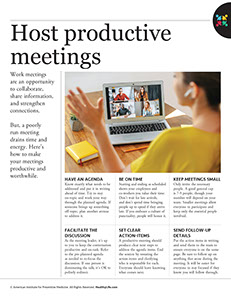
    Video conferencing.

    Work meetings are an opportunity to collaborate, share information, and strengthen connections. But, a poorly run meeting drains time and energy. Here’s how to make your meetings productive and worthwhile.

    Have an agenda

    Know exactly what needs to be addressed and put it in writing ahead of time. Try to stay on-topic and work your way through the planned agenda. If someone brings up something off-topic, plan another avenue to address it.

    Be on time

    Starting and ending as scheduled shows your employees and co-workers you value their time. Don’t wait for late arrivals, and don’t spend time bringing people up to speed if they arrive late. If you embrace a culture of punctuality, people will honor it.

    Keep meetings small

    Only invite the necessary people. A good general cap is 7-9 people, though your number will depend on your team. Smaller meetings allow everyone to participate and keep only the essential people involved.

    Facilitate the discussion

    As the meeting leader, it’s up to you to keep the conversation productive and on-task. Refer to the pre-planned agenda as needed to re-focus the discussion. If one person is dominating the talk, it’s OK to politely redirect.

    Set clear action-items

    A productive meeting should produce clear next steps to address the agenda items. End the session by restating the action items and clarifying who is responsible for each. Everyone should leave knowing what comes next.

    Send follow-up details

    Put the action items in writing and send them to the team to ensure everyone is on the same page. Be sure to follow up on anything that arose during the meeting. It will be easier for everyone to stay focused if they know you will follow through.

    © American Institute for Preventive Medicine

  • Reevaluate Your Budget

    FINANCIAL HEALTH

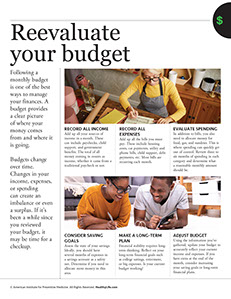
    Women working on a budget.

    Following a monthly budget is one of the best ways to manage your finances. A budget provides a clear picture of where your money comes from and where it is going.

    Budgets change over time. Changes in your income, expenses, or spending can create an imbalance or even a surplus. If it’s been a while since you reviewed your budget, it may be time for a checkup.

    Record all income

    Add up all your sources of income in a month. These can include paychecks, child support, and government benefits. The total of all money coming in counts as income, whether it came from a traditional paycheck or not.

    Record all expenses

    Add up all the bills you must pay. These include housing costs, car payments, utility and phone bills, child support, debt payments, etc. Most bills are recurring each month.

    Evaluate spending

    In addition to bills, you also need to allocate money for food, gas, and sundries. This is where spending can quickly get out of control. Review three to six months of spending in each category and determine what a reasonable monthly amount should be.

    Consider saving goals

    Assess the state of your savings. Ideally, you should have several months of expenses in a savings account as a safety net. Determine if you need to allocate more money in this area.

    Make a long-term plan

    Financial stability requires long-term thinking. Reflect on your long-term financial goals such as college savings, retirement, or big expenses. Is your current budget working?

    Adjust budget

    Using the information you’ve gathered, update your budget to accurately reflect your current income and expenses. If you have extra at the end of the month, consider increasing your saving goals or long-term financial plans.

    © American Institute for Preventive Medicine
  • See Your Fitness Progress

    BE FIT

    Two women walking with walking sticks.

    When you’re trying to get fit, it can be hard to stay motivated. Look for ways that you’re making progress. This can help you keep going!

    Progress isn’t just about weight. You are making progress if:

    *  You have more energy. Do you feel less tired than you used to? Are you getting more done?

    *  Your daily tasks are easier. Maybe carrying the groceries isn’t as tough as it used to be. Or going upstairs doesn’t leave you out of breath.

    *  You’re getting better sleep. Exercise can help you sleep better, leaving you feeling refreshed and energized in the morning.

    Keep it up! The longer you exercise, the better you’ll feel!

    Source: National Institute on Aging

    © American Institute for Preventive Medicine

  • Weekly Family Meetings

    FAMILY LIFE

    Young family smiling and laughing togething.

    A weekly family meeting is a time to be together, check in, and address any issues that arise.

    *  Make the meeting fun: Plan a special dessert to enjoy. Create a relaxed mood with special lighting or comfy pillows.

    *  Have an agenda: While you don’t want the meeting to be too formal, you should have a schedule to keep you on task.

    *  Get everyone involved: Let people take turns leading discussions. Encourage input and prioritize creative problem-solving.

    *  Set a respectful tone: This is a good time to practice resolving conflict with respect and consideration.

    *  End on a good note: If a tough topic needed to be addressed, be sure to end with something positive. Talk about fun upcoming events or brainstorm vacation ideas.

    © American Institute for Preventive Medicine