Tag: Health Conditions

  • Wash Hands For Health

    General Health Conditions

    Bar of soap.

    Having clean hands is one of the most important things you can do to prevent getting sick and spreading disease-causing germs. That’s why technique matters.

    Add water & soap:Wet hands with clean, running water (warm or cold) and apply soap.

    Lather up:Lather all parts of your hands well by rubbing them together.

    Sing a song:Scrub for at least 20 seconds or sing “Happy Birthday” twice.

    Rinse & dry:Rinse well under clean, running water. Dry hands using a clean towel or air-dry them.

    Option:If soap and water are not available, use a hand sanitizer that contains at least 60% alcohol.

    Health at Home Lifetime book by the American Institute for Preventive Medicine. www.HealthyLife.com. All rights reserved.

    © American Institute for Preventive Medicine

  • Bloody Nose Know-How

    MEDICAL NEWS

    Image of a nose bleed.

    Maybe you blew your nose too hard or bumped your nose. Causes aren’t always known. But when the blood starts gushing, nosebleeds can be frightening.

    Experts at eMedicineHealth tell what to do: Remain calm. Sit up straight and lean your head forward. Contrary to what some people think, do not lean your head back, you’ll only swallow the blood.

    Ice packs do not help either. Pinch your nostrils tightly together with your thumb and index finger for 10 minutes. Just hold it. Breathe through your mouth, of course. Do not release your grip.

    That should stop the blood flow, usually from an artery in the front of your nose. Then be nice to your tender nose for the rest of the day. Think about adding humidity to the air when you sleep, especially in dry winter weather.

    © American Institute for Preventive Medicine

  • Go Red To Manage Pain

    SELF-CARE CORNER

    Image of cherry juice.

    Tart cherries may help reduce chronic inflammation, especially for the millions of Americans suffering from joint pain and arthritis, according to research from Oregon Health & Science University. The researchers suggest tart cherries have the “highest anti-inflammatory content of any food” and can help people with osteoarthritis manage their disease.

    In a study of women ages 40 to 70 with inflammatory osteoarthritis, the researchers found that drinking tart cherry juice twice daily for three weeks led to significant reductions in important inflammation markers-especially for women who had the highest inflammation levels at the start of the study.

    Often thought of as “wear-and-tear” arthritis, osteoarthritis is the most common type of arthritis. Athletes are often at a greater risk for developing the condition, given their excessive joint use that can cause a breakdown in cartilage and lead to pain and injury, according to the Arthritis Foundation.

    Along with providing the fruit’s bright red color, the antioxidant compounds in tart cherries-called anthocyanins-have been specifically linked to high antioxidant capacity and reduced inflammation, at levels comparable to some well-known pain medications.

    Available every day of the year in dried, frozen, and juice forms, tart cherries are a versatile ingredient to include in any training or inflammation-fighting diet.

    © American Institute for Preventive Medicine
  • Open Wide

    SELF-CARE CORNER

    Image of dentist.

    Your dentist and dental hygienist inspect your mouth for oral cancers when you show up for your regular dental cleanings. But between visits, take note of these early warning signs, and see your dental professional if they do not improve or disappear after 2 to 3 weeks:

    *  A sore, or soreness or irritation that doesn’t go away

    *  Red or white patches, or pain, tenderness, or numbness in your mouth or lips

    *  Lumps, thickening tissues, rough spots, crusty or eroded areas

    *  Difficulty chewing, swallowing, or moving your jaw or tongue

    *  A change in the way your teeth fit together when you close your mouth

    Always call your dental professional right away if you have any immediate concerns. Those at high risk of developing oral cancer have traditionally been heavy alcohol drinkers and smokers over age 50. But today, cancer is occurring in younger, nonsmokers. The sexually transmitted HPV is related to some cancers in younger people.

    © American Institute for Preventive Medicine

  • Sun Sense

    SELF-CARE CORNER

    Image of sunscreen being applied to a kid's face.

    Did you know … the term “sunblock” is no longer used on sunscreen labels because no sunscreen can block all of the sun’s rays? You’ll now see the term “broad spectrum” that indicates a level of protection offered from both UVA and UVB rays.

    Sunscreens really aren’t waterproof either. Apply and reapply at least every 2 hours, but question why you’re out in the sun for that long a period of time anyway.

    Remember, only broad spectrum sunscreens with an SPF value of 15 or higher can claim to reduce the risk of skin cancer and early skin aging, and that’s only if they’re used correctly and with other sun protection measures such as wide-brimmed hats (not baseball caps) and sunglasses.

    Nobody ever applies enough sunscreen. And many people forget about ears, backs of necks, nose, lips, and tops of feet (avoid wearing flip-flops).

    Source: University of Michigan Health System, Loyola University Medical Center

    © American Institute for Preventive Medicine

  • When Allergies Get Real Serious

    MEDICAL NEWS

    Image of candy bar with warning "Not suitable for Nut allergy sufferers."

    A severe allergic reaction can be life threatening. It’s called anaphylaxis. The symptoms begin within minutes of eating a trigger food or after a bee sting or touching poison ivy. Some drugs can cause these serious reactions too. The Asthma and Allergy Foundation of America offers this safety advice:

    *  Know the symptoms: flushed skin, rash, tissue swelling, stuffy nose, sweating, panting, nausea, stomach cramps, rapid pulse, wheezing, convulsions, or fainting.

    *  Know what you’re allergic to: check food labels and ingredients. Ask at restaurants if you’re unsure if a menu item contains something you’re allergic to. Skin or blood tests done by a specialist can confirm that you’re sensitive to certain substances that can cause a severe reaction.

    *  Carry an auto-injectable epinephrine device that allows you to use a rescue medication until emergency help arrives.

    *  Wear a medical alert bracelet to let others know of your allergy.

    *  Anaphylaxis is a 9-1-1 medical emergency.

    © American Institute for Preventive Medicine

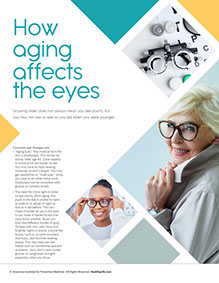
  • How Aging Affects The Eyes

    Eye Conditions

    Growing older does not always mean you see poorly. But you may not see as well as you did before. Common changes that affect your eyes are:

    *  “Aging Eyes.” The medical term for this is presbyopia (prez-bee-OH-pea-ah). This comes on slowly after age 40. Close objects or small print are harder to see. You may have to hold reading materials at arm’s length. You may get headaches or “tired eyes” while you read or do other close work. Presbyopia can be corrected with glasses or contact lenses.

    *  The need for more light in order to see clearly. With aging, the pupil in the eye is unable to open as wide or to adapt to light as fast as it did before. This can make it harder to see in the dark. It can make it harder to tell one color from another. Blues can look like different shades of gray. To help with this, add more and brighter lights in places around the house, such as at work counters, stairways, and favorite reading places. This may help you see better and can sometimes prevent accidents. Also, don’t wear tinted glasses or sunglasses at night, especially when you drive.

    Signs & Symptoms and What It Could Be

    Signs & Symptoms: Sudden loss of all or part of vision, especially in one eye with sudden weakness or numbness on one side.

    What It Could Be: Stroke

    What to Do: Get immediate care. Call 9-1-1.

    Signs & Symptoms: Vision loss after head or eye injury. Sudden vision loss or blurred vision, and seeing dark spots, or flashes of light all of a sudden.

    What It Could Be: Detached or torn retina.

    What to Do: Get immediate care.

    Signs & Symptoms: Severe pain in and above the eye. Eye redness, swollen upper eyelid. Dilated and fixed pupil. Very blurred vision, halos around lights.

    What It Could Be: Angle-closure glaucoma.

    What to Do: Get immediate care.

    Signs & Symptoms: Object or chemical in the eye.

    What It Could Be: Eye irritation or injury.

    See “Eye Irritations & Injuries” for more information.

    Signs & Symptoms: Gradual loss of side vision. Blurred vision. Halos around lights. Poor night vision.

    What It Could Be: Open-angle or chronic glaucoma.

    See “Glaucoma” for more information.

    Signs & Symptoms: Dark or blind spot in center of vision. Blurred or cloudy vision. Straight lines look wavy.

    What It Could Be: Macular degeneration.

    See “Macular Degeneration” for more information.

    Signs & Symptoms: Cloudy, fuzzy, foggy, or filmy vision. Halos around lights. Problems with glare from lamps or the sun.

    What It Could Be: Cataract.

    See “Cataracts” for more information.

    Signs & Symptoms: Pus discharge from the eye; the white of the eye and eyelid are red; crusting of the eyelid in the morning; feeling of sand in the eye

    What It Could Be: Conjunctivitis (“Pink Eye”).

    See “Conjunctivitis (Pink Eye)” for more information.

    Signs & Symptoms: Firm lump on eyelid or tender pimple on the edge of the eyelid.

    What It Could Be: Stye.

    See “Stye” for more information.

    Signs & Symptoms: Seeing spots, specks, wavy lines, or streaks of light.

    What It Could Be: Floaters and/or flashes.

    See “Floaters and/or flashes” for more information.

    Signs & Symptoms: Blurred vision when you look at close objects; headaches; eyestrain.

    What It Could Be: “Aging Eyes” or presbyopia.

    What to Do: Call eye doctor for an appointment and advice.

    Health at Home Lifetime book by the American Institute for Preventive Medicine. www.HealthyLife.com. All rights reserved.

    © American Institute for Preventive Medicine

  • Canker Sores

    Dental & Mouth Concerns

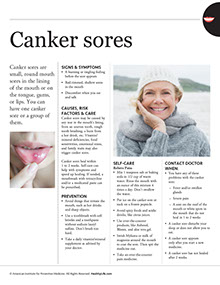
    Canker sores are small, round mouth sores in the lining of the mouth or on the tongue, gums, or lips. You can have one canker sore or a group of them.

    Signs & Symptoms

    *  A burning or tingling feeling before the sore appears

    *  Red-rimmed, shallow sores in the mouth

    *  Discomfort when you eat and talk

    Causes, Risk Factors & Care

    Canker sores may be caused by any tear in the mouth’s lining, from an uneven tooth, rough tooth brushing, a burn from a hot drink, etc. Vitamin/mineral deficiencies, emotional stress, and family traits may also trigger canker sores.

    Canker sores heal within 1 to 2 weeks. Self-care can help with symptoms and speed up healing. If needed, a mouthwash with tetracycline and/or an oral paste (amelxanox) can be prescribed.

    Self-Care / Prevention

    To Relieve Pain:

    *  Mix 1/2 cup salt in 1 cup of warm water. Rinse the mouth with an ounce of this mixture 4 times a day. Don’t swallow the water.

    *  Put ice on the canker sore or suck on a frozen popsicle.

    *  Avoid spicy foods and acidic drinks, like citrus juices.

    *  Use over-the-counter products, like Anbesol, Blistex, and aloe vera gel.

    *  Swish Mylanta or milk of magnesia around the mouth to coat the sore. Then spit the medicine out.

    *  Put the gel from a vitamin E capsule on the sore several times a day.

    *  Take an over-the-counter pain medicine.

    Prevention

    *  Avoid things that irritate the mouth, such as hot drinks and sharp objects.

    *  Use a toothbrush with soft bristles and a toothpaste without sodium lauryl sulfate. Don’t brush too hard.

    *  Take a daily vitamin/mineral supplement as advised by your doctor.

    Medical Care

    Contact Doctor When:

    *  You have any of these problems with the canker sore:

    – Fever and/or swollen glands

    – Severe pain

    – A sore on the roof of the mouth or white spots in the mouth that do not heal in 1 to 2 weeks

    *  A canker sore disturbs your sleep or does not allow you to eat.

    *  A canker sore appears only after you start a new medicine.

    *  A canker sore has not healed after 3 weeks.

    Healthier at Home book by the American Institute for Preventive Medicine. www.HealthyLife.com. All rights reserved.

    © American Institute for Preventive Medicine

  • Dental Hygiene

    Dental & Mouth Concerns

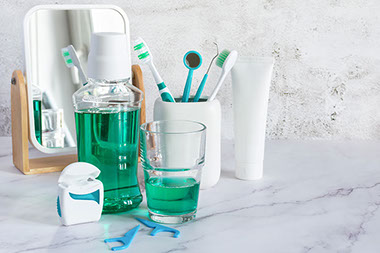
    Dental hygiene products, tooth brush, tooth paste, mouth wash, etc.

    Taking care of your teeth and gums helps your teeth last a lifetime.

    Brush and floss your teeth twice a day. Get a dental exam once or twice a year. If you have not seen a dentist in over a year, schedule a dental exam today.

    Dental problems affect more than your teeth and gums. Gum (periodontal) disease and other mouth infections may increase the risk for pneumonia, heart disease, and diabetes.

    Let your dentist know if you have tooth pain, red or swollen gums, bad breath that doesn’t go away or any other dental problem.

    Change toothbrushes at least every 3 to 4 months; sooner if the bristles are frayed.

    Rinse your toothbrush after each use to remove debris and leftover toothpaste. Store toothbrushes upright in a holder far enough apart that bristles don’t touch.

    Find out more from the American Dental Association atada.org.

    Health at Home Lifetime book by the American Institute for Preventive Medicine. www.HealthyLife.com. All rights reserved.

    © American Institute for Preventive Medicine
  • Fatigue & Autoimmune Diseases

    Women’s Health

    Fatigue is being very tired, weary, and lacking energy. Often, it is a symptom of other health problems.

    Signs & Symptoms

    *  Feeling drained of energy.

    *  Feeling exhausted.

    *  Having a very hard time doing normal activities.

    *  Having low motivation.

    *  Feeling inadequate.

    *  Having little desire for sex.

    Causes

    Causes that need medical care include anemia, depression, heart disease, and chronic fatigue syndrome (the fatigue lasts at least 6 months). Fatigue is also a common symptom of autoimmune diseases. These include diabetes, low thyroid, multiple sclerosis, and lupus (the systemic type).

    Other physical causes include lack of leisure activities or lack of sleep; poor diet; side effects from allergies, chemical sensitivities or drug or alcohol addiction; being in hot, humid conditions; and prolonged effects of the flu or a bad cold.

    Possible emotional causes are burnout, boredom, and a major life change (e.g., divorce, retirement, etc.).

    Treatment

    Treatment for fatigue depends on the cause(s). Keep track of any other symptoms that occur with the fatigue. This helps find out both physical and emotional causes.

    Questions to Ask

    Self-Care / Prevention

    If fatigue is due to a medical condition, follow your doctor’s or health care provider’s guidelines for rest, diet, medication, etc.

    *  Get regular physical activity. Exercise can give you more energy, especially if you sit all day at work. Exercise can calm you, too.

    *  Cool off. Working or playing in hot weather can drag you down. Rest in a cool, dry place as often as you can. Drink plenty of water.

    *  Rest and relax. Get a good night’s sleep. Relax during the day if you can, too. Practice deep breathing or meditation.

    *  Eat well. Eating too much and “crash dieting” are both hard on your body. Don’t skip breakfast. Limit high-fat and/or rich, sugary foods. Eat whole-grain breads and cereals and fruits and vegetables every day. Have 5 to 6 light meals a day, instead of 3 large ones. Take vitamin and mineral supplements, as advised by your doctor.

    *  Change your routine. Do something interesting each day. If you do too much, plan for some quiet time.

    *  Lighten your work load. Assign tasks to others when you can. Ask for help when you need it.

    *  Do something for yourself. Plan time to do things that meet only your needs.

    *  Avoid too much caffeine and alcohol. Don’t use illegal drugs. These trigger fatigue.

    Resources

    Chronic Fatigue Syndrome & Fibromyalgia Information Exchange Forum (Co-Cure)

    www.co-cure.org

    Women's Self-Care book by the American Institute for Preventive Medicine. www.HealthyLife.com. All rights reserved.

    © American Institute for Preventive Medicine