Tag: Healthcare

  • Save By Being A Wise Consumer

    Medical Care

    What price, health care?

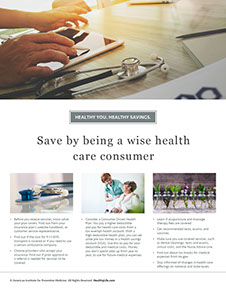
    It is more common to know the price of a car than the price of health care services. It is also more common to take more time looking for a car than a doctor. To be prepared to take care of your health and health care costs, plan ahead:

    *  Don’t wait until you get sick to find a doctor. Having a doctor can save the expense of having to go to an urgent care center or emergency room.

    *  Know what costs your health plan covers and what you need to pay.

    *  Post a list of places your health plan approves for treatment. When you need care, use them instead of out-of-plan ones, which could cost you extra money.

    *  If you have a yearly deductible, budget for this with the rest of your bills.

    Check credentials.

    You can’t afford to trust your health to just anyone. Find out about doctors from:

    *  American Board of Medical Specialties (ABMS) at 866.ASK.ABMS (275.2267) orwww.abms.org.

    *  DocFinder atwww.docboard.org/docfinder.html.

    *  The Federation of State Medical Boards at 888.ASK.FCVS (275.3287) orwww.fsmb.org.

    *  Health Grades atwww.healthgrades.com.

    Look for quality.

    Check out the track records of health plans, hospitals, and doctors. Contact the Agency for Health Care Research and Quality atwww.ahrq.gov.

    Protect yourself from medical errors.

    These could cost extra money and can even cost you your life. Be your own watch dog. Take an active role in every decision about your health care. If needed, have a family member or friend oversee your care.

    Know about tax breaks.

    Medical and dental expenses are tax deductible if they exceed 7.5% of your adjusted gross income. If you are self-employed, you may be allowed to deduct 45% of the cost of your health insurance premium. Find out fromwww.irs.gov.

    Cover image to the Healthy Savings book by the American Institute for Preventive Medicine. www.HealthyLife.com. All rights reserved.

    © American Institute for Preventive Medicine

  • When In Doubt, Get A Second Opinion

    Medical Care

    Image of doctor and patient talking.

    The very first thing you should do if a doctor suggests surgery is to get the opinion of a second doctor. Programs to encourage patients to pursue other options have been established all over the country in an effort to curtail unnecessary surgery.

    Ask your physician or someone else you trust to recommend a non-surgeon or another surgeon, not affiliated with the same hospital as your physician, who will review your case and offer an opinion. Generally, you should not submit to surgery on the basis of one medical opinion alone.

    The following table indicates the percentage of surgeries not recommended by the physician giving a second opinion.

    Always check with your insurance company to see if (and how much of) the cost of a second opinion will be covered. Most policies include this feature. If you have Medicare, call 1.800.MEDICARE (633.4227) for information on second surgical opinions.

    Page from A Year of Health Hints book by the American Institute for Preventive Medicine. www.HealthyLife.com. All rights reserved.

    © American Institute for Preventive Medicine

  • Save On Prescriptions

    FINANCIAL HEALTH

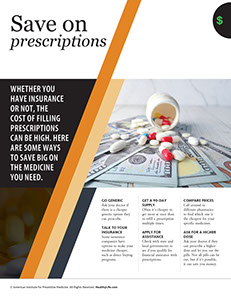
    Pills and bottle on top of a money.

    Whether you have insurance or not, the cost of filling prescriptions can be high. Here are some ways to save big on the medicine you need.

    Go generic

    Ask your doctor if there is a cheaper generic option they can prescribe.

    Talk to your insurance

    Some insurance companies have options to make your medicine cheaper, such as direct buying programs.

    Get a 90-day supply

    Often it’s cheaper to get more at once than to refill a prescription multiple times.

    Apply for assistance

    Check with state and local governments to see if you qualify for financial assistance with prescriptions.

    Compare prices

    Call around to different pharmacies to find which one is the cheapest for your specific medicines.

    Ask for a higher dose

    Ask your doctor if they can prescribe a higher dose and let you cut the pills. Not all pills can be cut, but if it’s possible, it can save you money.

    © American Institute for Preventive Medicine

  • Gather Facts

    Medical Care

    Image of 4 people sitting and talking.

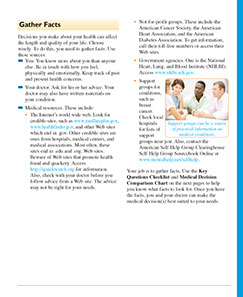
    Decisions you make about your health can affect the length and quality of your life. Choose wisely. To do this, you need to gather facts. Use these sources:

    *  You. You know more about you than anyone else. Be in touch with how you feel, physically and emotionally. Keep track of past and present health concerns.

    *  Your doctor. Ask for his or her advice. Your doctor may also have written materials on your condition.

    *  Medical resources. These include:

    – The Internet’s world wide web. Look for credible sites, such aswww.medlineplus.gov,www.healthfinder.gov, and other Web sites which end in .gov. Other credible sites are ones from hospitals, medical centers, and medical associations. Most often, these sites end in .edu and .org. Beware of Web sites that promote health fraud and quackery. Accesshttp://quackwatch.orgfor information. Also, check with your doctor before you follow advice from a Web site. The advice may not be right for your needs.

    – Not-for-profit groups. These include the American Cancer Society, the American Heart Association, and the American Diabetes Association. To get information, call their toll-free numbers or access their Web sites.

    – Government agencies. One is the National Heart, Lung, and Blood Institute (NHLBI). Accesswww.nhlbi.nih.gov.

    – Support groups for conditions, such as breast cancer. Check local hospitals for lists of support groups near you. Also, contact the American Self-Help Group Clearinghouse Self-Help Group Sourcebook Online atwww.mentalhelp.net/selfhelp.

    Your job is to gather facts. Once you have the facts, you and your doctor can make the medical decision(s) best suited to your needs.

    Page from the Healthier at Home book by the American Institute for Preventive Medicine. www.HealthyLife.com. All rights reserved.

    © American Institute for Preventive Medicine

  • Medicare

    Medical Care

    Image of older couple talking to agent.

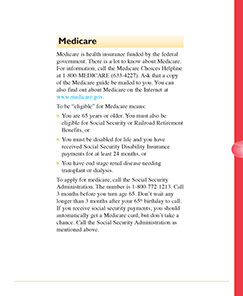
    Medicare is health insurance funded by the federal government. There is a lot to know about Medicare. For information, call the Medicare Choices Helpline at 1-800-MEDICARE (633-4227). Ask that a copy of the Medicare guide be mailed to you. You can also find out about Medicare on the Internet atwww.medicare.gov.

    To be “eligible” for Medicare means:

    *  You are 65 years or older. You must also be eligible for Social Security or Railroad Retirement Benefits, or

    *  You must be disabled for life and you have received Social Security Disability Insurance payments for at least 24 months, or

    *  You have end stage renal disease needing transplant or dialysis.

    To apply for medicare, call the Social Security Administration. The number is 1-800-772-1213. Call 3 months before you turn age 65. Don’t wait any longer than 3 months after your 65th birthday to call. If you receive social security payments, you should automatically get a Medicare card, but don’t take a chance. Call the Social Security Administration as mentioned above.

    Page from the Health at Home Lifetime book by the American Institute for Preventive Medicine. www.HealthyLife.com. All rights reserved.

    © American Institute for Preventive Medicine

  • Save By Being A Wise Health Care Consumer

    Medical Care

    Close up of hand using a tablet.

    *  Before you receive services, know what your plan covers. Find out from your insurance plan’s website handbook, or customer service representative.

    *  Find out if the cost for 9-1-1 EMS transport is covered or if you need to use a certain ambulance company.

    *  Choose providers who accept your insurance. Find out if prior approval or a referral is needed for services to be covered.

    *  Consider a Consumer Driven Health Plan. You pay a higher deductible and pay for health care costs from a tax-exempt health account. With a high-deductible health plan, you can set aside pre-tax money in a health savings account (HSA). Use this to pay for your deductible and medical costs. Money you don’t spend adds up from year to year, to use for future medical expenses.

    *  Learn if acupuncture and massage therapy fees are covered.

    *  Get recommended tests, exams, and vaccines.

    *  Make sure you use covered services, such as dental cleanings, tests and exams, virtual visits, and the Nurse Advice Line.

    *  Find out about tax breaks for medical expenses fromirs.gov.

    *  Stay informed of changes in health care offerings on national and state levels.

    A Year of Health Hints book by the American Institute for Preventive Medicine. www.HealthyLife.com. All rights reserved.

    © American Institute for Preventive Medicine

  • When To Refuse Tests Or Surgery

    Medical Care

    Image of doctor talking to hospital patient and spouse.

    It has been estimated that at least one-quarter of medical tests done each year are not needed. A study published in the Journal of the American Medical Association found that nearly 60 percent of the study’s 2,800 pre-surgery tests were not warranted because there were no symptoms indicating that the tests should be done. Just 22 percent of the tests studied yielded results, and even these played a very small role in treatment. Yet medical tests make up about half of the typical patient’s hospital charges, according to David Sobel, M.D., the director of patient education at Kaiser Permanente.

    Be frank with your doctor and ask for an explanation of why a particular test is being done. You’ll want to ask the following:

    *  Will the test results determine the treatment?

    *  Are there risks to the testing?

    *  Are there alternatives?

    *  Can outpatient testing be considered?

    If your doctor recommends a hysterectomy, tonsillectomy, coronary bypass, or gallbladder removal, ask questions about alternatives. According to Eugene Rubin, M.D., of Stanford University, these procedures are among the surgeries performed excessively. Others that Dr. Rubin lists are:

    *  Dilatation and curettage (D and C).

    *  Cesarean sections.

    *  Pacemaker insertion.

    *  Joint surgery.

    Find out about the following:

    *  Alternatives that are not as radical as surgery.

    *  If it would be risky to postpone the surgery.

    *  If the surgery is not effective, what treatment you should try next.

    Page from A Year of Health Hints book by the American Institute for Preventive Medicine. www.HealthyLife.com. All rights reserved.

    © American Institute for Preventive Medicine

  • Should You Be Taking Daily Aspirin?

    SELF-CARE CORNER

    An open pill bottle with aspirin spilled out.

    Taking a low dose aspirin every day can lower the chance of a heart attack. But that doesn’t mean that a daily aspirin is right for everyone. The National Institutes of Health says some people take aspirin each day – but they shouldn’t. The NIH has new guidelines about who should or should not take it.

    What does aspirin do?

    Aspirin is a non-steroidal anti-inflammatory drug (NSAID). It is a pain reliever for headaches and other aches and pains.

    Aspirin also thins the blood. This can prevent clots that can lead to a heart attack or stroke. Taking a low-dose aspirin every day can be life-saving for many people. However, aspirin also has risks. It can cause bleeding in the stomach and brain bleeding in rare cases.

    New guidelines to follow

    Researchers think many people are taking aspirin without their doctor’s approval. This can mean they could put themselves in danger of bleeding or stomach problems. Aspirin can also interact with other medications or supplements.

    Experts no longer think everyone over age 70 should take daily aspirin. People who have a low risk of heart attack or stroke may not need it. Also, people who have a higher risk of bleeding – no matter what age – should not take it.

    People who benefit from daily aspirin have a higher risk of heart attack or stroke. They may have already had a heart attack or stroke in the past. They may have a family history of heart problems or other risk factors.

    The best protection

    If you don’t need daily aspirin, you can help prevent heart disease with simple healthy habits.

    *  Get more exercise.

    *  Eat a heart-healthy diet.

    *  Don’t smoke.

    *  Get regular cholesterol and blood pressure checks.

    What’s the bottom line?Don’t start taking daily aspirin unless your doctor says you should. And, tell your doctor and pharmacist about all medications and supplements you take.

    Sources: American Heart Association, National Institutes of Health

    © American Institute for Preventive Medicine

  • Stopping Health Care Fraud

    Medical Care

    Health care fraud is stealing:

    *  It steals money from health insurance companies.

    *  It steals money from taxpayer programs, such as Medicare and Medicaid.

    *  It steals money from you.

    The stealing is done on purpose when someone submits false information to get paid for health care benefits. Health care fraud is a big problem. It occurs every day across the U.S. Persons from all ages, races, and incomes are victims of it.

    Types of Fraud

    Ways Medical Providers Commit Health Care Fraud

    *  They bill for services and/or supplies that were not given. A provider may use real patient information to fabricate an entire claim. Or, a claim can be padded with charges for services, etc. that did not take place.

    *  They bill for services that cost more than the ones that were given. This is called “upcoding.” For example, a provider may submit a claim for an extended office visit when the patient was seen only briefly. On the claim, the provider uses the code number for the extended visit, not for a brief visit, which costs less. Often, the provider “inflates” the patient’s diagnosis to justify billing for the more costly service.

    *  They charge more than once for the same service. This is double billing.

    *  They give services and/or order tests that are not medically needed. This is done just to get the insurance payment. The provider may even give a false diagnosis to justify doing this.

    *  They claim a non-covered treatment as one that is a covered expense. For example, a cosmetic surgery, such as a “tummy tuck,” is billed as a hernia repair.

    *  They bill separate claims for services that should be billed together as one. For example, surgery on four fingers done at the same time is billed as four claims, not one.

    *  They waive co-pays. This means they don’t collect money that patients should pay for out of their pockets. When patients don’t have to pay anything, they are more likely to agree to have services that aren’t medically needed. Also, health care providers use this practice as a way to misrepresent their “usual” fees to insurance companies and bill them for more than they should.

    *  They take money in exchange for patient referrals.

    *  They let an unlicensed person provide services and bill for them.

    Ways Patients Commit Health Care Fraud

    *  They submit claims for services, medicines, etc. that they didn’t get.

    *  They let another person use their health insurance card. They use someone else’s card.

    *  They change or forge bills, prescriptions, or receipts.

    *  They give wrong information on purpose to receive benefits.

    *  They fail to give information to the insurance company.

    *  They try to add someone who is not legally a dependent to their insurance plan. To do this, they lie about their marital status, paternity, etc.

    *  They don’t let the insurance plan know about a divorce. They do this on purpose to keep coverage for the ex-spouse and/or step children who are no longer eligible for coverage under the plan.

    *  They fail to disclose other insurance coverage. This could be worker’s compensation for an on-the-job- injury. It could be auto accident insurance payment for health care costs.

    *  They take money or other perks from a provider for receiving services.

    Ways Others Commit Health Care Fraud

    *  Identity theft. Health insurance card(s) or number(s) are taken and used to bill insurance programs for treatment not given.

    *  Mobile labs. Diagnostic labs in trailers, etc. give fake or needless procedures to consumers. Then, they bill insurance programs for costly procedures.

    Affects of Fraud

    Health Care Fraud Costs You Money

    *  It makes you pay more for health insurance. Your premiums go up. You pay more for out- of-pocket costs. Your co- pays and deductibles cost more.

    *  It increases the cost for Medicare and Medicaid. As a result, you may need to pay more taxes. Also, tax dollars spent on health care fraud leaves less money for other taxpayer programs, such as education.

    *  It increases costs in general. To cover increased costs for employee health benefits, companies need to charge more for products. Things you buy, such as cars, clothes, computers, etc. end up costing more money.

    Health Care Fraud Can Affect Your Health

    *  It can cause harm. Scam providers may order treatments that you don’t need. This includes heart surgery, which can threaten your life. They do this just to make money from your insurance company.

    *  It can use up lifetime caps or other limits of your benefits. Money used for false claims and needless treatments count toward your lifetime or other limits.

    *  It could cause injury and even death. This can occur in auto accidents that are staged to collect insurance money.

    Detect Fraud

    Ways To Detect It

    Fighting health care fraud is a priority for companies, insurers, and the government. They are using many measures to do this. These include:

    *  Computer software programs that help detect fraud. One kind analyzes data for trends or ratios that are unusual or not expected. Another kind quickly sorts data to get certain information, such as:

    – False billings.

    – Billing too much.

    – Billing too little.

    – Unusual patterns for paying vendors, etc.

    Software can also “rebundle” claims. This allows the insurance company to see if services performed at the same time were billed for as ones done at different times. These software programs don’t detect all types of fraud. Nothing about the coding or payment would signal fraud. For example, the software would not detect billing for an extended office visit when a brief visit was done.

    *  Special Investigation Units (SIUs). These include trained professionals in accounting, health care, law enforcement, nursing, etc.

    *  Fraud bureaus. These were created by state insurance regulators. They are found in most states.

    *  Employee training.

    *  Fraud hotlines.

    What You Can Do

    Ways To Help Prevent Health Care Fraud

    *  Learn about your health insurance. Read about your benefits. This can be in a booklet. It can be on the insurance company’s Web site.

    *  Find out what the plan does and does not pay for. Find out what you pay. Learn what the plan’s limits are. If you have more than one health plan, find out which expenses are covered by each plan. This prevents more than one plan from paying for the same service. Would you want an item you charge on a credit card to be billed on two credit cards?

    *  Ask questions about proposed treatment, tests, etc. Are these needed and why? What do they cost? Get a second opinion if surgery is proposed.

    *  Fill out, sign, and date one claim form at a time. I Keep a record of your medical care. Note the following:

    – Dates and places of care.

    – Services received.

    – Names of persons who treated you.

    – Medicines, supplies, and equipment you received.

    – Tests and other services that were ordered and if they were done.

    *  Don’t sign blank claim forms.

    *  If your health insurance company was not yet billed for services, give the provider your insurance information.

    *  Read the Explanation of Benefits (EOB) statements you get. An EOB is a report from your insurance company. It shows what it paid for and what it did not pay for. It is not a bill.

    – Compare the dates of services, procedures, tests, etc. with your medical bills. Do they match?

    – If you don’t understand the EOB form, contact your insurance company.

    *  Compare your medical bills and the EOB statements. Contact your provider and your insurance company to report errors.

    *  Protect your health insurance ID card. It represents your benefits. In general, be careful about giving out your insurance information.

    *  Don’t buy health insurance online

    *  Don’t buy health insurance from persons who sell it door-to-door or on the phone.

    *  Be wary of persons who offer cash or free items or services to get you to buy insurance.

    *  Read all medical bills you get from your doctor, hospital, etc.

    – Check the date(s) of service. Are these correct?

    – Look for errors.

    – Check to make sure that you received the services you are being billed for.

    – If the bill just lists a total charge, ask for an itemized bill. {Note: Ask for an itemized bill when you leave a hospital.} Ask for one that lists services in words you can understand, not just code numbers. Why? When providers bill for services, they use code numbers for diagnoses and procedures, such as ones called ICD-9-CM Codes. If necessary, ask what the code numbers stand for.

    – Check to see if you were billed more than once for the same service. Double-billing is a common error.

    – If a bill lists “miscellaneous” charges, find out all the items this includes.

    – If you don’t understand a bill, call the number on the statement. Call your insurance company, too. Get problems resolved before you pay for a bill or have the insurance company send payment.

    *  Know about the “qui tam” part of The False Claims Act. This allows a person to bring a civil case against persons who submitted false claims to the government, such as to Medicaid. If the lawsuit results in a court judgment, the “whistle blower” can get part of the money made.

    Is health care fraud a crime?

    Yes, it is a very serious crime. For the Department of Justice, health care fraud and abuse is the number two priority after violent crime. Persons convicted of health care fraud can go to prison. They can pay hefty fines. If the fraud they commit causes someone to die, they could be sentenced to life in prison.

    The cost of health care fraud is huge.

    *  Some estimates by government and law enforcement groups say it costs as much as $180 billion dollars a year!

    *  Medicare and Medicaid are big targets. One out of every seven dollars spent on Medicare is due to fraud and abuse.

    Resources

    BNA Health Care Fraud Report

    www.bna.com/products/health/hfra.htm

    Coalition Against Insurance Fraudwww.insurancefraud.org

    National Fraud Information Center/Internet Fraud Watch

    www.fraud.org

    National Health Care Anti-Fraud Association (NHCAA)

    www.nhcaa.org

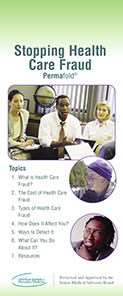
    Cover image to the Health Care Fraud brochure by the American Institute for Preventive Medicine. www.HealthyLife.com. All rights reserved.

    © American Institute for Preventive Medicine

  • Medication Interactions

    Medication

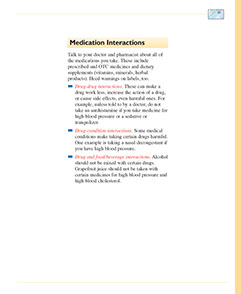
    Talk to your doctor and pharmacist about all of the medications you take. These include prescribed and OTC medicines and dietary supplements (vitamins, minerals, herbal products). Heed warnings on labels, too.

    Drug-drug interactions

    These can make a drug work less, increase the action of a drug, or cause side effects, even harmful ones. For example, unless told to by a doctor, do not take an antihistamine if you take medicine for high blood pressure or a sedative or tranquilizer.

    Drug-condition interactions

    Some medical conditions make taking certain drugs harmful. One example is taking a nasal decongestant if you have high blood pressure.

    Drug and food/beverage interactions

    Alcohol should not be mixed with certain drugs. Grapefruit juice should not be taken with certain medicines for high blood pressure and high blood cholesterol.

    Page from the Healthier at Home book by the American Institute for Preventive Medicine. www.HealthyLife.com. All rights reserved.

    © American Institute for Preventive Medicine