Tag: Healthcare

  • Save By Staying Healthy

    Medical Care

    An ounce of prevention is worth more than a pound of cure. The healthier you are, the less you will need to pay for medical care. Also, the state of your health is one of the main factors in setting the cost of health and life insurance.

    Don’t send money up in smoke.

    Cigarette smoking is bad for your health. It’s bad for your wallet, too. A person who smokes two packs a day spends over $3,000 a year just on cigarettes. Hundreds of dollars more are spent on extra dental and medical costs. The cost of health, life, and disability insurance is about 30% higher for persons who smoke.

    Weight does matter.

    Obesity is a leading cause of preventable death. Losing weight can lower the risk for type 2 diabetes, heart disease, and other chronic diseases. These can cost you and your employer a lot of money to treat. Obese persons who buy health insurance on their own may have to pay more. Insurance companies may even turn them down.

    Be fit at little or no cost.

    Take part in fitness programs at work. Join a mall walkers program. Walk with a friend. Follow along with fitness programs on TV. Or, if you have a stationary bike, ride it while you watch TV. Being active every day is a huge investment in your health.

    Look at your genes.

    Find out what health problems both sides of your family have or had. Start with your parents, brothers, and sisters. Then find out about ones your grandparents, uncles, aunts, and first cousins have or had. Once you know what health problems run in your family, talk with your doctor. He/she can suggest ways to lower your risk of getting them.

    Don’t back quacks.

    Find out about products and treatments that don’t work or could cause harm fromwww.quackwatch.organdwww.fda.gov. Don’t waste money on things that don’t help.

    Be savvy about AD-vice.

    Check with your doctor before you follow advice from Web sites and ads that promote products. Many are costly and give little or no benefit.

    Detect to protect.

    Have screening tests and exams that can help detect health problems in early stages when they are easier and less costly to treat. Follow your doctor’s advice.

    Money well spent.

    If you have no health insurance or your health plan does not pay for screening tests or doctor visits, it is still important to have them. Paying for these now could save you thousands in medical costs in the future. Tests may cost less than you think.

    Know thy “health self.”

    The more you know about your health problems, the easier it is to make informed choices about how to take care of them. Find out what you need to do from your doctor. Get reliable facts, too, from trusted sources.

    Follow your doctor’s treatment plan.

    This helps to improve your health. It helps keep problems from getting worse. For example, keeping blood pressure under control can reduce the risk of having a stroke or a heart attack.

    A shot in the arm for your health.

    Get vaccines, as needed, to prevent illnesses. This applies to children, as well as adults. The Centers for Disease Control and Prevention give guidelines for vaccines every year. Find out what they are atwww.cdc.gov/vaccines. Also, if you plan to travel to other countries, find out what vaccines you should get. Find out fromwww.cdc.gov/travel.

    Know about the Vaccines for Children (VFC) Program.

    Your children may be able to get free or low-cost vaccines. Find out fromwww.cdc.gov/vaccines/programs/vfc/default.htm.

    Cover image to the Healthy Savings book by the American Institute for Preventive Medicine. www.HealthyLife.com. All rights reserved.

    © American Institute for Preventive Medicine

  • Keep Track

    Healthylife® QuitWell™

    Part 3

    Man typing on his phone.

    Use a notebook, or a note in your phone. You can also find a sample scorecard at the end of this program.

    Each time that you use tobacco or nicotine, mark down the time. If you have space to write more, jot down the trigger or what you were doing right beforehand. At the end of each day, add up your total for the day.

    Do this for a few days to get an average. You many not use the same amount every day. Get your average for working days and days you have off. You will likely have different tobacco habits.

    © American Institute for Preventive Medicine

  • Telehealth: What To Know

    MEDICAL NEWS

    Phone and stethoscope.

    Telehealth or telemedicine uses video calls or other technology to help you see your doctor. This allows you to have medical appointments from home instead of going to the doctor’s office.

    Getting ready

    If you want to use telehealth, but don’t know how, contact your doctor’s office. Different doctors and hospitals use different apps and technology for their telemedicine appointments. Ask them for instructions on how to get set up.

    Before your appointment, check with your insurance company about coverage for telehealth appointments. Prepare a list of questions to ask your doctor so you’ll be sure to cover everything.

    If you need help

    If you’re feeling overwhelmed, ask a tech-savvy friend or family member to help. Usually, you only need:

    1.  A strong internet connection. Your connection needs to be fast enough for video chats.

    2.  A smartphone, tablet or computer that connects to your wi-fi and has a working microphone, speaker and camera. Most newer devices have all of these built in.

    Telehealth can be a safe and convenient way to have your medical appointments. Don’t be intimidated by technology. With a little help, you can be up and running – and it may become your favorite way to have your doctor visits!

    Source: National Institutes on Aging

    © American Institute for Preventive Medicine

  • Health Insurance Checklist

    Medical Care

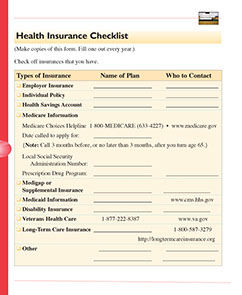
    (Make copies of this form. Fill one out every year.) Check off insurances that you have.

    Page from the Health at Home Lifetime book by the American Institute for Preventive Medicine. www.HealthyLife.com. All rights reserved.

    © American Institute for Preventive Medicine

  • Medication Safety

    Medication

    Smiling women holding a glass of water in one hand and a pill in the other hand.

    Knowing all the medicines you take makes it easier to list them on medical forms and to talk to your doctor and pharmacist about them.

    Keep a current list of all of the medicines you take. Include prescribed and over-the-counter ones, vitamins, minerals, herbs, etc. Give a copy of the list to your doctor (and pharmacist), as needed.

    Mixing some medicines with other medicines, alcohol, drugs, foods, etc. can cause harmful side effects. It can also limit or raise the desired effect of a medicine’s action.

    Mixing some “natural” products and foods with prescribed medicines can be harmful or make the medicine less effective.

    Follow warning labels on medicines and over-the-counter products, too.

    A Year of Health Hints book by the American Institute for Preventive Medicine. www.HealthyLife.com. All rights reserved.

    © American Institute for Preventive Medicine

  • Save By Staying Healthy. Prevention Is Worth More Than A Pound Of Cure.

    Medical Care

    Couple play dueling in the kitchen, laughing.

    *  Choose healthy foods. Control portion sizes. Maintain a healthy weight. Obesity raises the risk of type 2 diabetes, heart disease, and other chronic diseases, which can be very expensive to treat. Persons who are obese may be charged more for life and health insurance.

    *  Be fit at little or no cost. Walk with a friend.  Join a mall walkers program.

    *  If you smoke, quit! You’ll save money on cigarettes, health care, and insurance. Get free help from 800.QUIT. NOW orsmokefree.gov.

    *  Take part in health risk assessments and health and wellness offerings at work.

    *  Wash your hands often to lessen the chance of picking up germs.

    *  Brush and floss your teeth daily. Get a dental checkup once or twice a year. Doing these help prevent periodontal (gum) disease. Not only is it expensive to treat, it is associated with heart disease and pneumonia.

    *  Get at least 6 to 8 hours of sleep a night. Manage stress.

    A Year of Health Hints book by the American Institute for Preventive Medicine. www.HealthyLife.com. All rights reserved.

    © American Institute for Preventive Medicine

  • Telemedicine: Pros & Cons

    SELF-CARE CORNER

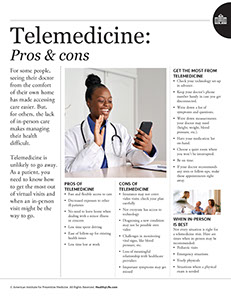
    Doctor smilng and waving Hi while on a telemedicine call.

    For some people, seeing their doctor from the comfort of their own home has made accessing care easier. But, for others, the lack of in-person care makes managing their health difficult.

    Telemedicine is unlikely to go away. As a patient, you need to know how to get the most out of virtual visits and when an in-person visit might be the way to go.

    Pros of telemedicine

    *  Fast and flexible access to care

    *  Decreased exposure to other ill patients

    *  No need to leave home when dealing with a minor illness or concern

    *  Less time spent driving

    *  Ease of follow-up for existing health issues

    *  Less time lost at work

    Cons of telemedicine

    *  Insurance may not cover video visits; check your plan carefully

    *  Not everyone has access to technology

    *  Diagnosing a new condition may not be possible over video

    *  Challenges in monitoring vital signs, like blood pressure, etc.

    *  Loss of meaningful relationship with healthcare providers

    *  Important symptoms may get missed

    Get the most from telemedicine

    *  Check your technology set-up in advance.

    *  Keep your doctor’s phone number handy in case you get disconnected.

    *  Write down a list of symptoms and questions.

    *  Write down measurements your doctor may need (height, weight, blood pressure, etc.).

    *  Have your medication list on-hand.

    *  Choose a quiet room where you won’t be interrupted.

    *  Be on time.

    *  If your doctor recommends any tests or follow-ups, make those appointments right away.

    When in-person is best

    Not every situation is right for a telemedicine visit. Here are times when in-person may be recommended:

    *  Pediatric visits

    *  Emergency situations

    *  Yearly physicals

    *  Situations where a physical exam is needed

    © American Institute for Preventive Medicine

  • Health Screenings Can Save Lives

    Medical Exams

    Smiling doctor.

    You take your children for regular health checkups to protect their health. You, too, need preventive health screenings to increase your chances of living a longer and healthier life. For example:

    *  A colonoscopy can find and remove polyps. These overgrowths of tissue on the lining of your colon may turn into cancer.

    *  Cervical cancer can be prevented nearly 100 percent of the time with regular screenings and early treatment, if needed.

    *  Schedule health screenings you need this year. Write when you will have these.

    *  Don’t use excuses, such as “I don’t have time” or “That illness doesn’t run in my family” to keep you from getting health screenings you need.

    Approximately one half of all cancer deaths may be prevented by not smoking, staying at a healthy weight, eating nutritious foods, and being physically active.

    ays to Well-Being book by the American Institute for Preventive Medicine. www.HealthyLife.com. All rights reserved.

    © American Institute for Preventive Medicine

  • Save If You Have Insurance

    Medical Care

    Image of doctor and piggy bank.

    Know health insurance terms and plans.

    This allows you to make wise choices. Read “Questions and Answers About Health Insurance – A Consumer Guide” fromwww.ahrq.gov/consumer/insuranceqaandwww.healthdecisions.org.

    If you can get health insurance through work, do it.

    More often than not, it will cost you less than if you buy it on your own. If you can choose from more than one plan, compare the options. The best deal may not be the cheapest plan. It is the one that gives the best price for the benefits you need and are most likely to use. If you need help to understand the options, ask your employer. Get facts from the insurance company’s Web site and/or customer service representative, too.

    Raise your deductible.

    Your deductible is the amount you must pay before your health insurance kicks in. Like car insurance, monthly premiums cost less if you pay a higher deductible. Healthy adults can usually save money with this option.

    Check into a Consumer Driven Health Plan.

    This gives you greater control over how you use your health care benefits. You pay a high deductible. You pay for your health care costs from a tax-exempt health account. If you expect to be healthy, this may be a good choice for you.

    Read your health plan.

    Read what products and services are covered before you pay for them on your own. Take advantage of covered services, such as dental checkups and cleanings twice a year. You may find out that your health plan covers some of the costs for flu vaccines and other services.

    Student health insurance.

    Find out about student health insurance from your child’s school or college, especially if your child plans to study abroad.

    Be Medicare aware.

    Medicare is the U.S. government’s health insurance for persons age 65 or older. It also covers people under age 65 who have disabilities. Find out when you will be eligible for Medicare fromwww.medicare.govor by calling 800.MEDICARE (633.4227).

    *  When you are enrolled in Medicare, you get Medicare Part A. This covers medical costs when you are in the hospital.

    *  Medicare Part B covers things that  Part A does not. Examples are doctors’ fees, outpatient hospital costs, physical therapy, etc. You pay a monthly premium for this.

    *  Medicare Part D helps cover the cost of prescribed medicines.

    Fill in the gaps.

    Find ways to pay for services not covered by your insurance plan.

    *  If you have Medicare, you can buy Medigap, Medicare Select, or Medicare Advantage HMO insurance to help pay for services not covered by Medicare. Contact your state health insurance department to find out about your choices for each of these health plans. You need only one of these. For free help choosing a Medicap policy, call your State Health Insurance Assistance Program.

    *  Look into extra coverage from providers, such as Aflac.

    Pay premiums on time.

    If you don’t, your coverage could be cancelled.

    Know about COBRA.

    This stands for Consolidated Omnibus Budget Reconciliation Act. COBRA is temporary health insurance. It applies to former employees, retirees, spouses, former spouses, and dependent children who are no longer covered under an employer health insurance plan. It lets you keep the same health insurance for 18 months (sometimes longer) if you pay for it yourself. Find out more about COBRA fromwww.dol.gov/dol/topic/health-plans/cobra.htm. Know, too, that it may cost you less to buy your own health insurance than to pay what COBRA will cost you, especially if you are in good health and have no pre-existing health problems.

    Find out who to contact when the insurance company denies a claim.

    Sometimes claims are rejected by mistake. When this happens, you can usually clear up the mistake by calling or writing a letter to your insurance company. Keep copies of all bills, letters, and notes from phone calls. Put your policy and claim numbers on all letters or e-mails. Call your insurance company if you don’t get an answer within a few weeks.

    Keep up-to-date.

    Find out how you learn about updates and changes in your health plan. Do you get notified by mail or by e-mail? Do you need to check the health plan’s Web site? How do you add a new dependent to the plan? Also, find out when you can change the plan you have. Often, you can only do this during open enrollment.

    Know before you go.

    Call your health insurance company before you have a medical service. Some services are only covered if the insurance company approves them first and/or if they are done at certain locations or by certain providers.

    One may be enough.

    If both you and your spouse both have health insurance through work, choose the plan that works best. Decide if it is better to keep separate plans or if it would cost less for either of you to join the other’s plan. Your employer may let you take cash or other benefits instead of health insurance. Keep the better policy if you can and “cash in” on the other one. Also, find out which policy covers your children better. Think about future needs, too. For prenatal and delivery costs to be covered, a woman may need to be a member of the plan for nine or more months before she gets pregnant.

    Take advantage of FSAs.

    Find out if your employer offers a Flexible Spending Account (FSA). This lets you set aside some money for medical expenses for the year. You could choose to set aside $1,000. This is usually taken out of your paycheck, but you don’t pay federal income tax or Social Security tax on this money. But be careful how much you put into your FSA. You lose any money you don’t spend on health care in the year. Look at last year’s health care expenses for a ballpark figure on what you think you will likely spend. Don’t count any money that is taken from your paycheck for insurance premiums. Do count deductibles, co-pays, and treatments your insurance doesn’t cover.

    Use it before you lose it!

    If you are going to lose your health insurance, you are part of a growing trend in the U.S. Schedule doctor visits and other health care services before expenses will no longer be covered.

    Before you travel, check out your health insurance coverage.

    Are you covered where you are going? If not, ask your health insurance provider how to get coverage while you are gone. You can also find out about travel health insurance fromwww.travelrinsurance.com.


    Cover image to the Healthy Savings book by the American Institute for Preventive Medicine. www.HealthyLife.com. All rights reserved.

    © American Institute for Preventive Medicine