Tag: Healthy Aging

  • Help For Bladder Control

    Mature Health: Over Age 50

    Image of mature women smiling.

    Many people are inconvenienced and embarrassed by urinary incontinence-they leak urine when they laugh, cough, sneeze, or lift heavy objects.

    Incontinence can be caused when muscles used to control the bladder weaken due to childbirth or prostate surgery. Neurological complications caused by injury or stroke, or neurologic disease (like multiple sclerosis) can also weaken bladder control. So can diabetes. But the most common cause of urinary incontinence in the older population is what doctors call urge incontinence or bladder instability: Frequent, involuntary bladder contractions release small amounts of urine.

    If urinary incontinence is a problem for you, see a urologist, a doctor who specializes in problems and diseases of the urinary system. Medications, biofeedback bladder training, exercise, or surgery can improve or cure urinary incontinence.

    To help manage urinary incontinence:

    *  Empty your bladder at least every 2 hours.

    *  Avoid highly spiced foods, which irritate the bladder. Avoid caffeine and alcohol at least 4 hours before bedtime.

    *  Practice Kegel exercises to improve bladder control. To feel the muscles to be exercised, practice stopping the flow of urine.

    Then practice the following three exercises.

    *  Squeeze these muscles for 3 seconds, then relax the muscles for 3 seconds. Do this ten times, three times a day.

    *  Squeeze and relax the muscles as quickly as possible. Repeat ten times, three times a day.

    *  For women only: Imagine pulling up a tampon in the vagina. Hold for 3 seconds. Then bear down as if having a bowel movement, holding for 3 seconds.

    *  If you wear sanitary pads or incontinence pads, change them often to prevent odor and infection.

    A Year of Health Hints book by the American Institute for Preventive Medicine. www.HealthyLife.com. All rights reserved.

    © American Institute for Preventive Medicine
  • Remember This: You Can Improve Your Memory

    WELL-BEING

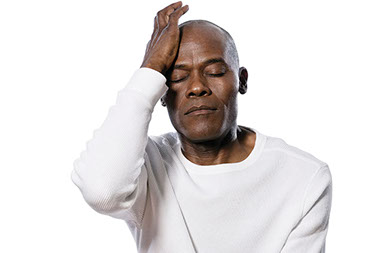
    Image of man with hand on his head.

    Worried because you searched a half hour before finding your reading glasses or car keys? Concerned that it took a couple minutes to remember the name of the familiar-looking woman who said hello to you in the restaurant?

    You probably don’t have much to worry about, said Dr. George Grossberg, an internationally recognized Alzheimer researcher and director of geriatric psychiatry at Saint Louis University School of Medicine. As annoying as it may be, temporary “tip of the tongue” forgetfulness is one of the changes that happens as we age.

    “If, on the other hand, the information is important to us, isn’t there when we want it, and doesn’t ever come back to us, that’s a more serious problem. The person who has Alzheimer’s disease and misplaces her reading glasses probably won’t even remember that she needs them to see. She knows the man next to her is familiar, but can’t remember that he’s her grandson and his name is Mark.”

    “In our society, we’re all on chronic systems overload. We’re multi-tasking – talking on our cell phones, listening for beepers to go off, walking into a store to shop,” he said. “It’s very easy for certain things to get lost in the shuffle. That’s not Alzheimer’s disease.”

    Dr. Grossberg offers this recipe for brain health:

    *  Try to figure out what is causing your forgetfulness. Did you make a wrong turn while driving while you were talking on a cell phone and listening to the radio? Maybe you’re trying to do too many things at once and need to put down the phone or turn off  the tunes.

    *  Exercise your body. Aerobic exercise improves your cardiovascular health. Exercise also increases your “feel-good” brain chemicals, which improve your mood and prevents depression which is a risk factor for Alzheimer’s disease.

    *  Exercise your mind. Research shows mental challenge can help rewire connections in the brain. So find a new hobby, learn to play chess, use your left hand if you’re right-handed, or study a foreign language.

    *  Take care of yourself. Control risk factors for cardiovascular disease such as high blood pressure, smoking, high cholesterol, and obesity to help decrease your risk.

    *  Get a good night’s sleep. Not getting enough deep, restful sleep causes mental impairment later in life. Besides, if you’re sleep deprived, you won’t think clearly and are more likely to forget in the present time.

    *  Feed your brain. Some research shows antioxidant vitamins have protective powers against Alzheimer’s disease. Some B vitamins, especially B-12 and folate, are very important in how brain cells function. Talk with your doctor about taking vitamin supplements.

    *  Check your meds. Discuss, with your doctor, if any prescribed and over-the-counter medications you take could cause memory or concentration problems.

    © American Institute for Preventive Medicine

  • Help For Hearing Loss

    Mature Health: Over Age 50

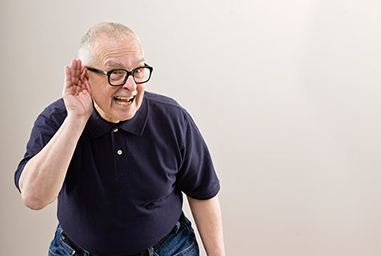
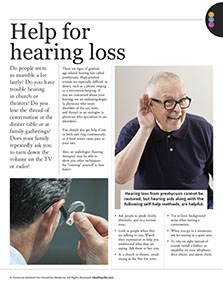
    Image of mature man with hand up to his ear trying to hear.

    Do people seem to mumble a lot lately? Do you have trouble hearing in church or theaters? Do you lose the thread of conversation at the dinner table or at family gatherings? Does your family repeatedly ask you to turn down the volume on the TV or radio?

    These are signs of gradual, age-related hearing loss called presbycusis. High-pitched sounds are especially difficult to discern. Another way to detect this problem is to hold a watch to your ear. If you can’t hear it ticking, see an otolaryngologist (a physician who treats disorders of the ear, nose, and throat) or an otologist (a physician who specializes in ear disorders).

    You should also get help if one or both ears ring continuously, or if loud noises cause pain in your ears.

    Hearing loss from presbycusis cannot be restored, but hearing aids. along with the following self-help methods, are helpful.

    *  Ask people to speak clearly, distinctly, and in a normal tone.

    *  Look at people when they are talking to you. Watch their expressions to help you understand what they are saying. Ask them to face you.

    *  Try to limit background noise when having a conversation.

    *  In a church or theater, sit near, but not in the front row. Sit in the third or fourth row with people sitting around you.

    *  To rely on sight instead of sound, install a buzzer, flasher, or amplifier on your telephone, door chime, and alarm clock.

    Also, an audiologist (hearing therapist) may be able to show you other techniques for “training” yourself to hear better.

    A Year of Health Hints book by the American Institute for Preventive Medicine. www.HealthyLife.com. All rights reserved.

    © American Institute for Preventive Medicine
  • Aging In Place For Older Adults

    FAMILY LIFE

    Smiling, happy older couple.

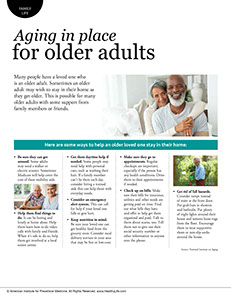
    Many people have a loved one who is an older adult. Sometimes an older adult may wish to stay in their home as they get older. This is possible for many older adults with some support from family members or friends.

    Here are some ways to help an older loved one stay in their home:

    *Be sure they can get around.Some adults may need a walker or electric scooter. Sometimes Medicare will help cover the cost of these mobility aids.

    *Help them find things to do.It can be boring and lonely at home alone. Help them learn how to do video calls with family and friends. When it’s safe to do so, help them get involved at a local senior center.

    *Get them daytime help if needed.Some people may need help with personal care, such as washing their hair. If a family member can’t be there each day, consider hiring a trained aide that can help them with everyday needs.

    *Consider an emergency alert system.This can call for help if your loved one falls or gets hurt.

    *Keep nutrition in mind.Be sure your loved one can get healthy food from the grocery store. Consider meal delivery services in your area that may be free or low-cost.

    *Make sure they go to appointments.Regular checkups are important, especially if the person has any health conditions. Drive them to their appointments if needed.

    *Check up on bills.Make sure their bills for insurance, utilities and other needs are getting paid on time. Find out what bills they have and offer to help get them organized and paid. Talk to them about scams, too. Tell them not to give out their social security number or other information to anyone over the phone.

    *Get rid of fall hazards.Consider ramps instead of stairs at the front door. Put grab bars in showers and bathtubs. Put plenty of night lights around their house and remove loose rugs from the floor. Encourage them to wear supportive shoes or non-slip socks around the house.

    Source: National Institute on Aging

    © American Institute for Preventive Medicine
  • Hospice Care

    Mature Health: Over Age 50

    Hospice care is for people with a terminal illness. To enter a hospice program (and to receive Medicare benefits), a doctor’s diagnosis is required stating that life expectancy is no more than about 6 months. No efforts are made to prolong life or to hasten death. The patient is kept comfortable and pain free. Hospice eases the process of dying. Most referrals for hospice come from doctors. Hospice care may be provided in:

    *  The home. Eighty percent of persons enrolled in hospice are cared for at home.

    *  A hospital

    *  A nursing home

    *  A hospice facility

    The bulk of care, especially with home hospice, is usually given by family members and friends. It is supported by a hospice care team which includes doctors, social workers, therapists, volunteers, clergy, nurses, and family members. The team plans care that ensures quality of life. {Note: VA offers Hospice & Palliative Care.}

    Most health insurance plans include the option of hospice care. Medicare and Medicaid cover the costs if the facility or hospice organization is certified by them. Under Medicare, the length of stay is two 90 day benefit periods. This may be followed by a 30 day period. Extensions are available. Persons must be certified to be terminally ill at the start of each period.

    Sometimes patients are charged if they do not qualify for reimbursement. Hospice care is based on need. No one is rejected for lack of finances.

    Some advantages to hospice care include:

    *  Availability of 24 hour a day, 7 day a week assistance. This is true for hospice care in hospitals, nursing homes, and hospice facilities. Find out if the home hospice program offers this service.

    *  Respite for family caretakers when care is given in the home

    *  Emotional comfort and support by trained hospice staff and volunteers

    *  Bereavement counseling

    Resources

    The National Hospice and Palliative Care Organization

    1-703-837-1500

    www.nhpco.org

    Health at Home Lifetime book by the American Institute for Preventive Medicine. www.HealthyLife.com. All rights reserved.

    © American Institute for Preventive Medicine

  • Housing Options

    Mature Health: Over Age 50

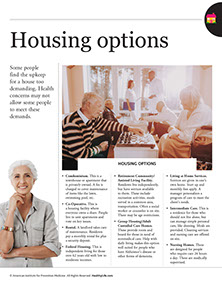
    Some people find the upkeep for a house too demanding. Health concerns may not allow some people to meet these demands. Consider other housing options:

    *  Condominium. This is a townhouse or apartment that is privately owned. A fee is charged to cover maintenance of items like the lawn, swimming pool, etc.

    *  Co-Operative. This is a housing facility where everyone owns a share. People live in unit apartments and vote on key issues.

    *  Rental. A landlord takes care of maintenance. Residents pay a monthly rental fee plus a security deposit.

    *  Retirement Community/Assisted Living Facility. Residents live independently, but have services available to them. These include recreation activities, meals served in a common area, transportation. Often a social worker or counselor is on site. There may be age restrictions.

    *  Federal Housing. This is independent living for those over 62 years old with low to moderate incomes.

    *  Group Housing/Adult Custodial Care Homes. These provide room and board for those in need of nonmedical care. Help with daily living makes this option well suited for Alzheimer’s patients.

    *  Life Care at Home (LCAH). Services are given in one’s own home. Start up and monthly fees apply. A manager personalizes a program of care to meet the client’s needs.

    *  Intermediate Care. This is a residence for those who should not live alone, but can manage simple personal care, like dressing. Meals are provided. Cleaning services and nursing care are offered on site.

    *  Nursing Homes. These are designed for people who require care 24 hours a day. These are medically supervised. Find and compare nursing homes in your area atwww.medicare.gov/NHCompare/home.asp.

    Health at Home Lifetime book by the American Institute for Preventive Medicine. www.HealthyLife.com. All rights reserved.

    © American Institute for Preventive Medicine