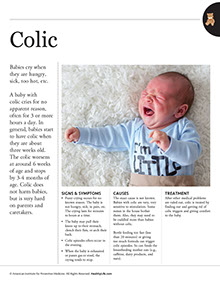
Babies cry when they are hungry, sick, too hot, etc. In general, babies start to have colic when they are about three weeks old. The colic worsens at around six weeks of age and stops by 3 months of age. Colic does not harm babies, but is very hard on parents and caretakers.
Signs & Symptoms
* Fussy crying occurs for no known reason. The baby is not hungry, sick, in pain, etc. The crying lasts for minutes to hours at a time.
* The baby may pull his or her knees up to the stomach.
* Colic episodes often occur in the evening.
Causes
The exact cause is not known. Babies with colic are very, very sensitive to stimulation. Noises in the house bother them. Also, they may need to be cuddled more than babies without colic.
Bottle feeding too fast (less than 20 minutes) or giving too much formula can trigger colic episodes. So can foods the breast-feeding mother eats (e.g., caffeine, dairy products, and nuts).
Treatment
After other medical problems are ruled out, colic is treated by finding out and getting rid of colic triggers and giving comfort to the baby.
Questions to Ask
Self-Care / Prevention
* Be sure the baby has enough to eat. Check with the baby’s doctor about trying a new formula.
* Try different bottle nipples. Make the hole bigger if it is too small. Cut across the hole that is already there. (You will make an X- shaped hole.) Here’s how to find out if the hole is too small:
– Put cold formula in the bottle.
– Turn the bottle upside down.
– Count the drops of formula that fall out. If the drops come out slower than 1 drop per second, the hole is too small.
* Don’t allow smoking in your home.
* Do not give fruit juice (e.g., apple juice, pear juice) to infants younger than 6 months old.
* Hold the baby up for feeding. Keep holding the baby up for awhile after feeding.
* Burp the baby after each ounce of formula or every few minutes when breast-feeding.
* Use a pacifier, but never put a pacifier on a string around the baby’s neck.
* Give the baby a warm bath and a massage.
* Wrap or swaddle the baby snugly in a soft blanket. Rock him or her or use a baby swing.
* Try the “colic carry.” Lay the baby on his or her stomach across your arm. Put the baby’s face in your hand and let the legs straddle your inner elbow. Hold the baby’s back with your other hand so he or she won’t fall. Walk around like this for awhile.
* Carry the baby while you vacuum. Use a baby carrier that you wear on your back or chest.
* Play soft, gentle music.
* Take your baby for a stroller or car ride.
* Run the dryer or dishwasher. Buckle your baby in a baby seat. Lean the seat against the side of the dryer or on the counter near the dishwasher. The sounds from these machines may help the baby fall asleep. Stay with your baby. Make sure the heat or steam won’t hurt the baby.
* Don’t give the baby antacids like Maalox or simethicone drops unless a doctor tells you to.
* Let your baby cry himself or herself to sleep if nothing else helps and your baby has been fed within 2-1/2 hours. Do call the doctor if the baby cries for more than 2 hours without stopping.
* Get someone else to take care of your baby if you get too stressed. Get some rest.
Resources
American Academy of Pediatrics
www.aap.org