Tag: Marriage & Relationships

  • Dating After Divorce

    FAMILY LIFE

    Couple on a date.

    If you’re a divorced parent with kids, you may be wondering how to handle future relationships. Kids often need some time to adjust to their parents’ separation.

    If you’re ready to begin a new romantic relationship after a divorce, keep these tips in mind:

    *  Consider waiting at least six months to help kids adjust to the divorce.

    *  Your child doesn’t need to meet everyone you date. Introduce them only if your relationship is becoming serious.

    *  Prepare for the first meeting with your significant other and child. Don’t expect the first meeting to be perfect.

    *  Help your child deal with negative feelings. Children often hold out hope that their parents will get back together. Seeing a new significant other in your life can be difficult for them. Be sure to tell them that you and your ex-spouse are not getting back together, but that you still love them and will be their parents no matter what.

    *  Understand if your child simply doesn’t like your new partner as much as their other parent. This is normal. With time, your child may develop their own special relationship with this person.

    *  Don’t ask them to keep secrets from their other parent. If you are dating, you may need to tell your ex-spouse about the person in case your child brings it up with them. Your child should not feel uncomfortable when they talk about it with your ex-spouse.

    *  Remember that your child is always watching. Be cautious about your behavior in front of your child, whether it’s public affection or things you say.

    Source: American Academy of Pediatrics

    © American Institute for Preventive Medicine

  • Is Your Relationship Healthy?

    FAMILY LIFE

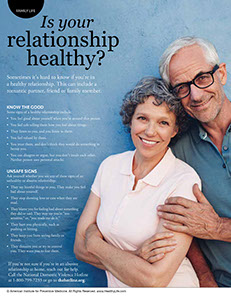
    Happy older couple.

    Sometimes it’s hard to know if you’re in a healthy relationship. This can include a romantic partner, friend or family member.

    Know the good

    Some signs of a healthy relationship include:

    *  You feel good about yourself when you’re around that person.

    *  You feel safe telling them how you feel about things.

    *  They listen to you, and you listen to them.

    *  You feel valued by them.

    *  You trust them, and don’t think they would do something to betray you.

    *  You can disagree or argue, but you don’t insult each other. Neither person uses personal attacks.

    Unsafe signs

    Ask yourself whether you see any of these signs of an unhealthy or abusive relationship:

    *  They say hurtful things to you. They make you feel bad about yourself.

    *  They stop showing love or care when they are mad.

    *  They blame you for feeling bad about something they did or said. They may say you’re “too sensitive,” or, “you made me do it.”

    *  They hurt you physically, such as pushing or hitting.

    *  They keep you from seeing family or friends.

    *  They threaten you or try to control you. They want you to fear them.

    If you’re not sure if you’re in an abusive relationship at home, reach out for help.

    Call the National Domestic Violence Hotline at 1-800-799-7233 or go tothehotline.org.

    © American Institute for Preventive Medicine

  • Violence & Abuse

    Mental Health

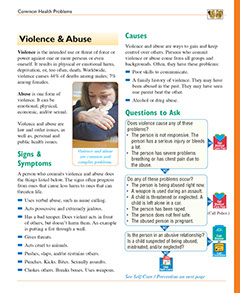
    Violence is the intended use or threat of force or power against one or more persons or even oneself. It results in physical or emotional harm, deprivation, or, too often, death. Worldwide, violence causes 44% of deaths among males; 7% among females.

    Abuse is one form of violence. It can be emotional, physical, economic, and/or sexual.

    Violence and abuse are law and order issues, as well as, personal and public health issues.

    Signs & Symptoms

    A person who commits violence and abuse does the things listed below. The signs often progress from ones that cause less harm to ones that can threaten life.

    *  Uses verbal abuse, such as name calling.

    *  Acts possessive and extremely jealous.

    *  Has a bad temper. Does violent acts in front of others, but doesn’t harm them. An example is putting a fist through a wall.

    *  Gives threats.

    *  Acts cruel to animals.

    *  Pushes, slaps, and/or restrains others.

    *  Punches. Kicks. Bites. Sexually assaults.

    *  Chokes others. Breaks bones. Uses weapons.

    Causes

    Violence and abuse are ways to gain and keep control over others. Persons who commit violence or abuse come from all groups and backgrounds. Often, they have these problems:

    *  Poor skills to communicate.

    *  A family history of violence. They may have been abused in the past. They may have seen one parent beat the other.

    *  Alcohol or drug abuse.

    Treatment

    Treatment for the victim of abuse or violence depends on the situation and includes:

    *  Emergency medical care. Calling the police.

    *  Going to a safe place, such as a shelter for victims of abuse.

    *  Counseling.

    *  Training to be assertive.

    In general, persons who abuse others or commit violence find it hard to change their behavior without professional help.

    Questions to Ask

    Self-Care / Prevention

    To Handle Being in an Abusive Relationship

    *  Get help!

    *  Have a safety plan for times you feel unsafe or in danger.

    – Decide who you will call (e.g., police, neighbors, relatives, a shelter). Make a list of these telephone numbers. Memorize them, too.

    – Decide where you will go. If you have children and pets, develop safety plans. Practice the safety plans with your children. Have a plan for taking them with you. Have plans for where they should go if you can’t get away.

    – Keep extra keys to your car and house in a safe place unknown to the person abusing you.

    – Put some cash in a safe place that you can get quickly in case you need money for transportation to a safe place.

    To Manage Conflict Without Violence

    *  When you communicate, state your needs without putting others down.

    *  Learn to deal with frustration, rejection, ridicule, jealousy, and anger.

    *  Accept differences in others. This includes sexual preferences, ethnic and religious backgrounds, etc. You do not need to change your beliefs, but don’t expect other persons to change theirs, either.

    *  Be an active listener. Focus on what the other person is saying. Try to understand his or her point of view. Or, simply accept it as an opinion.

    *  Take a course that teaches skills to manage conflict.

    *  When you can’t resolve a conflict on your own, get help.

    Resources

    National Center for Victims of Crime

    202.467.8700

    www.ncvc.org

    National Domestic Violence Hotline

    800.799.7233

    www.thehotline.org

    Healthier at Home book by the American Institute for Preventive Medicine. www.HealthyLife.com. All rights reserved.

    © American Institute for Preventive Medicine

  • 6 Simple Steps To A Healthier Marriage

    FAMILY LIFE

    Image of young smiling couple sitting against a wall.

    Having a healthy, supportive marriage is important to your overall well-being. But the stresses of life, work, family, and day-to-day problems can put a strain on even the best marriage at times.

    Fortunately, there are some ways you can help keep your marriage strong – or work on problems before they become major issues. Here are some tips from the National Healthy Marriage Resource Center:

    1. Make every effort to keep your commitment.

    Marriage will have “good times and bad,” and you need to realize that challenges will happen. The key is to work through them and be aware that everyone has disagreements and difficulties. No marriage is perfect, but with extra effort from both partners, you can make yours last.

    2. Make time for each other.

    Even when you’re overwhelmed with work, children, or other tasks, don’t forget about your marriage. Set aside time for a dinner alone or even a weekend getaway if you can. If that’s not possible, have 15 to 30 minutes of time to talk and connect each day – without TV or cell phones.

    3. Have a sense of humor.

    Life’s little mishaps are easier to take when you can laugh at them. Mistakes that don’t really hurt anyone don’t have to turn into arguments. Don’t focus on who’s to blame. Laugh at it if you can, and work on a solution together. Forgive your spouse (and yourself!) and try to find the humor in the situation.

    4. Communication is key.

    This is an important aspect of any marriage. Talk about what’s bothering you – and what you love. Listen to what your spouse is saying, and don’t be quick to defend yourself. No one has to “win” an argument. If you both listen and respect each other, a solution or compromise can usually be found.

    5. Do “little” things for your spouse.

    Make a favorite meal for the other person, do the dishes without being asked, or leave a love note. These small things can add up to big happiness. Just showing your spouse that you care about him or her will help build your marriage each day.

    6. Choose your battles.

    Before you get angry about something, ask yourself if it’s worth an argument. If it’s important to you, approach the subject calmly and be honest. If not, take a deep breath and focus your energy on better things.

    Marriage isn’t always easy, but working to keep it strong and healthy can have big payoffs. People in healthy marriages have better mental health and may even live longer. Give your marriage the attention it deserves, and you’ll both enjoy the benefits.

    © American Institute for Preventive Medicine

  • Coping With The Loss Of A Spouse

    FAMILY LIFE

    Image of sad, older female sitting on couch.

    Losing a husband or wife is devastating. A whirlwind of intense emotions-overwhelming sadness as well as shock, fear, guilt, anger, and numbness-make the days and weeks after a spouse’s death agonizing and confusing.

    It may be small comfort to know that these feelings are normal and will be temporary.

    “Sadness may never go away entirely,” said clinical psychologist Dr. Hayley Hirschmann of Morris Psychological Group, “but the pain of acute grief becomes less intense over time as the good days start to outnumber the bad.”

    Dr. Hirschmann offers this advice:

    *Accentuate the positive:Studies have shown that those who are able to draw on humor and pleasurable memories are happier and healthier than those whose thoughts of the deceased are mostly sad and focused on their loss.

    *Let others help:Don’t shy away from expressing your feelings to those close to you; you will feel less alone if you can share your grief with a sympathetic listener. Accept help with chores and legal and financial responsibilities. Consider joining a bereavement support group.

    *Take care of yourself:Eat well, exercise regularly, get enough sleep. Be alert to falling into bad habits.

    *Don’t make big changes right away:Wait a while before moving or changing jobs.

    © American Institute for Preventive Medicine

  • Is Your Relationship In Trouble?

    SUCCESS OVER STRESS

    Image of couple not getting along.

    Is your relationship stormy? Indifferent? One-sided? According to Pennsylvania psychologist, Dr. Michael S. Broder, these are the three types of troubled relationships. They account for the high divorce rate, as well as the much higher percentage of non-married relationships that end.

    Stormy Relationship:

    This type has plenty of passion, but it may not be the positive kind. Positive passion is a relationship at its best. Too much negative passion results in a great amount of anger and discomfort. At the extreme, these relationships can become abusive and even dangerous. A relationship with a lot of passion and little or no comfort can still be highly charged romantically and sexually. In some cases the most passionate sex actually occurs after the meanest and volatile arguments. The sad part is that the cause of the anger is never dealt with or resolved. Thus, the pattern can continue indefinitely.

    Indifferent Relationship:

    With this type, most-if not all-of the passion is missing. There can be a very comfortable living arrangement, but partners may have little feeling or sexual desire for each other. Sometimes partners simply grow apart without anger, or there can be as much anger as there is in the typical stormy relationship. The main difference is that there’s just not the tendency to argue or do battle with each other. This may be a result of the partners’ personality styles, or the absence of passion-including negative passion. Instead, the relationship merely begins to die a slow and quiet death. In other words, it may be brain alive but heart dead.

    One-Sided Relationships:

    In this type, one person usually puts out much more effort and energy to maintain and nurture the relationship than does the other. One partner can be quite content, having all the passion and comfort he or she needs. Yet the other partner feels somewhat to totally unfulfilled.

    In all types of troubled relationships it is important to ask: “What is the potential for change?” If the answer is none, the next question to ask yourself is, “Is this where I still want to be?”

    Adapted from Can Your Relationship Be Saved? How to Know Whether to Stay or Go by Dr. Michael S. Broder.

    © American Institute for Preventive Medicine

  • Start A Conversation About Domestic Violence

    FAMILY LIFE

    Image of female looking downwards.

    Everyone knows a victim of domestic violence, but most people don’t know what to do to help.

    “If someone comes to you and tells you they’re a victim of domestic violence, the most important thing you can do is offer your support without judgment,” said Vicky Dinges, vice president of corporate responsibility at Allstate. “There are 1,300 deaths and two million injuries related to domestic violence each year. Odds are we all know someone who’s in an abusive relationship. Knowing how to help might just save a life.”

    Here are some easy ways to start a conversation:

    *Offer support without judgment or criticism.There are a lot of reasons why victims may stay in an abusive relationship, and many reasons why they may also leave and return to the relationship multiple times. Let them know it’s not their fault and that they are not alone.

    *Don’t be afraid to tell them that you’re concerned for their safety.Help your friend or family member recognize the abuse while acknowledging that they are in a very difficult and dangerous situation.

    *Avoid confrontations.There are many reasons why people experiencing abuse don’t reach out to family and friends. It’s important to recognize when they are ready to talk about their experiences while still offering support.

    *Encourage them to get help.Suggest ways they can get additional support. Help them look into available resources, such as the National Domestic Violence Hotline number – 800-799-SAFE (7233) or website atwww.thehotline.org. This resource also finds local support groups and provides information on staying safe.

    © American Institute for Preventive Medicine

  • What Is Marriage Counseling?

    FAMILY LIFE

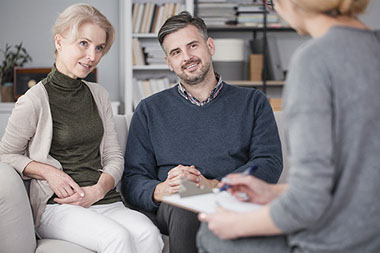
    Image of a couple with a marriage counselor.

    Marriage and relationships take lots of work. When a couple has a problem, they may wonder whether marriage therapy or couples counseling could help.

    Counseling usually includes talk therapy. This means you talk to a professional counselor about your issues. But, therapy isn’t just about talking. Your counselor may help one or both partners address mental health problems that can interfere with the relationship. For example, issues such as depression or anxiety may need treatment. This can go hand-in-hand with the couples counseling.

    When a couple goes to counseling, they can get “tools” to use in daily life that help them with their communications. For instance, therapy can give you new ways to look at challenges or problems. This can help you address issues before they become too big to handle. You may also learn ways to talk to each other so you can work out arguments in positive and constructive ways.

    However, if the marriage involves physical or emotional abuse, couples counseling is not going to be the answer. Instead, the person who is abusing their partner should seek treatment for their problems. The victim of abuse should speak privately with their doctor about how they can get away from the abuse.

    Help for resolving arguments

    If you need to talk something out with your spouse, try these tips:

    *  Listen first. Rather than tell your side, calmly listen to what your partner has to say. When he or she is done, then take your turn to speak.

    *  Don’t interrupt, and don’t yell.

    *  Be honest, but don’t insult. Talk about the behavior or incident that upset you. For instance: “When you did X, I felt like you didn’t care about my feelings.” Avoid name-calling.

    Sources: American Academy of Family Physicians, National Domestic Violence Hotline

    © American Institute for Preventive Medicine

  • Advocate Against Domestic Violence

    FAMILY LIFE

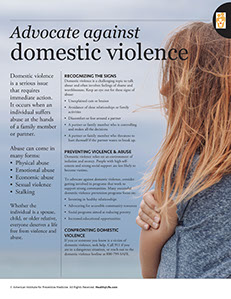
    Back of women, wind blowing her hair as she hugs herself.

    Domestic violence is a serious issue that requires immediate action. It occurs when an individual suffers abuse at the hands of a family member or partner.

    Abuse can come in many forms:

    *  Physical abuse

    *  Emotional abuse

    *  Economic abuse

    *  Sexual violence

    *  Stalking

    Whether the individual is a spouse, child, or older relative, everyone deserves a life free from violence and abuse.

    Recognizing the signs

    Domestic violence is a challenging topic to talk about and often involves feelings of shame and worthlessness. Keep an eye out for these signs of abuse:

    *  Unexplained cuts or bruises

    *  Avoidance of close relationships or family activities

    *  Discomfort or fear around a partner

    *  A partner or family member who is controlling and makes all the decisions

    *  A partner or family member who threatens to hurt themself if the partner wants to break up.

    Preventing violence & abuse

    Domestic violence relies on an environment of isolation and secrecy. People with high self-esteem and strong social support are less likely to become victims.

    To advocate against domestic violence, consider getting involved in programs that work to support strong communities. Many successful domestic violence prevention programs focus on:

    *  Investing in healthy relationships

    *  Advocating for accessible community resources

    *  Social programs aimed at reducing poverty

    *  Increased educational opportunities

    Confronting domestic violence

    If you or someone you know is a victim of domestic violence, seek help. Call 911 if you are in a dangerous situation, or reach out to the domestic violence hotline at 800-799-SAFE.

    © American Institute for Preventive Medicine