Tag: Men’s Health

  • Erectile Dysfunction Facts

    MEDICAL NEWS

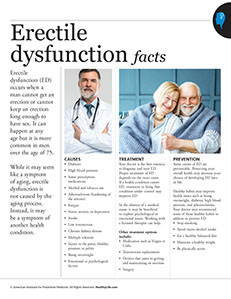
    Older couple cuddling with a blanket.

    Erectile dysfunction (ED) occurs when a man cannot get an erection or cannot keep an erection long enough to have sex. It can happen at any age but it is more common in men over the age of 75.

    While it may seem like a symptom of aging, erectile dysfunction is not caused by the aging process. Instead, it may be a symptom of another health condition.

    Causes

    *  Diabetes

    *  High blood pressure

    *  Some prescription medications

    *  Alcohol and tobacco use

    *  Atherosclerosis (hardening of the arteries)

    *  Fatigue

    *  Stress, anxiety, or depression

    *  Stroke

    *  Low testosterone

    *  Chronic kidney disease

    *  Multiple sclerosis

    *  Injury to the penis, bladder, prostate, or pelvis

    *  Being overweight

    *  Emotional or psychological factors

    Treatment

    Your doctor is the best resource to diagnose and treat ED. Proper treatment of ED depends on the exact cause. If a health condition causes ED, treatment to bring that condition under control may improve ED.

    In the absence of a medical cause, it may be beneficial to explore psychological or emotional issues. Working with a licensed therapist can help.

    Other treatment options include:

    *  Medication such as Viagra or Cialis

    *  Testosterone replacement

    *  Devices that assist in getting and maintaining an erection

    *  Surgery

    Prevention

    Some causes of ED are preventable. Protecting your overall health may decrease your chance of developing ED later in life.

    Healthy habits may improve health issues such as being overweight, diabetes, high blood pressure, and atherosclerosis. Your doctor may recommend some of these healthy habits to address or prevent ED.

    *  Stop smoking

    *  Avoid excess alcohol intake

    *  Eat a healthy, balanced diet

    *  Maintain a healthy weight

    *  Be physically active
    © American Institute for Preventive Medicine

  • Health Screenings For Men

    SELF-CARE CORNER

    Blue stethoscope on a blue table.

    Men can face health challenges at each stage of life. A yearly visit with a primary care doctor ensures access to the appropriate screenings. While some screenings are a standard part of routine medical care, a doctor may recommend additional screenings specific to a man’s health and family history.

    Men aged 18 to 39

    *  Blood pressure

    *  Cholesterol and heart disease screening

    *  Physical exam

    *  Diabetes screening

    *  Eye exam

    *  Dental exam

    *  Infectious disease screening, including STIs

    *  Immunizations

    *  Skin self-exam

    *  Testicular exam

    Men aged 40 to 64

    *  Blood pressure

    *  Cholesterol and heart disease screening

    *  Physical exam

    *  Diabetes screening

    *  Eye exam

    *  Dental exam

    *  Infectious disease screening, including STIs

    *  Immunizations

    *  Skin self-exam

    *  Testicular exam

    *  Colon cancer screening

    *  Lung cancer screening

    *  Osteoporosis screening

    *  Prostate cancer screening

    Men aged 65 and over

    *  Blood pressure

    *  Cholesterol and heart disease screening

    *  Physical exam

    *  Diabetes screening

    *  Eye exam & hearing test

    *  Dental exam

    *  Infectious disease screening, including STIs

    *  Immunizations

    *  Skin exam

    *  Colon cancer screening

    *  Lung cancer screening

    *  Osteoporosis screening

    *  Prostate cancer screening

    *  Abdominal aortic aneurysm screening

    © American Institute for Preventive Medicine

  • Understanding Enlarged Prostate

    MEDICAL NEWS

    Image of older male smiling.

    Benign prostatic hyperplasia, sometimes called BPH or enlarged prostate, is a condition where a man’s prostate gland gets larger. It is the most common prostate problem for men older than age 50. And, up to 90 percent of men over age 80 have it.

    An enlarged prostate is not cancer, and for many men, it’s not serious. But, it can cause some symptoms that are bothersome, such as urinating too frequently, trouble starting or stopping urinating and incontinence. This happens when the prostate gets too large and blocks the urethra, which lets urine out of the body. Or, it can stress the bladder as it tries to force urine past the blockage.

    In rare cases, an enlarged prostate can cause serious problems such as kidney damage. That’s why it’s important to talk with a doctor about enlarged prostate and to follow your doctor’s recommendations.

    Don’t ignore these signs

    Enlarged prostate is usually not serious. But, some symptoms could signal a more serious problem. Get medical care right away if you notice any of these signs:

    *  Complete inability to urinate

    *  Fever and chills along with frequent and painful urination

    *  Blood in urine

    *  Severe pain in lower belly and/or urinary tract

    How enlarged prostate is treated

    Treatment is based on symptoms and lifestyle. Many men who have mild symptoms find that lifestyle changes can help. Some recommendations include:

    *  Drink less fluids, especially before bedtime or when you won’t be near a bathroom.

    *  Avoid caffeine and/or alcohol. These can irritate the bladder and increase urination, which can worsen symptoms of an enlarged prostate.

    *  Avoid medications that can cause urination problems, including cold medicines with decongestants, antihistamines for allergies, diuretics and some antidepressants.

    *  Train your bladder, which means to gradually hold urine for longer periods.

    *  Exercises to strengthen muscles in the pelvic floor region of your body.

    *  Prevent and/or treat constipation, which can irritate a stressed bladder.

    Lifestyle changes usually help improve quality of life for men with an enlarged prostate. But if they don’t, your doctor may discuss medications or minimally invasive procedures. Surgery is usually not needed, but it is an option for severe cases.

    Fortunately, this common health issue can be managed and treated. Get regular checkups with your doctor or urologist to keep symptoms under control.

    Sources: National Institutes of Health, National Institute of Diabetes and Digestive and Kidney Diseases

    © American Institute for Preventive Medicine

  • Alternatives To Baldness

    Men’s Health

    Image of mature man with thinning hair.

    A lot of men worry about going bald, especially if their fathers and grandfathers went bald. Worry builds when men hit their thirties and they notice their hair is thinning.

    Don’t be taken in by fraudulent claims for vitamin formulas, massage oils, lotions, or ointments that promise to cure baldness. No existing potion or ointment will produce a full head of hair. Medications can help some cases of baldness. Examples are the prescribed drug finasteride (brand name Propecia) and minoxidil (brand name Rogaine), which can be prescribed or obtained over-the-counter.

    Another option is hair replacement surgery. This involves using your existing hair. Techniques in hair replacement surgery include punch grafts; mini-grafts; micro-grafts; slit-grafts, and strip grafts. Other transplant techniques are flap surgery, tissue expansion; and scalp reduction. Talk to your doctor about these options.

    If you choose to wear a hairpiece, be sure it matches your natural hair and fits properly. And remember to keep your hairpiece as clean and well- groomed as your own hair.

    See your doctor if you suffer sudden hair loss-you may have a medical problem.

    A Year of Health Hints book by the American Institute for Preventive Medicine. www.HealthyLife.com. All rights reserved.

    © American Institute for Preventive Medicine
  • Jock Itch

    Men’s Health

    Jock itch is an infection of the skin on the groin and upper inner thigh areas.

    Signs & Symptoms

    *  Redness.

    *  Itching.

    *  Raised red rash with borders. Center areas of the rash are dry with small scales.

    Causes

    Jock itch is usually caused by a fungus. It can also result from garments that irritate the skin. Jock itch is more likely to occur after taking antibiotics or steroids, or in persons who have diabetes or a weakened immune system.

    Treatment

    Over-the-counter antifungal creams treat most cases of jock itch. Stronger creams or an oral medicine can be prescribed, if needed.

    Questions to Ask

    Self-Care / Prevention

    To Treat Jock Itch

    *  Use over-the-counter antifungal cream, powder, or lotion for jock itch. Follow package directions.

    To Prevent Jock Itch

    *  Don’t wear tight, close-fitting clothing. Wear boxer shorts, not briefs. Put socks on before underwear. Fungus on the feet, such as from athlete’s foot can transfer to the groin. Change underwear often, especially after tasks that leave you hot and sweaty.

    *  Bathe or shower right after a workout. Don’t use antibacterial soaps. Dry the groin area well.

    *  Apply talc or other powder to the groin area to help keep it dry. If you sweat a lot or are very overweight, use a drying powder with miconazole nitrate.

    *  Wash workout clothes after each wearing. Don’t store damp clothing in a locker or gym bag.

    *  Sleep in the nude or in a nightshirt.

    *  Don’t share towels or clothes that have come in contact with the rash.

    Healthier at Home book by the American Institute for Preventive Medicine. www.HealthyLife.com. All rights reserved.

    © American Institute for Preventive Medicine

  • Kidney Stones

    Abdominal & Urinary Conditions

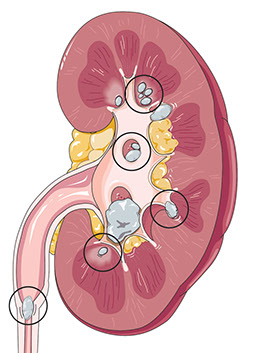
    Kidney stones are hard masses of mineral deposits formed in the kidney(s). They can be as small as a tiny pebble or an inch or more across. They are more common in men.

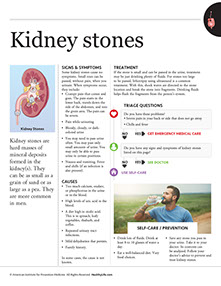
    Illustration of kidney stones.

    Kidney Stones

    Signs & Symptoms

    Some kidney stones cause no symptoms. Small ones can be passed, without pain, when you urinate. When symptoms occur, they include:

    *  Crampy pain that comes and goes. The pain starts in the lower back, travels down the side of the abdomen, and into the groin area. The pain can be severe.

    *  Bloody, cloudy, or dark-colored urine.

    *  You may need to pass urine often. You may pass only small amounts of urine. You may only be able to pass urine in certain positions.

    *  Nausea and vomiting. Fever and chills (if an infection is also present).

    Causes

    *  Too much calcium in the urine or in the blood.

    *  High levels of uric acid in the blood.

    *  A diet high in oxalic acid. This is in spinach, leafy vegetables, rhubarb, and coffee.

    *  Repeated urinary tract infections.

    *  Mild dehydration that persists.

    *  Family history of kidney stones.

    *  Living in certain parts of the U.S. Areas of the southeast have the highest rates.

    In some cases, the cause is not known.

    Treatment

    If the stone is small and can be passed in the urine, treatment may be just drinking plenty of fluids. For stones too large to be passed, lithotripsy using ultrasound is a common treatment. With this, shock waves are directed to the stone location and break the stone into fragments. Drinking fluids helps flush the fragments from the person’s system.

    Questions to Ask

    Self-Care / Prevention

    *  Drink lots of fluids. Drink at least 8 to 10 glasses of water a day.

    *  Eat a well-balanced diet. Vary food choices.

    *  Save any stone you pass in your urine. Take it to your doctor. Its contents can be analyzed. Follow your doctor’s advice to prevent and treat kidney stones.

    Healthier at Home book by the American Institute for Preventive Medicine. www.HealthyLife.com. All rights reserved.

    © American Institute for Preventive Medicine

  • Reversing Male Infertility

    Men’s Health

    Image of male doctor.

    If a man has been unsuccessful at fathering a child, he’ll probably be checked for two kinds of problems: low sperm count (too few sperm per given volume of semen) and poor sperm motility (sperm that are poor swimmers and have trouble fertilizing an egg).

    Factors that can reduce fertility in men include:

    *  Extreme overweight.

    *  Heavy smoking. (Smoking has been associated with low sperm count and poor sperm motility.)

    *  Drug and alcohol use. (Marijuana and alcohol lower production of testosterone, a hormone produced by the testicles.)

    *  Wearing tight, restrictive underwear. (Clothing that holds the testicles too close to the body heats them up and thus interferes with sperm production, which is temperature sensitive.)

    *  Work that requires you to sit for long periods of time (for reasons similar to those above).

    *  Frequent use of saunas or hot tubs.

    *  Prolonged occupational exposure to lead, zinc, copper, or radiation. (Pollutants can disrupt the production, quality, and transportation of sperm.)

    *  Prolonged abstinence from sex.

    *  Use of lubricants, such as petroleum jelly and K-Y brand jelly, which can kill or immobilize sperm.

    *  Infection or other illness. (These hamper the testicles’ ability to do their job.)

    *  A varicocele (a congenital defect in the blood vessels to the testes).

    For many men, restoring fertility is simply a matter of switching to boxer shorts, quitting smoking, losing weight, or making other adjustments. Be patient, though. It may take two or three months to restore fertility. If your partner still doesn’t conceive, see a doctor who specializes in treating infertility.

    A Year of Health Hints book by the American Institute for Preventive Medicine. www.HealthyLife.com. All rights reserved.

    © American Institute for Preventive Medicine

  • Managing Male Menopause

    Men’s Health

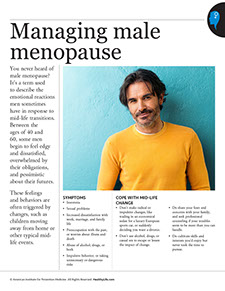
    Image of smiling couple laying down.

    You never heard of male menopause? It’s a term used to describe the emotional reactions men sometimes have in response to mid-life transitions. Between the ages of 40 and 60, some men begin to feel edgy and dissatisfied, overwhelmed by their obligations, and pessimistic about their futures.

    Typical symptoms include:

    *  Insomnia.

    *  Sexual problems.

    *  Increased dissatisfaction with work, marriage, and family life.

    *  Preoccupation with the past, or worries about illness and death.

    *  Abuse of alcohol, drugs, or both.

    *  Impulsive behavior, or taking unnecessary or dangerous risks.

    These feelings and behaviors are often triggered by changes, such as children moving away from home or other typical mid-life events.

    To cope with mid-life change:

    *  Don’t make radical or impulsive changes, like trading in an economical sedan for a luxury European sports car, or suddenly deciding you want a divorce.

    *  Don’t use alcohol, drugs, or casual sex to escape or lessen the impact of change.

    *  Do share your fears and concerns with your family, and seek professional counseling if your troubles seem to be more than you can handle.

    *  Do cultivate skills and interests you’d enjoy but never took the time to pursue.

    A Year of Health Hints book by the American Institute for Preventive Medicine. www.HealthyLife.com. All rights reserved.

    © American Institute for Preventive Medicine
  • Men Need Calcium, Too

    Men’s Health

    Image of calcium rich dairy products.

    Much has been written about the importance of calcium for women’s health, but men need calcium, too. Although osteoporosis is more prevalent in women, it can strike men. And studies have suggested that calcium may play some role in controlling blood pressure for some people-something worth asking your physician about.

    In addition to eating foods high in calcium-like fat-free or low-fat milk, cheese, and yogurt-you can protect your bones by performing a weight- bearing exercise like walking regularly, by avoiding over-consumption of alcohol, and by getting adequate vitamin D (from either fortified milk or sunshine).

    Medications like corticosteroids or Dilantin can interfere with calcium absorption, so if you’re taking these medications, find out if you should also take a calcium supplement.

    A Year of Health Hints book by the American Institute for Preventive Medicine. www.HealthyLife.com. All rights reserved.

    © American Institute for Preventive Medicine
  • Men’S Health

    Men’s Health

    Older man smiling.

    Common reasons men give for not seeing a doctor or getting health screenings are, “I feel fine” and “I’m afraid of what the doctor will find.”

    Don’t wait until you get sick to find a doctor. It is better to prevent a health problem than to get it. The next best thing is to detect and treat an illness early.

    Testicular cancer is very curable, especially when it is found and treated in its early stages. Do a testicular self-exam monthly.

    Erectile dysfunction is usually caused by blood vessel diseases, diabetes, and other physical problems.

    An enlarged prostate gland is common. Signs of this are the need to pass urine more often, especially at night and delay in onset and/or slow stream of urine flow. If you have these signs, see your doctor. They can also be signs of a prostate infection or prostate cancer.

    Discuss prostate cancer screening with your doctor if you are a male aged 50 to 69; starting at 45 if you are an African American male; 40 and older if you have a family history of prostate cancer.

    Though rare, men can get breast cancer.

    Health at Home Lifetime book by the American Institute for Preventive Medicine. www.HealthyLife.com. All rights reserved.

    © American Institute for Preventive Medicine