Tag: Men’s Medical Conditions

  • Erectile Dysfunction Facts

    MEDICAL NEWS

    Older couple cuddling with a blanket.

    Erectile dysfunction (ED) occurs when a man cannot get an erection or cannot keep an erection long enough to have sex. It can happen at any age but it is more common in men over the age of 75.

    While it may seem like a symptom of aging, erectile dysfunction is not caused by the aging process. Instead, it may be a symptom of another health condition.

    Causes

    *  Diabetes

    *  High blood pressure

    *  Some prescription medications

    *  Alcohol and tobacco use

    *  Atherosclerosis (hardening of the arteries)

    *  Fatigue

    *  Stress, anxiety, or depression

    *  Stroke

    *  Low testosterone

    *  Chronic kidney disease

    *  Multiple sclerosis

    *  Injury to the penis, bladder, prostate, or pelvis

    *  Being overweight

    *  Emotional or psychological factors

    Treatment

    Your doctor is the best resource to diagnose and treat ED. Proper treatment of ED depends on the exact cause. If a health condition causes ED, treatment to bring that condition under control may improve ED.

    In the absence of a medical cause, it may be beneficial to explore psychological or emotional issues. Working with a licensed therapist can help.

    Other treatment options include:

    *  Medication such as Viagra or Cialis

    *  Testosterone replacement

    *  Devices that assist in getting and maintaining an erection

    *  Surgery

    Prevention

    Some causes of ED are preventable. Protecting your overall health may decrease your chance of developing ED later in life.

    Healthy habits may improve health issues such as being overweight, diabetes, high blood pressure, and atherosclerosis. Your doctor may recommend some of these healthy habits to address or prevent ED.

    *  Stop smoking

    *  Avoid excess alcohol intake

    *  Eat a healthy, balanced diet

    *  Maintain a healthy weight

    *  Be physically active

    © American Institute for Preventive Medicine

  • Health Screenings For Men

    SELF-CARE CORNER

    Blue stethoscope on a blue table.

    Men can face health challenges at each stage of life. A yearly visit with a primary care doctor ensures access to the appropriate screenings. While some screenings are a standard part of routine medical care, a doctor may recommend additional screenings specific to a man’s health and family history.

    Men aged 18 to 39

    *  Blood pressure

    *  Cholesterol and heart disease screening

    *  Physical exam

    *  Diabetes screening

    *  Eye exam

    *  Dental exam

    *  Infectious disease screening, including STIs

    *  Immunizations

    *  Skin self-exam

    *  Testicular exam

    Men aged 40 to 64

    *  Blood pressure

    *  Cholesterol and heart disease screening

    *  Physical exam

    *  Diabetes screening

    *  Eye exam

    *  Dental exam

    *  Infectious disease screening, including STIs

    *  Immunizations

    *  Skin self-exam

    *  Testicular exam

    *  Colon cancer screening

    *  Lung cancer screening

    *  Osteoporosis screening

    *  Prostate cancer screening

    Men aged 65 and over

    *  Blood pressure

    *  Cholesterol and heart disease screening

    *  Physical exam

    *  Diabetes screening

    *  Eye exam & hearing test

    *  Dental exam

    *  Infectious disease screening, including STIs

    *  Immunizations

    *  Skin exam

    *  Colon cancer screening

    *  Lung cancer screening

    *  Osteoporosis screening

    *  Prostate cancer screening

    *  Abdominal aortic aneurysm screening

    © American Institute for Preventive Medicine

  • Jock Itch

    Men’s Health

    Jock itch is an infection of the skin on the groin and upper inner thigh areas.

    Signs & Symptoms

    *  Redness.

    *  Itching.

    *  Raised red rash with borders. Center areas of the rash are dry with small scales.

    Causes

    Jock itch is usually caused by a fungus. It can also result from garments that irritate the skin. Jock itch is more likely to occur after taking antibiotics or steroids, or in persons who have diabetes or a weakened immune system.

    Treatment

    Over-the-counter antifungal creams treat most cases of jock itch. Stronger creams or an oral medicine can be prescribed, if needed.

    Questions to Ask

    Self-Care / Prevention

    To Treat Jock Itch

    *  Use over-the-counter antifungal cream, powder, or lotion for jock itch. Follow package directions.

    To Prevent Jock Itch

    *  Don’t wear tight, close-fitting clothing. Wear boxer shorts, not briefs. Put socks on before underwear. Fungus on the feet, such as from athlete’s foot can transfer to the groin. Change underwear often, especially after tasks that leave you hot and sweaty.

    *  Bathe or shower right after a workout. Don’t use antibacterial soaps. Dry the groin area well.

    *  Apply talc or other powder to the groin area to help keep it dry. If you sweat a lot or are very overweight, use a drying powder with miconazole nitrate.

    *  Wash workout clothes after each wearing. Don’t store damp clothing in a locker or gym bag.

    *  Sleep in the nude or in a nightshirt.

    *  Don’t share towels or clothes that have come in contact with the rash.

    Healthier at Home book by the American Institute for Preventive Medicine. www.HealthyLife.com. All rights reserved.

    © American Institute for Preventive Medicine

  • Kidney Stones

    Abdominal & Urinary Conditions

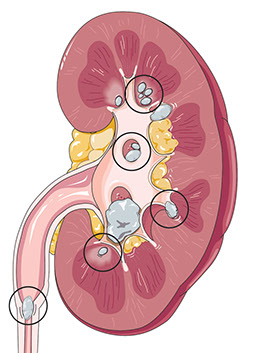
    Kidney stones are hard masses of mineral deposits formed in the kidney(s). They can be as small as a tiny pebble or an inch or more across. They are more common in men.

    Illustration of kidney stones.

    Kidney Stones

    Signs & Symptoms

    Some kidney stones cause no symptoms. Small ones can be passed, without pain, when you urinate. When symptoms occur, they include:

    *  Crampy pain that comes and goes. The pain starts in the lower back, travels down the side of the abdomen, and into the groin area. The pain can be severe.

    *  Bloody, cloudy, or dark-colored urine.

    *  You may need to pass urine often. You may pass only small amounts of urine. You may only be able to pass urine in certain positions.

    *  Nausea and vomiting. Fever and chills (if an infection is also present).

    Causes

    *  Too much calcium in the urine or in the blood.

    *  High levels of uric acid in the blood.

    *  A diet high in oxalic acid. This is in spinach, leafy vegetables, rhubarb, and coffee.

    *  Repeated urinary tract infections.

    *  Mild dehydration that persists.

    *  Family history of kidney stones.

    *  Living in certain parts of the U.S. Areas of the southeast have the highest rates.

    In some cases, the cause is not known.

    Treatment

    If the stone is small and can be passed in the urine, treatment may be just drinking plenty of fluids. For stones too large to be passed, lithotripsy using ultrasound is a common treatment. With this, shock waves are directed to the stone location and break the stone into fragments. Drinking fluids helps flush the fragments from the person’s system.

    Questions to Ask

    Self-Care / Prevention

    *  Drink lots of fluids. Drink at least 8 to 10 glasses of water a day.

    *  Eat a well-balanced diet. Vary food choices.

    *  Save any stone you pass in your urine. Take it to your doctor. Its contents can be analyzed. Follow your doctor’s advice to prevent and treat kidney stones.

    Healthier at Home book by the American Institute for Preventive Medicine. www.HealthyLife.com. All rights reserved.

    © American Institute for Preventive Medicine

  • Testicle Problems

    Men’s Health

    The testicles (also called testes) are two oval shaped organs that make and store sperm. They also make male sex hormones. The testicles are inside the scrotum. This sac of skin hangs under the penis. The scrotum can swell or be painful without a testicle problem. An example of this is an inguinal hernia.

    Problems that affect the testicles include: Injury, swelling and infection; torsion; undescended testicles; and cancer.

    Signs & Symptoms

    For Injury, Swelling, and/or Infection

    *  Pain and swelling in the scrotum.

    *  Feeling of heaviness in the scrotum.

    For Torsion of a Testicle

    *  Sudden and severe pain in the scrotum.

    *  Swelling. Most often, this occurs in one testicle.

    *  Fever.

    *  Abdominal pain. Nausea. Vomiting.

    For Undescended Testicles

    *  In baby boys, testicles do not descend into the scrotum from the abdomen before birth or within months of birth like they should.

    For Cancer of a Testicle

    In the early stages, there may be no symptoms. When symptoms occur, they include:

    *  A lump on a testicle, epididymis, or vas deferens.

    *  An enlarged testicle.

    *  A heavy feeling, pain or discomfort in the testicle or scrotum.

    *  A change in the way a testicle feels.

    *  A dull ache in the lower abdomen or groin.

    *  Enlarged or tender breasts.

    *  Sudden pooling of fluid in the scrotum.

    Causes

    For Injury, Swelling, and Infection

    *  Trauma to the testicles from being hit, kicked, struck, etc. Often, this occurs during sports. Though rare, trauma to the abdomen can cause the testicles to move outside the scrotum.

    *  Orchitis. With this, a testicle is inflamed. Often it is due to an infection, such as mumps or chlamydia. The epididymis can also be inflamed from an infection.

    For Torsion of a Testicle

    When the spermatic cord twists, a testicle rotates. This cuts off blood supply to and from the testicle.

    *  This usually occurs in males under age 30, most often between the ages of 12 and 18.

    *  Symptoms often occur after physical activity or during sleep.

    *  Symptoms may occur for no known reason.

    For Undescended Testicles

    Testicles fail to drop from inside the pelvic area down into the scrotum before birth or within a year of birth.

    For Cancer of a Testicle

    The cause is not known. Risk factors include:

    *  Undescended testicles that are not corrected in infants and young children. Parents should see that their infant boys are checked at birth for this problem.

    *  Having cancer of a testicle in the past.

    *  A family history of cancer of a testicle, especially in an identical twin.

    *  Injury to the scrotum.

    Treatment

    For Injury, Swelling, and/or Infection

    *  Pain from a minor injury to a testicle usually goes away on its own.

    *  Antibiotics treat bacterial infections. Untreated infections can cause infertility.

    For Torsion of a Testicle

    Emergency medical care is needed. The testicle may be untwisted by hand. If not, surgery is needed to restore blood flow to the testicle.

    For Undescended Testicles

    Surgery is done to bring the testicles down into the scrotum.

    For Cancer of a Testicle

    This kind of cancer is almost always curable if it is found and treated early. Surgery is done to remove the testicle. Other things can further treat the disease:

    *  Chemotherapy.

    *  Radiation therapy.

    *  If needed, lymph nodes are removed by surgery.

    Questions to Ask

    Self-Care / Prevention

    To Avoid Injury to the Scrotum

    *  Wear protective gear and clothing during exercise and sports.

    *  Wear an athletic cup to protect the testicles.

    To Help Prevent Infections

    *  See that your children get vaccines for measles, mumps, and rubella (MMR) as advised by their doctor.

    *  To help prevent STDs, follow “Safer Sex” guidelines.

    To Treat Infections

    *  Take medication as prescribed.

    *  Take an over-the-counter medicine for pain and swelling, if needed. Follow directions.

    *  Rest.

    *  Apply cold compresses or an ice pack to painful, swollen area.

    Testicular Self-Exam

    Talk to your doctor about doing testicular self-exams (TSEs). If you choose to do TSEs, follow your doctor’s advice.

    The best time to do a TSE is after a warm bath or shower. This relaxes the scrotum, allows the testicles to drop down, and makes it easier to find anything unusual. Doing a TSE is easy and takes only a few minutes.

    1.  Stand in front of a mirror. Look for any swelling on the skin of the scrotum.

    2.  Examine each testicle with both hands. Place your index and middle fingers underneath the testicle and your thumbs on top. Gently roll one testicle then the other between your thumbs and fingers. One testicle may be larger. This is normal. Examine each testicle for any lumps. These are usually painless and about the size of a pea.

    3.  Find the epididymis. This is the comma-shaped cord behind the testicle. It may be tender to the touch. Check it for lumps.

    4.  Examine the vas deferens. This is the tubelike structure at the back of each testicle. Check it for lumps.

    Resources

    National Cancer Institute

    800.4.CANCER (422.6237)

    www.cancer.gov

    Healthier at Home book by the American Institute for Preventive Medicine. www.HealthyLife.com. All rights reserved.

    © American Institute for Preventive Medicine

  • Important Health Screenings For Men

    WELL-BEING

    Image of male doctor.

    Even if you feel fine, you should see your doctor for regular health screenings. Many health conditions cause no symptoms in their earliest stages. Screenings can help you get earlier treatment and a better outcome. The National Institutes of Health recommends the following tests for men:

    Abdominal aortic aneurysm:

    Adults ages 65 to 75 who have smoked may need this screening once. Others should consult with their doctor.

    Blood pressure:

    Every one to two years, depending on your risk factors or health conditions.

    Cholesterol:

    Beginning at age 35, every five years if levels are normal. Men with high blood pressure, other risk factors for heart disease or certain health conditions may need to get screened sooner or more often.

    Colon cancer:

    Screening may begin at age 50, or earlier, if you have a family history of the disease, certain risk factors or certain health conditions.

    Diabetes:

    Every three years beginning at age 45. Earlier and/or more frequent testing may be advised if you have certain risk factors.

    Eyes:

    Every one to two years, or more often if you have glaucoma, have certain eye conditions or if your doctor recommends it.

    Hearing:

    Adults over age 65 may need a hearing test if signs of hearing loss are present.

    Lung cancer:

    Annual screening may be recommended for adults aged 55 to 80 years who have a 30 pack-year (smoke one pack per day for 30 years) smoking history AND currently smoke or have quit within the past 15 years.

    Osteoporosis:

    Discuss screening with your doctor if you are over age 50.

    Physical exam:

    Height, weight and Body Mass Index (BMI) should be measured at well visits.

    Prostate cancer:

    Discuss screening with your doctor. Men with certain risk factors may need screenings beginning at age 45.

    Sexually transmitted infections:

    Depending on age, lifestyle and medical history, you may need to discuss with your doctor about getting tested for chlamydia, syphilis, HIV and other infections.

    Men of all ages and health statuses need regular health screenings. Call your doctor to schedule your well visit!

    © American Institute for Preventive Medicine

  • Understanding Enlarged Prostate

    MEDICAL NEWS

    Image of older male smiling.

    Benign prostatic hyperplasia, sometimes called BPH or enlarged prostate, is a condition where a man’s prostate gland gets larger. It is the most common prostate problem for men older than age 50. And, up to 90 percent of men over age 80 have it.

    An enlarged prostate is not cancer, and for many men, it’s not serious. But, it can cause some symptoms that are bothersome, such as urinating too frequently, trouble starting or stopping urinating and incontinence. This happens when the prostate gets too large and blocks the urethra, which lets urine out of the body. Or, it can stress the bladder as it tries to force urine past the blockage.

    In rare cases, an enlarged prostate can cause serious problems such as kidney damage. That’s why it’s important to talk with a doctor about enlarged prostate and to follow your doctor’s recommendations.

    Don’t ignore these signs

    Enlarged prostate is usually not serious. But, some symptoms could signal a more serious problem. Get medical care right away if you notice any of these signs:

    *  Complete inability to urinate

    *  Fever and chills along with frequent and painful urination

    *  Blood in urine

    *  Severe pain in lower belly and/or urinary tract

    How enlarged prostate is treated

    Treatment is based on symptoms and lifestyle. Many men who have mild symptoms find that lifestyle changes can help. Some recommendations include:

    *  Drink less fluids, especially before bedtime or when you won’t be near a bathroom.

    *  Avoid caffeine and/or alcohol. These can irritate the bladder and increase urination, which can worsen symptoms of an enlarged prostate.

    *  Avoid medications that can cause urination problems, including cold medicines with decongestants, antihistamines for allergies, diuretics and some antidepressants.

    *  Train your bladder, which means to gradually hold urine for longer periods.

    *  Exercises to strengthen muscles in the pelvic floor region of your body.

    *  Prevent and/or treat constipation, which can irritate a stressed bladder.

    Lifestyle changes usually help improve quality of life for men with an enlarged prostate. But if they don’t, your doctor may discuss medications or minimally invasive procedures. Surgery is usually not needed, but it is an option for severe cases.

    Fortunately, this common health issue can be managed and treated. Get regular checkups with your doctor or urologist to keep symptoms under control.

    Sources: National Institutes of Health, National Institute of Diabetes and Digestive and Kidney Diseases

    © American Institute for Preventive Medicine