Tag: movement

  • Burn Calories Without Trying

    BE FIT

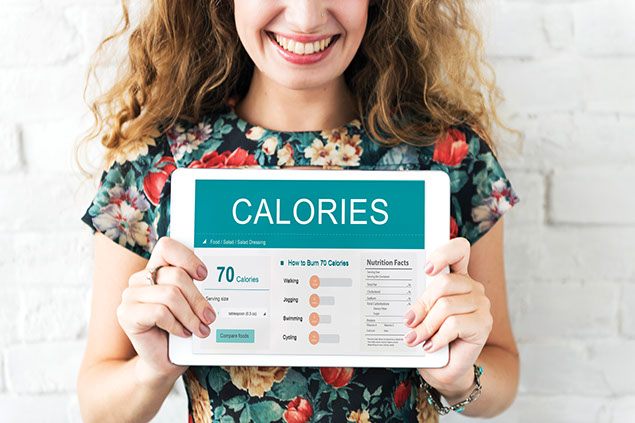
    Image of women holding up tablet with calorie tracking.

    When you’re not exercising, you can still burn extra calories! Use little ways to get more fit every day.

    Don’t make things convenient.

    Take the stairs instead of the elevator. Park farther away from your destination and walk. Use your bike instead of a car for quick grocery store runs. Put your favorite snack foods in the basement, rather than on the main floor near the TV.

    Get up.

    Take a short break every hour if you sit at a desk. Get up, move your arms and legs or even do a few jumping jacks. Use a hands-free headset so you can get up and walk or lift weights while you’re on the phone. Have a meeting? See if you can stand during part of it or even have a walking meeting.

    Sneaky exercises.

    Do some isometric exercises if you sit a lot. Try squeezing your glute muscles and knees together for eight counts, holding for five seconds then release. Do this every couple of hours.

    Move whenever you can. Walk in place instead of standing still.

    © American Institute for Preventive Medicine
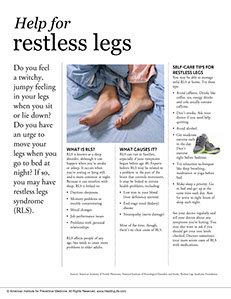
  • Help For Restless Legs

    SELF-CARE CORNER

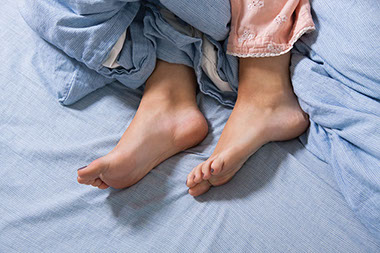
    Close up feet laying in bed.

    Do you feel a twitchy, jumpy feeling in your legs when you sit or lie down? Do you have an urge to move your legs when you go to bed at night? If so, you may have restless legs syndrome (RLS).

    What is RLS?

    RLS is known as a sleep disorder, although it can happen when you’re awake or asleep. It occurs when you’re resting or lying still, and is more common at night. Because it can interfere with sleep, RLS is linked to:

    *  Daytime sleepiness

    *  Memory problems or trouble concentrating

    *  Mood changes

    *  Job performance issues

    *  Problems with personal relationships

    RLS affects people of any age, but tends to cause more problems in older adults.

    What causes it?

    RLS can run in families, especially if your symptoms began before age 40. Experts believe RLS may be related to a problem in the part of the brain that controls movement. It may be linked to certain health problems, including:

    *  Low iron in your blood (iron deficiency anemia)

    *  End-stage renal (kidney) disease

    *  Neuropathy (nerve damage)

    Most of the time, though, there’s no clear cause of RLS.

    Self-care tips for restless legs

    You may be able to manage mild RLS at home. Try these tips:

    *  Avoid caffeine. Drinks like coffee, tea, energy drinks and cola usually contain caffeine.

    *  Don’t smoke. Ask your doctor if you need help quitting.

    *  Avoid alcohol.

    *  Get moderate exercise early in the day. Don’t exercise right before bedtime.

    *  Try relaxation techniques like deep breathing, meditation or yoga before bed.

    *  Make sleep a priority. Go to bed and get up at the same time each day. Aim for seven to eight hours of sleep each night.

    See your doctor regularly and tell your doctor about any symptoms you’re having. You may also want to ask if you should get your iron levels checked. Doctors sometimes treat more severe cases of RLS with medications.

    Sources: American Academy of Family Physicians, National Institute of Neurological Disorders and Stroke, Restless Legs Syndrome Foundation

    © American Institute for Preventive Medicine
  • Stay Healthy At Work

    WORK LIFE

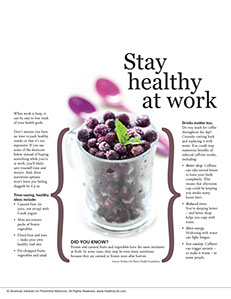
    Image of frozen berries in a glass.

    When work is busy, it can be easy to lose track of your health goals.

    Don’t assume you have no time to pack healthy snacks or that it’s too expensive. If you use some of the shortcuts below instead of buying something while you’re at work, you’ll likely save yourself time and money. And, these nutritious options won’t leave you feeling sluggish by 4 p.m.

    Time-saving, healthy ideas include:

    *  Canned fruit (in juice, not syrup) with Greek yogurt

    *  Mini microwave packs of frozen vegetables

    *  Dried fruit and nuts – make your own healthy trail mix

    *  Pre-chopped fruits, vegetables and salad

    Did you know?

    Frozen and canned fruits and vegetables have the same nutrients as fresh. In some cases, they may be even more nutritious because they are canned or frozen soon after harvest.

    Source: Produce for Better Health Foundation

    Drinks matter too.

    Do you reach for coffee throughout the day? Consider cutting back and replacing it with water. You could reap numerous benefits of reduced caffeine intake, including:

    *  Better sleep. Caffeine can take several hours to leave your body completely. This means that afternoon cup could be keeping you awake many hours later.

    *  Reduced stress. You’re sleeping better – and better sleep helps you cope with stress.

    *  More energy. Hydrating with water can fight fatigue.

    *  Less anxiety. Caffeine can trigger anxiety – or make it worse – in some people.

    © American Institute for Preventive Medicine
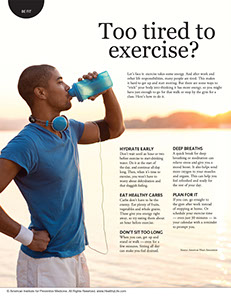
  • Too Tired To Exercise?

    BE FIT

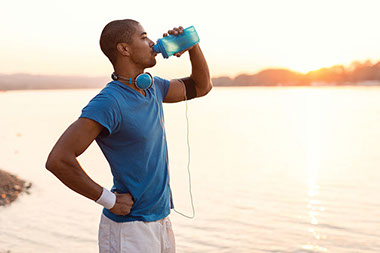
    Man standing by a body of water drinking out of a water bottle.

    Let’s face it: exercise takes some energy. And after work and other life responsibilities, many people are tired. This makes it hard to get up and start moving. But there are some ways to “trick” your body into thinking it has more energy, so you might have just enough to go for that walk or stop by the gym for a class. Here’s how to do it.

    Hydrate early

    Don’t wait until an hour or two before exercise to start drinking water. Do it at the start of the day, and continue all day long. Then, when it’s time to exercise, you won’t have to worry about dehydration and that sluggish feeling.

    Eat healthy carbs

    Carbs don’t have to be the enemy. Eat plenty of fruits, vegetables and whole grains. These give you energy right away, so try eating them about an hour before exercise.

    Don’t sit too long

    When you can, get up and stand or walk – even for a few minutes. Sitting all day can make you feel drained.

    Deep breaths

    A quick break for deep breathing or meditation can relieve stress and give you a mood boost. It also helps send more oxygen to your muscles and organs. This can help you feel refreshed and ready for the rest of your day.

    Plan for it

    If you can, go straight to the gym after work instead of stopping at home. Or schedule your exercise time – even just 30 minutes – in your calendar with a reminder to prompt you.

    Source: American Heart Association

    © American Institute for Preventive Medicine

  • 5 Reasons To Be Active

    Fitness

    Grandparents playing with their grandchildren.

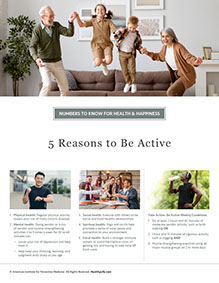
    1.  Physical health: Regular physical activity lowers your risk of many chronic diseases.

    2.  Mental health: Doing aerobic or a mix of aerobic and muscle-strengthening activities 3 to 5 times a week for 30 to 60 minutes can:

    –  Lower your risk of depression and help treat it

    –  Help keep your thinking, learning, and judgment skills sharp as you age

    3.  Social health: Exercise with others to be social and build healthy relationships.

    4.  Spiritual health: Yoga and tai chi help promote a sense of inner peace and connection to your environment.

    5.  Fiscal health: Build a stronger immune system to avoid the medical costs of getting sick and having to take time off from work.

    Take Action: Be Active Weekly Guidelines

    1.  Do at least 2 hours and 30 minutes of moderate aerobic activity, such as brisk walkingOR

    2.  1 hour and 15 minutes of vigorous activity, such as joggingAND

    3.  Muscle strengthening exercises using all major muscle groups on 2 or more days.

    Page from HealthyLife Weigh book by the American Institute for Preventive Medicine. www.HealthyLife.com. All rights reserved.

    © American Institute for Preventive Medicine
  • Consider Low-Impact Or Nonimpact Aerobics

    Fitness

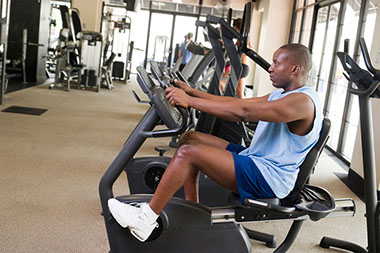
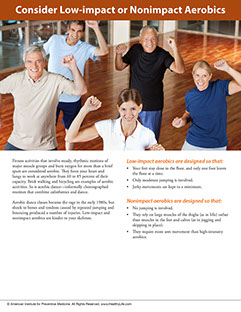
    Image of man exercising at the gym.

    Fitness activities that involve steady, rhythmic motions of major muscle groups and burn oxygen for more than a brief spurt are considered aerobic. They force your heart and lungs to work at anywhere from 60 to 85 percent of their capacity. Brisk walking and bicycling are examples of aerobic activities. So is aerobic dance-informally choreographed routines that combine calisthenics and dance.

    Aerobic dance classes became the rage in the early 1980s, but shock to bones and tendons caused by repeated jumping and bouncing produced a number of injuries. Low-impact and nonimpact aerobics are kinder to your skeleton.

    Low-impact aerobics are designed so that:

    *  Your feet stay close to the floor, and only one foot leaves the floor at a time.

    *  Only moderate jumping is involved.

    *  Jerky movements are kept to a minimum.

    Nonimpact aerobics are designed so that:

    *  No jumping is involved.

    *  They rely on large muscles of the thighs (as in lifts) rather than muscles in the feet and calves (as in jogging and skipping in place).

    *  They require more arm movement than high-intensity aerobics.

    Page image from A Year of Health Hints book by the American Institute for Preventive Medicine. www.HealthyLife.com. All rights reserved.

    © American Institute for Preventive Medicine

  • Do Your Chores

    Fitness

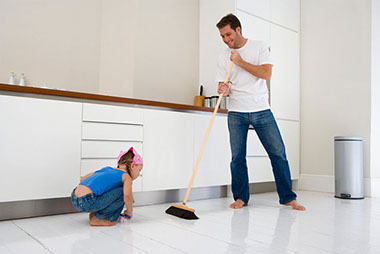
    Image of father and daugher cleaning.

    Burn calories while you clean.

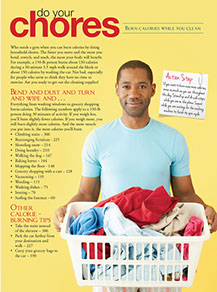
    Who needs a gym when you can burn calories by doing household chores. The faster you move and the more you bend, stretch, and reach, the more your body will benefit. For example, a 150-lb person burns about 130 calories during a 30-minute 3.5 mph walk around the block or about 150 calories by washing the car. Not bad, especially for people who seem to think they have no time to exercise. Are you ready to get out the cleaning supplies?

    Bend and dust and turn and wipe and . . .

    Everything from washing windows to grocery shopping burns calories. The following numbers apply to a 150-lb person doing 30 minutes of activity. If you weigh less, you’ll burn slightly fewer calories. If you weigh more, you will burn slightly more calories. And the more muscle you put into it, the more calories you’ll burn.

    *  Climbing stairs – 306

    *  Rearranging furniture – 225

    *  Shoveling snow – 214

    *  Doing laundry – 210

    *  Walking the dog – 147

    *  Raking leaves – 144

    *  Mopping the floor – 140

    *  Vacuuming – 119

    *  Weeding – 115

    *  Washing dishes – 75

    *  Ironing – 70

    *  Surfing the Internet – 60

    Other calorie – burning tips

    *  Take the stairs instead of the elevator – 306

    *  Park the car farther from your destination and walk – 227

    *  Carry your grocery bags to the car – 190

    Action Step

    If you want to burn even more calories, move as much as you can throughout the day. Stand up and do side steps while you are on the phone. Squat while you are waiting for the washing machine to finish its spin cycle.

    Page image from Ways to Well-Being book by the American Institute for Preventive Medicine. www.HealthyLife.com. All rights reserved.

    © American Institute for Preventive Medicine
  • Exercise Your Calories Away

    Weight Control

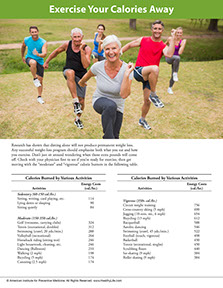
    Research has shown that dieting alone will not produce permanent weight loss. Any successful weight-loss program should emphasize both what you eat and how you exercise. Don’t just sit around wondering when those extra pounds will come off. Check with your physician first to see if you’re ready for exercise, then get moving with the “moderate” and “vigorous” calorie burners in the following table.

    Page from A Year of Health Hints book by the American Institute for Preventive Medicine. www.HealthyLife.com. All rights reserved.

    © American Institute for Preventive Medicine
  • Fitness In Flight

    Healthy Travel

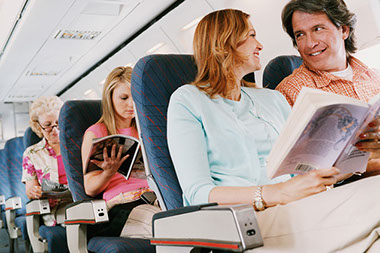
    Passengers aboard an airplane.

    Sitting in a narrow, crowded airplane seat for hours causes cramped and achy muscles, swollen feet, and fatigue. And anyone who has a problem with circulation in his or her legs runs a risk of thrombophlebitis when sitting for long periods of time. Fortunately, there are ways to prevent the typical aches and pains travelers frequently experience during long flights. One is to charter your own plane and stretch out in comfort. If you’re like most people, however, a private plane is probably beyond your means. Instead, you can try to reduce stiffness with the following exercises.

    *  Tense your feet for 5 seconds, then relax them. Repeat with each muscle group, including your calves, thighs, buttocks, shoulders, neck, forearms, and hands.

    *  Drop your head forward. Then slowly move it to your right, and continue rotating your head, to the back, to the left, and to the front again. Repeat four times. Then reverse direction, and repeat five times.

    *  Raise both shoulders, then move them back, down, and forward in a circular motion.

    *  Reaching toward the ceiling, stretch your right arm. Then repeat with your left arm.

    To promote circulation in your legs:

    *  Flex and extend your feet, pointing your toes up and down.

    *  Try to get up and walk at least once every 2 hours, if possible. You should also make an effort to breathe slowly and deeply. Aircraft air is lower in oxygen than outdoor air, and deep breathing helps you to get enough oxygen into your blood and avoid fatigue or sluggishness.

    Page image from A Year of Health Hints book by the American Institute for Preventive Medicine. www.HealthyLife.com. All rights reserved.

    © American Institute for Preventive Medicine