Tag: protection

  • Patient Safety

    Medical Care

    Doctor helping patient walk.

    Although estimates vary, as many as 251,000 people a year die in U.S. hospitals due to medical errors, also called Preventable Adverse Events (PAEs).

    Take an active role in every decision about your health care. If needed, have a family member or friend oversee your care.

    “Wrong-site” surgery includes operating on the wrong person, the wrong organ, or the wrong limb.

    Before you are taken into surgery, make sure the surgery is the one scheduled for you. Mark the body part to be operated on, too. Use the marker, etc. the doctor gives you to do this.

    Find out about patient safety from the Institute for Healthcare Improvement atihi.organd the Agency for Healthcare Research and Quality atahrq.gov.

    A Year of Health Hints book by the American Institute for Preventive Medicine. www.HealthyLife.com. All rights reserved.

    © American Institute for Preventive Medicine

  • Yes, More Sunscreen!

    SELF-CARE CORNER

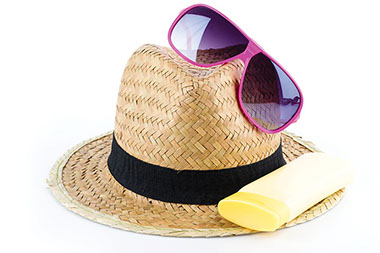
    Image of sun hat, sunglasses and sunscreen.

    Wear it. Wear plenty of it. And this summer is the first season for the new FDA regulations. Here’s what you need to know about labels and ingredients from Dr. Alan Friedman of Montefiore Medical Center.

    Water-resistant

    Sunscreens claiming to be waterproof and sweat proof are no longer on the shelves. In their place are 40- and 80-minute water-resistant sunscreens. They offer sun protection for a limited time when exposed to water. Choose the 80-minute water-resistant product and reapply after swimming or toweling off.

    Sun Protection Factor (SPF)

    Some people think that SPF measures the length of time users can be in the sun before getting sunburned. Not so. SPF defines the amount of ultraviolet B (UVB) radiation needed to cause sunburn, even while sunscreen is on. Sunscreens with SPF 2 through SPF 14 can prevent sunburn, but they provide no protection against skin cancer or premature skin aging. Such sunscreens must now carry a warning label stating, “Spending time in the sun increases your risk of skin cancer and early skin aging. This product has been shown only to help prevent sunburn, not skin cancer or early skin aging.”

    The FDA has yet to rule on whether products with SPF values higher than 50 provide extra protection compared to ones with SPF values of 50.

    For a sunscreen to reach its listed SPF, a full ounce (think of a shot glass full) needs to be applied. Recent research shows that people only apply 20-25% of this amount, unknowingly lowering the protection factor of their sunscreens. Best choice: SPF 30 or higher and plenty of it.

    Broad spectrum

    Until the final FDA requirements took effect, sunscreens were only evaluated and regulated for their ability to protect against UVB radiation, as measured by SPF. Now, sunscreens also are evaluated for their UVA protection. Sunscreens labeled as “broad spectrum” protect against both UVA and UVB radiation.

    “UVA penetrates deeper into the skin where it can accelerate skin aging and cause skin cancer. I call UVA the silent killer, because unlike UVB, it does not cause sunburns so it is hard to tell if you are getting harmful exposure,” said Dr. Friedman. “Broad spectrum sunscreen use should not be limited to beach outings or summer months. Recent research showed that the skin aging process is significantly slower among people who apply broad spectrum sunscreen daily, year round.”

    Read the ingredients

    Sunscreen companies use different mixtures of ingredients. Choose products that have a variety of sun-blocking agents. Dr. Friedman recommends selecting a sunscreen that contains several organic sun-blocking agents such as ecamsule, cinoxate, octyl salicylate, and benzophenones (oxybenzone). The different chemicals work in synergy to create greater sun protection than any one ingredient alone. Also, combining multiple agents allows companies to use less of each, which decreases the risk of any associated irritation.

    The best products also contain mineral, physical sun-blocking agents like zinc oxide and titanium oxide. In the past, these ingredients appeared chalky and left skin greasy, but newer products deliver “micronized” thinner, sheerer formulations. Products that contain talc and bentone gel prevent these ingredients from clumping, and improve cosmetic appearance.

    Look for pH stabilizers to hydrate and fortify the skin, like dimethicone, cyclomethicone, and sodium phosphate. When the skin is hydrated, its can heal and repair itself much more quickly.


    © American Institute for Preventive Medicine

  • Advocate Against Domestic Violence

    FAMILY LIFE

    Back of women, wind blowing her hair as she hugs herself.

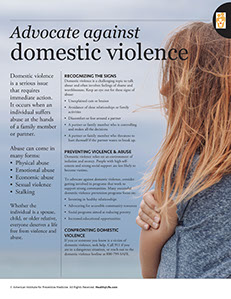
    Domestic violence is a serious issue that requires immediate action. It occurs when an individual suffers abuse at the hands of a family member or partner.

    Abuse can come in many forms:

    *  Physical abuse

    *  Emotional abuse

    *  Economic abuse

    *  Sexual violence

    *  Stalking

    Whether the individual is a spouse, child, or older relative, everyone deserves a life free from violence and abuse.

    Recognizing the signs

    Domestic violence is a challenging topic to talk about and often involves feelings of shame and worthlessness. Keep an eye out for these signs of abuse:

    *  Unexplained cuts or bruises

    *  Avoidance of close relationships or family activities

    *  Discomfort or fear around a partner

    *  A partner or family member who is controlling and makes all the decisions

    *  A partner or family member who threatens to hurt themself if the partner wants to break up.

    Preventing violence & abuse

    Domestic violence relies on an environment of isolation and secrecy. People with high self-esteem and strong social support are less likely to become victims.

    To advocate against domestic violence, consider getting involved in programs that work to support strong communities. Many successful domestic violence prevention programs focus on:

    *  Investing in healthy relationships

    *  Advocating for accessible community resources

    *  Social programs aimed at reducing poverty

    *  Increased educational opportunities

    Confronting domestic violence

    If you or someone you know is a victim of domestic violence, seek help. Call 911 if you are in a dangerous situation, or reach out to the domestic violence hotline at 800-799-SAFE.

    © American Institute for Preventive Medicine

  • Eye Health At Work

    Eye Conditions

    Man wearing protective eye and hearing gear while using machinery.

    Follow your workplace’s safety rules to protect your eyes. Wear safety glasses, goggles, face shields, etc. Keep your safety eyewear clean and in good condition.

    More than 700,000 persons in the U.S. have eye injuries at work a year. Most of these could have been prevented.

    Find out if and what type of eyewear is required for your job. Ask loved ones if they wear required safety eyewear at work.

    Persons who walk through work areas that have eye hazard areas need to wear protective eyewear.

    When you visit a worksite that poses a risk of eye injuries, ask for protective eyewear if it is not provided.

    Glasses and contact lenses used for other activities may not be effective when working with computer screens.

    Let your eye doctor know if you work at a computer so they can prescribe the proper eyewear for you to use.

    Health at Home Lifetime book by the American Institute for Preventive Medicine. www.HealthyLife.com. All rights reserved.

    © American Institute for Preventive Medicine

  • Safety Tips For Your Teeth

    Dental & Mouth Concerns

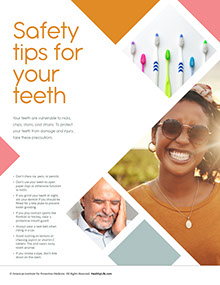
    Your teeth are vulnerable to nicks, chips, stains, and strains. To protect your teeth from damage and injury, take these precautions.

    *  Don’t chew ice, pens, or pencils.

    *  Don’t use your teeth to open paper clips or otherwise function as tools.

    *  If you smoke a pipe, don’t bite down on the stem.

    *  If you grind your teeth at night, ask your dentist if you should be fitted for a bite plate to prevent tooth grinding.

    *  If you play contact sports like football or hockey, wear a protective mouth guard.

    *  Always wear a seat belt when riding in a car.

    *  Avoid sucking on lemons or chewing aspirin or vitamin C tablets. The acid wears away tooth enamel.

    Image of man brushing teeth.
    A Year of Health Hints book by the American Institute for Preventive Medicine. www.HealthyLife.com. All rights reserved.

    © American Institute for Preventive Medicine

  • Tips To Protect Your Eyes

    Eye Conditions

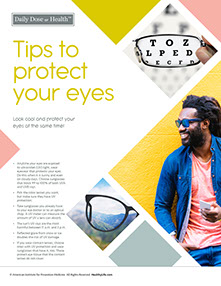
    Man smiling wearing dark sunglasses.

    Look cool and protect your eyes at the same time!

    *  Anytime your eyes are exposed to ultraviolet (UV) light, wear eyewear that protects your eyes. Do this when it is sunny and even on cloudy days. Choose sunglasses that block 99 to 100% of both UVA and UVB rays.

    *  Pick the color lenses you want, but make sure they have UV protection.

    *  Take sunglasses you already have to your eye doctor or to an optical shop. A UV meter can measure the amount of UV a lens can absorb.

    *  The sun’s UV rays are the most harmful between 11 a.m. and 3 p.m.

    *  Reflected glare from snow or ice doubles the risk of UV damage.

    *  If you wear contact lenses, choose ones with UV protection and wear sunglasses that have it, too. These protect eye tissue that the contact lenses do not cover.

    Health at Home Lifetime book by the American Institute for Preventive Medicine. www.HealthyLife.com. All rights reserved.

    © American Institute for Preventive Medicine

  • Uv Safety

    Skin Conditions

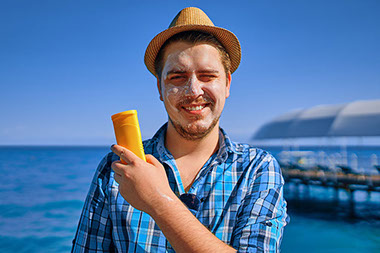
    Man holding sun block in hand with sun screen on face.

    Exposure to the sun’s UV rays causes most skin cancers. Even a few serious sunburns can raise the risk.

    Limit exposure to the sun. When in the sun, wear sun screen and lip balm with a sun protective factor (SPF) of 30 or higher.

    Ultraviolet (UV) radiation comes in three forms: UVA, UVB, and UVC. UVA and UVB rays cause skin and eye damage. UVC rays don’t reach the earth.

    UV rays also reflect off of surfaces like water, sand, and snow.

    Use sun screens that protect against both UVA and UVB rays. Choose eyewear that absorbs 99-100% of both UVA and UVB rays. Wrap-around sunglasses work best because they block UV rays from sneaking in from the side.

    High doses of UVA radiation comes from tanning beds.

    For the look of a tan, use sunless tanning lotions, sprays, and bronzers, instead of sun bathing, tanning beds, and sun lamps.

    Health at Home Lifetime book by the American Institute for Preventive Medicine. www.HealthyLife.com. All rights reserved.

    © American Institute for Preventive Medicine

  • Decoding Sunscreen Labels

    MEDICAL NEWS

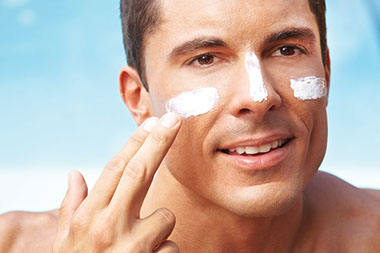
    Image of a man placing sunscreen on his face.

    You may already know you should wear sunscreen to decrease your risk of skin cancer and sun damage. In fact, the Skin Cancer Foundation says that wearing sunscreen regularly can decrease your chance of getting melanoma (the deadliest skin cancer) by 50 percent. Wearing sunscreen regularly will also help you avoid signs of aging like wrinkles and dark spots.

    But the sunscreen aisle at the store leaves many people feeling overwhelmed. There are so many choices, different labels, numbers and ingredients. How do you choose one?

    The best sunscreen is one you like, because you should use it every day, says the American Academy of Dermatology (AAD). Here’s how to narrow it down and choose the sunscreen that’s right for you:

    BROAD SPECTRUM

    Always look for the words “broad spectrum.” This means it protects against both kinds of UV rays, and it’s important for proper protection.

    SPF

    Choose an SPF of at least 30.

    SPF NUMBERS

    Don’t let high numbers fool you. The Skin Cancer Foundation says higher SPF sunscreens do protect more, but not by much. No matter what the SPF number says, you still need to reapply at least every two hours, and always after toweling off, sweating or swimming.

    WATER RESISTANT

    If you’re going to be sweating or swimming, choose one that says “water resistant.” There is no such thing as “waterproof” sunscreen. The bottle will say how long the sunscreen will remain water resistant. It may say “40 minutes” or “80 minutes.” That’s how often you need to reapply it when you’ve been in the water.

    LIPS

    Choose a sunscreen for your lips too. A lip balm with broad spectrum SPF 30 is also important. Skin cancer can – and does – affect the lips.

    GELS vs CREAMS

    Sunscreen gels are great for oily skin, while creams work well for dry skin.

    SENSITIVE SKIN

    If you have sensitive skin, consider a physical-only sunscreen. This means the active ingredients on the bottle will only include titanium dioxide or zinc oxide, or both. While chemical sunscreens work well, they can irritate some sensitive-skin types.

    PRICE TAG

    Expensive doesn’t always mean better. A higher price tag may be due to the brand name or certain extra ingredients that make it feel nicer or smell good. It doesn’t mean it will protect you more than a cheaper bottle.

    NO COMBINATION

    Don’t choose a combination sunscreen and insect repellant. The AAD says sunscreen should be reapplied liberally every two hours. But insect repellant should only be applied lightly every several hours as needed.

    BABIES

    Most sunscreens are only approved for babies over 6 months of age. Look for a physical-only sunscreen or one formulated for babies. Babies younger than 6 months should be kept in the shade and covered with lightweight protective clothing and hats, says the American Academy of Pediatrics.

    © American Institute for Preventive Medicine

  • How To Recognize And Report Abuse

    FAMILY LIFE

    Image of the word "Help" spelled out on a green chalk board.

    Child and elder abuse is a serious problem that affects people from all walks of life. One of the most important ways to protect victims from abuse is by making sure they get the help they need and by reporting cases to the authorities. Here’s how to recognize the different types of abuse and what to do in case you know someone who is a victim. This advice is from the General Services Administration of the U.S. government (www.USA.gov).

    Child Abuse

    Children who are victims of physical or emotional abuse often display mental and social development problems. In most cases, the abuse comes from their own parents or caretakers. Here are some of the signs of abuse:

    *Physical abuse:A child who suffers from physical abuse might have bruises, burn marks, broken bones and scars. They are often fearful of adults or certain people.

    *Sexual abuse:Victims of sexual abuse are forced to have sexual relations or engage in inappropriate physical contact with adults. Signs include feeling uncomfortable when changing clothes.

    *Emotional abuse:Children who experience emotional abuse are often victims of private or public humiliation and neglect. A child might show sudden changes in behavior and act violently.

    *Neglect:Children who are physically neglected show signs of lack of personal hygiene and bad health due to malnutrition, among other things.

    If you know or suspect that a child is a victim of abuse and is in immediate danger, call 911. To report a case of child abuse, call the National Child Abuse Hotline at 1-800-422-4453.

    Elder Abuse

    Elder abuse can occur in the victim’s home or at places such as assisted living facilities. People who abuse the elderly are usually people who know or take care of the victims. There are several types of abuse and all of them can have a profound negative impact on a person’s physical and mental health.

    *Physical abuse:As with child abuse, elders who suffer from physical abuse also might show bruises or other signs of injury on their bodies.

    *Sexual abuse:Elders who suffer from sexual abuse might become withdrawn.

    *Emotional abuse:This occurs when the victim is humiliated and treated with disrespect. The victim might feel useless or inferior and might suffer from depression.

    *Neglect:Elders show signs of physical neglect when caretakers fail to help them with their personal hygiene, food, clothing, and medications.

    *Financial abuse:Elders are often targets of financial fraud. This usually happens when people who take care of elders steal their retirement.

    If you know or suspect an elder is a victim of abuse and is in immediate danger, call 911. To report a case of elder abuse, call 1-800-677-1116 or visit the National Center on Elder Abuse atwww.ncea.aoa.gov.

    © American Institute for Preventive Medicine

  • Look Cool & Protect Your Eyes

    SELF-CARE CORNER

    Image of women smiling while wearing sunglasses and a sun hat.

    Sunglasses are a great fashion item, but their most important job is to protect your eyes from the sun’s ultraviolet rays. Prolonged exposure to the sun can damage the surface tissues, cornea, and lens of the eye. It has also been linked to cataract, macular degeneration, and temporary vision loss.

    Through its EyeSmart® UV Safety campaign, the American Academy of Ophthalmology offers tips to keep your eyes safe:

    Wear sunglasses that protect your eyes from both UVA and UVB rays.

    *  When you purchase sunglasses, look for either UV400 or 100% UV protection on the label. Frames with a close-fitting wraparound style give the best protection.

    *  Wear sunglasses even if you wear UV-blocking contact lenses. Contacts do not cover enough eye area.

    *  Wear sunglasses on cloudy days, too. The sun’s rays can pass through haze and clouds.

    Wear a hatalong with your sunglasses. Hats with a wide brim are best.

    Protect your children’s eyes.

    *  Keep children out of direct sunlight during the middle of the day.

    *  Have them wear sunglasses and hats whenever they are in the sun.

    Be extra careful in UV-intense conditions:

    *  Mid-day to early afternoon, when sunlight is strongest

    *  At higher altitudes

    *  Places where the sun is reflected off of water, ice or snow

    Learn more about UV eye safety and tips to protect the eyes from the sun atwww.geteyesmart.org/eyesmart/living/sun.cfm

    © American Institute for Preventive Medicine