Tag: questions

  • Flu Shot Faqs

    MEDICAL NEWS

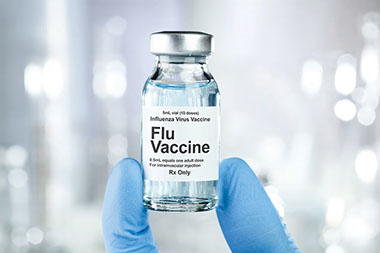
    Flu vaccine in bottle.

    Every year, millions of people get the flu. Some get very sick and need to be hospitalized. Thousands of people die from the flu every year.

    This year as we battle COVID-19, getting a flu shot is more important than ever. Flu shots decrease the chance that you will be hospitalized or die from the flu. This helps ensure that hospitals will not become overwhelmed with flu and COVID-19 patients.

    Won’t last year’s shot help me?

    Everyone needs to get a flu shot every year. There are two reasons why:

    *  Your immune system’s protection from the shot gets weaker over time.

    *  Flu viruses are always changing, so you need a shot that has this year’s flu strains in it.

    Will a flu shot increase my risk of getting COVID-19?

    No. Studies have shown that a flu vaccine will not put you at risk for COVID-19. But it will help protect you from the flu, which also protects your loved ones and people around you!

    Will the flu shot give me the flu?

    The flu shot is made from inactivated flu virus. An inactivated virus cannot give you the flu. Some people notice side effects from the shot like aches or a mild fever. These side effects last only a day or two. This is much milder than getting the flu, where fever, aches and other symptoms last a week or longer.

    What if I’m not high risk?

    Everyone 6 months of age and older should get the flu shot, even if they have no health problems. Even young, healthy people – including children – can become very sick with the flu.

    When more people get the flu shot, we help protect people who are high risk, including babies, older adults and people who are allergic to the shot.

    Is it too late to get a flu shot?

    Even if you haven’t gotten your flu shot yet, it’s not too late. After getting the shot, you won’t have immunity right away. It takes about two weeks for your body to develop antibodies to the flu.

    Source: Centers for Disease Control and Prevention, World Health Organization
    © American Institute for Preventive Medicine

  • Questions About Metabolism

    MEDICAL NEWS

    Women flexing arm while holding a fork in the other hand, with the word "Metabolism".

    Your body has a process for taking food and turning it into energy. This is known as your metabolism. Some diets and exercise plans claim to raise metabolism so you can lose more weight. How does this work, and is it even true?

    Does exercise boost metabolism?

    Exercise burns calories, and you’ll continue to burn some more calories after you’re done. But don’t count on exercise to rev up your metabolism so you can eat much more than usual.

    If you exercise and then eat a lot of calories, this can lead to weight gain. Even if your workout is long and hard, watch out for high-calorie foods and drinks if you’re trying to lose extra pounds.

    Use exercise for its amazing health-boosting powers. But be careful about how many calories you eat. Exercise can’t drastically change your metabolism.

    Does muscle burn more calories than fat?

    Having more muscle can boost your metabolism a little. But it’s only a small amount. Most of your metabolism is controlled by other organs like your brain, kidneys, liver, heart and lungs. Building muscle mass is still valuable. Lifting weights boost bone health. It can help you with everyday tasks and balance. Just don’t count on it to change your metabolism very much.

    Can certain foods boost metabolism?

    Green tea, caffeine or hot peppers can boost your metabolism for a short time. But it’s not enough to help a person lose weight.

    Green tea has health benefits but be careful with caffeine. The Food and Drug Administration says adults should get no more than 400 mg of caffeine each day. That’s about three or four cups of coffee. Some people are sensitive to caffeine and should get much less than this amount. Remember, caffeine can also be found in tea, energy drinks and some sodas.

    If I eat regular meals, does that speed up metabolism?

    There are some benefits to spreading your meals out each day. You want to eat on a regular schedule so you don’t get too hungry. If you’re famished, you’re more likely to overeat and take in a lot more calories.

    But there isn’t any evidence that says eating regular meals will help boost metabolism. Instead, follow your hunger cues. Eat when you’re hungry and stop when you start to feel full and satisfied.

    Source: U.S. National Library of Medicine

    © American Institute for Preventive Medicine
  • How To Make The Most Of A Doctor Visit

    Medical Care

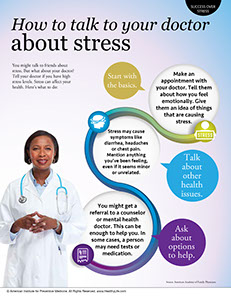
    Image of doctor and patient talking.

    When a doctor knows how to really communicate well with a patient, it can make a big difference in how that patient responds. But communication is a two-way process. Listening as well as speaking to one another is something both doctor and patient must work on together. Being honest and open with each other is also important.

    What Your Doctor Should Know about You

    Aside from a general health history, it is important that your doctor ask certain questions about the following:

    *  Dietary habits (Are you a frequent junk-food eater? Are you especially fond of cheesecake, sour cream, or other fatty foods?)

    *  Your occupation (Do you work in a high-stress job? Are you exposed to nickel, nuclear power radiation, or other toxic substances?)

    *  Sleep habits (Do you frequently awaken before dawn or have problems getting to sleep?)

    *  Family problems (Are you currently going through a divorce?)

    *  Lifestyle (Do you get any exercise?)

    *  Stress (Do you work in a noisy environment?)

    *  Health attitude (Are you serious about quitting smoking?)

    *  History of family illness (Does heart disease, high blood pressure, diabetes, kidney problems, or cancer run in your family?)

    *  Major life events (Have you recently retired from work?)

    *  Living arrangements (Do you live alone?)

    Quizzing Your Doctor

    Often, patients feel rushed or uneasy during a doctor visit. And when you’re sick, there is a tendency to feel vulnerable and passive. But by heeding these suggestions, you can still make the most of your doctor-patient communications.

    *  Repeat back in your own words what the doctor has told you.

    *  Use simple phrases like “Do I hear you say that…  ?” or “My understanding of the problem is. . .”

    *  Plan ahead of time what you will say to your doctor about your problem. Your observations about a health problem can be invaluable in making a diagnosis.

    *  Take notes on what is wrong and what you need to do.

    *  If you are confused by medical terms, ask for simple definitions. There is no need to be embarrassed by this.

    *  When a medication is prescribed, ask about its possible side effects, its effectiveness, and how long it must be taken.

    *  If your doctor discusses surgery, ask about alternatives, risks, and a second opinion.

    *  Be frank with the doctor if any part of the office visit is annoying, such as lengthy waiting time or discourteous staff. Be tactful, but honest.

    *  Don’t be afraid to voice your fears or apprehensions about what you’ve heard. The doctor may be able to clarify any misconceptions.

    *  Discuss any self-care practices you’ve used that have relieved symptoms.

    *  Find out the best time for the doctor to receive your phone calls should any questions arise.

    Page from A Year of Health Hints book by the American Institute for Preventive Medicine. www.HealthyLife.com. All rights reserved.

    © American Institute for Preventive Medicine

  • Save By Being A Wise Consumer

    Medical Care

    What price, health care?

    It is more common to know the price of a car than the price of health care services. It is also more common to take more time looking for a car than a doctor. To be prepared to take care of your health and health care costs, plan ahead:

    *  Don’t wait until you get sick to find a doctor. Having a doctor can save the expense of having to go to an urgent care center or emergency room.

    *  Know what costs your health plan covers and what you need to pay.

    *  Post a list of places your health plan approves for treatment. When you need care, use them instead of out-of-plan ones, which could cost you extra money.

    *  If you have a yearly deductible, budget for this with the rest of your bills.

    Check credentials.

    You can’t afford to trust your health to just anyone. Find out about doctors from:

    *  American Board of Medical Specialties (ABMS) at 866.ASK.ABMS (275.2267) orwww.abms.org.

    *  DocFinder atwww.docboard.org/docfinder.html.

    *  The Federation of State Medical Boards at 888.ASK.FCVS (275.3287) orwww.fsmb.org.

    *  Health Grades atwww.healthgrades.com.

    Look for quality.

    Check out the track records of health plans, hospitals, and doctors. Contact the Agency for Health Care Research and Quality atwww.ahrq.gov.

    Protect yourself from medical errors.

    These could cost extra money and can even cost you your life. Be your own watch dog. Take an active role in every decision about your health care. If needed, have a family member or friend oversee your care.

    Know about tax breaks.

    Medical and dental expenses are tax deductible if they exceed 7.5% of your adjusted gross income. If you are self-employed, you may be allowed to deduct 45% of the cost of your health insurance premium. Find out fromwww.irs.gov.

    Cover image to the Healthy Savings book by the American Institute for Preventive Medicine. www.HealthyLife.com. All rights reserved.

    © American Institute for Preventive Medicine
  • 4 Questions To Ask Before Having Surgery

    MEDICAL NEWS

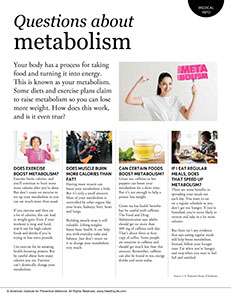
    Image of doctors.

    Millions of people have surgery every year. No matter what your reason is for having surgery, be sure you ask your surgeon these questions in advance:

    1.Do I have other options?Surgery is safer today than ever before. But, there are still risks to having any surgery. Find out if other treatments, such as medicine or therapy, may be tried first. This will depend on how serious your health condition is. With any treatment, you and your doctor should discuss any possible risks and benefits.

    2.What will happen during the procedure?Ask your doctor to explain how and why the surgery will be performed. Where will your incisions be made? What kind of anesthesia is used? How  will you be monitored  during surgery?

    3.What should I do before surgery?Tell your doctor about all supplements, vitamins and medicines you take. You may need to stop taking some or all of these things a few days or weeks before surgery. Plus, you may need to follow a special diet and/or stop using tobacco for a period of time.

    4.What is the recovery like?Many of today’s minimally invasive procedures mean that you can go home the same day. Major surgeries may require you stay more days in the hospital. Ask your doctor about which activities you should avoid and when you can get back to things like work, driving, exercise, and a regular diet.

    Sometimes, surgery must be performed in emergency situations. In these cases, you may not be able to talk with your doctor beforehand. But, be sure to talk afterward about what you can expect from your recovery and how to take care of yourself in the days and weeks ahead.

    © American Institute for Preventive Medicine
  • 5 Must-Ask Questions For Your Next Checkup

    SELF-CARE CORNER

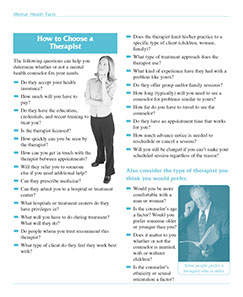
    Image of doctor and patient with thumbs up.

    Got a checkup coming up? Don’t let your doctor do all the talking. Speak up – and ask these important questions to get the most out of your visit. If you don’t understand an answer, always ask him or her to clarify. Your doctor wants to be sure you leave the office knowing how to get – or stay – healthy.

    Are there any vaccines I should get?

    Vaccines aren’t just for kids. Many important vaccines are

    given in the adult years, including:

    *  Influenza (flu)

    *  Tdap (tetanus, diphtheria, and pertussis)

    *  Shingles

    *  Pneumococcal (Pneumovax or Prevnar 13)

    *  Measles, mumps, rubella (MMR)

    The vaccines you need will depend on your age and health status. Your doctor is the best person to help you get fully protected from many diseases.

    Do you have my most recent family history?

    Tell your doctor if you have a family member with health conditions. This history helps you and your doctor think about what health conditions could affect you in the future. Catching problems early boosts your chances of successful treatment.

    Am I due for any cancer or health screenings?

    Your age, gender, family history, and current health all play a role in what tests you may need. High cholesterol, high blood pressure, depression, certain cancers, and diabetes are just a few of the conditions that can be found through preventive care.

    What can I do to feel my best?

    Whether it’s quitting smoking, weight loss, stress management, or other health tips, ask your doctor about your health concerns. Even if you’ve tried in the past to manage these issues, your doctor may have some fresh ideas or tips that could help. Or, if you’re feeling great and in excellent health, talk about ways you can maintain healthy habits in the months and years ahead.

    When should I have my next doctor’s visit?

    Follow-up visits may be needed if you’re managing certain health problems like diabetes or high blood pressure. Even if you don’t have health issues, regular checkups are important. Your doctor can tell you when you should come back for your next visit based on your age and any health concerns.

    Sources: Centers for Disease Control and Prevention, U.S. Department of Health and Human Services

    © American Institute for Preventive Medicine

  • Questions To Ask Before Choosing A Financial Planner

    FINANCIAL HEALTH

    Image of women writing different types of investments.

    1. How are you paid? Is it by a fee and commission? Do you fully disclose the fees and the commissions you earn on every investment you make or service you offer? If paid by fees, what is the average fee your clients pay?

    2. How many years have you been in the business? How long have you been a financial planner?

    3. Can you give me some references of people you have worked with for more than two years?

    4. What is your typical client like? Income levels, issues, investment amounts?

    5. What training did you have to be a planner? What requirements were needed to attain this degree or title?

    6. How many hours of continuing education must you have to keep your degree/designation?

    7. What does a completed financial plan look like?

    8. What is the most important difference your work made in someone’s life?

    9. How many clients do you have?

    10. How many support staff do you have? What are their credentials?

    11. Do you have a privacy statement?  May I have a copy?

    12. Is there an agreement among you and your staff to keep information confidential? Have there ever been any violations of that agreement?

    13. Do you have a copy of your Form ADV (a required disclosure form from the securities authorities)? Have you been responsible for any securities violations?

    14. Do you have a formal contract to define the responsibilities of the clients and those of the planners? Does it also address a protocol to settle differences and to terminate the relationship? How long does the contract last?

    Answers you will get to these questions can vary suggests Lynn S. Evans, CFP, author of Power of the Purse: Fear-Free Finances for Baby Boomer Women. You may have other questions that are important to you. Examples include if the offices are nearby and if you can communicate by email).

    A question regarding the planner’s investment performance is absent. For good reason: the planner’s average return on an investment is not the key to his or her success. The ability to meet the clients’ goals is what really counts.

    Lost without cyberspace?

    What if you couldn’t get a Wi-Fi signal on your smartphone? How anxious would you be if you forgot your phone or lost it? Worry about not being able to see instant news and weather? Or freak about a low battery? If you say yes, you may be a nomophobe (that’s having no mobile phone phobia), according to Iowa State University researchers, in the journal Computers in Human Behavior. Take the 20-question test and judge for yourself atwww.news.iastate.edu/news/2015/08/26/nomophobia. It’s not an addiction but an obsession, they say.

    © American Institute for Preventive Medicine