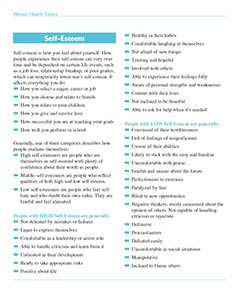
Self-esteem is how you feel about yourself. How people experience their self-esteem can vary over time and be dependent on certain life events, such as a job loss, relationship breakup, or poor grades, which can temporarily lower one’s self-esteem. It affects everything you do:
* How you select a major, career or job
* How you choose and relate to friends
* How you relate to your children
* How you give and receive love
* How successful you are at reaching your goals
* How well you perform in school
Self-Esteem Types
Generally, one of three categories describes how people evaluate themselves:
* High self-esteemers are people who see themselves as self-assured with plenty of confidence about their worth as people.
* Middle self-esteemers are people who reflect qualities of both high and low self-esteem.
* Low self-esteemers are people who feel self-hate and who doubt their own value. They are fearful and feel alienated.
People with HIGH Self-Esteem are generally:
* Not defeated by mistakes or failures
* Eager to express themselves
* Comfortable in a leadership or active role
* Able to handle criticism and learn from it
* Unlimited in their development
* Ready to take appropriate risks
* Positive about life
* Healthy in their habits
* Comfortable laughing at themselves
* Not afraid of new things
* Trusting and hopeful
* Involved with others
* Able to experience their feelings fully
* Aware of personal strengths and weaknesses
* Content with their lives
* Not inclined to be boastful
* Able to ask for help when it’s needed
People with LOW Self-Esteem are generally:
* Convinced of their worthlessness
* Full of feelings of insignificance
* Unsure of their abilities
* Likely to stick with the easy and familiar
* Uncomfortable with praise
* Fearful and unsure about the future
* Perfectionists to extremes
* Paralyzed by fear
* Blind to new opportunities
* Negative thinkers, overly concerned about the opinion of others. Not capable of handling criticism or rejection
* Defensive
* Procrastinators
* Defeated easily
* Uncomfortable in social situations
* Manipulative
* Inclined to blame others
Many people lack positive self-esteem because of negative feelings they picked up in childhood from parents or peers. Self-esteem can be damaged if you continue to believe the negative messages received early in life regardless of the reality of these messages. It doesn’t matter if you were attractive, well-behaved, said all the right things, got good grades and were sweeter than your sister. All that matters is what you thought about yourself at those times. If you had negative thoughts about yourself, your self-esteem as an adult is probably suffering. If you had positive thoughts, your self-esteem is probably stronger.
Self-esteem can also be damaged if you act against your own sense of values, such as honesty and integrity. You may judge yourself too harshly for certain behaviors that go against these values.
Questions to Ask
Self-Help
Ways to Improve Self-Esteem
Identify:
* Wants and needs that are important to you
* The people you feel intimidated by. Learn to be assertive with them.
* The situations you have the hardest time with. Ask for help, if you need it.
* Things in your life where you can feel successful and make plans to work toward them.
Nurture yourself.
Treat yourself in the same way that a patient, loving and encouraging parent would. (Note: Get outside help from family, friends or a counselor for these tips if you need to.) For example:
* When you fail at something, say: “That’s okay. I’ll do better next time.”
* Praise yourself every day for something.
* Let yourself cry when you feel like it.
* If your day was rough, relax in the evening or as soon as you can.
* Accept compliments from others with pride.
* Accept “mistakes” you’ve made without condemning yourself.
* When you succeed, say it was because you worked hard.
* Get at least 7 hours of sleep each night.
* Keep in touch with people who care about you.
* List ten things you do well.
* Look at old photos that bring back good memories.
* Meditate.
* Give yourself a present.
* Volunteer some time to a good cause.
Make affirmations.
Affirmations are statements which reinforce positive thinking patterns. People behave in ways that fit their belief systems about themselves. If an individual believes he is a poor student or salesman, he will act in ways to prove it.
It is better to affirm positive beliefs than it is to oppose negative ones, just as it is wiser to turn on the light in a dark room instead of trying to remove the darkness.
How to Make Affirmations
* Make affirmations simple.
* Make them personal. Use the words “I,” “Me” and “My.”
* Be positive. Avoid negative words like “can’t,” “don’t,” and “won’t.”
* Use the present tense as if “it” is already happening. For example, instead of saying, “I will” say “I am.”
* Make affirmations ongoing and progressive. For example, “Each day, I feel more…”
* Make affirmations that you can attain. Make them as specific as possible.
* Try to reinforce positive behaviors rather than stopping negative behaviors.
* Be brief or you won’t remember it.
* Use feeling words.
* Continue making affirmations even if you don’t fully believe them at first. This can change over time.
Select a few affirmations and use them daily for twenty-one days. You’ll be amazed at your progress.
Sample Affirmations
1. I do something to treat myself well every day. I am worthwhile.
2. I am like other people. I’m not perfect.
3. I am striving to improve myself in some way every day and I accept and enjoy who I am today.
4. I approve of myself and I accept how I feel, think and act.
5. I give myself the leeway to make mistakes and learn from them.
6. I am asserting myself by standing up for my values and wishes.
7. I am approaching new situations with confidence.
8. I expect successes and mistakes and I accept and learn from each situation.
Overcome Negative Self-Esteem
Learn how to control negative thoughts that are self-defeating. One way to do this is to question a self-defeating belief about an event when it leads to feelings of low self-esteem. Use the ABCDE model that follows. It identifies how beliefs influence self-esteem and work or school performance. Once identified, beliefs that are undesirable can be disputed or changed. When this happens, higher self-esteem and improved work performance can be the result.
How to Use the ABCDE Model
Activating the Event.
What event made you feel unworthy, self-doubting or guilty?
Example: You were overlooked for a promotion or received a poor grade.
Beliefs.
What thoughts did you have about the event? Examples:
1. It’s my fault for not being smarter.
2. I’m wasting my time here.
3. I’m never going to amount to much.
Consequences.
How did you feel because of your beliefs?
Examples: Blue, passive, angry, self-abusive, negative towards others and yourself.
Dispute.
Challenge the negative thoughts you identified in the “beliefs” section on the previous page. Start with a phrase like “That’s not right.” and add a positive statement.
Example: That’s not right. This happens to lots of people at one time or another. I’ll take my time to plan and do some self-improvement activities. If I feel negatively about myself now, it may affect my work. I’m not a failure as a person. Failure is only an event. It’s not a person.
Effect.
How do you feel now that you have challenged your negative thoughts?
Example: Relaxed and positive. I’ve made good use of rational thinking to improve my mood.
What You Can Do to Help Someone
* Involve them. Try to get your friend or relative involved with others. This will help them see that they can make a positive contribution to events, people, etc.
* Give them positive feedback. Tell your friend or relative about his or her strengths, accomplishments and assets. This will not only remind them, but let them know that you think enough of them to remember all these things.
* Express your care and concern. Let your friend or relative know how much you value them and their place in your life. This will give them a greater sense of belonging.
* Encourage them. Try to get your friend or relative to learn something new. Tell them how good they’re likely to be at it.
* Laugh with them, not at them. Help your friend or relative to laugh at their and your mistakes by trying to find some humor (when appropriate) in their life.
* Listen to them. Allow your friend or relative to express themselves by giving him or her your complete attention while they are speaking to you. This will let them know that their opinions matter to you and that they are important enough to be paid attention to.