Tag: safety

  • Backpacks. Crayons. Glue Sticks. Epipen?

    FAMILY LIFE

    Image of 2 school kids in the classroom.

    For more and more school-age children the Epipen is becoming a necessity for completing the back-to-school supply list. In fact, allergic conditions are one of the most common medical conditions affecting children in the U.S.

    “Accidental exposure to allergens at school is a major concern for kids with severe allergies since any exposure could be fatal,” said Dr. Joyce Rabbat, pediatric allergist at Loyola University Health System.

    Food allergies are the most concerning for school-age children since allergens can be hidden in food or utensils and pots and pans could be contaminated without the child’s knowledge. Dr. Rabbat said that parents of children with food allergies should ensure an Allergy Action Plan is in place for the child at his or her school.

    This really could mean life or death to the child,” she said in suggesting that parents should make sure the school reviews the child’s health records that they provide from the doctor. She also suggests asking what the school does to prevent accidental exposure and that staff are trained to deal with an emergency situation.

    If the child is older and knows how to self-administer medications, Dr. Rabbat suggests talking to the school about allowing the child to carry the medication with them. If that is not allowed at the school, make sure the following medications are available:

    *  Epinephrine autoinjectors

    *  Antihistamines

    *  Albuterol rescue inhalers

    Also make sure a staff member, who is available at all times, is properly trained on to how to administer these medications and that your child is familiar with this person.

    © American Institute for Preventive Medicine

  • Stay Healthy When Swimming

    WELL-BEING

    Image of beach ball in swimming pool.

    Did you know you can get sick from swimming? Whether it’s a pool, hot tub, water park, fountain, lake, river or ocean, some water can have germs or chemicals in it that cause recreational water illness (RWI). And, the number of RWI outbreaks have increased steadily in the last 30 years.

    RWIs can ruin summer fun

    RWIs most often cause diarrhea, but they can make you sick in other ways too. They can also cause nausea and vomiting, skin rashes, and infections of the eyes, ears, skin and respiratory system.

    Most healthy people will recover from RWIs, but they can be dangerous to pregnant women, young children, and people with weakened immune systems.

    Healthy swimming guidelines

    Many times, the water may look clean and safe when it contains dangerous germs or unsafe chemicals. Though proper chlorine levels are important, some germs are not killed by chlorine. Some water may be treated with too much chlorine or an improper balance that can make people sick. So what can you do to enjoy the water this summer and stay healthy?

    *  Don’t swim when you have diarrhea or you’ve been vomiting. Even a tiny, invisible amount of germs can get in the water and make others sick.

    *  Never get swimming water in your mouth. Keep your mouth closed when underwater.

    *  Shower with soap before you swim and wash your hands after using the toilet or changing diapers. Have your children wash their hands as well.

    *  Don’t allow kids to play in fountains that haven’t been treated with chlorine.

    *  Stop swimming at least once every hour for bathroom breaks and/or diaper changes. Use swim diapers on kids who aren’t potty trained. Many kids will have “accidents” in the water if they don’t get out to use the bathroom.

    *  Don’t change diapers near the swimming area. Do it in a bathroom or away from the water.

    *  If you own a pool, check chlorine levels regularly. Use pool test strips to check for proper pH levels and chemical balances.

    *  Ask to see the last pool inspection report before swimming in a public pool or water park.

    The germ that survives chlorine

    Cryptosporidium, commonly called crypto, is a bacteria that can be spread in swimming water. Chlorine won’t kill crypto, and people with weakened immune systems can get very sick from it. It can cause severe watery diarrhea and is a leading cause of RWIs. To avoid getting or spreading crypto, follow the healthy swimming guidelines on this page. It is not killed by hand sanitizer, so washing hands with soap and water is critical.

    © American Institute for Preventive Medicine

  • Eye Health At Work

    Eye Conditions

    Man wearing protective eye and hearing gear while using machinery.

    Follow your workplace’s safety rules to protect your eyes. Wear safety glasses, goggles, face shields, etc. Keep your safety eyewear clean and in good condition.

    More than 700,000 persons in the U.S. have eye injuries at work a year. Most of these could have been prevented.

    Find out if and what type of eyewear is required for your job. Ask loved ones if they wear required safety eyewear at work.

    Persons who walk through work areas that have eye hazard areas need to wear protective eyewear.

    When you visit a worksite that poses a risk of eye injuries, ask for protective eyewear if it is not provided.

    Glasses and contact lenses used for other activities may not be effective when working with computer screens.

    Let your eye doctor know if you work at a computer so they can prescribe the proper eyewear for you to use.

    Health at Home Lifetime book by the American Institute for Preventive Medicine. www.HealthyLife.com. All rights reserved.

    © American Institute for Preventive Medicine

  • Stay Safe When Holiday Shopping

    FINANCIAL HEALTH

    Image of female on laptop with credit card in hand.

    The holidays are often a time for celebrations, get-togethers, and lots of shopping for gifts. Unfortunately, theft can happen any time of year, including during the holiday season. To keep yourself and loved ones safe when holiday shopping, consider these tips from the National Crime Prevention Council (NCPC):

    At malls and stores:

    *  To keep your money safe, carry your purse close to your body. Wallets are better kept in a front pocket, where they are harder to pickpocket.

    *  Have your keys ready when walking to your vehicle. Glance at the back seat and be aware of your surroundings before getting in.

    *  Don’t leave packages or valuables in your car where they can be seen. Take them home immediately, if possible, or keep them in the trunk.

    *  When shopping with children, teach them to go to a meeting place in case you get separated. Talk to them about finding store security guards or employees to help, if needed.

    When online shopping:

    *  Be sure you update anti-virus and anti-spyware software on your computer. Visitwww.bytecrime.org.

    *  Never give out your password or credit card information in response to emails. Valid companies will never ask for this type of information.

    *  Make sure the website is secure: look for a locked padlock at the bottom of the screen or “https” in the address at the top.

    *  Use secure payment methods, such as PayPal or Apple Pay, whenever possible. If using a credit card, check your transactions regularly and alert your bank if you notice anything suspicious.

    *  Check reviews of online stores to ensure the company is credible.

    Warm-up thefts are in season

    During the winter months, many people start their cars and let them warm up while they wait inside. This can be a prime opportunity for someone to steal your vehicle or items inside it, according to the NCPC. Here’s how to avoid these situations:

    *  Never leave your car running or keys in the ignition if you’re not in it, even for a minute.

    *  Always keep your car locked, and use anti-theft or alarm devices if you have them.

    *  Keep valuables out of sight (and preferably out of your car), such as phones, purses and electronics.

    © American Institute for Preventive Medicine
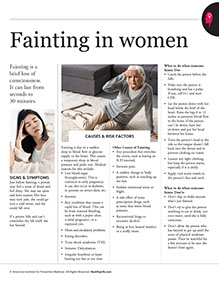
  • Fainting

    Women’s Health

    Fainting is a brief loss of consciousness. It can last from seconds to 30 minutes.

    Signs & Symptoms

    Just before fainting, a person may feel a sense of dread and feel dizzy. She may see spots and have nausea. Her face may turn pale, she could go into a cold sweat, and she could fall over.

    If a person falls and can’t remember the fall itself, she has fainted.

    Causes

    Fainting is due to a sudden drop in blood flow or glucose supply to the brain. This causes a temporary drop in blood pressure and pulse rate. Medical reasons for this include:

    *  Low blood sugar (hypoglycemia). This is common in early pregnancy. It can also occur in diabetes, in persons on severe diets, etc.

    *  Anemia.

    *  Any condition that causes a rapid loss of blood. This can be from internal bleeding, such as with a peptic ulcer, a tubal pregnancy, or a ruptured cyst.

    *  Heart and circulatory problems, such as abnormal heart rhythm, heart attack, or stroke.

    *  Eating disorders.

    *  Toxic shock syndrome (TSS).

    *  Seizures.

    Other Causes of Fainting

    *  Any procedure that stretches the cervix, such as having an IUD inserted.

    *  Extreme pain.

    *  A sudden change in body position, such as standing up too fast.

    *  Sudden emotional stress or fright.

    *  A side effect of some prescription drugs, such as some that lower blood pressure.

    *  Recreational drugs or excessive alcohol.

    *  Being in hot, humid weather or being in a stuffy room.

    Know what to do when someone faints.

    Dos

    *  Catch the person before she falls.

    *  Lie the person down with her head below the level of the heart. Raise the legs 8 to 12 inches to promote blood flow to the brain. If the person can’t lie down, have her sit down, bend forward, and put her head between her knees.

    *  Turn the person’s head to the side so the tongue doesn’t fall back into the throat and to prevent choking on vomit.

    *  Loosen any tight clothing, but keep the person warm, especially if the surroundings are chilly.

    *  Apply moist towels to the person’s face and neck.

    Don’ts

    *  Don’t slap or shake anyone who’s just fainted.

    *  Don’t try to give the person anything to eat or drink, not even water, until she is fully conscious.

    *  Don’t allow the person who’s fainted to get up until the sense of physical weakness passes. Then be watchful for a few minutes to be sure she doesn’t faint again.

    Questions to Ask

    Self-Care / Prevention

    *  When you feel faint, lie down and elevate both legs. Or, sit down, bend forward and put your head between your knees.

    *  Get up slowly from bed or from a sitting position.

    *  Follow your doctor’s advice to treat any condition which may lead to fainting. Take prescribed medicines, but tell your doctor about any side effects, so he or she can monitor your condition.

    *  Don’t wear tight clothing around your neck.

    *  Avoid turning your head suddenly.

    *  Stay out of stuffy rooms and hot, humid places. If you can’t, use a fan.

    *  If you have fainting spells often, avoid activities that can put lives in danger, such as driving a car.

    *  Drink a lot of fluids, but drink alcoholic ones in moderation, if at all. Eat small, frequent meals.

    When Pregnant

    *  Get out of bed slowly.

    *  Keep crackers at your bedside and eat a few before getting out of bed.

    *  Eat small, frequent meals instead of a few large ones. With each meal, have a good source of protein, such as lean meat, low-fat cheese, milk, etc. Avoid sweets. Don’t skip meals or go for a long time without eating. Drink plenty of fluids.

    *  Don’t sit for long periods of time. Elevate your legs when you sit.

    *  When you stand, as in a line, move your legs to pump blood up to your heart.

    *  Take vitamin and mineral supplements, as your doctor prescribes.

    *  Don’t lay on your back during the 2nd and 3rd trimesters of your pregnancy. Lie on your left side. When you can’t, lie on your right side.

    Women's Self-Care book by the American Institute for Preventive Medicine. www.HealthyLife.com. All rights reserved.

    © American Institute for Preventive Medicine

  • Burn Notice

    SELF-CARE CORNER

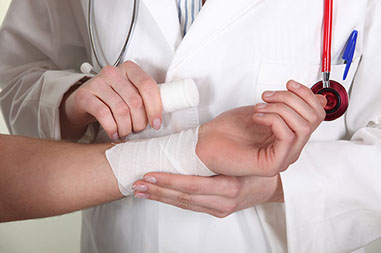
    Close-up image of a doctor wrapping up a burn on a patients arm.

    Follow this simple advice from the Home Safety Council and H2otStop to help reduce the risk of burn and scald injuries at home:

    Bathing

    *  Set your water heater at 120ºF or just below the medium setting.

    *  Fill the bathtub. Run your hand through the water to test for hot spots. Then help children get in. When children are in or near the tub, watch them closely. Young children and older people have thin skin. They burn more quickly.

    *  Install special tub spouts and shower heads that prevent hot water burns. These can sense if the water gets hot enough to cause a burn and shut off the flow of water.

    Cooking

    *  Wear long oven mitts to protect your skin when cooking or handling hot food.

    *  Turn pot handles toward the back of the stove so children cannot pull them down. Use back burners when cooking. Keep children away from the stove when you are cooking. Put tape on the floor around the stove/oven to help children learn to stay out of the “no-kid-zone.”

    *  Food cooked in the microwave can get very hot and cause a burn. Use oven mitts when you take off the lid. Stir and test the food before serving to make sure it is cool enough to eat.

    *  Keep hot drinks away from the edge of tables and counters. Do not use tablecloths or placemats because young children can pull them down. Use a travel mug with a tight-fitting lid for all hot drinks. This can help prevent a burn if the cup tips over.

    *  Do not hold or carry a child while you have a hot drink in your hand. Put only cold drinks in the cup holder of your child’s stroller and child safety seat.

    If a burn occurs:

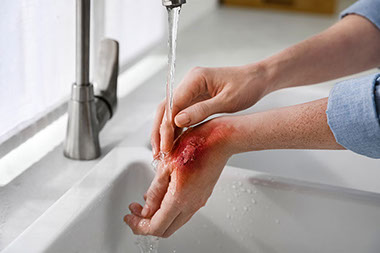
    *  Cool it with running water. Do this right away.

    *  Keep the burned area in cool water for 3 minutes or longer. Do not put ice, butter, or lotion on the burn. This could make it worse.

    *  Call your doctor or 911 if the burn looks bad.

    © American Institute for Preventive Medicine

  • Take Mowing Seriously

    WELL-BEING

    Image of mower, cutting grass.

    More than 37,000 Americans are injured by power lawn mowers each year. Even a minor cut can become a problem if it gets infected. And, it’s possible to get severe injuries and even lose a toe if proper safety steps aren’t followed. Avoid getting hurt with these tips:

    *  Don’t mow when the grass is wet. Wet grass can be very slippery, leading to falls and injuries.

    *  Never mow barefoot. Wear heavy shoes or work boots when mowing.

    *  Don’t mow up and down hills. Mow them side to side to keep control of the mower.

    *  Keep children and pets away from running lawn mowers.

    *  Use a mower that turns off when you let go of the handle. Never pull the mower backward while it’s running.

    *  Keep the clippings bag attached to prevent injuries from flying sticks and other debris.

    Source: American College of Foot and Ankle Surgeons

    © American Institute for Preventive Medicine

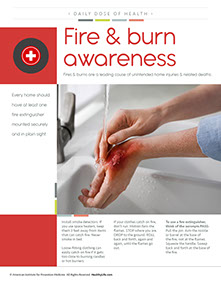
  • Fire & Burn Awareness

    First Aid

    Dental hygiene products, tooth brush, tooth paste, mouth wash, etc.

    Fires & burns are a leading cause of unintended home injuries & related deaths.

    Every home should have at least one fire extinguisher mounted securely and in plain sight.

    Install smoke detectors. If you use space heaters, keep them 3 feet away from items that can catch fire. Never smoke in bed.

    Loose-fitting clothing can easily catch on fire if it gets too close to burning candles or hot burners.

    If your clothes catch on fire, don’t run. Motion fans the flames. STOP where you are. DROP to the ground. ROLL back and forth, again and again, until the flames go out.

    To use a fire extinguisher, think of the acronym PASS:

    Pull the pin. Aim the nozzle or barrel at the base of the fire, not at the flames. Squeeze the handle. Sweep back and forth at the base of the fire.

    Health at Home Lifetime book by the American Institute for Preventive Medicine. www.HealthyLife.com. All rights reserved.

    © American Institute for Preventive Medicine

  • Choose The Right Summer Camp For Your Child

    FAMILY LIFE

    Image of child at summer camp.

    When school’s out for the summer, what will the kids do? Many families choose summer camp options for school-age children to help make summer an educational and fun experience. But choosing the right camp for your child can seem daunting with so many choices.

    To simplify your decision, consider these factors:

    *What type of camp works with your child’s personality?Some children only want to be gone for a day camp and come home in the evening. Others want to do overnight camps. This may depend on the child’s age and whether they are accustomed to being away from home.

    *How many children attend the camp?Some kids do better in small groups, while others enjoy the excitement of being around many people.

    *What are your child’s interests?Some camps focus on particular activities, such as sports, cooking, music or art. Some offer programs for special needs children. Look for one that offers activities they like to do.

    *How will your child get there?Is there a bus or other transportation offered?

    *What is your budget?Be sure you understand the total cost of the camp. Some may have extra charges for food, special outings, or transportation.

    *How are the staff trained on safety, supervision, and other issues?If your child will be near water, discuss life guards and safety precautions for swimming.

    Once you’ve decided upon a camp, ask about a packing list, particularly for overnight camps. Even day camps often ask the children to bring a bathing suit, water bottle, snack, sunscreen, or other supplies.

    Source: American Camp Association

    © American Institute for Preventive Medicine