Tag: Screening & Preventive Care

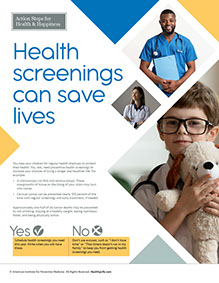
  • Health Screenings Can Save Lives

    Medical Exams

    Smiling doctor.

    You take your children for regular health checkups to protect their health. You, too, need preventive health screenings to increase your chances of living a longer and healthier life. For example:

    *  A colonoscopy can find and remove polyps. These overgrowths of tissue on the lining of your colon may turn into cancer.

    *  Cervical cancer can be prevented nearly 100 percent of the time with regular screenings and early treatment, if needed.

    *  Schedule health screenings you need this year. Write when you will have these.

    *  Don’t use excuses, such as “I don’t have time” or “That illness doesn’t run in my family” to keep you from getting health screenings you need.

    Approximately one half of all cancer deaths may be prevented by not smoking, staying at a healthy weight, eating nutritious foods, and being physically active.

    ays to Well-Being book by the American Institute for Preventive Medicine. www.HealthyLife.com. All rights reserved.

    © American Institute for Preventive Medicine

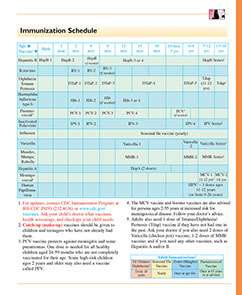
  • Immunization Schedule

    Medical Exams

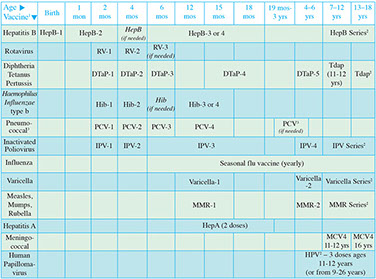
    1.  For updates, contact CDC Immunization Program at 800.CDC.INFO (232.4636) orwww.cdc.gov/vaccines. Ask your child’s doctor what vaccines, health screenings, and checkups your child needs.

    2.  Catch-up vaccines should be given to children and teenagers who have not already had them.

    3.  PCV vaccine protects against meningitis and some pneumonias. One dose is needed for all healthy children aged 24-59 months who are not completely vaccinated for their age.

    Vaccines for Traveling Abroad

    Before you travel to other countries, find out if you need certain vaccines. Get information from the CDC Travelers’ Information Line. Call 800.CDC.INFO (232.4636) or use thewww.cdc.gov/travelWeb site. Discuss your needs with your doctor.

    Page from the Healthier at Home book by the American Institute for Preventive Medicine. www.HealthyLife.com. All rights reserved.

    © American Institute for Preventive Medicine

  • Immunize Or Your Health Care Costs Could Rise

    Medical Exams

    Women wearing face mask, smiling, showing bandage on arm where she got a vaccine.

    Vaccines prevent many diseases that could have a costly impact, resulting in doctor’s visits, hospitalizations, and premature deaths. Sick children can also cause parents to lose time from work.

    *  Learn about vaccines you and your children need fromcdc.gov/vaccines.

    *  Find if and which vaccines are covered benefits of your health plan.

    *  Contact your local health department about its vaccine services.

    *  Find out about free or low-cost vaccines for kids from the Vaccines for Children (VFC) Program atcdc.gov/vaccines/programs/vfc/index.html.

    *  Beginning in early fall, read local papers and store ads to find out where flu shots will be given. Find out if and when flu shots will be given at work.

    ays to Well-Being book by the American Institute for Preventive Medicine. www.HealthyLife.com. All rights reserved.

    © American Institute for Preventive Medicine

  • 4 Questions To Ask Before Having Surgery

    MEDICAL NEWS

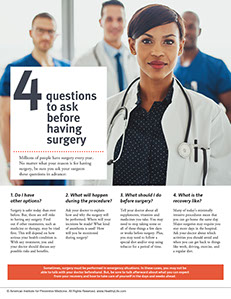
    Image of doctors.

    Millions of people have surgery every year. No matter what your reason is for having surgery, be sure you ask your surgeon these questions in advance:

    1.Do I have other options?Surgery is safer today than ever before. But, there are still risks to having any surgery. Find out if other treatments, such as medicine or therapy, may be tried first. This will depend on how serious your health condition is. With any treatment, you and your doctor should discuss any possible risks and benefits.

    2.What will happen during the procedure?Ask your doctor to explain how and why the surgery will be performed. Where will your incisions be made? What kind of anesthesia is used? How  will you be monitored  during surgery?

    3.What should I do before surgery?Tell your doctor about all supplements, vitamins and medicines you take. You may need to stop taking some or all of these things a few days or weeks before surgery. Plus, you may need to follow a special diet and/or stop using tobacco for a period of time.

    4.What is the recovery like?Many of today’s minimally invasive procedures mean that you can go home the same day. Major surgeries may require you stay more days in the hospital. Ask your doctor about which activities you should avoid and when you can get back to things like work, driving, exercise, and a regular diet.

    Sometimes, surgery must be performed in emergency situations. In these cases, you may not be able to talk with your doctor beforehand. But, be sure to talk afterward about what you can expect from your recovery and how to take care of yourself in the days and weeks ahead.

    © American Institute for Preventive Medicine

  • 5 Must-Ask Questions For Your Next Checkup

    SELF-CARE CORNER

    Image of doctor and patient with thumbs up.

    Got a checkup coming up? Don’t let your doctor do all the talking. Speak up – and ask these important questions to get the most out of your visit. If you don’t understand an answer, always ask him or her to clarify. Your doctor wants to be sure you leave the office knowing how to get – or stay – healthy.

    Are there any vaccines I should get?

    Vaccines aren’t just for kids. Many important vaccines are

    given in the adult years, including:

    *  Influenza (flu)

    *  Tdap (tetanus, diphtheria, and pertussis)

    *  Shingles

    *  Pneumococcal (Pneumovax or Prevnar 13)

    *  Measles, mumps, rubella (MMR)

    The vaccines you need will depend on your age and health status. Your doctor is the best person to help you get fully protected from many diseases.

    Do you have my most recent family history?

    Tell your doctor if you have a family member with health conditions. This history helps you and your doctor think about what health conditions could affect you in the future. Catching problems early boosts your chances of successful treatment.

    Am I due for any cancer or health screenings?

    Your age, gender, family history, and current health all play a role in what tests you may need. High cholesterol, high blood pressure, depression, certain cancers, and diabetes are just a few of the conditions that can be found through preventive care.

    What can I do to feel my best?

    Whether it’s quitting smoking, weight loss, stress management, or other health tips, ask your doctor about your health concerns. Even if you’ve tried in the past to manage these issues, your doctor may have some fresh ideas or tips that could help. Or, if you’re feeling great and in excellent health, talk about ways you can maintain healthy habits in the months and years ahead.

    When should I have my next doctor’s visit?

    Follow-up visits may be needed if you’re managing certain health problems like diabetes or high blood pressure. Even if you don’t have health issues, regular checkups are important. Your doctor can tell you when you should come back for your next visit based on your age and any health concerns.

    Sources: Centers for Disease Control and Prevention, U.S. Department of Health and Human Services

    © American Institute for Preventive Medicine

  • Navigate Open Enrollment

    WELL-BEING

    Image of 2 people talking.

    Make the most of your benefit plan, especially during open enrollment periods. Here are money-saving tips from HighRoads, a benefits management company.

    *Get your plan materials.Some companies are giving you a Summary Plan Description online, via mobile apps, as well as on paper. It’s good to know how you can access this information during open enrollment and throughout the year, in case you want to review it again when you are in need of a particular medical service. Take time to read the plan.

    *Calculate your costs.Many employers provide cost calculators to help project your total cost for the coming plan year. The total cost includes the premium you pay as well as your share of the deductible and coinsurance. Take the time during open enrollment to think through your potential medical needs and calculate your anticipated expenses before selecting a plan. It may save you hundreds in the long run.

    *Consider an account.Your employer may offer you the option of a health care account, whether it is a flexible spending account, a health reimbursement account, or a health savings account. These accounts can help you save money on qualified medical expenses that aren’t covered by your health care plan, such as deductibles and coinsurance. Each account has a different set of rules about how and when you can spend the money, but each is worth considering because the savings you’ll see can add up quickly.

    *Is prevention covered?One of the benefits of health care reform is an extended list of preventive care benefits that must be offered by new health care plans for free. Preventive services such as colonoscopy screenings, Pap smears and mammograms for women, well-child visits, and flu shots for all children and adults must be offered without out-of-pocket costs. However, these benefits are only for new health plans and don’t apply to “grandfathered” plans that haven’t significantly changed in a few years.

    *Use wellness incentives.More employers than ever before are offering incentives such as premium discounts, low deductibles, gym memberships, or prizes to employees and their family members for health improvement.

    *Know your deadlines.No matter what changes you may make, if any, during this year’s open enrollment period, don’t let your selection deadlines slip by without action.

    © American Institute for Preventive Medicine

  • Vaccinations For Adults

    SELF-CARE CORNER

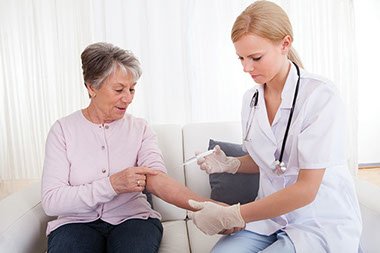
    Image of nurse giving a patient a shot.

    Do you think shots are only for kids? Actually, there are several important vaccines you need as an adult.

    Vaccinations protect yourself from disease, but also protect people around you. Young babies who aren’t yet vaccinated or people with weak immune systems can benefit from your vaccination. You will be less likely to spread an illness, such as whooping cough, to someone who is more likely to get sick.

    Don’t wait until it’s too late. Ask your doctor about which vaccines you may need at your next well visit.

    Adults may get shots for a variety of reasons:

    *  You need to be vaccinated for something that affects adults, such as the flu.

    *  You need boosters of vaccines you got as a child. This is because many vaccines start to lose their protection over time.

    *  You didn’t receive the complete set of vaccines in your youth and want to be protected now.

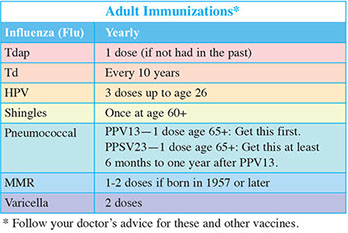
    The CDC says that all adults should get:

    *Influenza vaccine.This helps prevent influenza, or the flu. You get this every year.

    *Td vaccine.This protects you from tetanus and you should get one every 10 years.

    *Tdap vaccine instead of Td vaccine (one time only).This protects against tetanus and diphtheria plus whooping cough (pertussis). Pregnant women should get the Tdap vaccine during each pregnancy.

    *Pneumonia vaccine.This helps prevent certain bacteria that can cause pneumonia. Ask your doctor when you should get this vaccine.

    *Shingles vaccine.This can prevent shingles, a painful rash that can develop from a previous chickenpox infection.

    Other shots may also be recommended for you. Not every adult needs the same vaccines. Some will depend on your past vaccines, your age, lifestyle and health. Talk with your doctor about whether you need other shots.

    © American Institute for Preventive Medicine