Tag: screening

  • Men’S Health

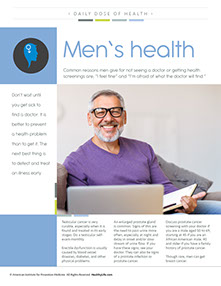
    Men’s Health

    Older man smiling.

    Common reasons men give for not seeing a doctor or getting health screenings are, “I feel fine” and “I’m afraid of what the doctor will find.”

    Don’t wait until you get sick to find a doctor. It is better to prevent a health problem than to get it. The next best thing is to detect and treat an illness early.

    Testicular cancer is very curable, especially when it is found and treated in its early stages. Do a testicular self-exam monthly.

    Erectile dysfunction is usually caused by blood vessel diseases, diabetes, and other physical problems.

    An enlarged prostate gland is common. Signs of this are the need to pass urine more often, especially at night and delay in onset and/or slow stream of urine flow. If you have these signs, see your doctor. They can also be signs of a prostate infection or prostate cancer.

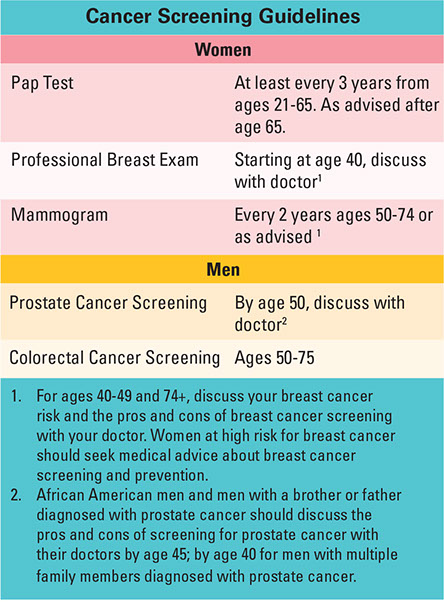
    Discuss prostate cancer screening with your doctor if you are a male aged 50 to 69; starting at 45 if you are an African American male; 40 and older if you have a family history of prostate cancer.

    Though rare, men can get breast cancer.

    Health at Home Lifetime book by the American Institute for Preventive Medicine. www.HealthyLife.com. All rights reserved.

    © American Institute for Preventive Medicine

  • Top Ten Recommendations For Cancer Prevention

    MEDICAL NEWS

    Image of doctor checking a women for skin cancer.

    1. Be as lean as possible without becoming underweight.

    2. Be physically active for at least 30 minutes every day.

    3. Avoid sugary drinks. Limit consumption of energy-dense foods.

    4. Eat more of a variety of vegetables, fruits, whole grains and legumes such as beans.

    5. Limit consumption of red meats (such as beef, pork and lamb) and avoid processed meats.

    6. If consumed at all, limit alcoholic drinks to 2 for men and 1 for women a day.

    7. Limit consumption of salty foods and foods processed with salt (sodium).

    8. Don’t use supplements to protect against cancer.

    9. It is best for mothers to breastfeed only for up to 6 months and then add other liquids and foods.

    10. After treatment, cancer survivors should follow these recommendations for cancer prevention.

    Source: American Institute for Cancer Research

    © American Institute for Preventive Medicine

  • Preventing Cancer

    Cancer

    Nearly 1 in 4 deaths in the U.S. is due to cancer. In the U.S., the lifetime risk for developing cancer is:

    *  Slightly less than 1 in 2 for men

    *  A little more than 1 in 3 for women

    What is Cancer?

    *  Cancer is a broad group of diseases.

    *  All types of cancer begin when cells in a part of the body start to grow out of control and become abnormal.

    *  These extra cells may form a mass of tissue called a growth or tumor.

    *  The tumor destroys healthy tissue.

    *  If the tumor gets bigger, it can invade and grow into other tissues and organs.

    *  Cancer cells also can break away and spread through the lymphatic system or blood stream to other parts of the body. This is called metastasis.

    *  Tumors that are not cancer are called benign. They do not grow into other tissues. They cannot spread to other parts of the body. Benign tumors can cause problems, especially if they grow very large and press on healthy tissues and body organs, but they almost never threaten life.

    *  Untreated cancers can cause serious illness and even death.

    Warning Signs & Symptoms

    You can have cancer for years without having symptoms. There is usually no pain at the onset of cancer. As different types of cancers grow, warning signs may occur. See your doctor for a proper diagnosis.

    For Bladder Cancer

    *  Blood in urine

    *  Pale yellow-red colored urine to bright red urine

    *  Frequent urination or feeling the need to without being able to urinate

    *  Pain during urination

    For Breast Cancer

    *  Lump or firmness in your breast or under your arm

    *  A change in the size or shape of your breast

    *  A nonmilky discharge from the nipple. Sometimes this has blood.

    *  Inverted or tender nipple

    *  The skin on a breast, areola, or nipple may be scaly, red, or swollen.

    *  An area of the breast may retract or pucker.

    Discuss with your doctor the pros and cons of doing monthly breast self-exams and how to perform them. Ask, too, about your risk for breast cancer. You can also call 800.4.CANCER (422.6237) or accesswww.cancer.gov/bcrisktoolfor the Breast Cancer Risk Assessment Tool.

    Note: Men can get breast cancer, too, and should report a breast lump or other change to their doctors.

    For Colon and Rectal Cancers

    *  Rectal bleeding or red or dark blood in or on the stool. Very narrow stools.

    *  Change in bowel habits for 2 or more weeks or constipation or diarrhea for 1 week or longer

    *  Frequent gas pains, cramps, bloating, or feeling of fullness in the abdomen

    *  Feeling that your bowel does not empty completely

    *  Weight loss with no explanation

    For Kidney Cancer

    *  Blood in urine

    *  Lump or mass on the side or lower back

    *  Low back pain on one side (not due to an injury)

    *  Weight loss without trying

    *  Fever that doesn’t go away after a few weeks and that is not from an infection

    *  Feeling very tired

    *  Swelling of the ankles and legs

    For Lung Cancer

    *  Cough that gets worse or does not go away. Hoarse voice. Coughing up blood or rust-colored phlegm

    *  Shortness of breath. New onset of wheezing.

    *  Chest pain. Often, this worsens with taking deep breaths, coughing, or laughing.

    *  Bronchitis, pneumonia, and other lung infections occur often and keep coming back.

    *  Tiredness

    *  Unexplained weight loss

    For Ovarian Cancer

    These 4 symptoms last almost daily for longer than a few weeks:

    *  Bloating or swelling of the abdomen

    *  Pain in the upper abdomen or pelvic pressure

    *  Trouble eating or feeling full quickly

    *  Urgent need to urinate or urinating often

    For Prostate Cancer

    Early prostate cancer often does not cause symptoms. When symptoms occur, they may include:

    *  Problems urinating

    *  Blood in the urine or semen

    *  Pain in the lower back, hips, ribs, or upper thighs

    *  Trouble having or keeping an erection

    *  Weakness or numbness in the feet or legs

    For Testicular Cancer

    *  A lump on either testicle or surrounding area

    *  An enlarged testicle

    *  A feeling of heaviness in the scrotum

    *  A dull ache in the lower abdomen or groin

    *  Sudden build-up of fluid in the scrotum

    *  Pain or discomfort in a testicle or the scrotum

    *  Enlarged or tender breasts

    These symptoms could also be caused by other problems, such as infection or trauma of the scrotum or testicle from being hit or kicked. See your doctor if any of these symptoms lasts 2 weeks or longer. Males who are 15 and older should do a testicular self-exam if and as often as their doctors advise. Results are best after a warm bath or shower, which relaxes the scrotum, allowing the testicles to drop down for easier examination.

    For Throat Cancer

    *  A sore in the mouth that does not heal

    *  Numbness of the tongue or other mouth area

    *  Pain in the mouth or bad breath that persists. A sore throat or a feeling that something is caught in the throat. This doesn’t go away.

    *  A white or red patch on the gums, tongue, tonsil, or lining of the mouth

    *  Hoarseness or other changes in the voice

    *  Lump or mass in the neck or cheek or a feeling of a lump in the throat

    *  Pain in the front of the neck, sometimes going up to the ears

    *  Trouble chewing or swallowing or moving the jaw or tongue.

    *  A cough that doesn’t go away

    *  Pressure, fullness, or burning sensations as food goes down the throat

    *  Upset stomach, heartburn, vomiting, and choking on food

    *  Unexplained weight loss

    Basal and Squamous Cell Cancers

    *  Basal cell. More than 90% of all skin cancers in the U.S. are this type. It grows slowly. It seldom spreads to other parts of the body.

    *  Squamous cell. This type of skin cancer spreads more often than the basal cell type. It is still rare for it to spread, though.

    Basal and squamous cell cancers are found mainly on areas of the skin that are exposed to the sun, like the head, face, neck, hands, and arms. These skin cancers can occur anywhere, though.

    Early Warning Signs of Basal and Squamous Cell Cancers

    Small, smooth, shiny, pale, or waxy lump.

    Firm red lump.

    A lump that bleeds or develops a crust.

    A flat, red spot that is rough, dry, or scaly.

    Warning Signs of Melanoma

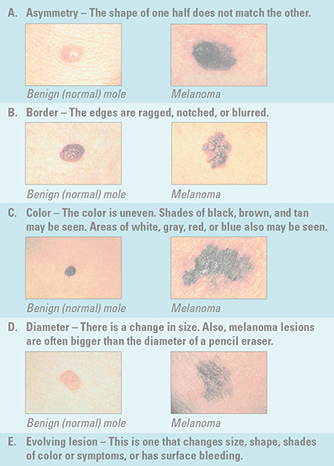
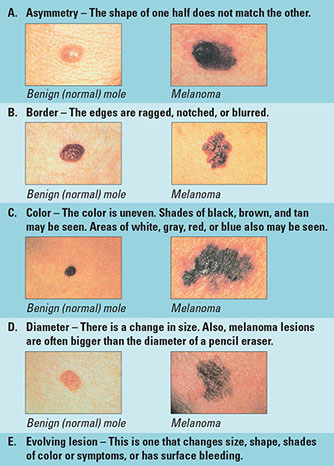
    This type of skin cancer can spread to other parts of the body and be fatal if not treated early. Often, the first sign is a change in the size, shape, or color of an existing mole. It also may appear as a new, abnormal, or “ugly looking” mole. Learn the ABCD and E’s that can help you detect it early.

    Skin Self-Exam

    *  Do an exam monthly, after a shower or bath. To check your skin, use:

    – A well-lit room

    – A full-length mirror

    – A hand-held mirror

    *  Locate your birthmarks, moles, and blemishes. Check for a change in the size, texture, or color of a mole. Check for a sore that does not heal.

    Check all areas.

    1.  Look at the front and back of your body in the mirror. Raise your arms and look at your left and right sides.

    2.  Bend your elbows and look carefully at the palms of your hands. Look at both sides of your forearms and upper arms.

    3.  Look at the back and front of your legs. Look between the buttocks and around the genital area.

    4.  Sit and closely examine your feet. Look at the soles and between the toes.

    5.  Look at your face, neck, and scalp. Use a comb to move your hair so you can see your scalp.

    See your doctor if you find anything unusual.

    Causes & Risk Factors

    With all cancers, genes that control cell growth and division malfunction. Damage to genes can occur from many factors.

    Factors that damage genes include:

    *  Tobacco use and exposure

    *  Exposure to ultraviolet (UV) rays from the sun and indoor tanning

    *  Exposure to cancer causing chemicals

    *  A person’s genetic makeup and immune status

    *  Use of certain medicines, such as DES (a synthetic estrogen)

    *  Certain viruses and bacteria:

    – Human papillomavirus (HPV). This causes most cervical cancers and some vaginal and vulvar cancers.

    – Hepatitis B virus (HBV). This raises the risk for liver cancer.

    – Human immunodeficiency virus (HIV). This raises the risk for some cancers, such as Kaposi sarcoma and non-Hodgkin lymphoma.

    – Helocobactor pylori (H. pylori) bacteria, the main cause of stomach ulcers, raises the risk for stomach cancer.

    Lower Your Risk

    There are many things you can do to prevent and lower your risk of getting cancer. Do them for yourself. Do them for your loved ones.

    *  Protect yourself from ultraviolet (UV) radiation. Limit time in the sun. Wear sunscreen, sunglasses, a hat, and clothing that protects your skin. And, don’t fake bake. Sun lamps and tanning booths also emit cancer-causing rays.

    *  Have X-rays only when necessary.

    *  Avoid asbestos, pesticides, herbicides, and other cancer-causing agents. Protect yourself from cancer-causing chemicals at work and elsewhere.

    *  Have your home tested and treated for radon, if found.

    *  Do regular physical activity. Control your weight.

    *  Eat healthy foods. Have 5-9 colorful fruits and vegetables per day. Opt for whole-grain breads and cereals. Limit red meat and foods high in fat.

    *  Limit alcohol -no more than two drinks per day for men; no more than one drink per day for women.

    *  Find ways to manage stress. Too much stress can weaken your immune system.

    *  Talk with your doctor about taking vitamins, herbal products, or other supplements.

    *  Follow your doctor’s advice to prevent, lower the risk, and treat virus and bacteria that can cause cancer.

    *  The obvious – avoid tobacco:

    – Don’t smoke it.

    – Don’t shove it between your lips and gums.

    – Don’t inhale it secondhand.

    – Avoid thirdhand smoke – tobacco toxins that linger in carpets, clothes, furniture, and other materials hours or even days after a cigarette is put out.

    Screening Tests & Treatments

    Screening tests help detect some types of cancer in early stages, when they are most treatable.

    Finding and removing precancerous tissue can prevent cancers of the cervix, colon, and rectum.

    Get screening tests, as listed below, or as advised by your doctor. If you are at a greater risk for one or more cancers, you may need screenings earlier or more often. You may need additional screenings. If a certain type of cancer is common in your family, consider asking your doctor about genetic testing. Also, check with your insurance plan to find out if and when screening tests are covered.

    Treatment

    Treatment depends on the type of cancer, the stage it is in, and individual factors. Cancer treatment includes:

    *  Surgery to remove the cancerous tumor(s) and clear any obstruction to vital passageways

    *  Radiation therapy

    *  Chemotherapy

    *  Biological therapy

    *  Targeted therapy, such as drugs, that affect only the cancer cells

    *  Stem cell or bone marrow transplant

    *  Clinical trials

    Resources

    American Cancer Society

    800.ACS.2345 (227.2345)

    www.cancer.org

    National Cancer Institute

    800.4.CANCER (422.6237)

    www.cancer.gov

    Clinical Trials

    www.clinicaltrials.gov

    Preventing Cancer brochure by the American Institute for Preventive Medicine. www.HealthyLife.com. All rights reserved.

    © American Institute for Preventive Medicine

  • You May Need To Get Tested For Hepatitis C

    MEDICAL NEWS

    Image of doctor talking to a patient.

    An estimated 3.2 million Americans are infected with chronic hepatitis C, a viral infection of the liver. Among those are larger numbers of Veterans and baby boomers.

    The CDC recently recommended that all baby boomers in the U.S. (those born between 1945 and 1965) get a simple one-time blood test for hepatitis C. They estimate that this testing could identify more than 800,000 additional people with the disease.

    Here’s what we know:

    *  Chronic hepatitis C won’t go away on its own.

    *  Many people living with hepatitis C are not aware they have the condition and may go years without showing symptoms. Hepatitis C is treated with a combination of medications.

    *  The rate of hepatitis C among people born in 1945 through 1965 is about 4%, compared to about 1% among other Americans. That difference is likely due to risky behaviors among this group.

    *  You can get hepatitis C from infected blood or body fluids. Today, the most common way people get infected is by needle-sharing during intravenous drug use. Most new infections occur among drug users. In addition, an infected pregnant woman can infect her unborn baby.

    *  Since 1992, when reliable blood screening procedures became available, the risk of transmission of hepatitis C by blood transfusion has fallen to less than one per million units of transfused blood, according to the CDC. Rarely, the virus can be transmitted through sexual intercourse.

    *  Hepatitis C is not transmitted through shaking hands, coughing, sneezing, breastfeeding, or sharing cups and utensils.

    *  Hepatitis C can cause serious liver problems.

    © American Institute for Preventive Medicine

  • Prostate Cancer

    Cancer

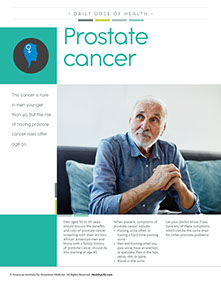
    Man sitting looking up and sideways.

    This cancer is rare in men younger than 40, but the risk of having prostate cancer rises after age 50.

    Men aged 50 to 69 years should discuss the benefits and risks of prostate cancer screening with their doctors. African American men and those with a family history of prostate cancer should do this starting at age 40.

    When present, symptoms of prostate cancer include:

    *  Passing urine often or having a hard time passing urine

    *  Pain and burning when you pass urine, have an erection, or ejaculate. Pain in the hips, pelvis, ribs, or spine

    *  Blood in the urine

    Let your doctor know if you have any of these symptoms, which can be the same ones for other prostate problems.

    Health at Home Lifetime book by the American Institute for Preventive Medicine. www.HealthyLife.com. All rights reserved.

    © American Institute for Preventive Medicine

  • Birth Defects

    Pregnancy & Prenatal Care

    Pregnant women standing in open field.

    In the U.S., about one out of 33 babies is born with a birth defect. This includes cystic fibrosis, Down syndrome, heart defects, sickle cell disease, spina bifida, and Tay-Sachs disease.

    A baby’s neural tube starts to develop about 3 weeks after conception (before many women know they are pregnant).

    Females of childbearing age should take a daily supplement with 400 micrograms of folic acid (a B vitamin). Women who have had a baby with a neural tube defect should follow their doctor’s advice about folic acid for future pregnancies.

    Learn about birth defects from the March of Dimes atmarchofdimes.com.

    Health at Home Lifetime book by the American Institute for Preventive Medicine. www.HealthyLife.com. All rights reserved.

    © American Institute for Preventive Medicine

  • Sexually Transmitted Infections (Sti)

    Sexual Health

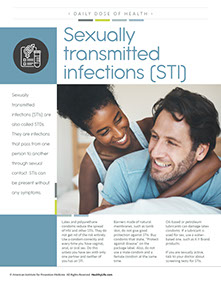
    Smiling couple.

    Sexually transmitted infections (STIs) are also called STDs. They are infections that pass from one person to another through sexual contact. STIs can be present without any symptoms.

    Latex and polyurethane condoms reduce the spread of HIV and other STIs. They do not get rid of the risk entirely. Use a condom correctly and every time you have vaginal, anal, or oral sex. Do this unless you have sex with only one partner and neither of you has an STI.

    Barriers made of natural membranes, such as lamb skin, do not give good protection against STIs. Buy condoms that state, “Protect against disease” on the package label. Also, do not use a male condom and a female condom at the same time.

    Oil-based or petroleum lubricants can damage latex condoms. If a lubricant is used for sex, use a water-based one, such as K-Y Brand products.

    If you are sexually active, talk to your doctor about screening tests for STIs.

    Health at Home Lifetime book by the American Institute for Preventive Medicine. www.HealthyLife.com. All rights reserved.

    © American Institute for Preventive Medicine

  • Breast Cancer

    Cancer

    Female doctor holding a pink ribbon for breast cancer awareness.

    The pink ribbon is the symbol of breast cancer awareness.

    If you are due for a mammogram, and have not yet scheduled one this year, do it today.

    Schedule a mammogram. This X-ray of the breasts can help detect breast cancer early, when it is easier to treat successfully.

    Women are advised to get a mammogram every 1 to 2 years starting at age 40. Women at a higher risk for breast cancer should seek expert medical advice about getting mammograms.

    Ask your doctor about your risk for breast cancer. You can also use the Breast Cancer Risk Assessment Tool atcancer.gov/bcrisktool.

    Health at Home Lifetime book by the American Institute for Preventive Medicine. www.HealthyLife.com. All rights reserved.

    © American Institute for Preventive Medicine

  • 4 Reasons To Get Your Colonoscopy

    MEDICAL NEWS

    Illustration of doctor's hand with the word "Colonoscopy."

    If you’re age 50 or older, your doctor may have recommended you get a colonoscopy. This test, which uses a thin, lighted tube to view inside the colon and rectum, checks for:

    *  Polyps, which are growths or bumps that could turn into cancer

    *  Colorectal cancer (cancer in the colon and/or rectum)

    A colonoscopy gives the doctor a chance to remove polyps and possible cancerous growths during the test.

    Even though a colonoscopy is a safe and effective way to help prevent colorectal cancer or find it early, many people put off getting one. This is often because they are nervous about the test or they don’t want to do the “prep.” Preparing for a colonoscopy usually means you take medicines that cause diarrhea the day before the test. This can be inconvenient, but it’s worth the hassle.

    Here are 4 good reasons you should call your doctor about scheduling it today:

    1.Early colon cancer has no symptoms.Many people have polyps or even colon cancer for months or years and don’t know it. A colonoscopy can find these things early and increase the chances of a good outcome. The earlier colon cancer is found, the higher the likliehood of successful treatment.

    2.One day of prep could save your life.No one likes to have diarrhea. But, one day of prep means you’re getting a test that checks for a common and sometimes deadly cancer. In fact, the American Cancer Society says more than 50,000 Americans will die from colorectal cancer in 2018. It is the third most common cancer in the U.S.

    3.There are ways to make the prep easier.Ask your doctor about adding certain flavorings to your medicine to make it taste better. Also, there are many clear liquids other than water you may be able to drink. Sports drinks, tea, coffee, popsicles and some broths may be allowed. Usually, red, blue and purple dyes need to be avoided, but other flavors are fine.

    4.Can’t put a price on peace of mind.With so many people being diagnosed with colorectal cancer, isn’t it worth a day of discomfort to know that you’ve been screened? Even if a polyp or possible sign of cancer is found, you can get on the path to treatment that could be life-saving.

    Sources: Centers for Disease Control and Prevention, National Institutes of Health, American Cancer Society

    © American Institute for Preventive Medicine

  • Breast Lumps & Breast Cancer

    Women’s Health

    For Breast Lumps

    Feeling a lump in a breast can be scary. For a lot of women, the first thought is cancer. The good news is that 80% to 90% of breast lumps are not cancer.

    Signs, Symptoms, and Causes

    *  Solid tumors. These include:

    – Lipomas. These are fatty tumors that can grow very large. They are usually benign.

    – Fibroadenomas. These lumps are round, solid, and movable and are usually benign.

    – Cancerous lumps. Often, these are firm to hard masses that do not move when felt. They are often an irregular shape.

    *  Cysts. (These can be very small and diffuse, as in fibrocystic breast disease). These cysts:

    – Are fluid filled sacs.

    – Are painful and feel lumpy or tender.

    – Can occur near the surface of the skin of the breast and/or be deep within the breast. This second type may need to be tested with a biopsy to make sure it is benign.

    *  Nipple-duct tumors. These tumors occur within the part of the nipple that milk flows through. They cause a discharge from the nipple. These tumors should be removed by surgery.

    *  In rare cases, a bloody discharge from the nipple could be a sign of cancer.

    Treatment

    Tests can be done to help diagnose whether or not a breast lump is benign.

    *  Mammogram. This X-ray of the breast can detect breast problems before they can be felt.

    *  Ultrasound. This tells whether the lump is fluid-filled (usually harmless) or solid.

    *  Needle aspiration. With this, a needle is put into the lump to remove fluid or cells.

    *  Biopsy. There are many types. With these, a sample of the breast tissue is taken and examined.

    *  Ductal lavage. Fluid is sent through a catheter to the milk ducts. Cells inside the milk ducts are collected and checked for the risk of breast cancer.

    Benign breast lumps may go away if you breast-feed for many months or take a low-dose birth control pill. Prescribed medicines can get rid of severe breast lumps. These have side effects, though.

    For Breast Cancer

    Signs & Symptoms

    Breast cancer is the most common form of cancer among women. It accounts for 30% of cancers women get. Each year, there are about 227,000 new cases of breast cancer. About 49,500 women die from it. Only lung cancer causes more cancer deaths among women.

    Breast cancer often develops without signs and symptoms. This is why screening for breast cancer is needed.

    Causes & Risk Factors

    Breast cancer results from malignant tumors that invade and destroy normal tissue. When these tumors break away and spread to other parts of the body, it is called metastasis. Breast cancer can spread to the lymph nodes, lungs, liver, bone, and brain.

    *  Being a women is the main risk factor. {Note: Men can get breast cancer, too. Yearly, about 410 men die from breast cancer. Men should look for and report a breast lump or other change to their doctors.}

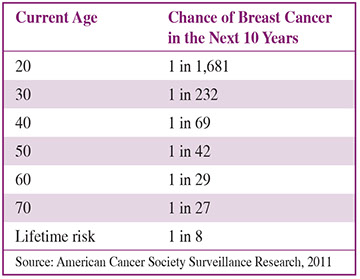
    *  Increase in age. The American Cancer Society has given these figures for women’s chances of getting breast cancer:

    *  Changes in BRCA1, BRCA2, and other cancer genes.

    *  Personal history of breast cancer.

    *  A mother or sister has or had breast cancer.

    *  One or more breast biopsies were done, especially if they showed certain changes in breast tissue.

    *  Dense breast tissue (shown on mammograms).

    *  Radiation therapy to the chest before age 30.

    *  Never giving birth or having a first full-term pregnancy after age 30. Never breast-fed a child.

    *  Menstruation started before age 12. Menopause occurred after age 55.

    *  Hormone therapy (estrogen plus progestin) after menopause and/or recent use of birth control pills may be factors.

    *  Being overweight or obese after menopause.

    *  Alcohol. The more consumed, the higher the risk.

    *  Race. Caucasian women have a slightly greater risk than African American, Asian, Hispanic, and Native American women.

    *  Eastern and Central European Jewish ancestry.

    *  Lack of physical activity throughout life.

    Ask your doctor about your risk for breast cancer. Contact the National Cancer Institute for The Breast Cancer Risk Assessment Tool. Accesswww.cancer.gov/bcrisktoolor call 800.4.CANCER (422.6237).

    Detection

    *  Breast exams by a doctor or nurse and mammograms. Have mammograms at facilities that are accredited by the American College of Radiology (ACR). Call The National Cancer Institute 800.4.CANCER (422.6237) to find ones in your area.

    *  Ultrasound exam.

    *  Magnetic resonance imaging (MRI).

    *  Noticing problems in your breasts.

    If you find a change in a breast or a lump, call your doctor. Additional tests can check for cancer. Most lumps that are found and tested are not cancer.

    Treatment

    Finding and treating the cancer early is vital. Treatment is based on the type, size, and location of the tumor. It also depends on the stage of the disease and individual factors you may have.

    One or More of These Treatment Methods are Used

    *  Surgery.

    *  Sentinal lymph node biopsy and surgery.

    *  Chemotherapy.

    *  Radiation therapy.

    *  Targeted therapy. This kills cancer cells but not normal cells.

    *  Hormone therapies.

    *  Stem cell or bone marrow transplant.

    *  Clinical trials.

    Questions to Ask

    Self-Care / Prevention

    For Cystic Breasts

    *  Get to and stay at a healthy body weight.

    *  Follow a low saturated fat diet. Eat soy foods.

    *  Do regular exercise. This can promote blood flow to your breasts.

    *  Limit or have no caffeine.

    *  Limit salt and sodium intake. This helps prevent fluid buildup in the breasts.

    *  Don’t smoke. Don’t use nicotine gum or patches.

    *  Take an over-the-counter pain reliever.

    *  Take vitamin E, as advised by your doctor.

    *  Wear a bra that provides good support. You may want to wear it while you sleep, too.

    For Breast Pain and/or Swelling without Lesions or Redness

    *  For pain due to trauma or surgery, apply cold packs for the first 48 hours. Do this every 2 to 4 hours for 10 to 15 minutes at a time. After 48 hours, apply heat, such as a hot water bottle. Do this 4 times a day for 10 to 15 minutes at a time.

    *  For pain not due to trauma or injury, apply warm heat. Use a heating pad set on low or a hot water bottle. Do this for 30 minutes. Then apply an ice pack for 10 minutes. Repeat as often as needed.

    *  Take vitamins, as advised by your doctor.

    *  Take an over-the-counter medicine for pain and swelling, as directed.

    To Reduce the Risk for Breast Cancer

    *  If you are at a high risk for breast cancer, ask  your doctor about taking prescribed medicine, such as raloxifene.

    *  Avoid X-rays that are not needed. Wear a lead  apron when you get dental and other X-rays not of the chest.

    *  Eat a variety of fruits and vegetables and whole-grain breads and cereals.

    *  Get to and stay at a healthy body weight.

    *  Do 30 or more minutes of moderate activity most days of the week. Daily is better.

    *  Limit alcohol intake to 1 drink per day, if any.

    *  Breast-feed your babies.

    Breast Self-Exam

    Breast observance is being aware of how your breasts normally look and feel and checking for changes. You can do this while you shower or get dressed. A breast self-exam (BSE) is a step-by-step method to examine your breasts. Beginning at age 20, ask your health care provider about the pros and cons of doing a BSE. If you choose to do a BSE, use the steps given on this page. At your next health exam, show your health care provider how you do a BSE.

    BSE Steps

    Examine your breasts during times of the month when they are not normally tender or swollen. For example, if you menstruate, the best time may be within 3 days after your period stops.

    1.  Lie down. Place a pillow under your right shoulder and put your right hand behind your head.

    2.  Move the pads of your left hand’s 3 middle fingers, held flat, in small, circular motions as you start to feel your right breast tissue.

    3.  Use this circular motion in an up and down pattern as you check the entire breast area. This includes the area from as high up as your collarbone to as low as the ribs below your breast; and from your right side (imagine a line straight down from under your arm) across the breast to the middle of your chest bone.

    Feel every part of the entire area you check with 3 different levels of pressure:

    *  Light – Feel the tissue closest to the skin.

    *  Medium – Feel a little deeper than the skin.

    *  Firm- Feel the tissue closest to your chest and ribs.

    4.  Squeeze the nipple gently. Check for a clear or bloody discharge.

    5.  Repeat steps 1 to 4 for the left breast using the finger pads of your right hand.

    6.  Stand in front of a mirror. Press your hands firmly on your hips. Look for:

    – Any changes in the size, shape, or contour of your breasts

    – Puckering, scaling, or redness of the skin

    – Nipple changes or discharge

    7.  Sit or stand. Raise your arm slightly. Examine each underarm area for lumps or changes.

    If you a find a lump or any change in the way your breasts normally look or feel, let your health care provider know right away. Most lumps that are found and tested are not cancer.

    Resources

    National Cancer Institute

    800.4.CANCER (422.6237)

    www.cancer.gov

    www.clinicaltrials.gov

    National Breast and Cervical Cancer Early Detection Program (NBCCEDP)

    800.CDC.INFO (232.4636)

    www.cdc.gov/cancer/nbccedp

    Women's Self-Care book by the American Institute for Preventive Medicine. www.HealthyLife.com. All rights reserved.

    © American Institute for Preventive Medicine