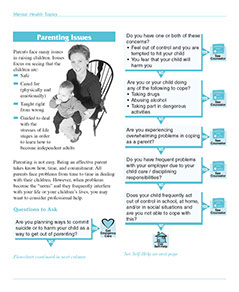
Parents face many issues in raising children. Issues focus on seeing that the children are:
* Safe
* Cared for (physically and emotionally)
* Taught right from wrong
* Guided to deal with the stresses of life stages in order to learn how to become independent adults
Parenting is not easy. Being an effective parent takes know how, time, and commitment. All parents face problems from time to time in dealing with their children. However, when problems become the “norm” and they frequently interfere with your life or your children’s lives, you may want to consider professional help.
Questions to Ask
Self-Help
* Take courses in effective parenting, such as Systematic Training for Effective Parenting (STEP) and STEP of Teens. Check local community education programs for places where these are offered.
* Follow the principles generally agreed upon by professionals to be important in effective parenting:
– Unconditional love. This means that you love your child without exception and you let your child know this. Unconditional love is always present even when the child has misbehaved. Let your child know when you do not like their behavior, but that you love them.
– Constructive discipline. Set and stick to specific standards of behavior. This is an important part of readying your child to adjust to the world. Discipline should take the form of “do’s” rather than “don’ts.” Carry through with consequences when you say you will. Don’t make idle threats. Discipline should be:
1. Consistent – Don’t undermine your spouse and don’t change what is or isn’t acceptable behavior from one day to the next.
2. Clear – Tell the child specific rules to follow and the consequences of not following these rules.
3. Private – Do not publicly humiliate your child.
4. Reasonable – Give the child a reason they can understand.
5. Flexible – Take your child’s point of view into account.
6. Independence promoting – Allow your child an expanding role in decision making.
7. Authoritative – Make a decision and stick to it.
* Make time for your children. This includes playing, talking, listening, and teaching them how to do things around the house in addition to family activities.
* Make time for your spouse (if applicable) and yourself. It is an easier job to be an effective parent when you and your partner have a solid, loving relationship. Also, make time for yourself and do something you enjoy. This will help you avoid being overwhelmed. Children need to know that everyone in the family is important and that they are not the center of the household.
* Teach right from wrong. Parents need to teach basic values and manners so the children will function well in society. Be honest and show respect, moral values, and kindness in dealing with your children.
* Listen. Good communication between parent and child is vital. It lets children feel that their ideas and feelings are important. Even if you don’t agree with them, don’t criticize their ideas. However, reinforce the idea that even though the two of you may have differing opinions on certain subjects, certain behaviors will not be acceptable (i.e., taking drugs, drinking, etc.).
* Guide your children. When they have problems, offer them “suggestions” rather than “should do’s” or “better not do’s.” This encourages them to find their own solutions.
* Be realistic. Expect to make mistakes and allow your children to make mistakes. Be aware that they have many outside influences to deal with, such as peer pressure, which may conflict with your teachings.
* Praise your children. Give compliments to your children for doing something well.
Special Parenting Concerns
In today’s complicated world, life or death issues now face parents in raising their children. These include:
* Drug/alcohol abuse
* AIDS
* Random violence
Raising children is complex. It requires a range of skills and knowledge. Today’s parents must have a firm handle on how to effectively deal with their children regarding the concerns listed above. The following suggestions can help parents understand these special parenting concerns.
* Educate yourself. Learn all you can about the subjects in the previous column by reading and talking to professionals who deal with these topics.
* Know the warning signs of drug and alcohol use
– Abrupt change in mood, attitude, or appearance
– Decline in performance and/or attendance at school or work
– Resistance to disciple and/or “authority” figures
– Withdrawal from family and/or friends
– Recurrent fights
– Increased borrowing (or stealing) of money from parents, siblings, employer
– Replacing old, stable friends with new, unstable ones
* Educate your children. Make them aware of the many dangers of drug/alcohol abuses and unsafe sexual practices. Talk to them about AIDS and how to prevent it through abstinence or safe sex. If it is not easy for you to talk to your child about these issues, arrange for other knowledgeable and caring persons to do so.
* Communicate. Talk to your children and let them know that they can count on you in a crisis.