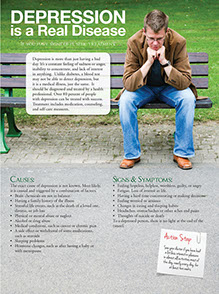
Depression is a medical illness. It is just as much an illness as are diabetes and heart disease. Depression is not a sign of being weak. It is not the person’s “fault.” A person who is depressed:
* Feels sad.
* Feels hopeless.
* Feels helpless.
* Sleeps or eats too little or too much.
* Thinks negative thoughts.
* Has lost interest in life.
Depression makes a person less able to manage his or her life. It affects everything from mood to behavior.
Persons of all ages, races, and ethnic backgrounds get depression. In the U.S., it will affect 10 to 25 percent of women and 5 to 12 percent of men during their lifetimes.
Types & Symptoms
Major Depression
This is also called clinical depression. You may have this type if, for 2 or more weeks, you have 5 or more of the symptoms listed below or you have 1 or 2 of the symptoms in bold type.
* Loss of interest in things you used to enjoy. This includes sex.
* Feeling sad, blue, or down in the dumps.
* Feeling slowed down or restless.
* Feeling worthless or guilty.
* Changes in appetite. You lose or gain weight.
* Loss of energy or feeling tired all of the time.
* Problems concentrating or thinking. It is hard for you to remember things or make decisions.
* Trouble sleeping or sleeping too much.
* Thoughts of death or suicide. You attempt suicide.
You Could Also Have One or More of These Symptoms
* Anger.
* Headaches or other aches and pains.
* Stomach and/or bowel problems.
* Sexual problems.
* Feeling negative, hopeless, anxious or worried.
Note: Postpartum depression is a form of major depression that occurs in the mother after giving birth. Depression symptoms last more than 2 weeks after the baby is born.
Dysthymia
This is a mild but long lasting type of depression. An adult is thought to have this type when he or she has a depressed mood for most of the day, more days than not, for at least 2 years. For children, the same is true, but the symptoms are present for at least 1 year. Besides being sad, children with dysthymia may often:
* Be irritable, cranky, or act difficult.
* Have low self-esteem.
With dysthymia, symptoms drain the person’s energy and keep him or her from feeling good. Sometimes people with dysthymia have bouts of major depression.
Bipolar Disorder
This used to be called manic-depression. With bipolar disorder, there are feelings of terrible “lows” and feelings of extreme “highs.” With these “highs,” a person feels happy, giddy, elated, or euphoric (manic). These cycles of “highs” and “lows” can last from days to months. In between these cycles, persons with bipolar disorder can feel normal.
You may have this type of depression if you have had 4 of the symptoms below at one time for at least 1 week or you have had the symptom in bold type.
* You feel unusually “high,” euphoric, or irritable.
* You need less sleep.
* You talk a lot or feel that you can’t stop talking.
* You are easily distracted.
* You get lots of ideas at one time.
* You do things that feel good, but that have bad effects (e.g., foolish business ventures or uncontrolled spending habits).
* You have feelings of greatness.
* You make lots of plans for activities (at work, school, or socially) or feel that you have to keep moving.
Causes
* Some types of depression run in families.
* Brain chemical imbalances.
* Life changes, such as the birth of a baby, divorce, retirement, job loss, and the death of a loved one.
* Hormonal and other changes, such as after having a baby (postpartum depression) or with menopause.
* Medical illnesses.
* Problems with others.
* Worries about money.
* Abuse of drugs or alcohol.
* Seasonal Affective Disorder (SAD). This is due to a lack of natural sunlight in the fall and winter.
* Low self-esteem. Negative attitudes about the world and self. Low tolerance for stress.
* Holiday “blues.”
* A side effect of medicines, such as some for high blood pressure. Some antidepressant medicines may increase suicidal thoughts and attempts, especially in children and teens. This is more likely to occur early in treatment or when changing a dose.
Most Likely, Major Depression is Caused by a Mix of These Things:
* Family history of depression.
* Brain chemical imbalances.
* Emotional issues.
* Other factors, such as certain medical problems.
In some persons, life events, such as extreme stress and grief, may bring on depression. In others, depression occurs when life is going well.
Treatment
Too Often, People Don’t Get Help for Depression. They Don’t Get Help for Many Reasons:
* They don’t know they are depressed.
* They blame themselves for how they feel.
* They have a hard time asking for help.
* They don’t know what to do or where to go for help.
Why Get Help?
Over 80% of people with depression can be treated with success, usually in a short time. Here are good reasons to seek help:
* Depression is the most common cause of suicide.
* Elderly depressed people have higher rates of chronic medical problems, such as heart disease.
* According to one study, severely depressed people are as disabled as those disabled with a chronic physical illness.
* Studies show a link between depression and a greater chance of getting ill in people of all ages.
* Social and family life suffer. Depressed people withdraw from others. Parents who are depressed have trouble tending to their children.
* The annual cost for treatment and lost wages due to depression is estimated at $43 to $53 billion a year.
Treatment depends on a proper diagnosis. This should start with a complete physical exam by your doctor or health care provider to rule out illnesses and medicine side effects that have the same symptoms as depression. If depression is diagnosed, your doctor or mental health care provider will prescribe one or more treatments for your needs.
Medicine(s). Antidepressant medicines work to alter brain chemicals. Doing this evens out mood. Over half of the people who take these medicines recover from depression in about 3 to 6 weeks.
Types of Medicines for Depression
These are in groups based on their chemical makeup or how they affect brain chemistry.
* SSRIs. These medicines alter serotonin, a chemical in the brain that affects mood, sleep, appetite, etc. There are many brand name and generic forms.
* SNRIs. These medicines alter serotonin and another brain chemical called norepinephrine.
* NDRIs. These medicines alter norephinphrine and another brain chemical called dopamine.
* Tricyclic antidepressants (TCAs). These medicines alter serotonin and another brain chemical.
* MAOIs. Persons who take MAOIs must follow a special diet. This is needed because some foods, if taken with MAOIs, can cause a high blood pressure crisis. Examples are aged cheeses and red wine. Because of this and other reasons, MAOIs are not used often.
* Lithium. This is used to treat bipolar disorder. Lithium reduces both manic and depressive episodes. When episodes occur, they are less severe in most persons who take lithium.
* Medicine used to treat acute mania in bipolar disorder.
* Over-the-counter herbal remedies, such as SAMe and St. John’s Wort for mild to moderate depression. Consult your doctor before taking these.
It may take some time to find the medicine that works best with the least side effects. Prescribed antidepressant medicines are not habit forming.
A therapist listens, talks, and helps you deal with your problems. This treatment is usually brief. Ten to 20 visits is common. This type of therapy can be done with:
* Just you and the therapist. This is one-on-one therapy.
* You, the therapist, and other people with similar problems. This is group therapy.
* You, the therapist, and family members, loved ones, or a partner. This is family or marriage therapy.
Types of Psychotherapy Used for Depression
* Cognitive therapy. This focuses on thoughts and beliefs.
* Behavior therapy. This focuses on current behaviors.
* Interpersonal therapy. This focuses on current relationships.
Psychotherapy may begin to help right away. For some people, it may take 8 to 10 weeks to show a full effect. More than half of the people with mild to moderate forms of depression do well in therapy.
Medicine and Psychotherapy.
The medicine treats the symptoms of depression. Psychotherapy helps people handle the ways depression can cause problems in their lives.
Electro-Convulsive Therapy (ECT).
Most depressions can be treated with medicine, psychotherapy, or both. ECT is mostly used for severe depression that is not helped with medicines. It can also be used for persons who are severely depressed with severe medical illnesses.
Light Therapy.
A special kind of light, called broad-spectrum light, is used. This gives people the effect of having a few extra hours of daylight each day. Special light boxes or light visors are used. Light therapy may help people who have Seasonal Affective Disorder (SAD). This mild or moderate form of depression comes in the fall and winter.
Hospital Care.
A person with severe depression may need to be given care in a hospital to prevent harm to himself, herself, or others; to monitor medicine(s); and/or to adjust medical therapy.
Self-Care
* Take medicine(s), as prescribed, even when you begin to feel better. Tell your doctor about side effects.
* Consult with your doctor before taking over-the-counter herbs, such as SAMe or St. John’s Wort.
* Don’t use illegal drugs. Limit alcohol. These can cause or worsen depression. Drugs and alcohol can also make medicines for depression less effective. Harmful side effects can happen when alcohol and/or drugs are mixed with medicine.
* Attend support groups, such as ones for new mothers who have postpartum depression.
* Know that negative thinking is part of depression. As the depression lifts, the negative thoughts will lift, too.
* Don’t make major decisions during bouts of depression. Ask someone you trust to help you.
* Eat healthy foods. Eat at regular times.
* Exercise regularly.
* Express your feelings. Talk to friends, relatives, co-workers, etc.
* Try not to isolate yourself. Be with people you trust and feel safe with even though you feel down. Be with positive people.
* Help someone else. This will focus your thoughts away from yourself.
* Do something new or that you enjoy. Walk or drive to a new place. Try a new place to eat. Take a vacation. Take on a new project that will let you express yourself.
* Keep an emergency number handy (e.g., crisis hotline, trusted friend’s number, etc.) in case you feel desperate.
* If suicidal thoughts occur, remove any weapons, pills, etc. that could be used for suicide and get medical help.
Medical Care
Reasons to Call Doctor or Health Care Provider
* Symptoms of major depression occur.
* Depression has kept you from doing daily activities for more than 2 weeks or you withdraw from normal activities for more than 2 weeks.
* Depression results from one of these things:
– A medical problem.
– Taking over-the-counter or prescribed medicine. (This includes an antidepressant.)
– Alcohol or drug abuse.
– Grief over the loss of a loved one does not start to improve after a couple of months.
* Depression doesn’t lift 2 weeks after having a baby.
* Depression comes with dark, cloudy weather or winter months. It lifts when spring comes.
* You feel depressed now and one or more of these things apply:
– You have been depressed before and did not get treatment.
– You have been treated (with or without medicine) for depression in the past and it has come back.
* Any of these problems occur during holiday times:
– You withdraw from family and friends.
– You dwell on past holidays to the point that it interferes with your present life.
Reasons to Get Immediate Care
* Attempting or planning suicide or writing a suicide note. Call the Suicide Prevention Lifeline at 800.273.8255 or have someone take you to a hospital emergency room. Or call 9-1-1 or your local rescue squad.
* Hearing voices, having overwhelming thoughts, or attempting to harm others, such as your baby after giving birth.
Resources
Depression and Bipolar Support Alliance
800.826.3632
www.dbsalliance.org
International Foundation for Research and Education on Depression (iFred)
www.ifred.org
National Institute of Mental Health
866.615.6464
www.nimh.nih.gov
Mental Health America! (MHA)
800.969.6642
www.mentalhealthamerica.net