Tag: teamwork

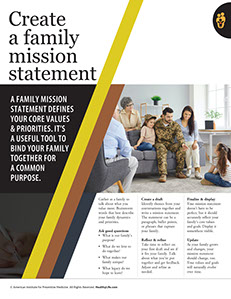
  • Create A Family Mission Statement

    FAMILY LIFE

    Family sitting together talking.

    A family mission statement defines your core values & priorities. It’s a useful tool to bind your family together for a common purpose.

    Gather as a family to talk about what you value most. Brainstorm words that best describe your family dynamics and priorities.

    Ask good questions

    *  What is our family’s purpose?

    *  What do we love to do together?

    *  What makes our family unique?

    *  What legacy do we hope to leave?

    Create a draft

    Identify themes from your conversations together and write a mission statement. The statement can be a paragraph, bullet points, or phrases that capture your family.

    Reflect & refine

    Take time to reflect on your first draft and see if it fits your family. Talk about what you’ve put together and get feedback. Adjust and refine as needed.

    Finalize & display

    Your mission statement doesn’t have to be perfect, but it should accurately reflect your family’s core values and goals. Display it somewhere visible.

    Update

    As your family grows and changes, your mission statement should change, too. Your values and goals will naturally evolve over time.

    © American Institute for Preventive Medicine

  • The Importance Of Chores

    FAMILY LIFE

    Child holding a load of clothes in her arms.

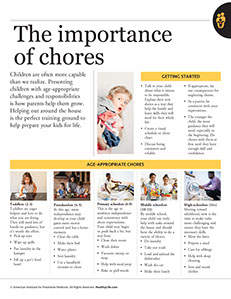
    Children are often more capable than we realize. Presenting children with age-appropriate challenges and responsibilities is how parents help them grow. Helping out around the house is the perfect training ground to help prepare your kids for life.

    Getting started

    *  Talk to your child about what it means to be responsible. Explain their new duties as a way they help the family and learn skills they will need for their whole life.

    *  Create a visual schedule or chore chart.

    *  Discuss being consistent and reliable.

    *  If appropriate, lay out consequences for neglecting chores.

    *  As a parent, be consistent with your expectations.

    *  The younger the child, the more guidance they will need, especially in the beginning. Do chores with them at first until they have enough skill and confidence.

    Age-appropriate chores

    Toddlers (2-3)

    Toddlers are eager helpers and love to do what you are doing. They will need lots of hands-on guidance, but it’s worth the effort.

    *  Pick up toys

    *  Wipe up spills

    *  Put laundry in the hamper

    *  Fill up a pet’s food bowl

    Preschoolers (4-5)

    At this age, more independence may develop as your child gains more motor control and has a better memory.

    *  Clear the table

    *  Make their bed

    *  Water plants

    *  Sort laundry

    *  Use a handheld vacuum to clean

    Primary schoolers (6-9)

    This is the age to reinforce independence and consistency with chore expectations. Your child may begin to push back a bit, but stay firm.

    *  Clean their room

    *  Wash dishes

    *  Vacuum, sweep, or mop

    *  Help with meal prep

    *  Rake or pull weeds

    Middle schoolers (10-13)

    By middle school, your child can truly help with tasks around the house and should have the ability to do a variety of chores.

    *  Do laundry

    *  Take out trash

    *  Load and unload the dishwasher

    *  Wash the car

    *  Make their lunch

    High-schoolers (14+)

    Moving toward adulthood, now is the time to make tasks more challenging and ensure they have the necessary skills.

    *  Mow the lawn

    *  Prepare a meal

    *  Care for siblings

    *  Help with deep cleaning

    *  Iron and mend clothes

    © American Institute for Preventive Medicine

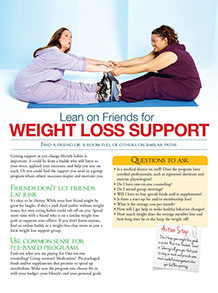
  • Lean On Friends For Weight Loss Support

    Weight Control

    Find a friend or a room full of others on similar paths.

    Getting support as you change lifestyle habits is important. It could be from a buddy who will listen to your woes, applaud your successes, and help you stay on track. Or you could find the support you need in a group program where others’ successes inspire and motivate you.

    Friends don’t let friends eat junk.

    Image of two friends eating healthy.

    It’s okay to be choosy. While your best friend might be great for laughs, if she’s a junk food junkie without weight issues, her own eating habits could rub off on you. Spend more time with a friend who is on a similar weight loss path or supports your efforts. If you don’t know anyone, find an online buddy in a weight-loss chat room or join a local weight loss support group.

    Use common sense for fee-based programs.

    Find out what you are paying for. One-on-one counseling? Group sessions? Medication? Pre-packaged foods and/or supplements that promise to speed up metabolism. Make sure the program you choose fits in with your budget, your lifestyle, and your personal goals.

    Questions to ask:

    *  Is a medical doctor on staff? Does the program have certified professionals, such as registered dietitians and exercise physiologists?

    *  Do I have one-on-one counseling?

    *  Do I attend group meetings?

    *  Will I have to buy special foods and/or supplements?

    *  Is there a start-up fee and/or membership fees?

    *  What is the average cost per month?

    *  How will I get help to make healthy behavior changes?

    *  How much weight does the average member lose and how long does he or she keep the weight off?

    Action Step

    Don’t keep your weight loss goals a secret. Post it on Facebook. Tweet it. Sharing will give you that push to stay on track and provide some much needed encouragement when you feel like quitting.

    Page from Ways to Well-Being book by the American Institute for Preventive Medicine. www.HealthyLife.com. All rights reserved.

    © American Institute for Preventive Medicine

  • Build Support At Home

    Healthylife® Weigh

    Part 4

    Mature couple talking together on sofa.

    Talk to the people you live with about what you are doing. Let them know why you are making these changes. Ask for their support and say “thank you” for things they do that help you.

    *  Set food rules for everyone in the family to follow. This may include eating together at the table and keeping the TV off. Keep phones in another room.

    *  Keep unhealthy snacks in dark containers, out of plain sight.

    *  Encourage positive talk about new meals and snacks in the house. If a new food is disliked, talk about why. A food can be prepared in a different way.

    *  Involve others in meal planning, especially if everyone will be eating the same meals.

    *  Prepare meals together. Adults and children can learn valuable lessons in the kitchen, from math skills to building self-confidence.

    *  Be active together. Make this time more about shared family joys than weight loss. Stretch together in the morning or go for a walk after dinner. Plan family picnics that involve a hike or bike ride.

    © American Institute for Preventive Medicine

  • 6 Simple Steps To A Healthier Marriage

    FAMILY LIFE

    Image of young smiling couple sitting against a wall.

    Having a healthy, supportive marriage is important to your overall well-being. But the stresses of life, work, family, and day-to-day problems can put a strain on even the best marriage at times.

    Fortunately, there are some ways you can help keep your marriage strong – or work on problems before they become major issues. Here are some tips from the National Healthy Marriage Resource Center:

    1. Make every effort to keep your commitment.

    Marriage will have “good times and bad,” and you need to realize that challenges will happen. The key is to work through them and be aware that everyone has disagreements and difficulties. No marriage is perfect, but with extra effort from both partners, you can make yours last.

    2. Make time for each other.

    Even when you’re overwhelmed with work, children, or other tasks, don’t forget about your marriage. Set aside time for a dinner alone or even a weekend getaway if you can. If that’s not possible, have 15 to 30 minutes of time to talk and connect each day – without TV or cell phones.

    3. Have a sense of humor.

    Life’s little mishaps are easier to take when you can laugh at them. Mistakes that don’t really hurt anyone don’t have to turn into arguments. Don’t focus on who’s to blame. Laugh at it if you can, and work on a solution together. Forgive your spouse (and yourself!) and try to find the humor in the situation.

    4. Communication is key.

    This is an important aspect of any marriage. Talk about what’s bothering you – and what you love. Listen to what your spouse is saying, and don’t be quick to defend yourself. No one has to “win” an argument. If you both listen and respect each other, a solution or compromise can usually be found.

    5. Do “little” things for your spouse.

    Make a favorite meal for the other person, do the dishes without being asked, or leave a love note. These small things can add up to big happiness. Just showing your spouse that you care about him or her will help build your marriage each day.

    6. Choose your battles.

    Before you get angry about something, ask yourself if it’s worth an argument. If it’s important to you, approach the subject calmly and be honest. If not, take a deep breath and focus your energy on better things.

    Marriage isn’t always easy, but working to keep it strong and healthy can have big payoffs. People in healthy marriages have better mental health and may even live longer. Give your marriage the attention it deserves, and you’ll both enjoy the benefits.

    © American Institute for Preventive Medicine

  • Be A Good Sport

    BE FIT

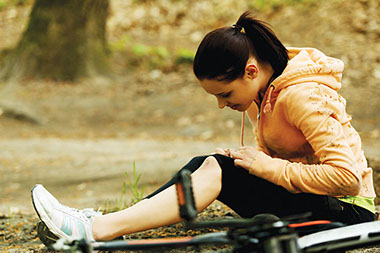
    Image of women with knee injury from riding a bike.

    Whether you’ve never had a sports injury and you’re trying to keep it that way or you’ve had an injury and don’t want another, the following tips from the National Institute of Arthritis and Musculoskeletal and Skin Diseases can help:

    *  Avoid bending knees past 90 degrees when doing half knee bends.

    *  Avoid twisting knees by keeping feet as flat as possible during stretches.

    *  When jumping, land with your knees bent.

    *  Do warm-up exercises not just before vigorous activities like running, but also before less vigorous ones such as golf.

    *  Don’t overdo.

    *  Do warm-up stretches before activity. Stretch the Achilles tendon, hamstring, and quadriceps areas and hold the positions. Don’t bounce.

    *  Cool down following vigorous sports. For example, after a race, walk or walk/jog for 5 minutes so your pulse comes down gradually.

    *  Wear properly fitting shoes that provide shock absorption and stability.

    *  Use the softest exercise surface available, and avoid running on hard surfaces like asphalt and concrete. Run on flat surfaces. Running uphill may increase the stress on the Achilles tendon and the leg itself.

    © American Institute for Preventive Medicine

  • How To Be A Team Player At Work

    WORK LIFE

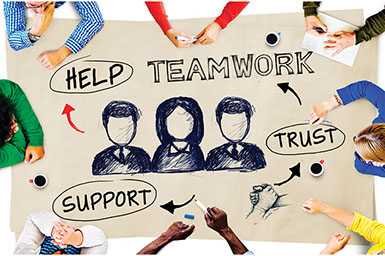
    Concept drawing on table to being a team palyer at work.

    You’re bound to run into many different personality types at the workplace. And when you’re working as a team, it can be challenging to adjust to different work styles.

    The American Management Association says teamwork leads to better problem solving and productivity. But it’s not as simple as just saying you’re part of a team. Here are some tips to help you achieve the best possible outcome with your group:

    *Use your strengths.People have different talents and skills that make them who they are. Offer to use your unique strengths to help get things done. Don’t wait to be asked; volunteer to help when you can.

    *Don’t place blame.When things don’t go well, it’s usually not helpful to blame someone else. Instead, look at the problem and work together to find ways to solve it.

    *Listen without talking.When others have ideas or opinions, listen to their side before jumping in with your thoughts. Listen with the goal of understanding their point, not adding your own.

    *Be aware of different work styles.You may be on a team with someone who does things differently than you. Instead of trying to correct them, see if you can learn something from their way of doing things.

    *Be dependable.The best team players are those who get things done on time. Missing deadlines could cause trouble for others on your team or jeopardize your project.

    *Communicate.If you’re running into problems or have too much on your plate, tell your team about it. Someone else may be able to help so you can keep the project running smoothly. People may have no idea you’re struggling – unless you speak up and tell them.

    © American Institute for Preventive Medicine

  • Lightening The Load: Dividing Household Chores

    FAMILY LIFE

    Image of couple ready to clean.

    Chores are a part of daily life for families. And, the way they are divided can have a big impact on your family relationships. A survey by the Pew Research Center found that sharing household chores was among the top three things that make a marriage work.

    This can be easier said than done in many households. Many families have to work outside the home, attend kids’ activities and deal with other demands every day. With all these things taking up time, chores may be an additional source of stress.

    First, have a good talk

    It’s easy to get angry or upset with someone for not doing enough chores.

    But before you do this, stop and think. Did you clearly tell them when and how you wanted this chore done? Have they been busy with other activities?

    Be kind and respectful when talking about chores; then you may find that the other person is more willing to take part. Try to look at things from their perspective. Perhaps they’ve been overwhelmed with other things or simply didn’t know that something needed to be done. Or, if you feel like you’ve been doing most of the work, ask if others can help take some things off your plate. Be specific with which chores you would like them to do and when.

    Get the kids involved

    Even small children can do chores. Toddlers can pick up toys and help make their beds. Preschool kids can help clean up spills, feed a pet and even take their laundry to the hamper. Older children may be able to wash dishes, and do laundry and fold clothes.

    Younger children often do well with a chore list so they know what is expected of them. If they can’t read yet, use pictures and stickers.

    Set aside a few minutes

    One strategy that works for many families is finding just 10 or 15 minutes a day to do some basic chores. This can be anything that needs to be done. Examples include picking up and putting things away, cleaning a bathroom or running the vacuum. You can even set a timer so it doesn’t feel so overwhelming. Make it fun by turning on music while you clean. Or, make it a “race” with little ones: who can pick up their room first? When the time is up, everyone can feel good about helping out around the house.

    © American Institute for Preventive Medicine

  • Physical Fitness And Sports

    BE FIT

    Image of older man ready to exercise.

    Along with healthy eating, physical activity increases your chances of living longer. Exercise can also help:

    *  Control your blood pressure, blood sugar, and weight

    *  Lower your “bad” cholesterol and raise your “good” cholesterol

    *  Prevent heart disease, colorectal and breast cancer, and type 2 diabetes

    And that’s not all. Being more active can:

    *  Be fun

    *  Help you look your best

    *  Improve your sleep

    *  Make your bones, muscles, and joints stronger

    *  Lower your chances of becoming depressed

    *  Reduce falls and arthritis pain

    *  Help you feel better about yourself

    For adults, most health benefits come with at least 150 minutes a week of moderate-intensity physical activity, such as brisk walking. Extra benefits occur with more physical activity. Both aerobic (endurance) and muscle-strengthening (resistance) physical activity are helpful.

    Children need 60 minutes of play with moderate to vigorous activity every day. If this sounds like a lot, consider that eight to 18 year olds spend an average of 7.5 hours a day sitting. This includes using computers, video games, cell phones and watching TV and movies.

    Make exercise fun

    No matter what shape you are in, you can find activities that you enjoy. If you think of exercise as a chore that you have to do, it can be harder to stick with it.

    *  Choose activities you enjoy and look forward to. Do ones you enjoyed as a child.

    *  Set up a walking program with a friend, family member, or coworker you enjoy being with.

    *  Wear a pedometer to track your steps. Aim for a goal of 10,000 steps a day.

    *  Enjoy a sunny day and fresh air with outdoor activities.

    *  Play outdoors with your children and grandchildren.

    *  Use fitness facilities at your work.

    © American Institute for Preventive Medicine