Tag: therapy

  • The Healing Touch

    Alternative Medicine

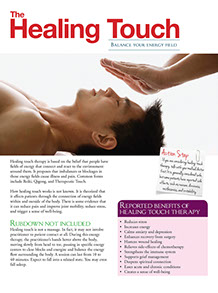
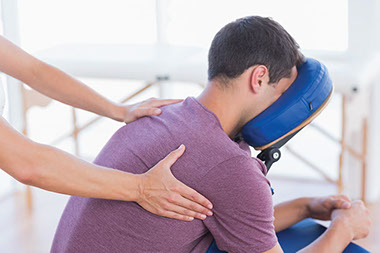
    Image of person having healing touch therapy.

    Balance your energy field

    Healing touch therapy is based on the belief that people have fields of energy that connect and react to the environment around them. It proposes that imbalances or blockages in those energy fields cause illness and pain. Common forms include Reiki, Qigong, and Therapeutic Touch.

    How healing touch works is not known. It is theorized that it affects patients through the connection of energy fields within and outside of the body. There is some evidence that it can reduce pain and improve joint mobility, reduce stress, and trigger a sense of well-being.

    Rubdown not included

    Healing touch is not a massage. In fact, it may not involve practitioner to patient contact at all. During this energy therapy, the practitioner’s hands hover above the body, moving slowly from head to toe, pausing in specific energy centers to clear blocks and energize and balance the energy flow surrounding the body. A session can last from 10 to 40 minutes. Expect to fall into a relaxed state. You may even fall asleep.

    Reported benefits of healing touch therapy

    *  Reduces stress

    *  Increases energy

    *  Calms anxiety and depression

    *  Enhances recovery from surgery

    * Hastens wound healing

    *  Relieves side-effects of chemotherapy

    *  Strengthens the immune system

    *  Supports grief management

    *  Deepens spiritual connection

    *  Eases acute and chronic conditions

    *  Creates a sense of well-being

    Action Step

    If you are considering healing touch therapy, talk with your medical doctor first. It is generally considered safe, but some patients have reported side effects, such as nausea, dizziness, restlessness, and irritability.

    Page from Ways to Well-Being book by the American Institute for Preventive Medicine. www.HealthyLife.com. All rights reserved.

    © American Institute for Preventive Medicine

  • Give Water Exercise A Try

    Fitness

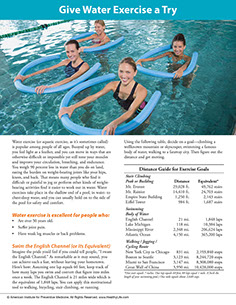
    Water exercise class in session.

    Water exercise (or aquatic exercise, as it’s sometimes called) is popular among people of all ages. Buoyed up by water, you feel light as a feather, and you can move in ways that are otherwise difficult or impossible yet still tone your muscles and improve your circulation, breathing, and endurance. You weigh 90 percent less in water than you do on land, easing the burden on weight-bearing joints like your hips, knees, and back. That means many people who find it difficult or painful to jog or perform other kinds of weight-bearing activities find it easier to work out in water. Water exercises take place in the shallow end of a pool, in waist- to chest-deep water, and you can usually hold on to the side of the pool for safety and comfort.

    Swim the English Channel (or Its Equivalent)

    Imagine the pride you’d feel if you could tell people, “I swam the English Channel.” As remarkable as it may sound, you can achieve such a feat, without leaving your hometown. Here’s how: Assuming one lap equals 60 feet, keep track of how many laps you swim and convert that figure into miles once a week. The English Channel is 21 miles wide which is the equivalent of 1,848 laps. You can apply this motivational tool to walking, bicycling, stair climbing, or running. Using the following table, decide on a goal-climbing a well-known mountain or skyscraper, swimming a famous body of water, walking to a faraway city. Then figure out the distance and get moving.

    Water exercise is excellent for people who:

    *  Are over 50 years old.

    *  Suffer joint pain.

    *  Have weak leg muscles or back problems.

    Page image from A Year of Health Hints book by the American Institute for Preventive Medicine. www.HealthyLife.com. All rights reserved.

    © American Institute for Preventive Medicine

  • Get Help For Addictive Behaviors

    Substance Use & Abuse

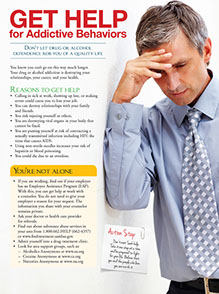
    Image of counseling group.

    Don’t let drug or alcohol dependence rob you of a quality life.

    You know you can’t go on this way much longer. Your drug or alcohol addiction is destroying your relationships, your career, and your health.

    Reasons to get help:

    *  Calling in sick at work, showing up late, or making errors could cause you to lose your job.

    *  You can destroy relationships with your family and friends.

    *  You risk injuring yourself or others.

    *  You are destroying vital organs in your body that cannot be fixed.

    *  You are putting yourself at risk of contracting a sexually transmitted infection including HIV, the virus that causes AIDS.

    *  Using non-sterile needles increases your risk of hepatitis or blood poisoning.

    *  You could die due to an overdose.

    You’re not alone

    *  If you are working, find out if your employer has an Employee Assistance Program (EAP). With this, you can get help at work with a counselor. You do not need to give your employer a reason for your request. The information you share with your counselor remains private.

    *  Ask your doctor or health care provider  for referrals.

    *  Find out about substance abuse services in your area from 1.800.662.HELP (662-4357) orwww.findtreatment.samhsa.gov.

    *  Admit yourself into a drug treatment clinic.

    *  Look for area support groups, such as:

    – Alcoholics Anonymous atwww.aa.org

    – Cocaine Anonymous atwww.ca.org

    – Narcotics Anonymous atwww.na.org

    Action Step

    Don’t wait. Seek help. Take it one step at a time and be prepared to fight for your life. Believe that you and the people who love you are worth it.

    Page from Ways to Well-Being book by the American Institute for Preventive Medicine. www.HealthyLife.com. All rights reserved.

    © American Institute for Preventive Medicine

  • Address Depression

    Healthylife® Weigh

    Part 6

    Man coping with depression.

    Signs & Symptoms

    *  Feeling sad, hopeless, helpless, and/or worthless

    *  Fatigue

    *  Loss of interest in daily activities, including sex

    *  Change in eating and sleeping patterns

    *  Anger, anxiety, or irritability

    *  Having a hard time concentrating or making decisions

    *  Thoughts of suicide or death

    Strategy

    *  Accept thoughts as they are. Focus on your response, rather than trying to shoo away the emotion.

    *  Be with and call relatives and friends who lift your morale and make you laugh.

    *  Do something to help someone else.

    *  Keep up with your regular exercise.

    *  Do something different. Walk or drive to someplace new.

    *  Challenge yourself with a new project. It doesn’t have to be difficult, but it should be enjoyable.

    *  Watch a funny TV show or movie.

    *  Reflect on your expectations and make adjustments –  it takes a long time to change habits and feel the new habits are “normal.”

    *  Change your clothes. Take a shower. Do small self-care activities.

    If you feel depressed for two weeks or longer, see a doctor.

    For a screening test for depression, contact:

    Mental Health America

    800-969-6642

    www.mhanational.org

    © American Institute for Preventive Medicine

  • Injury And Disability

    Healthylife® Weigh

    Part 5

    Doctor helping elderly man with fitness.

    Talk to your doctor or physical therapist about exercises you can do at home, at a gym, or in a pool. While there may be activities you can’t do, there are probably many that you can do. Plus, there are many exercises that can be adapted to suit your individual needs and abilities.

    *  Focus on what you CAN do.

    *  Choose low-impact exercises that don’t make an injury worse.

    *  Find a supportive buddy to help motivate you or assist you with exercises.

    *  Use flotation devices in a pool for support.

    *  Try new things as you lose weight. You may find some activities easier when you are carrying less weight on your joints.

    © American Institute for Preventive Medicine

  • Massage

    Healthylife® Weigh

    Part 5

    Man getting a chair massage.

    Massage can be a form of recovery for your muscles. Massage, especially deep compression massage, can help relax tight muscles and knots that have formed between muscle layers. This can help with normal blood flow, keep your muscles flexible, and reduce pain.

    A professional massage therapist or a friend can assist you with massage.  Or, you can give yourself a massage.

    Self-Massage

    Use a foam roller, tennis ball, Thera Cane®, or muscle roller stick. These items are fairly inexpensive and can be purchased from major retailers and sporting goods stores. Or, using your fingers is free! Apply pressure to specific parts of your body. Go slowly. If you purchase a self-massage tool, follow package instructions.

    © American Institute for Preventive Medicine

  • Helping A Depressed Family Member

    FAMILY LIFE

    Image of man talking with a counselor.

    Depression is a medical condition that can be serious. The National Institutes of Mental Health say depression can affect how you feel, think and cope with daily life. Eating, sleeping, socializing and working can all be difficult for someone with depression.

    If a member of your family has depression, there are ways to support them.

    Tip #1:

    Don’t tell them to “just snap out of it.” Experts believe depression is caused by a chemical imbalance in the brain. This may be due to genetics or it may be triggered by a stressful event such as death of a family member, divorce or abuse. Sometimes, a cause cannot be found. It’s important to understand that the person’s everyday actions may be affected by this disease, and they can’t make it just go away.

    Tip #2:

    Take medical care seriously. Treatment for depression often involves medication  and/or therapy. It can take some time to find the treatment that works for your family member. Whenever possible, offer to go with them to doctor appointments. Support them in following their treatment plan. Do what you can to make sure they take medications as prescribed without forcing or arguing.

    Tip #3:

    Offer to take them out, but don’t push. Many people with depression struggle to get out of bed each day or leave the house. But, with treatment, it is possible to start enjoying life again. Ask the family member if they’d like to do something simple, such as go to the store or park. If they decline, wait a few days and offer again. Eventually, they may say yes.

    Tip #4:

    Listen when they want to talk. If your family member wishes to talk about his or her feelings, let them do so without judging or offering advice. Simply listen to their thoughts and feelings without trying to “fix” anything.

    Take loved ones’ comments about suicide or self-harm seriously. Many times a person will confide in a loved one prior to committing a harmful act.

    With help from a doctor, depression can be treated. Let your family member know you care, and ask them to get the medical help they need. Proper medical care can help them get on the path to a healthier, happier life.

    © American Institute for Preventive Medicine