Tag: Travel Tips

  • Destination: Healthy Vacation

    Healthy Travel

    Image of father and child playing in the pool.

    Plan ahead to have a safe and fun trip!

    You deserve a break. In fact, doctors recommend it. Vacations are good for your health and happiness. Planning ahead, packing smart, and knowing about your destination will help you relax and enjoy.

    Do your homework.

    Learn about the places you plan to go to. Check out their weather conditions, construction areas, crime rates, and health concerns. Find out what your health insurance plan does and does not cover and if you need extra insurance. No matter where you travel, following these steps could make the difference between a great and a dreadful vacation.

    Dos

    *  Pack a basic first-aid kit.

    *  Pack all prescriptions and other valuables, such as jewelry in your carry-on luggage.

    *  Stretch your arms and legs at least every hour during travel.

    *  Stay hydrated. If the drinking water could be unsafe, choose bottled water.

    *  Wash your hands often. Take travel-size hand sanitizer gels and cloths.

    *  Talk to your family about safety concerns. Set rules for the kids.

    *  Tell a trusted friend or relative your trip schedule so you can be contacted for emergencies.

    *  Stop deliveries of papers and mail. Or, arrange to have someone pick them up.

    *  Ask your cell phone provider if you will have coverage. If not, consider renting a cell phone that does.

    Don’ts

    *  Don’t carry large amounts of cash or wear expensive jewelry.

    *  Don’t let kids wander or swim unsupervised.

    *  Don’t announce your vacation on Facebook, Twitter, or any other social network.

    *  Don’t hide the house key under the doormat.

    *  Don’t leave your pets home alone.

    Traveling abroad?

    Find out if you need certain vaccines. Contact the CDC Travelers’ Information Line at 800.CDC.INFO (232.4636) orwww.cdc.gov/travel. Ask your doctor, too. Discuss what medications you need to take to prevent and treat illnesses for you and your family.

    Action Step

    Make a To-Do list. Ask others traveling with you to contribute. Nothing is too obvious to write down. Check off tasks as you complete them.
    Page image from Ways to Well-Being book by the American Institute for Preventive Medicine. www.HealthyLife.com. All rights reserved.

    © American Institute for Preventive Medicine

  • Eat, Drink, And Be Wary

    Healthy Travel

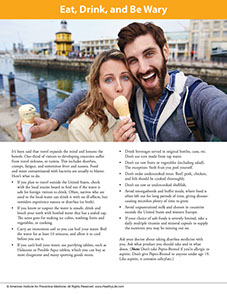
    Image of couple eating at a resturant.

    It’s been said that travel expands the mind and loosens the bowels. One-third of visitors to developing countries suffer from travel sickness, or turista. This includes diarrhea, cramps, fatigue, and sometimes fever and nausea. Food and water contaminated with bacteria are usually to blame. Here’s what to do.

    *  If you plan to travel outside the United States, check with the local tourist board to find out if the water is safe for foreign visitors to drink.  Often, natives who are used to the local water can drink it with no ill effects, but outsiders experience nausea or diarrhea (or both).

    *  If you know or suspect the water is unsafe, drink and brush your teeth with bottled water that has a sealed cap. The same goes for making ice cubes, washing fruits and vegetables, or cooking.

    *  Carry an immersion coil so you can boil your water. Boil the water for at least 10 minutes, and allow it to cool before you use it.

    *  If you can’t boil your water, use purifying tablets, such as Halazone or Potable Aqua tablets, which you can buy at most drugstores and many sporting goods stores.

    *  Drink beverages served in original bottles, cans, etc. Don’t use ice made from tap water.

    *  Don’t eat raw fruits or vegetables (including salad). The exception: fresh fruit you peel yourself.

    *  Don’t order undercooked meat. Beef, pork, chicken, and fish should be cooked thoroughly.

    *  Don’t eat raw or undercooked shellfish.

    *  Avoid smorgasbords and buffet meals, where food is often left out for long periods of time, giving disease-causing microbes plenty of time to grow.

    *  Avoid unpasteurized milk and cheeses in countries outside the United States and western Europe.

    *  If your choice of safe foods is severely limited, take a daily multiple vitamin and mineral capsule to supply the nutrients you may be missing out on.

    Ask your doctor about taking diarrhea medicine with you. Ask what  product you should take and in what doses. (Note: Don’t take Pepto-Bismol if you’re allergic to aspirin. Don’t give Pepto-Bismol to anyone under age 19. Like aspirin, it contains salicylate.)

    Page image from A Year of Health Hints book by the American Institute for Preventive Medicine. www.HealthyLife.com. All rights reserved.

    © American Institute for Preventive Medicine
  • Fitness In Flight

    Healthy Travel

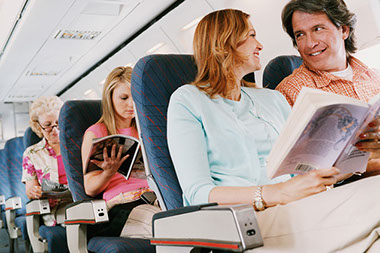
    Passengers aboard an airplane.

    Sitting in a narrow, crowded airplane seat for hours causes cramped and achy muscles, swollen feet, and fatigue. And anyone who has a problem with circulation in his or her legs runs a risk of thrombophlebitis when sitting for long periods of time. Fortunately, there are ways to prevent the typical aches and pains travelers frequently experience during long flights. One is to charter your own plane and stretch out in comfort. If you’re like most people, however, a private plane is probably beyond your means. Instead, you can try to reduce stiffness with the following exercises.

    *  Tense your feet for 5 seconds, then relax them. Repeat with each muscle group, including your calves, thighs, buttocks, shoulders, neck, forearms, and hands.

    *  Drop your head forward. Then slowly move it to your right, and continue rotating your head, to the back, to the left, and to the front again. Repeat four times. Then reverse direction, and repeat five times.

    *  Raise both shoulders, then move them back, down, and forward in a circular motion.

    *  Reaching toward the ceiling, stretch your right arm. Then repeat with your left arm.

    To promote circulation in your legs:

    *  Flex and extend your feet, pointing your toes up and down.

    *  Try to get up and walk at least once every 2 hours, if possible. You should also make an effort to breathe slowly and deeply. Aircraft air is lower in oxygen than outdoor air, and deep breathing helps you to get enough oxygen into your blood and avoid fatigue or sluggishness.

    Page image from A Year of Health Hints book by the American Institute for Preventive Medicine. www.HealthyLife.com. All rights reserved.

    © American Institute for Preventive Medicine
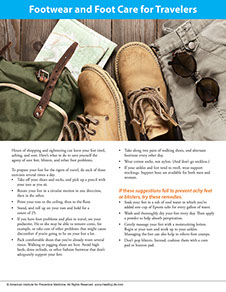
  • Footwear And Foot Care For Travelers

    Healthy Travel

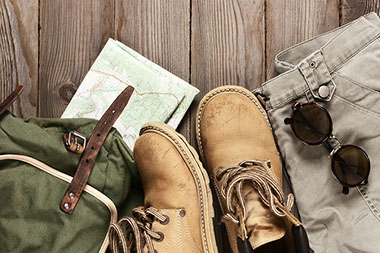
    Image of hiking boots, backpack and map.

    Hours of shopping and sightseeing can leave your feet tired, aching, and sore. Here’s what to do to save yourself the agony of sore feet, blisters, and other foot problems.

    To prepare your feet for the rigors of travel, do each of these exercises several times a day.

    *  Take off your shoes and socks, and pick up a pencil with your toes as you sit.

    *  Rotate your feet in a circular motion in one direction, then in the other.

    *  Point your toes to the ceiling, then to the floor.

    *  Stand, and roll up on your toes and hold for a count of 25.

    *  If you have foot problems and plan to travel, see your podiatrist. He or she may be able to remove corns, for example, or take care of other problems that might cause discomfort if you’re going to be on your feet a lot.

    *  Pack comfortable shoes that you’ve already worn several times. Walking or jogging shoes are best. Avoid high heels, dress oxfords, or other fashion footwear that don’t adequately support your feet.

    *  Take along two pairs of walking shoes, and alternate footwear every other day.

    *  Wear cotton socks, not nylon. (And don’t go sockless.)

    *  If your ankles and feet tend to swell, wear support stockings. Support hose are available for both men and women.

    If these suggestions fail to prevent achy feet or blisters, try these remedies.

    *  Soak your feet in a tub of cool water to which you’ve added one cup of Epsom salts for every gallon of water.

    *  Wash and thoroughly dry your feet every day. Then apply a powder to help absorb perspiration.

    *  Gently massage your feet with a moisturizing lotion. Begin at your toes and work up to your ankles. Massaging the feet can also help to relieve foot cramps.

    *  Don’t pop blisters. Instead, cushion them with a corn pad or bunion pad.

    Page image from A Year of Health Hints book by the American Institute for Preventive Medicine. www.HealthyLife.com. All rights reserved.

    © American Institute for Preventive Medicine
  • How To Prevent Jet Lag

    Healthy Travel

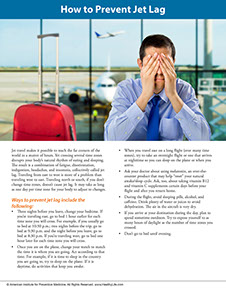
    Image of man covering his face while at the airport.

    Jet travel makes it possible to reach the far corners of the world in a matter of hours. Yet crossing several time zones disrupts your body’s natural rhythm of eating and sleeping. The result is a combination of fatigue, disorientation, indigestion, headaches, and insomnia, collectively called jet lag. Traveling from east to west is more of a problem than traveling west to east. Traveling north or south, if you don’t change time zones, doesn’t cause jet lag. It may take as long as one day per time zone for your body to adjust to changes.

    Ways to prevent jet lag include the following:

    *  Three nights before you leave, change your bedtime. If you’re traveling east, go to bed 1 hour earlier for each time zone you will cross. For example, if you usually go to bed at 10:30 p.m.; two nights before the trip, go to bed at 9:30 p.m. and the night before you leave, go to bed at 8:30 p.m. If you’re traveling west, go to bed one hour later for each time zone you will cross.

    *  Once you are on the plane, change your watch to match the time it is where you are going. Act according to that time. For example, if it is time to sleep in the country you are going to, try to sleep on the plane. If it is daytime, do activities that keep you awake.

    *  When you travel east on a long flight (over many time zones), try to take an overnight flight or one that arrives at nighttime so you can sleep on the plane or when you arrive.

    *  Ask your doctor about using melatonin, an over-the-counter product that may help “reset” your natural awake/sleep cycle. Ask, too, about taking vitamin B12 and vitamin C supplements certain days before your flight and after you return home.

    *  During the flight, avoid sleeping pills, alcohol, and caffeine. Drink plenty of water or juices to avoid dehydration. The air in the aircraft is very dry.

    *  If you arrive at your destination during the day, plan to spend some time outdoors. Try to expose yourself to as many hours of daylight as the number of time zones you crossed.

    *  Don’t go to bed until evening.

    Page image from A Year of Health Hints book by the American Institute for Preventive Medicine. www.HealthyLife.com. All rights reserved.

    © American Institute for Preventive Medicine
  • How To Prevent Motion Sickness

    Healthy Travel

    Motion sickness is like a hangover you don’t deserve. Symptoms include fatigue, dizziness, nausea, vomiting, pallor, and sweating. Experts think this misery results because your eyes and inner ear receive conflicting messages when you travel by car, boat, or plane. The inner ear, which is responsible for your sense of balance, tells your body it’s moving in one direction, while your eyes tell you you’re moving in another. So closing your eyes can reduce the conflict. The following steps can also help prevent motion sickness.

    Aboard ship:

    *  Spend as much time as you can on deck in the fresh air.

    *  If you’re going to be spending the night (or nights) on a boat, try to get a cabin near the middle of the craft, close to the waterline, where there’s less pitching and rolling.

    On a plane:

    *  Request a seat over the wings. Avoid sitting in the tail section; it’s the bumpiest.

    *  Open the overhead vents and direct air at your face.

    On land transportation:

    *  Fix your gaze on the scenery straight ahead, not to the side.

    *  Sit near an open window, for fresh air, unless you’re traveling through a heavily polluted area.

    *  If you’re traveling by car, offer to drive. The person at the wheel never gets motion sickness.

    In addition, the following steps are helpful no matter what your means of transportation.

    *  Get plenty of rest before setting out. Fatigue makes you more vulnerable to motion sickness.

    *  Avoid drinking alcohol before or during travel, and don’t overindulge the night before.

    *  Take an over-the-counter motion sickness medication (such as Dramamine) approximately 30 minutes before travel begins. Read the package for cautions and other important information.

    *  If over-the-counter medications don’t bring relief, ask your doctor about a prescription medication containing scopolamine, available as a patch that’s usually worn behind your ear.

    *  Don’t read while traveling and don’t try to focus on any other stationary object. Aboard a ship, lie down on your back and close your eyes.

    *  If any of your traveling companions get sick, move as far away from them as possible; otherwise, you may get sick, too.

    Some people report that taking tablets of powdered gingerroot relieves their motion sickness. Others find relief by pressing on an acupressure point about midway on the inside of the wrist, where the hand and forearm meet.

    If preventive measures fail and you feel sick anyway, you can try the following:

    *  Breathe slowly and deeply.

    *  Remove yourself from smoke and food odors, and get some fresh air.

    *  To reduce tension and anxiety, concentrate on relaxing all your muscles, as though you’re a limp rag doll, and visualize a peaceful scene.

    *  To settle a queasy stomach, eat dry crackers.

    Page image from A Year of Health Hints book by the American Institute for Preventive Medicine. www.HealthyLife.com. All rights reserved.

    © American Institute for Preventive Medicine
  • Hassle-Free Screening Tips While Traveling

    WELL-BEING

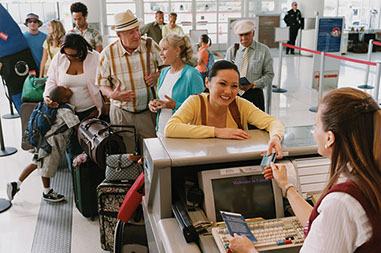
    Image of airport check-in line.

    If you’re flying, make sure you familiarize yourself with the TSA screening process. You’ll have smooth flying if you do the following when passing through airport security:

    *Clothing:To maximize efficiency at the security checkpoint, avoid wearing clothing with metal and stow all metal items in carry-on luggage.

    *Zip it:Make sure any liquids are in 3-ounce bottles in a clear, quart-size, zip top plastic bag.

    *Footwear:Passengers are required to remove footwear for X-ray screening. Wearing footwear that can be easily removed helps speed the screening process.

    *Boarding pass and ID:When approaching the security checkpoint, passengers will be asked to present a boarding pass and a government-issued identification.

    *Electronics:Large electronics such as laptops should be removed from their cases for X-ray screening. E-readers and small electronics may stay in luggage.

    *Locking checked bags:When locking checked baggage, use a TSA recognized lock. A list of these locks can be found atwww.tsa.gov.

    © American Institute for Preventive Medicine
  • How Not To Get Sick When Traveling

    SELF-CARE CORNER

    Illustration of different city landmarks.

    Nothing can ruin a vacation faster than someone getting sick. Whether you’re planning a trip just an hour away or across the ocean, there are many things you can do to stay healthy while away from home.

    See your doctor before you go

    Get a checkup before you go on vacation. Ask the doctor if you need any vaccines or preventive medicines. Some countries require vaccines that you wouldn’t normally need in the U.S. Make plans to get everyone vaccinated at least six weeks before you leave.

    If you take any medicines regularly, make sure you have enough to last throughout your trip. Running out of a prescription medicine can be inconvenient – or even dangerous –  if you’re not near your doctor or pharmacy. If possible, keep your medicine with you in a carry-on bag so you have it with you at all times.

    Avoid traveler’s diarrhea

    Traveler’s diarrhea is the most common travel-related illness. It can happen nearly anywhere if you eat contaminated food or drink contaminated water. Lower your risk of getting it with these guidelines:

    *  Eat only cooked food served hot.

    *  Avoid eating food from street vendors, if possible.

    *  Don’t eat or drink unpasteurized milk or dairy products.

    *  Avoid eating raw seafood or undercooked meats.

    *  Avoid tap water and ice on airplanes and in places where water may not be safe. Drink only commercially-bottled water and beverages.

    *  Use bottled water to brush your teeth when traveling abroad. Don’t get shower water in your mouth.

    *  Wash your hands thoroughly and often. Be especially careful about washing hands after using the bathroom and before eating.

    *  Consider bringing some anti-diarrhea medicine with you in case you get sick. Make sure you stay hydrated with water, electrolyte drinks, and/or sports drinks.

    Tell bugs to buzz off

    Mosquitoes can spread disease, both in the U.S. and abroad. Protect yourself by wearing repellents with DEET. Use bed nets for international travel in areas where bugs are a problem. If you’re traveling to a country with a higher risk of malaria, ask your doctor about preventive medicine to take before you go on your trip. Be sure to also pack lightweight clothing that covers the arms and legs to keep bugs off.

    A few simple precautions can ensure you have a safe and healthy summer vacation.

    © American Institute for Preventive Medicine