Tag: Weight Control

  • Digging Into Detox Diets

    HEALTHY EATING

    Image of different berries.

    The word “detox” is a popular term in diets today. Many detox diets and plans promise to help your body flush out toxins and get you healthier.

    Some detox diets follow extreme guidelines like:

    *  Fasting (not eating) for long periods

    *  Drinking only special detox drinks or juices

    *  Using supplements or products that claim to detox your body

    *  Using laxatives, enemas or other products to empty the colon

    Safety concerns

    Many detox plans haven’t been proven to be safe. Supplements and extreme diets can cause health problems. The Food and Drug Administration (FDA) has taken action against detox products that are dangerous or contain illegal ingredients.

    Don’t assume that a “natural” detox plan is safe. It may be risky because:

    *  Drinking large quantities of juice can be dangerous for people with kidney disease.

    *  Drinking juices that are “raw” or unpasteurized can cause serious illnesses from bacteria.

    *  People with diabetes often need to eat a healthy diet and need to eat at regular times. Fasting or drinking juice instead of meals can cause dangerous blood sugar levels.

    *  Using too many laxatives can cause dehydration, severe diarrhea and an imbalance in minerals and vitamins.

    *  Fasting for long periods can cause headaches, dehydration and fainting.

    Your body’s own detox

    The human body is already designed to get rid of toxins. Most of this is done by the liver, which processes and removes chemicals, toxins and other unwanted things.

    Supporting your liver is a healthy and safe way to “detox” without extreme or dangerous diets. You can support your liver by:

    *  Eating a healthy diet rich in fruits, vegetables, lean protein and whole grains

    *  Working toward a healthy weight if you’re overweight

    *  Avoiding or limiting processed foods

    *  Drinking plenty of water

    *  Avoiding or limiting alcoholic drinks

    *  Getting exercise regularly

    *  Following directions on medicines and take medicines as your doctor prescribes

    *  Getting vaccines for hepatitis A and B, which are diseases that affect the liver

    Not all diets are safe. Before you start any detox or diet plan, ask your doctor.

    Sources: American Liver Foundation, National Center for Complementary and Integrative Health

    © American Institute for Preventive Medicine
  • How To Survive A Dieting Setback

    Weight Control

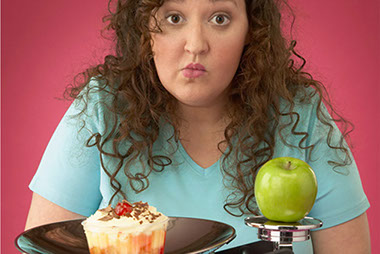
    Image of women in front of a cupcake and apple on a scale.

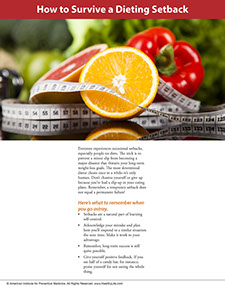
    Everyone experiences occasional setbacks, especially people on diets. The trick is to prevent a minor slip from becoming a major disaster that thwarts your long-term weight-loss goals.

    The most determined dieter cheats once in a while-it’s only human. Don’t chastise yourself or give up because you’ve had a slip-up in your eating plans. Remember, a temporary setback does not equal a permanent failure!

    Here’s what to remember when you go astray.

    *  Setbacks are a natural part of learning self-control.

    *  Acknowledge your mistake and plan how you’ll respond to a similar situation the next time. Make it work to your advantage.

    *  Remember, long-term success is still quite possible.

    *  Give yourself positive feedback. If you eat half of a candy bar, for instance, praise yourself for not eating the whole thing.

    Page from A Year of Health Hints book by the American Institute for Preventive Medicine. www.HealthyLife.com. All rights reserved.

    © American Institute for Preventive Medicine
  • Weight Control

    Weight Control

    General Guidelines

    © American Institute for Preventive Medicine
  • Mindfulness 3

    SleepWell® Program

    Week 4

    Image of women sitting out in nature.

    Mindfulness means you are fully aware of all aspects of what you are sensing in the present moment.

    *  You focus on current thoughts without judging them.

    *  You put past thoughts and what the future has in store out of your mind.

    Mindfulness Exercise

    *  Set aside five (or more) minutes. Find a place with no distractions. Get comfortable.

    *  Focus on your breathing or anything in the present, such as the sounds you hear or an object in your sight.

    *  As thoughts pop up in your mind, let them go without judging them. Return your focus to what you see, hear, feel, or are doing in the moment.

    You can also practice mindfulness while you listen to music, walk, run, garden, or with any activity.

    Take a Rest from Your Emotions

    Detach yourself from your thoughts and emotions. Imagine sitting on a hill and viewing your thoughts and feelings at the bottom of the hill. Observe your thoughts as they pass by. Or, you can stop and think about them. Tell yourself: “I have control over when and how I think about a situation.”

    Allow your emotional reactions to a situation or issue take a rest for a bit. This helps your mind use logical thinking.

    © American Institute for Preventive Medicine

  • Healthy Weight, Healthy Kids

    HEALTHY EATING

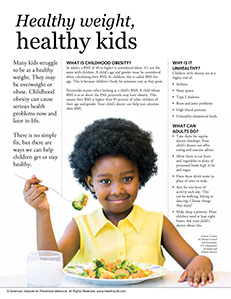
    Young child smiling eating vegetables.

    Many kids struggle to be at a healthy weight. They may be overweight or obese. Childhood obesity can cause serious health problems now and later in life.

    There is no simple fix, but there are ways we can help children get or stay healthy.

    What is childhood obesity?

    In adults, a BMI of 40 or higher is considered obese. It’s not the same with children. A child’s age and gender must be considered when calculating their BMI. In children, this is called BMI-for-age. This is because children’s body fat amounts vary as they grow.

    Percentiles matter when looking at a child’s BMI. A child whose BMI is at or above the 95th percentile may have obesity. This means their BMI is higher than 95 percent of other children of their age and gender. Your child’s doctor can help you calculate their BMI.

    Why is it unhealthy?

    Children with obesity are at a higher risk of:

    *  Asthma

    *  Sleep apnea

    *  Type 2 diabetes

    *  Bone and joint problems

    *  High blood pressure

    *  Unhealthy cholesterol levels

    What can adults do?

    *  Take them for regular doctor checkups. Your child’s doctor can offer eating and exercise advice.

    *  Allow them to eat fruits and vegetables in place of processed foods high in fat and sugar.

    *  Have them drink water in place of juice or soda.

    *  Aim for one hour of activity each day. This can be walking, biking or dancing. Choose things they enjoy!

    *  Make sleep a priority. Most children need at least eight hours. Ask your child’s doctor about this.

    Sources: Centers for Disease Control and Prevention, U.S. Department of Health and Human Services

    © American Institute for Preventive Medicine
  • Keep Fat At Bay With Water Each Day

    Weight Control

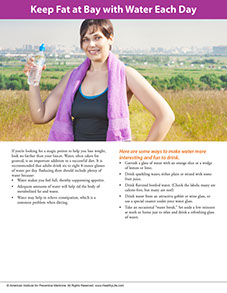
    Image of water bottle.

    If you’re looking for a magic potion to help you lose weight, look no farther than your faucet. Water, often taken for granted, is an important addition to a successful diet. It is recommended that adults drink six to eight 8-ounce glasses of water per day. Reducing diets should include plenty of water because:

    *  Water makes you feel full, thereby suppressing appetite.

    *  Adequate amounts of water will help rid the body of metabolized fat and waste.

    *  Water may help to relieve constipation, which is a common problem when dieting.

    Here are some ways to make water more interesting and fun to drink.

    *  Garnish a glass of water with an orange slice or a wedge of lemon or lime.

    *  Drink sparkling water, either plain or mixed with some fruit juice.

    *  Drink flavored bottled water. (Check the labels; many are calorie-free, but many are not!)

    *  Drink water from an attractive goblet or wine glass, or use a special coaster under your water glass.

    *  Take an occasional “water break.” Set aside a few minutes at work or home just to relax and drink a refreshing glass of water.

    Page from A Year of Health Hints book by the American Institute for Preventive Medicine. www.HealthyLife.com. All rights reserved.

    © American Institute for Preventive Medicine

  • Whittle Your Waist

    Weight Control

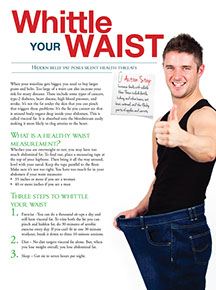
    Hidden belly fat poses silent health threats.

    When your waistline gets bigger, you need to buy larger pants and belts. Too large of a waist can also increase your risk for many diseases. These include some types of cancers, type-2 diabetes, heart disease, high blood pressure, and stroke. It’s not the fat under the skin that you can pinch that triggers these problems. It’s the fat you cannot see that is around body organs deep inside your abdomen. This is called visceral fat. It is absorbed into the bloodstream easily making it more likely to clog arteries to the heart.

    What is a healthy waist measurement?

    Whether you are overweight or not, you may have too much abdominal fat. To find out, place a measuring tape at the top of your hipbone. Then bring it all the way around, level with your naval. Keep the tape parallel to the floor. Make sure it’s not too tight. You have too much fat in your abdomen if your waist measures:

    *  35 inches or more if you are a woman

    *  40 or more inches if you are a man

    Three steps to whittle your waist:

    1.  Exercise −You can do a thousand sit-ups a day and still have visceral fat. To trim both the fat you can pinch and hidden fat, do 30 minutes of aerobic exercise every day. If you can’t fit in one 30 minute workout, break it down to three 10-minute sessions.

    2.  Diet − No diet targets visceral fat alone. But, when you lose weight overall, you lose abdominal fat.

    3.  Sleep – Get six to seven hours per night.

    Action Step

    Increase foods with soluble fiber. These include lentils, kidney and other beans, oat bran, oatmeal, and the fleshy parts of apples and carrots.

    Page from Ways to Well-Being book by the American Institute for Preventive Medicine. www.HealthyLife.com. All rights reserved.

    © American Institute for Preventive Medicine
  • Practice Relaxation Techniques 3

    SleepWell® Program

    Week 4

    Image of man deep breathing.

    Learn These Three Skills to Relax

    1.  Relaxation Reflex: Get rid of muscle tension.

    2.  Mental Imagery: Think of calm, restful places.

    3.  Deep Natural Breathing: Feel relaxed by breathing in more oxygen.

    Plan Relaxation Time

    If possible, use the hour before you sleep to wind down and prepare your body and mind for sleep. You can also do relaxation exercises as needed throughout the day. Relaxation techniques can help reduce stress-related health problems, such as high blood pressure, headaches, and pain. These tools also help you to exercise greater mental and physical control and reduce negative emotions.

    How the mind can control the body:

    *  It can slow brain wave patterns.

    *  It can reduce heart and breathing rates.

    *  It can increase blood flow to your limbs.

    *  It can relax muscles.

    Prepare for Relaxation

    Remove external factors that could be causing your body and mind to be overly alert. Watching TV is ok, but avoid loud, violent, or exciting programs. Mindless programs are better. Dim the lights. Play a quiet game (though not on your phone or computer), read a book, or organize your sock drawer or the clothes in your closet.

    A bath taken two hours before bedtime allows your body temperature to drop to a sleep-inducing level.

    Relaxation Reflex

    This skill relaxes four basic muscle groups. Tightening and relaxing these muscles produces a soothing effect which helps you relax. Take slow deep breaths, drop your head, and place your shoulders forward to add to the effect.

    Practice this every day for about five to 10 minutes. Divide the body into four muscle groups. Tense each group for five seconds, then release.

    1. Arms and Hands – Lift your arms, bend them at your wrists and elbows, make fists, and tighten your upper arms.

    2. Face and Neck – Squinch your eyes, nose, cheeks and brow. Stretch your mouth and grit your teeth. Point your chin down toward your chest.

    3. Middle Torso – Push your shoulders back, tighten your stomach and the middle of your back.

    4. Legs and Feet – Lift your legs off the floor and hold them straight out. Point your toes towards your face. Tighten your thighs.

    Mental Imagery

    Choose a peaceful scene like a beach, forest, or sunrise. You can even choose a place of fantasy. Then take an imaginary visit there and relax in the process. Imagine this place using the following 10 steps:

    1. Find a comfortable sitting or reclining position.

    2. Gently close your eyes.

    3. Notice nothing but your own gentle breathing pattern.

    4. Begin to think about your peaceful scene. Picture where you are and what you do when your mind and body are very, very relaxed. Pause to create and capture the image of your soothing place.

    5. Pretend that you are really there in your special relaxing environment. Picture all the colors… Hear the sounds… Smell the aromas… Taste… Touch your surroundings as if you are really there… Enjoy… Relax…

    6. Find the calm and peace. Allow yourself to feel good… Let your whole body relax and enjoy the moment.

    7. Pause for five to 10 minutes and become filled with relaxation.

    8. Allow the relaxation to re-energize your body and mind.

    9. As you feel comfortable, slowly open your eyes, feeling totally refreshed.

    10. Escape to your special place anytime you wish to relax, if even for a moment.

    Deep Natural Breathing

    An increased amount of oxygen allows your heart rate to slow down. This produces a calming effect.

    1. Sit in a chair, arms at your sides, with your legs uncrossed.

    2. Note any tension in your muscles.

    3. Put one hand on your chest and the other hand on your abdomen.

    4. Take in a breath slowly and deeply through your nose allowing your abdomen to expand and push up your hand. After your abdomen is full of air, allow your chest to expand, pushing up your other hand. This is one long steady breath.

    5. Hold the air in for three seconds.

    6. Purse your lips and exhale through your mouth making a relaxing, whooshing sound.

    7. Continue to take long, slow, deep inhales through your nose and let out long, slow exhales through your mouth.

    8. Focus on the sound and feeling of deep breathing. Continue for three to five minutes.

    9. Your chest should feel less constricted. You should feel less stress and tension physically and mentally.

    © American Institute for Preventive Medicine
  • Mindful Eating Can Boost Your Health

    HEALTHY EATING

    Women eating with friends.

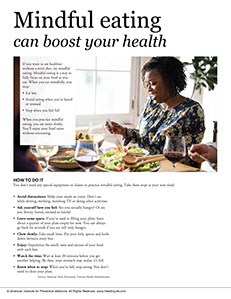
    If you want to eat healthier without a strict diet, try mindful eating. Mindful eating is a way to fully focus on your food as you eat. When you eat mindfully, you may:

    *  Eat less

    *  Avoid eating when you’re bored or stressed

    *  Stop when you feel full

    When you practice mindful eating, you eat more slowly. You’ll enjoy your food more without overeating.

    How to do it

    You don’t need any special equipment or classes to practice mindful eating. Take these steps at your next meal:

    *Avoid distractions:Make your meals an event. Don’t eat while driving, working, watching TV or doing other activities.

    *Ask yourself how you feel:Are you actually hungry? Or are you thirsty, bored, stressed or lonely?

    *Leave some space:If you’re used to filling your plate, leave about a quarter of your plate empty for now. You can always go back for seconds if you are still truly hungry.

    *Chew slowly:Take small bites. Put your fork, spoon and knife down between every bite.

    *Enjoy:Experience the smell, taste and texture of your food with each bite.

    *Watch the time:Wait at least 20 minutes before you get another helping. By then, your stomach may realize it’s full.

    *Know when to stop:When you’re full, stop eating. You don’t need to clean your plate.

    Sources: American Heart Association, Veterans Health Administration

    © American Institute for Preventive Medicine
  • Know Your Bmi

    Weight Control

    A simple measurement can help detect your health risks.

    Body Mass Index − BMI− estimates body fat based on height and weight. Underwater weighing gives a more exact measure of body fat, but is costly and not practical. BMI is used as a screening tool to place people in categories of underweight, normal weight, overweight, or obese.

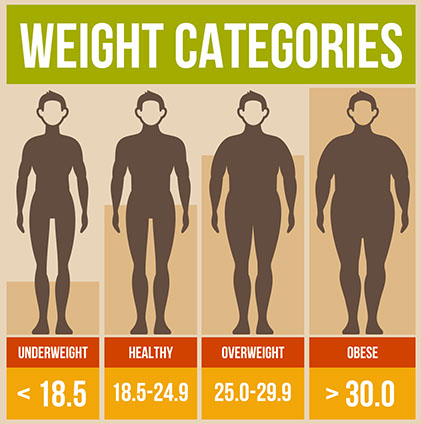
    Illustration of BMI weight categories.

    What’s your number?

    To find your BMI, multiply your weight in pounds by 703.

    Divide this number by your height in inches squared.

    Example: Weight = 150 lbs; Height = 5’5″ (65″)

    Calculation: [(150 x 703) ÷ (65²)] = 24.96

    If you’d rather not do the math, use the online calculator  from the National Heart, Lung, and Blood Institute atwww.nhlbisupport.com/bmi.

    BMI – WEIGHT STATUS

    Below 18.5 – Underweight

    18.5 – 24.9 – Normal

    25.0 – 29.9 – Overweight

    30.0 and above Obese

    A BMI above the normal weight range is less healthy for most people. It may be fine if you have lots of muscle and little fat. In general, though, if your BMI is above the normal range, you are at an increased risk for many diseases and health conditions. These include:

    *  Breathing problems

    *  Gallbladder disease

    *  High blood cholesterol

    *  High blood pressure

    *  Type 2 diabetes

    *  Heart disease

    *  Osteoarthritis

    *  Some cancers, such as ones   of the breast, colon, kidney,  and pancreas

    *  Stroke

    The higher the BMI, the higher the risk for these problems.

    Other factors to consider

    Bodies vary. BMI does not take body fat percentage into account. For people who are very muscular, their BMI may overestimate body fat. BMI may underestimate body fat in older persons or those losing muscle. People over age 65 should check with their doctors for their  recommended BMI.

    Action Step

    Discuss your BMI with your doctor.  Ask about your personal risk of weight-related chronic diseases. Together, make an action plan to reduce your risks.

    Page from Ways to Well-Being book by the American Institute for Preventive Medicine. www.HealthyLife.com. All rights reserved.

    © American Institute for Preventive Medicine