Tag: Work Life

  • Breastfeeding And Work

    WORK LIFE

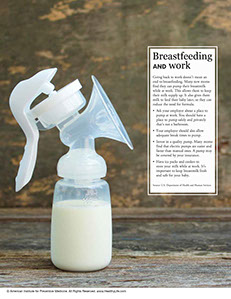
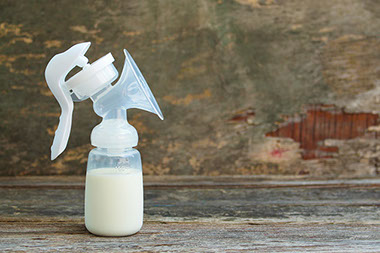
    Breast pump bottle filled with milk.

    Going back to work doesn’t mean an end to breastfeeding. Many new moms find they can pump their breastmilk while at work. This allows them to keep their milk supply up. It also gives them milk to feed their baby later, so they can reduce the need for formula.

    *  Ask your employer about a place to pump at work. You should have a place to pump safely and privately that’s not a bathroom.

    *  Your employer should also allow adequate break times to pump.

    *  Invest in a quality pump. Many moms find that electric pumps are easier and faster than manual ones. A pump may be covered by your insurance.

    *  Have ice packs and coolers to store your milk while at work. It’s important to keep breastmilk fresh and safe for your baby.

    Source: U.S. Department of Health and Human Services

    © American Institute for Preventive Medicine

  • Balance It All

    Work Life

    Mother and son sitting while son is writing in a notebook.

    Career, family, and a personal life. You can have it all, can’t you? Absolutely! But when the demands of work overtake the demands of your family and personal life, you can suffer chronic stress and burnout. And miss out on some of the best things in life. Sometimes it takes effort to balance it all.

    The key might be to keep your eye on your values, learn to say no, stop reaching for perfection, and “unplug” regularly.

    ays to Well-Being book by the American Institute for Preventive Medicine. www.HealthyLife.com. All rights reserved.

    © American Institute for Preventive Medicine

  • Conquer Job Stress

    SUCCESS OVER STRESS

    Happy man with arms up while setting at work desk.

    Burnout: When stress goes too far

    When stress goes on for too long, a person may feel “burned out.” This usually means they become exhausted and unable to do their job well anymore. They may also become negative or feel angry toward others at work.

    Burnout can seriously affect your health. It can lead to depression and possibly other problems, like heart disease and stroke.

    Stop the cycle

    It’s not too late to manage your work stress. Even if you feel your stress is high, there are ways to make things better. Here’s how:

    *Take breaks – even short ones.Just 10 minutes of downtime during the day can make a big difference in your stress levels. Don’t work through lunch and break times.

    *Practice the art of waiting and walking away.If you feel angry or stressed about something, don’t respond right away. Say something like, “let me think about that and get back to you.” Avoid sending angry emails when you feel stressed.

    *Go easy on yourself.Are you expecting perfection from yourself? No one is perfect. Learn from mistakes and move on.

    *Discuss your concerns.If you’re having trouble with something at work, talk to your supervisor about solutions. Don’t keep it bottled inside and assume it will work itself out.

    Source: American Psychological Association

    © American Institute for Preventive Medicine

  • Manage Job Stress

    Work Life

    Job stress causes a worker to feel overly taxed both mentally and physically. It affects both workers and employers.

    What Causes Job Stress?

    *  Too much work to do. Conflicting expectations.

    *  Lack of support from co-workers and bosses.

    *  Crowded, noisy, unsafe work conditions. Infrequent rest breaks.

    *  Rapid changes for which workers are not prepared. Job insecurity.

    If not dealt with, job stress can lead to health problems.

    Signs & Symptoms of Job Stress

    *  Hard time concentrating. Headache.

    *  Sleep problems. Stomach problems.

    *  Short temper.

    *  Job dissatisfaction. Low morale.

    *  Increase in being late for work or not going to work.

    Ways to Manage Job Stress

    *  Schedule your time and tasks to be done. Use a calendar, planner, “TO DO” lists, etc. Rank order tasks. Break tasks down into steps. Check off items that are done.

    *  Organize your work space to make it easier to find things. Get rid of items and e-mails that you don’t need.

    *  Ask for help from your boss and co-workers, as needed. Ask your boss for the order in which your job tasks need to be done.

    *  Take breaks. Get enough sleep.

    *  Leave work at work. Try not to take work home. If this is not possible, take as little work home as you need to.

    *  Plan for and take vacations that give you a rest from work.

    *  Relax as much as you can.

    Resources

    National Institute for Occupational Safety and Health (NIOSH)

    800.CDC.INFO (232.4636)

    www.cdc.gov/niosh

    Occupational Safety and Health Administration (OSHA)

    800.321.OSHA (321.6742)

    www.osha.gov

    Healthier at Home book by the American Institute for Preventive Medicine. www.HealthyLife.com. All rights reserved.

    © American Institute for Preventive Medicine

  • Dealing With Difficult Personalities

    WORK LIFE

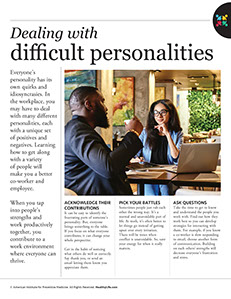
    Two coworkers sitting with laptop, talking and drinking coffee.

    Everyone’s personality has its own quirks and idiosyncrasies. In the workplace, you may have to deal with many different personalities, each with a unique set of positives and negatives. Learning how to get along with a variety of people will make you a better co-worker and employee.

    When you tap into people’s strengths and work productively together, you contribute to a work environment where everyone can thrive.

    Acknowledge their contributions

    It can be easy to identify the frustrating parts of someone’s personality. But, everyone brings something to the table. If you focus on what everyone contributes, it can change your whole perspective.

    Get in the habit of noticing what others do well or correctly. Say thank you, or send an email letting them know you appreciate them.

    Pick your battles

    Sometimes people just rub each other the wrong way. It’s a normal and unavoidable part of life. At work, it’s often better to let things go instead of getting upset over every irritation. There will be times when conflict is unavoidable. So, save your energy for when it really matters.

    Ask questions

    Take the time to get to know and understand the people you work with. Find out how they work best so you can develop strategies for interacting with them. For example, if you know a co-worker is slow responding to email, choose another form of communication. Building on each others’ strengths will decrease everyone’s frustration and stress.

    © American Institute for Preventive Medicine

  • Prevent Burnout 2

    Work Life

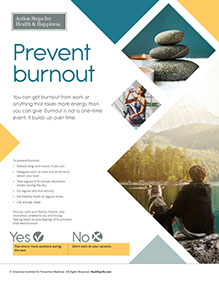
    Man sitting on roack along a lake with his dog.

    You can get burnout from work or anything that takes more energy than you can give. Burnout is not a one-time event. It builds up over time.

    To prevent burnout:

    *  Reduce long work hours, if you can.

    *  Delegate tasks at work and at home to lessen your load.

    *  Take regular 5-10 minute relaxation breaks during the day.

    *  Do regular physical activity.

    *  Eat healthy foods at regular times.

    *  Get enough sleep.

    *  Plan one or more vacations during the year.

    *  Don’t work on your vacation.

    Discuss, with your family, friends, and coworkers, problems you are having. Talking helps to ease feelings of frustration that feed burnout.

    ays to Well-Being book by the American Institute for Preventive Medicine. www.HealthyLife.com. All rights reserved.

    © American Institute for Preventive Medicine

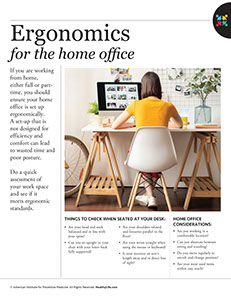
  • Ergonomics For The Home Office

    WORK LIFE

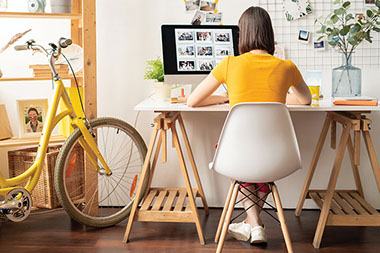
    Women sitting at desk working on computer.

    If you are working from home, either full or part-time, you should ensure your home office is set up ergonomically. A set-up that is not designed for efficiency and comfort can lead to wasted time and poor posture.

    Do a quick assessment of your work space and see if it meets ergonomic standards.

    Things to check when seated at your desk:

    *  Are your head and neck balanced and in line with your spine?

    *  Can you sit upright in your chair with your lower back fully supported?

    *  Are your shoulders relaxed and forearms parallel to the floor?

    *  Are your wrists straight when using the mouse or keyboard?

    *  Is your monitor an arm’s length away and in direct line of sight?

    Home office considerations:

    *  Are you working in a comfortable location?

    *  Can you alternate between sitting and standing?

    *  Do you move regularly to stretch and change position?

    *  Are your most used items within easy reach?

    © American Institute for Preventive Medicine

  • Prevent Musculoskeletal Disorders

    Work Life

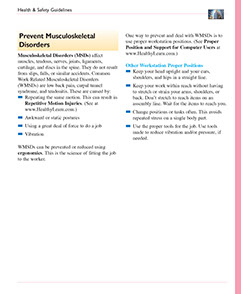
    Musculoskeletal Disorders (MSDs) affect muscles, tendons, nerves, joints, ligaments, cartilage, and discs in the spine. They do not result from slips, falls, or similar accidents. Common Work-Related Musculoskeletal Disorders (WMSDs) are low back pain, carpal tunnel syndrome, and tendonitis. These are caused by:

    *  Repeating the same motion. This can result in Repetitive Motion Injuries.

    *  Awkward or static postures

    *  Using a great deal of force to do a job

    *  Vibration

    WMSDs can be prevented or reduced using ergonomics. This is the science of fitting the job to the worker.

    One way to prevent and deal with WMSDs is to use proper workstation positions.

    Other Workstation Proper Positions

    *  Keep your head upright and your ears, shoulders, and hips in a straight line.

    *  Keep your work within reach without having to stretch or strain your arms, shoulders, or back. Don’t stretch to reach items on an assembly line. Wait for the items to reach you.

    *  Change positions or tasks often. This avoids repeated stress on a single body part.

    *  Use the proper tools for the job. Use tools made to reduce vibration and/or pressure, if needed.

    Healthier at Home book by the American Institute for Preventive Medicine. www.HealthyLife.com. All rights reserved.

    © American Institute for Preventive Medicine

  • Get Up & Move After Work

    WORK LIFE

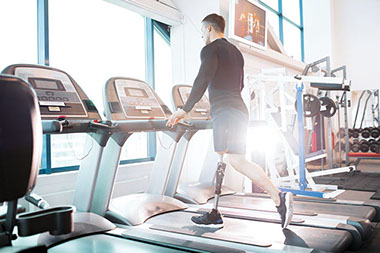
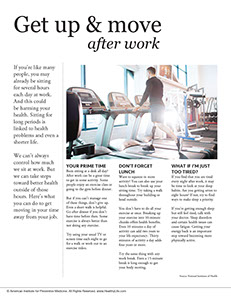
    Man with amputee leg using the treadmill.

    If you’re like many people, you may already be sitting for several hours each day at work. And this could be harming your health. Sitting for long periods is linked to health problems and even a shorter life.

    We can’t always control how much we sit at work. But we can take steps toward better health outside of those hours. Here’s what you can do to get moving in your time away from your job.

    Your prime time

    Been sitting at a desk all day? After work can be a great time to get in some activity. Some people enjoy an exercise class or going to the gym before dinner.

    But if you can’t manage one of these things, don’t give up. Even a short walk is helpful. Go after dinner if you don’t have time before then. Some exercise is always better than not doing any exercise.

    Try using your usual TV or screen time each night to go for a walk or work out to an exercise video.

    Don’t forget lunch

    Want to squeeze in more activity? You can also use your lunch break to break up your sitting time. Try taking a walk throughout your building or head outside.

    You don’t have to do all your exercise at once. Breaking up your exercise into 10-minute chunks offers health benefits. Even 10 minutes a day of activity can add two years to your life expectancy. Thirty minutes of activity a day adds four years or more.

    Try the same thing with any work break. Even a 15-minute break is long enough to get your body moving.

    What if I’m just too tired?

    If you find that you are tired every night after work, it may be time to look at your sleep habits. Are you getting seven to eight hours? If not, try to find ways to make sleep a priority.

    If you’re getting enough sleep but still feel tired, talk with your doctor. Sleep disorders and certain health issues can cause fatigue. Getting your energy back is an important step toward becoming more physically active.

    Source: National Institutes of Health
    © American Institute for Preventive Medicine

  • Prevent Injuries

    Work Life

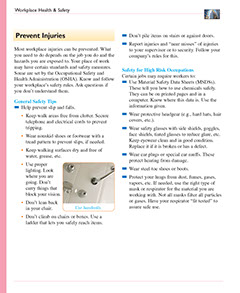
    Most workplace injuries can be prevented. What you need to do depends on the job you do and the hazards you are exposed to. Your place of work may have certain standards and safety measures. Some are set by the Occupational Safety and Health Administration (OSHA). Know and follow your workplace’s safety rules. Ask questions if you don’t understand them.

    General Safety Tips

    *  Help prevent slip and falls.

    – Keep walk areas free from clutter. Secure telephone and electrical cords to prevent tripping.

    – Wear nonskid shoes or footwear with a tread pattern to prevent slips, if needed.

    – Keep walking surfaces dry and free of water, grease, etc.

    – Use proper lighting. Look where you are going. Don’t carry things that block your vision.

    – Don’t lean back in your chair.

    – Don’t climb on chairs or boxes. Use a ladder that lets you safely reach items.

    *  Don’t pile items on stairs or against doors.

    *  Report injuries and “near misses” of injuries to your supervisor or to security. Follow your company’s rules for this.

    Safety for High Risk Occupations

    Certain jobs may require workers to:

    *  Use Material Safety Data Sheets (MSDSs). These tell you how to use chemicals safely. They can be on printed pages and in a computer. Know where this data is. Use the information given.

    *  Wear protective headgear (e.g., hard hats, hair covers, etc.).

    *  Wear safety glasses with side shields, goggles, face shields, tinted glasses to reduce glare, etc. Keep eyewear clean and in good condition. Replace it if it is broken or has a defect.

    *  Wear ear plugs or special ear muffs. These protect hearing from damage.

    *  Wear steel-toe shoes or boots.

    *  Protect your lungs from dust, fumes, gases, vapors, etc. If needed, use the right type of mask or respirator for the material you are working with. Not all masks filter all particles or gases. Have your respirator “fit tested” to assure safe use.

    Healthier at Home book by the American Institute for Preventive Medicine. www.HealthyLife.com. All rights reserved.

    © American Institute for Preventive Medicine