Tag: Work Life

  • Host Productive Meetings

    WORK LIFE

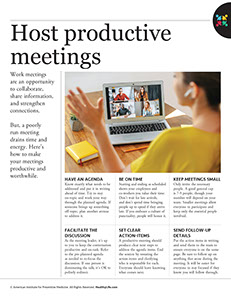
    Video conferencing.

    Work meetings are an opportunity to collaborate, share information, and strengthen connections. But, a poorly run meeting drains time and energy. Here’s how to make your meetings productive and worthwhile.

    Have an agenda

    Know exactly what needs to be addressed and put it in writing ahead of time. Try to stay on-topic and work your way through the planned agenda. If someone brings up something off-topic, plan another avenue to address it.

    Be on time

    Starting and ending as scheduled shows your employees and co-workers you value their time. Don’t wait for late arrivals, and don’t spend time bringing people up to speed if they arrive late. If you embrace a culture of punctuality, people will honor it.

    Keep meetings small

    Only invite the necessary people. A good general cap is 7-9 people, though your number will depend on your team. Smaller meetings allow everyone to participate and keep only the essential people involved.

    Facilitate the discussion

    As the meeting leader, it’s up to you to keep the conversation productive and on-task. Refer to the pre-planned agenda as needed to re-focus the discussion. If one person is dominating the talk, it’s OK to politely redirect.

    Set clear action-items

    A productive meeting should produce clear next steps to address the agenda items. End the session by restating the action items and clarifying who is responsible for each. Everyone should leave knowing what comes next.

    Send follow-up details

    Put the action items in writing and send them to the team to ensure everyone is on the same page. Be sure to follow up on anything that arose during the meeting. It will be easier for everyone to stay focused if they know you will follow through.
    © American Institute for Preventive Medicine
  • Workstation Exercises

    Work Life

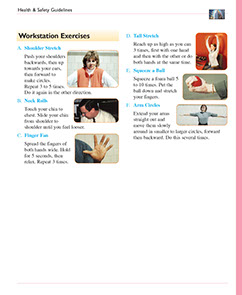
    Shoulder Stretch

    Push your shoulders backwards, then up towards your ears, then forward to make circles. Repeat 3 to 5 times. Do it again in the other direction.

    Neck Rolls

    Touch your chin to chest. Slide your chin from shoulder to shoulder until you feel looser.

    Finger Fan

    Spread the fingers of both hands wide. Hold for 5 seconds, then relax. Repeat 3 times.

    Tall Stretch

    Reach up as high as you can 3 times, first with one hand and then with the other or do both hands at the same time.

    Squeeze a Ball

    Squeeze a foam ball 5 to 10 times. Put the ball down and stretch your fingers.

    Arm Circles

    Extend your arms straight out and move them slowly around in smaller to larger circles, forward then backward. Do this several times.

    Healthier at Home book by the American Institute for Preventive Medicine. www.HealthyLife.com. All rights reserved.

    © American Institute for Preventive Medicine

  • How To Handle Criticism

    WORK LIFE

    Women at the office sitting in chair, smiling.

    No one likes to be criticized. It’s not an enjoyable experience to have your work, speech, or actions critiqued by those around you. However, handled well, criticism can be helpful. If you learn to listen and discern when a critique is valid, you can leverage the discomfort as a tool for growth.

    Steps to handle criticism

    Listen

    Resist the urge to shut down and shield yourself from the uncomfortable feeling of being criticized. Pause and listen to what is being shared.

    Don’t make it personal

    While sometimes you may experience a personal attack disguised as critique, try to separate yourself from the criticism. You’re not a bad person for having room to improve.

    Ask for clarification

    Not everyone is skilled at giving constructive criticism. You, as the receiver, may need to ask questions to determine how to improve.

    Take time to reflect

    Criticism that stings in the moment may be easier to learn from after your initial emotions fade. Take time to digest criticism to see how you can improve.

    Follow-up

    Make a follow-up plan to ensure you’ve made the necessary changes. This demonstrates your commitment to personal growth.

    If necessary, let it go

    Criticism shouldn’t hang over your head. Learn what you can and then move on. This is especially important in the face of criticism that is not helpful.

    © American Institute for Preventive Medicine
  • Keeping Cool When Work Heats Up

    WORK LIFE

    Image of a great of employees.

    Have you ever been in a tense situation at work? Perhaps two people were arguing or someone got angry with you.

    Though it’s hard to stay calm in these types of situations, it’s the best thing you can do. If you don’t react strongly, you can help defuse tension and find a helpful resolution.

    Focus on a solution

    It’s easy to get wrapped up in the problem, not the solution. Ask yourself, “what are we trying to accomplish?” Many workplace arguments start because two people have different ideas about what should be done. But, both people ultimately want to fix the same problem.

    Sometimes, an argument can be stopped if both parties remember what they both want: a good outcome. Talk about what you agree upon, and try to build from there.

    Take pause

    When something stressful is happening, your body immediately wants to respond. You may feel tense and anxious. You may also want to run from the situation or defend yourself. This is a normal “fight-or-flight” response that wants to protect you. But, this isn’t always the best way to react. Here’s how you can stay in control:

    *  Watch your breathing. Take deep, slow breaths to help calm your body’s natural response to stress. This can help you think more clearly and lower your anxious feelings.

    *  Think before you speak. It’s okay to pause before answering a question. Also, you can say, “Let me think about that for a moment.” This gives you time to come up with a professional response, rather than an angry one.

    *  Wait to hit “send.” Read emails out loud to yourself before you send them. Save the draft and wait before you send it if you’re angry. This can help avoid something you will later regret.

    © American Institute for Preventive Medicine

  • Own Your Work From Home

    WORK LIFE

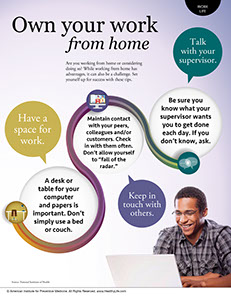
    Man working on laptop.

    Are you working from home or considering doing so? While working from home has advantages, it can also be a challenge. Set yourself up for success with these tips.

    Talk with your supervisor.

    Be sure you know what your supervisor wants you to get done each day. If you don’t know, ask.

    Keep in touch with others.

    Maintain contact with your peers, colleagues and/or customers. Check in with them often. Don’t allow yourself to “fall of the radar.”

    Have a space for work.

    A desk or table for your computer and papers is important. Don’t simply use a bed or couch.

    © American Institute for Preventive Medicine
  • Q&A: Diversity In The Workplace

    WORK LIFE

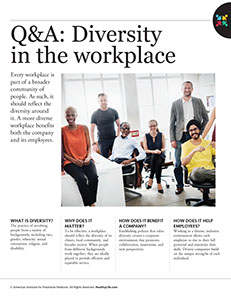
    A diverse group of co-workers sitting around at the office.

    Every workplace is part of a broader community of people. As such, it should reflect the diversity around it. A more diverse workplace benefits both the company and its employees.

    What is diversity?

    The practice of involving people from a variety of backgrounds, including race, gender, ethnicity, sexual orientation, religion, and disability.

    Why does it matter?

    To be effective, a workplace should reflect the diversity of its clients, local community, and broader society. When people from different backgrounds work together, they are ideally placed to provide efficient and equitable service.

    How does it benefit a company?

    Establishing policies that value diversity creates a corporate environment that promotes collaboration, innovation, and new perspectives.

    How does it help employees?

    Working in a diverse, inclusive environment allows each employee to rise to their full potential and maximize their skills. Diverse companies build on the unique strengths of each individual.

    © American Institute for Preventive Medicine

  • Simple Steps To A Great Work Day

    WORK LIFE

    Smiling man with arms crossed.

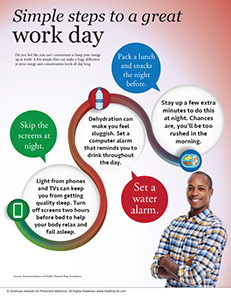
    Do you feel like you can’t concentrate or keep your energy up at work? A few simple fixes can make a huge difference in your energy and concentration levels all day long.

    Pack a lunch and snacks the night before.Stay up a few extra minutes to do this at night. Chances are, you’ll be too rushed in the morning.

    Set a water alarm.Dehydration can make you feel sluggish. Set a computer alarm that reminds you to drink throughout the day.

    Skip the screens at night.Light from phones and TVs can keep you from getting quality sleep. Turn off screens two hours before bed to help your body relax and fall asleep.

    Sources: National Institutes of Health, National Sleep Foundation

    © American Institute for Preventive Medicine
  • Slouching Harms Your Health

    WORK LIFE

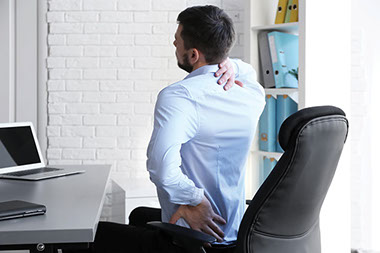
    Man sitting on chair at desk stretching his back.

    Many people sit at a desk for hours each day. And the way you sit can affect your health.

    Muscles & bones

    Your musculoskeletal system includes your bones, joints and muscles. These parts of the body work together to provide support and stability. They allow you to move around.

    The musculoskeletal system has to change and adapt to your life. The type of shoes you wear, how you walk and even how you use devices can affect your musculoskeletal system.

    The way you sit at your desk affects this system too. Slouching can cause wear and tear on the spine. This makes it more likely that you will hurt your back. It can also lead to neck or shoulder pain.

    Having bad posture at your desk can lower your flexibility. It can make it harder for your joints to move, too.

    Un-learning bad posture

    Many people slouch without thinking about it. It becomes a habit. But there are ways to fix it and prevent more injury to your back.

    Researchers think that yoga could have positive benefits for posture and health. Some evidence suggests that it could help with hyperkyphosis in older people. Hyperkyphosis is a condition that causes the spine to curve forward, giving a “hunched” appearance.

    To be safe, people should talk with their doctor before doing yoga or any exercise program.

    Other ways to improve posture include:

    *  Be aware of your posture. Set alarms or reminders that tell you to sit up straight.

    *  Think about your posture when you stand and walk. This can carry over to better sitting posture.

    *  Make sure your keyboard and computer are working for you. You shouldn’t be slouching to reach the keyboard or see the screen.

    *  Change positions often. Don’t sit all day with one leg crossed or your feet tucked under your chair.

    *  Get up for breaks. Don’t spend breaks at your desk. Take a walk or gently stretch. Don’t eat at your desk.

    *  Work toward a healthy weight. Extra weight around the belly can weaken abdominal muscles. This can lead to back pain.

    Talk to your doctor if you have back, shoulder or neck pain. Ask them about the best exercise options for you or a possible referral to physical therapy. Exercise can help you support your body and boost your overall health, whether you’re sitting or not.

    Source: National Institutes of Health

    © American Institute for Preventive Medicine

  • Stay Healthy At Work

    WORK LIFE

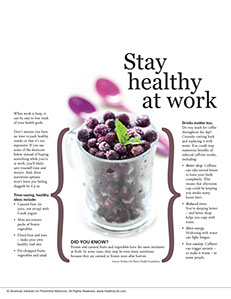
    Image of frozen berries in a glass.

    When work is busy, it can be easy to lose track of your health goals.

    Don’t assume you have no time to pack healthy snacks or that it’s too expensive. If you use some of the shortcuts below instead of buying something while you’re at work, you’ll likely save yourself time and money. And, these nutritious options won’t leave you feeling sluggish by 4 p.m.

    Time-saving, healthy ideas include:

    *  Canned fruit (in juice, not syrup) with Greek yogurt

    *  Mini microwave packs of frozen vegetables

    *  Dried fruit and nuts – make your own healthy trail mix

    *  Pre-chopped fruits, vegetables and salad

    Did you know?

    Frozen and canned fruits and vegetables have the same nutrients as fresh. In some cases, they may be even more nutritious because they are canned or frozen soon after harvest.

    Source: Produce for Better Health Foundation

    Drinks matter too.

    Do you reach for coffee throughout the day? Consider cutting back and replacing it with water. You could reap numerous benefits of reduced caffeine intake, including:

    *  Better sleep. Caffeine can take several hours to leave your body completely. This means that afternoon cup could be keeping you awake many hours later.

    *  Reduced stress. You’re sleeping better – and better sleep helps you cope with stress.

    *  More energy. Hydrating with water can fight fatigue.

    *  Less anxiety. Caffeine can trigger anxiety – or make it worse – in some people.

    © American Institute for Preventive Medicine
  • Stay Healthy With Shift Work

    WORK LIFE

    Doctor on phone working the night shift.

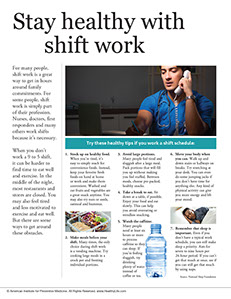
    For many people, shift work is a great way to get in hours around family commitments. For some people, shift work is simply part of their profession. Nurses, doctors, first responders and many others work shifts because it’s necessary.

    When you don’t work a 9 to 5 shift, it can be harder to find time to eat well and exercise. In the middle of the night, most restaurants and stores are closed. You may also feel tired and less motivated to exercise and eat well. But there are some ways to get around these obstacles.

    Try these healthy tips if you work a shift schedule:

    1.  Stock up on healthy food. When you’re tired, it’s easy to simply reach for convenience foods. Instead, keep your favorite fresh foods on hand at home or work and make them convenient. Washed and cut fruits and vegetables are a great snack anytime. You may also try nuts or seeds, oatmeal and hummus.

    2.  Make meals before your shift. Many times, the only choice during shift work is a vending machine. Try cooking large meals in a crock pot and freezing individual portions.

    3.  Avoid large portions. Many people feel tired and sluggish after a large meal. Pack portions that will fill you up without making you feel stuffed. Between meals, choose pre-packed, healthy snacks.

    4.  Take a break to eat. Sit down at a table, if possible. Enjoy your food and eat slowly. This can help you avoid overeating or mindless snacking.

    5.  Watch the caffeine.  Many people need at least six hours or more to process caffeine so they can sleep. If you’re feeling sluggish, try drinking plenty of water instead of coffee or tea.

    6.  Move your body when you can. Walk up and down stairs or hallways on breaks. Try stretching at your desk. You can even do some jumping jacks if you don’t have time for anything else. Any kind of physical activity can give you more energy and lift your mood.

    7.  Remember that sleep is important. Even if you don’t have a typical work schedule, you can still make sleep a priority. Aim for seven to nine hours per 24-hour period. If you can’t get that much at once, see if you can still get that much by using naps.

    Source: National Sleep Foundation

    © American Institute for Preventive Medicine