FINANCIAL HEALTH
© American Institute for Preventive Medicine

FINANCIAL HEALTH
© American Institute for Preventive Medicine

SELF-CARE CORNER

Do you feel a twitchy, jumpy feeling in your legs when you sit or lie down? Do you have an urge to move your legs when you go to bed at night? If so, you may have restless legs syndrome (RLS).
What is RLS?
RLS is known as a sleep disorder, although it can happen when you’re awake or asleep. It occurs when you’re resting or lying still, and is more common at night. Because it can interfere with sleep, RLS is linked to:
* Daytime sleepiness
* Memory problems or trouble concentrating
* Mood changes
* Job performance issues
* Problems with personal relationships
RLS affects people of any age, but tends to cause more problems in older adults.
What causes it?
RLS can run in families, especially if your symptoms began before age 40. Experts believe RLS may be related to a problem in the part of the brain that controls movement. It may be linked to certain health problems, including:
* Low iron in your blood (iron deficiency anemia)
* End-stage renal (kidney) disease
* Neuropathy (nerve damage)
Most of the time, though, there’s no clear cause of RLS.
Self-care tips for restless legs
You may be able to manage mild RLS at home. Try these tips:
* Avoid caffeine. Drinks like coffee, tea, energy drinks and cola usually contain caffeine.
* Don’t smoke. Ask your doctor if you need help quitting.
* Avoid alcohol.
* Get moderate exercise early in the day. Don’t exercise right before bedtime.
* Try relaxation techniques like deep breathing, meditation or yoga before bed.
* Make sleep a priority. Go to bed and get up at the same time each day. Aim for seven to eight hours of sleep each night.
See your doctor regularly and tell your doctor about any symptoms you’re having. You may also want to ask if you should get your iron levels checked. Doctors sometimes treat more severe cases of RLS with medications.
Sources: American Academy of Family Physicians, National Institute of Neurological Disorders and Stroke, Restless Legs Syndrome Foundation
SELF-CARE CORNER

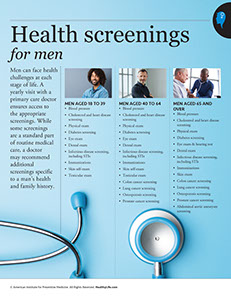
Women are at risk for a unique set of health issues. Every woman should visit their primary care and OB-GYN provider every year for a checkup that includes the recommended screenings.
Ask your doctor what screenings are right for you. Your doctor will decide which screenings you need based on your age, family history, health history, and other risk factors.
Women aged 18 to 39
* Blood pressure screening
* Cholesterol screening
* Diabetes screening
* Immunizations
* Infectious disease screening including STI’s
* Physical exam
* Breast cancer screening
* Cervical cancer screening
* Skin self-exam
* Dental and eye exams
* Early and regular prenatal care during pregnancy
Women aged 40 to 64
* Blood pressure screening
* Cholesterol screening
* Diabetes screening
* Immunizations
* Infectious disease screening including STI’s
* Physical exam
* Breast, colon, and lung cancer screenings
* Cervical cancer screening
* Osteoporosis screening
* Skin cancer screening
* Dental and eye exams
Women aged 65 and over
* Blood pressure screening
* Cholesterol and heart disease screening
* Diabetes screening
* Immunizations
* Infectious disease screening including STI’s
* Physical exam
* Breast, colon, and lung cancer screenings
* Cervical cancer screening may no longer be needed. Check with your doctor.
* Osteoporosis screening
* Skin cancer screening
* Hearing test
* Dental and eye exams
WELL-BEING

If there’s one habit that’s good for everyone’s health, it’s hand washing. But is hand sanitizer just as good as soap and water? Maybe not. Hand sanitizers:
* Do not get rid of all germs.
* Don’t work well when hands have dirt or grease on them.
* May not remove dangerous chemicals, like pesticides and heavy metals.
Hand washing does all these things – when you use soap and water and scrub for at least 20 seconds.
Use hand sanitizer when you can’t get soap and water. But always choose the sink and soap when you can!
Source: Centers for Disease Control and Prevention
© American Institute for Preventive Medicine
HEALTHY EATING

Nuts often get a reputation as being unhealthy. We add them to cookies and ice cream. People eat them by the handful at parties. But do nuts deserve a bad rap?
Concerns about calories
For years, many people avoided nuts because they are high in calories and fat. However, newer research finds that nuts can be an important part of a healthy diet. They contain many nutrients needed for body functions.
The key is to eat nuts in moderation. This means you may need to eat smaller portions. Then, you can avoid eating too many calories from nuts.
Look at the serving size on a package of nuts to get an idea of how much to eat. One serving may be quite small (2-4 tablespoons).
Some Fats are Healthy
Yes, most nuts are high in total fat. But these fats found in nuts actually promote good health! Most are high in healthy monounsaturated or polyunsaturated fats.
Monounsaturated and polyunsaturated fats can help lower bad cholesterol, which can lower the risk of heart disease and stroke. The American Heart Association recommends people eat more of these fats from healthy sources like nuts and seeds.
Protein packed
Nuts are a good source of plant-based protein. Protein is an essential nutrient that the body needs for building muscle, repairing tissues and making hormones.
It takes longer for the body to digest proteins than carbohydrates. That’s why eating some protein could help you feel less hungry than if you ate only carbohydrates, like crackers or bread.
The Dietary Guidelines for Americans recommend that people eat healthy sources of protein, like those that come from nuts and seeds, and plant foods.
Which types to eat
Of course, there are many different kinds of nuts. Each type tastes different and may contain a variety of nutrients. As long as you’re not coating nuts with sugar and salt, any type can be healthy.
Take a look at your favorite nut’s nutrition facts and go from there. For instance, macadamia nuts are one of the highest in calories and fat per ounce. But take those calories into account, and eat them instead of chips or cookies.
Replace unhealthy, processed foods with nuts. You’ll get more nutrients and might even feel more full.
Sources: Academy of Nutrition and Dietetics, National Institutes of Health, U.S. Department of Agriculture
© American Institute for Preventive Medicine
MEDICAL NEWS

Speech is an important part of communicating. Yet millions of people cope with a speech disability every day.
What is stuttering?
Stuttering is a problem that affects how your speech flows. People who stutter may:
* Stretch words out for too long when speaking
* Have pauses where they can’t get a word out
* Repeat whole words or parts of words
* Have uncontrolled movements when speaking, such as trembling in the jaw or excessive blinking
Scientists don’t fully understand why stuttering happens. But we do have plenty of facts about this speech disorder. Learn more about what it is and how you can help someone who has it.
FACT #1: Stuttering isn’t related to intelligence.
Stuttering isn’t a problem with being confused or less intelligent. In fact, many intelligent and successful people have dealt with this speech disorder.
FACT #2: Finishing a word or sentence for someone is not helpful.
People who don’t understand stuttering may get frustrated or impatient when someone stutters. They may just want to say the word for them so they can keep talking. This is not helpful and could make stuttering worse.
FACT #3: Stuttering is not caused by stress or being tense.
Experts believe that people who stutter may have some brain differences. These differences affect how a person’s brain works when they speak. But it’s not caused by anxiety, stress or a mental health condition. However, being stressed could make stuttering worse for a person who already has the disorder.
FACT #4: Stuttering is more common in children.
Many children stutter while they are learning how to speak and understand others. Most of the time, children stop stuttering before they become adults. They may need help from their doctor and a speech-language pathologist. If you’re concerned about your child’s stuttering, talk to their pediatrician.
If you have concerns about stuttering, finding words or other speech issues, talk to your doctor about seeing a licensed speech-language pathologist.
Sources: American Speech-Language-Hearing Association, National Institutes of Deafness and Other Communication Disorders
© American Institute for Preventive Medicine
BE FIT

Exercise provides so many health benefits. Recent research now adds strengthening the immune system to the list. Here are three ways exercise can help fight infections and prevent you from getting sick.
* Regular bouts of moderate to high-intensity exercise reduce inflammation in the body. Lower levels of inflammation are linked to a decreased risk of chronic diseases such as heart disease, cancer, and diabetes.
* Exercise supports the healthy bacteria in the digestive tract. These bacteria, called the microbiome, make up about 70% of your immune system.
* Consistent physical activity may prevent the decline in immune function that is common as people age. Being active keeps the body’s defense system in peak condition.
SUCCESS OVER STRESS

Spending time with people you care about can be a powerful stress reliever. This is true for every person in your family. Finding activities you all enjoy can strengthen family bonds, reduce everyone’s stress, and bring more fun into your life. Here are some stress-relieving activities that can work for the whole family.
Plan a craft night
Creative activities are a great way to relax together. Put on some music and get out crafting, drawing, or painting supplies. If you’re not much of a crafter, consider signing up the family for a class or a night out at a local craft shop.
Play a sport
Find a sport you all enjoy. Plan a weekly or monthly time to play together as a family. Keep it low stakes and focused on fun. Being active as a family can relieve stress and put everyone in a more positive mood.
Watch a comedy
Turn on a show everyone finds funny or look up some silly online videos. Instead of each family member retreating to their own screens, make time to watch something together. Choose something that will get everyone laughing to reduce stress and promote family bonding.
SELF-CARE CORNER

People with diabetes have a higher risk of getting certain foot problems. This usually happens because diabetes can cause nerve damage in the feet. This is known as diabetic neuropathy, which can lead to tingling, burning or weakness in your feet.
Why does neuropathy matter?
Diabetic neuropathy isn’t just painful. It also means that you may not feel things like cuts, injuries or heat or cold on your feet. Your feet could get hurt or burned and you wouldn’t know it. Then, with reduced blood flow, your body may not be able to heal the skin very well.
Keeping skin healthy
Wash, dry and moisturize the skin on your feet every day. Also, check for problems. Here’s how:
* After bathing, dry your feet gently with a towel.
* Look for corns, calluses, blisters or cuts. If you notice any of these, call your health care provider. Don’t try to remove corns or calluses yourself.
* If your skin looks healthy, you can moisturize. Apply a skin cream to dry areas.
* Don’t apply cream between your toes. This can cause fungus to grow. Keep the area between toes clean and dry.
* If you can’t trim your toenails easily, have this done by a podiatrist or other health provider.
Good shoes are your friend
Poorly fit shoes can cause sores, or ulcers, on your feet. These can lead to infection. Even if you don’t feel pain, see your doctor about any sores on your feet. You should also stay off your feet until your doctor says it’s ok. Don’t walk in your bare feet because this can put your feet at risk.
You can avoid many foot ulcers by getting comfortable, supportive shoes. A podiatrist or foot specialist may help you find a pair that fits your feet well without rubbing. Wearing socks that wick moisture, such as wool socks, can also help. Wearing wet socks or shoes can lead to fungal infections.
Helpful ways to avoid foot problems with diabetes:
1. Go to regular checkups.
2. See your doctor if you have any foot injuries or skin changes on your feet.
3. Follow your diabetes plan to keep blood sugar under control.
4. Check your feet every day.
Source: American Diabetes Association
© American Institute for Preventive Medicine