Category: Work Life

  • Breastfeeding And Work

    WORK LIFE

    Breast pump bottle filled with milk.

    Going back to work doesn’t mean an end to breastfeeding. Many new moms find they can pump their breastmilk while at work. This allows them to keep their milk supply up. It also gives them milk to feed their baby later, so they can reduce the need for formula.

    *  Ask your employer about a place to pump at work. You should have a place to pump safely and privately that’s not a bathroom.

    *  Your employer should also allow adequate break times to pump.

    *  Invest in a quality pump. Many moms find that electric pumps are easier and faster than manual ones. A pump may be covered by your insurance.

    *  Have ice packs and coolers to store your milk while at work. It’s important to keep breastmilk fresh and safe for your baby.

    Source: U.S. Department of Health and Human Services

    © American Institute for Preventive Medicine

  • Dealing With Difficult Personalities

    WORK LIFE

    Two coworkers sitting with laptop, talking and drinking coffee.

    Everyone’s personality has its own quirks and idiosyncrasies. In the workplace, you may have to deal with many different personalities, each with a unique set of positives and negatives. Learning how to get along with a variety of people will make you a better co-worker and employee.

    When you tap into people’s strengths and work productively together, you contribute to a work environment where everyone can thrive.

    Acknowledge their contributions

    It can be easy to identify the frustrating parts of someone’s personality. But, everyone brings something to the table. If you focus on what everyone contributes, it can change your whole perspective.

    Get in the habit of noticing what others do well or correctly. Say thank you, or send an email letting them know you appreciate them.

    Pick your battles

    Sometimes people just rub each other the wrong way. It’s a normal and unavoidable part of life. At work, it’s often better to let things go instead of getting upset over every irritation. There will be times when conflict is unavoidable. So, save your energy for when it really matters.

    Ask questions

    Take the time to get to know and understand the people you work with. Find out how they work best so you can develop strategies for interacting with them. For example, if you know a co-worker is slow responding to email, choose another form of communication. Building on each others’ strengths will decrease everyone’s frustration and stress.

    © American Institute for Preventive Medicine

  • Work-Related Skin Problems

    WORK LIFE

    Electrician wearing gloves while working.

    Your skin is the largest organ on your body, and it has important functions. When it’s healthy, your skin helps:

    *  Regulate your body’s temperature

    *  Keep invaders like bacteria and fungus out

    *  Protect you from the elements, such as cold and sun

    Your job & your skin

    Your skin needs care and protection to stay healthy – at home and at work. Do you work with chemicals or harmful substances? Do you wash your hands often? People who work in these fields are more prone to work-related skin problems:

    *  Manufacturing

    *  Food production

    *  Construction

    *  Machine tool operation

    *  Printing

    *  Metal plating

    *  Leather processing

    *  Engine service

    *  Landscaping

    *  Farming

    *  Forestry

    *  Health care

    Healthy skin at work

    Take precautions to prevent skin irritation and injury at work. If you work with chemicals, follow these steps:

    *  Store all chemicals safely and label them correctly.

    *  Use proper waste containers.

    *  Have a material safety data sheet (MSDS) for every dangerous substance used at work.

    *  Wear protective gear like gloves, aprons, hats and masks.

    *  Take off oil- or chemical-soaked work clothes before you leave work.

    *  Know what to do if your skin comes in contact with a harmful substance.

    *  When possible, use tools to handle dangerous materials so they don’t touch your skin.

    *  If you work with radiation, wear protective clothing and gear to prevent exposure.

    If you wash your hands frequently at work:

    *  Do not clean your skin with chemicals. Use only cleansers designed for the skin.

    *  Apply lotion, cream or petroleum jelly after washing hands to prevent dryness, cracking and eczema.

    If you work outdoors, take sun protection seriously. Make sure you:

    *  Apply sunscreen at least every two hours if you’re in the sun.

    *  Wear sunglasses, a wide-brimmed hat and clothing that covers your body.

    Source: American Academy of Family Physicians

    © American Institute for Preventive Medicine

  • Email – Use It Wisely

    WORK LIFE

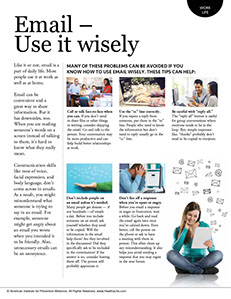
    Hands typing on keyboard of laptop with mail concept icons floating.

    Like it or not, email is a part of daily life. Most people use it at work as well as at home.

    Email can be convenient and a great way to share information. But it has downsides, too. When you are reading someone’s words on a screen instead of talking to them, it’s hard to know what they really mean.

    Communication skills like tone of voice, facial expression, and body language, don’t come across in emails. As a result, you might misunderstand what someone is trying to say in an email. For example, someone might get angry about an email you wrote when you intended it to be friendly. Also, unnecessary emails can be an annoyance.

    Many of these problems can be avoided if you know how to use email wisely. These tips can help:

    *Call or talk face-to-face when you can.If you don’t need to share files or other things in writing, consider skipping the email. Go and talk to the person. Your conversation may be more productive and can help build better relationships at work.

    *Use the “cc” line correctly.If you expect a reply from someone, put them in the “to” line. People who need to know the information but don’t need to reply usually go in the “cc” line.

    *Be careful with “reply all.”The “reply all” button is useful for group conversations where everyone needs to be in the loop. But, simple responses like, “thanks” probably don’t need to be copied to everyone.

    *Don’t include people on an email unless it’s needed.Many people get dozens – if not hundreds -of emails a day. Before you include someone on an email, ask yourself whether they need to be copied. Will the information in the email help them? Are they involved in the discussion? Did they specifically ask to be included in the conversation? If the answer is no, consider leaving them off. The person will probably appreciate it.

    *Don’t fire off a response when you’re upset or angry.Before you email a response in anger or frustration, wait a while. Go back and read the email again later once you’ve calmed down. Even better, call the person on the phone or ask to have a meeting with them in person. This often clears up any misunderstanding. It also helps you avoid sending a response that you may regret in the near future.

    © American Institute for Preventive Medicine

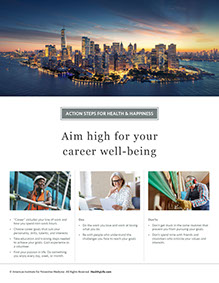
  • Aim High For Your Career Well-Being

    Work Life

    Man reaching out his hand.

    *  “Career” includes your line of work and how you spend non-work hours.

    *  Choose career goals that suit your personality, skills, talents, and interests.

    *  Take education and training steps needed to achieve your goals. Gain experience as a volunteer.

    *  Find your passion in life. Do something you enjoy every day, week, or month.

    Dos

    *  Do the work you love and work at loving what you do.

    *  Be with people who understand the challenges you face to reach your goals.

    Don’ts

    *  Don’t get stuck in the same routines that prevent you from pursuing your goals.

    *  Don’t spend time with friends and coworkers who criticize your values and interests.

    ays to Well-Being book by the American Institute for Preventive Medicine. www.HealthyLife.com. All rights reserved.

    © American Institute for Preventive Medicine

  • Ergonomics For The Home Office

    WORK LIFE

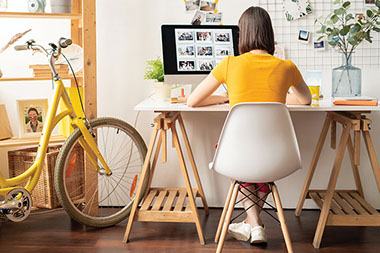
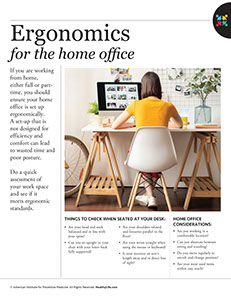
    Women sitting at desk working on computer.

    If you are working from home, either full or part-time, you should ensure your home office is set up ergonomically. A set-up that is not designed for efficiency and comfort can lead to wasted time and poor posture.

    Do a quick assessment of your work space and see if it meets ergonomic standards.

    Things to check when seated at your desk:

    *  Are your head and neck balanced and in line with your spine?

    *  Can you sit upright in your chair with your lower back fully supported?

    *  Are your shoulders relaxed and forearms parallel to the floor?

    *  Are your wrists straight when using the mouse or keyboard?

    *  Is your monitor an arm’s length away and in direct line of sight?

    Home office considerations:

    *  Are you working in a comfortable location?

    *  Can you alternate between sitting and standing?

    *  Do you move regularly to stretch and change position?

    *  Are your most used items within easy reach?

    © American Institute for Preventive Medicine

  • Balance It All

    Work Life

    Mother and son sitting while son is writing in a notebook.

    Career, family, and a personal life. You can have it all, can’t you? Absolutely! But when the demands of work overtake the demands of your family and personal life, you can suffer chronic stress and burnout. And miss out on some of the best things in life. Sometimes it takes effort to balance it all.

    The key might be to keep your eye on your values, learn to say no, stop reaching for perfection, and “unplug” regularly.

    ays to Well-Being book by the American Institute for Preventive Medicine. www.HealthyLife.com. All rights reserved.

    © American Institute for Preventive Medicine

  • Get Up & Move After Work

    WORK LIFE

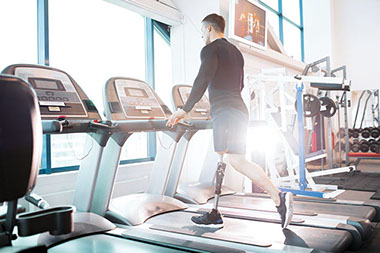
    Man with amputee leg using the treadmill.

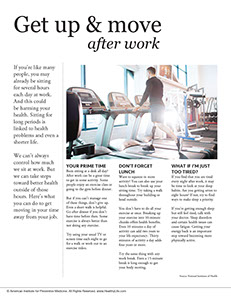
    If you’re like many people, you may already be sitting for several hours each day at work. And this could be harming your health. Sitting for long periods is linked to health problems and even a shorter life.

    We can’t always control how much we sit at work. But we can take steps toward better health outside of those hours. Here’s what you can do to get moving in your time away from your job.

    Your prime time

    Been sitting at a desk all day? After work can be a great time to get in some activity. Some people enjoy an exercise class or going to the gym before dinner.

    But if you can’t manage one of these things, don’t give up. Even a short walk is helpful. Go after dinner if you don’t have time before then. Some exercise is always better than not doing any exercise.

    Try using your usual TV or screen time each night to go for a walk or work out to an exercise video.

    Don’t forget lunch

    Want to squeeze in more activity? You can also use your lunch break to break up your sitting time. Try taking a walk throughout your building or head outside.

    You don’t have to do all your exercise at once. Breaking up your exercise into 10-minute chunks offers health benefits. Even 10 minutes a day of activity can add two years to your life expectancy. Thirty minutes of activity a day adds four years or more.

    Try the same thing with any work break. Even a 15-minute break is long enough to get your body moving.

    What if I’m just too tired?

    If you find that you are tired every night after work, it may be time to look at your sleep habits. Are you getting seven to eight hours? If not, try to find ways to make sleep a priority.

    If you’re getting enough sleep but still feel tired, talk with your doctor. Sleep disorders and certain health issues can cause fatigue. Getting your energy back is an important step toward becoming more physically active.

    Source: National Institutes of Health

    © American Institute for Preventive Medicine

  • Do The Work You Love & Work At Loving What You Do

    Work Life

    Top view of construction workers.

    Spend time with coworkers you enjoy being with. Avoid people with negative attitudes.

    *  Enjoy using your skills and talents on the job, as well as during non-work hours.

    *  Take pride in your accomplishments. Learn from setbacks.

    *  Choose to be happy at work. Greet others with a smile.

    ays to Well-Being book by the American Institute for Preventive Medicine. www.HealthyLife.com. All rights reserved.

    © American Institute for Preventive Medicine