Alcohol is a depressant. It is the most widely used drug in the world.
Harmful Effects of Alcohol
* Heavy drinkers have a greater risk of depression, heart disease, liver disease, sleep disorders, stroke, and some cancers. These include cancers of the mouth, liver, and breast.
* Alcohol plays a factor in about 60% of fatal burn injuries, drownings, and homicides.
* About 40% of suicides and deaths from falls and vehicle accidents include alcohol use.
Facts
Sources of Alcohol
* Beer. This has about 5% alcohol. Lite beers have about 3% alcohol.
* Wine. This usually has between 11 and 14% alcohol.
* Hard liquors (e.g., gin, rum, vodka, whiskey). The word “proof” means 2 times the % of alcohol. For example, 100-proof means 50% alcohol.
* Some medicines. Read the labels.
* One standard drink has about 1/2 oz. of pure alcohol. Examples are:
– 12 oz. of regular beer
– 8-9 oz. of malt liquor
– 5 oz. of wine
– 1-1/2 oz. of 80-proof hard liquor (40% alcohol)
Low-Risk Guidelines
* In general, alcohol should be limited to:
– Two drinks per day for men
– One drink per day for women and persons age 65 and older
You Should Not Drink Alcohol If:
* You are pregnant.
* You are under the legal age to drink, (e.g., 21 years old).
* You are driving or operating equipment.
* You are alcohol or drug dependent.
Drugs other than alcohol include:
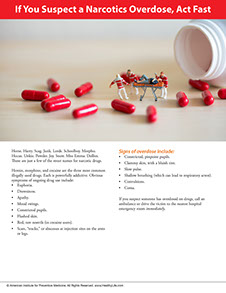
* Some prescribed drugs. These include fentanyl, muscle relaxants, stimulants, tranquilizers, and strong pain relievers, such as oxycodone and other opioids. {Note: Discuss, with your doctor, the benefits and risks of opioid use to control pain. Opioid abuse is a common cause of death from prescribed drugs.}
* Marijuana and “synthetic marijuana” (e.g., K-2 and Spice)
* Inhalants. These are vapors from substances, such as glue, solvents, and paints, that are used to get “high.”
* Illicit drugs:
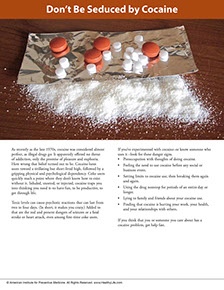
– Cocaine / Crack
– Ecstacy
– Heroin
– Ketamine
– Opium
– LSD and PCP (“angel dust”)
– Date rape drugs (e.g., GHB, Rohypnol)
* About half of emergency room visits due to drug misuse or abuse involve illicit drugs.
* About 75% of illegal drug users age 18 and older work full time or part time.
* In the workplace, employees who abuse drugs have 300% higher medical costs than nondrug abusers.
Wise Use of Alcohol
* Some prescribed drugs and alcohol do not mix. Some mixtures can be fatal. Don’t have alcohol with prescribed drugs if the drug’s label or your doctor tells you not to. Ask your doctor if and how much alcohol you can have if you take any prescribed drugs.
* Know your limit and stick to it. You may decide it is better not to drink at all.
* Drink slowly. You are apt to drink less.
* When you have a drink, take pauses between sips.
* In a mixed drink, use less alcohol and more mixer.
* After you have 1 or 2 drinks with alcohol, drink ones without alcohol.
* Eat when you drink to slow alcohol absorption.
* If you drink when you eat out, order your drink with, not before, your meal.
* Don’t drink and drive. Designate a driver who will not be drinking.
* Coffee or fresh air cannot make you sober. To get sober, stop drinking.
How to Avoid Problems
* Ask your doctor about the risks of addiction with prescribed medicines, such as sleeping pills and pain pills. Ask if your problem can be treated without medicine.
* Stop the use of prescribed pain pills as soon as you can. Don’t use more than you need.
* Don’t socialize with drug and alcohol abusers.
* If your friends insist that you drink alcohol or take drugs in order to be with them, just say NO!
* Talk to persons who will listen to your feelings without putting you down.
* Seek help for mental health problems, such as depression or chronic anxiety.
* If you have been drinking or taking drugs, don’t take part in risky behaviors. Examples are unsafe sex, sharing needles, and using non-sterile needles.
* Learn how to relax without alcohol or drugs. Develop healthy interests.
– Listen to calm music.
– Do deep breathing exercises.
– Do regular exercise, such as swimming, jogging, or walking.
– Learn something new. Take a class that interests you. Spend time with a hobby that you enjoy.
– Do things that you know and do well in order to feel confident.
* Contact your Employee Assistance Person (EAP) at work. He or she can help evaluate your risk level or help you get treatment.
Addiction
Alcohol & Drug Abuse
Abuse is misusing alcohol or drugs. You are an abuser when you use alcohol or drugs and it leads to one or more of the problems, listed below, in a 12-month period.
* You fail to fulfill work, school, or home duties.
* You drink or use drugs and put you or others in danger (e.g., when you drive a car or operate machines).
* You have a legal problem from alcohol or drugs.
* You keep drinking or taking drugs even though it causes or worsens problems with others.
Alcohol & Drug Dependence (Addiction)
Dependence is addiction. An alcoholic is addicted to alcohol. A person who depends on drugs is a drug addict. When you are addicted:
* You crave the substance. The craving can feel as strong as the need for food or water.
* You are often unable to stop using the substance.
* You get withdrawal symptoms when you stop using the substance. The symptoms vary with the drug used. The symptoms go away if you drink alcohol or use the drug.
* You need more and more alcohol or drugs to get “high.” This is known as developing a tolerance.
Risk Factors for Alcohol/Drug Abuse and Dependence
* Increased use and tolerance of alcohol or a drug
* Family history of alcohol or drug abuse. You are about 4 times more likely to be an alcoholic if one of your parents is. You are 10 times more likely if both parents are.
* Mental health problems, such as depression, anxiety, or poor self-esteem
* Prolonged use of prescribed pain pills
* Prolonged fatigue or stress
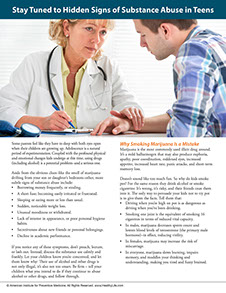
* Peer pressure. This is especially true for teens.
* Ongoing financial or family problems
Questions to Detect an Alcohol Problem
Answer the 4 questions that follow. These can apply to you or someone else. A key word in each of these questions spells CAGE.
* Have you ever felt you should Cut down on your drinking?
* Have people Annoyed you by criticizing your drinking?
* Have you ever felt bad or Guilty about your drinking?
* Have you ever had a drink to steady your nerves or to get rid of a hangover (Eye opener)?
One “Yes” answer means there might be an alcohol problem. Two or more “Yes” answers means it is highly likely that there is an alcohol problem. In either case, contact your doctor or other health care provider to discuss your responses to these questions. You may have answered “No” to all four CAGE questions, but there could still be a problem. Some people say, “But I only drink beer.” This doesn’t mean they don’t have an alcohol problem.
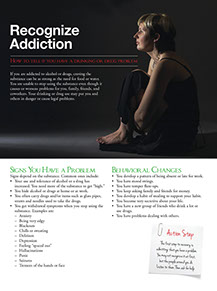
Signs of Alcohol/Drug Abuse and Dependence
Signs will depend on the substance. They include:
* Drugs or items used to take drugs are found. Examples are glass pipes (to smoke drugs); straws (to sniff drugs); and needles (to inject drugs).
* Alcohol is found hidden at home or at work.
* Withdrawal symptoms. These include:
– Tremors of the hand or face
– Chills, sweating
– Nausea, vomiting
– Fatigue. Depression.
– Anxiety. Panic.
– Being very edgy
– Insomnia
– Blackouts
– Acting “spaced out”
– Hallucinations
– Delirium
– Seizures
* Behavior changes. These include:
– Being late or absent for work or school. Often, this happens on Mondays and Fridays.
– Abrupt change in mood or attitude
– Temper flare-ups that are not usual
– Asking for money, more than usual, from family and friends
– Stealing items from work, home, stores, school, etc.
– Being more and more secretive about actions and things that are owned
– Being with a new group of people, especially with those who drink a lot or use drugs
– Having problems dealing with others
Alcohol Poisoning
Call 9-1-1 for one or more of the following signs of alcohol poisoning or combining alcohol and other drugs, such as sedatives or tranquilizers. Act quickly. Alcohol poisoning can be fatal.
* Unconsciousness. This means the person is hard to rouse and can’t be made aware of his or her surroundings. This can be brief, such as with fainting or blacking out. It can put a person into a coma.
* No breathing or slow and shallow breathing. This means 10 or fewer breaths per minute or time lapses of more than 8 seconds between breaths.
* Slow pulse rate (40 or fewer beats per minute).
* Skin that is cold, clammy, and/or pale or blue in color.
{Note: Before emergency care arrives, place the person on his or her side with the knees bent, to prevent choking if he or she vomits. Loosen the person’s clothing around the neck and check the mouth and back of the throat to see that nothing obstructs the person’s breathing. Stay with the person.}
Getting Help
The first step is to admit there is a problem. Often, the person who has the problem does not see the harm that it causes. Other persons around him or her see the problem first. Knowing how harmful alcohol and drug abuse and dependence are can help a person seek treatment.
Reasons to Get Help
Alcohol and drug abuse and dependence can lead to:
* Problems at work. This includes being late or not showing up for work; making errors; and crimes at work, such as stealing.
* Problems with your family
* Injury to oneself or others from accidents
* Damage to body organs that cannot be fixed
* Poor nutrition
* Sexually transmitted infections and HIV
* Conditions, such as hepatitis and blood poisoning, from IV injections with nonsterile needles
* Death caused by overdose
Where to Get Help
* Your Employee Assistance Program (EAP) at work, if you have one. You make the choice to go. No one else is told about it.
* Your doctor or other health care provider
* A drug treatment clinic
* Support groups
Your EAP person or health care provider will refer you to a treatment program best suited for you, such as a treatment or “rehab” center. Treatment can be given in outpatient or inpatient settings. Components of treatment are:
* A complete physical exam
* “Detox” – Getting the person off the abused substance. Sometimes other drugs are used to control the withdrawal symptoms that occur.
* Counseling – One-on-one, group therapy, and/or family sessions. The goals are:
– To understand the addiction
– To get the person to be well, physically and mentally
– To help the addict stay alcohol and drug free. Learning life-coping skills and how to deal with “high-risk” times and places can help prevent the addict from using the substance again.
You may be advised to take part in a self-help group, such as Alcoholics Anonymous.
Resources
Alcoholics Anonymous (AA)
www.aa.org
Al-Anon Family Groups (includes Alateen)
888.4AL-ANON (425.2666)
www.al-anon.org
American Council for Drug Education
800.488.DRUG (488.3784)
www.acde.org
Cocaine Anonymous (CA) World Services
310.559.5833
www.ca.org
Narcotics Anonymous (NA) World Services
818.773.9999
www.na.org
Substance Abuse and Mental Health Services Administration (SAMHSA)
www.samhsa.gov
National Helpline: 800.662.HELP (662.4357)
www.samhsa.gov/find-help/national-helpline