Category: Mental Health Care

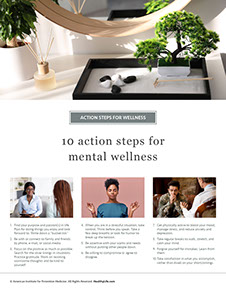
  • 10 Action Steps For Mental Wellness

    Mental Health Care

    Table top zen sand garden.

    1.  Find your purpose and passion(s) in life. Plan for doing things you enjoy and look forward to. Write down a “bucket list.”

    2.  Be with or connect to family and friends by phone, e-mail, or social media.

    3.  Focus on the positive as much as possible. Search for the silver linings in situations. Practice gratitude. Work on resisting worrisome thoughts and be kind to yourself.

    4.  When you are in a stressful situation, take control. Think before you speak. Take a few deep breaths or look for humor to break up the tension.

    5.  Be assertive with your wants and needs without putting other people down.

    6.  Be willing to compromise or agree to disagree.

    7.  Get physically active to boost your mood, manage stress, and reduce anxiety and depression.

    8.  Take regular breaks to walk, stretch, and calm your mind.

    9.  Forgive yourself for mistakes. Learn from them.

    10. Take satisfaction in what you accomplish, rather than dwell on your shortcomings.

    Minding Your Mental Health Book. Published by the American Institute for Preventive Medicine. www.HealthyLife.com. All rights reserved.

    © American Institute for Preventive Medicine

  • Improving Your Emotional Health

    Mental Health Care

    Smiling man with thumbs up.

    Your emotional and mental well-being is essential for overall health and happiness. How you feel and think affects how you live your life every day – in your personal and work life. Take steps to take care of your emotional health.

    Answering the following questions may help you reflect on how you are doing with your emotional health. Then, tally your scores for each question. You may consider taking further steps to improve in certain areas. You may also consider reaching out for additional help and support from a mental health professional.

    Never – 1 Point

    Rarely – 2 Points

    Sometimes – 3 Points

    Usually – 4 Points

    *  I follow healthy, self-care habits that include healthy eating, exercise and quality sleep.

    *  I give myself credit when I accomplish good things.

    *  When something goes wrong, I forgive myself if it is something within my control, figure out what went wrong, and try to do better next time.

    *  When good things happen, I feel grateful and hold on to those positive emotions for a while.

    *  I adapt to change in a positive way.

    *  I take time to reflect on my beliefs and principles that are important to me.

    *  I set priorities and say “no” to new tasks that would overwhelm me.

    *  I do relaxation exercises on a regular basis, such as mindfulness, meditation, yoga, tai chi, etc.

    *  I feel supported and respected by my friends and family.

    *  When I experience a personal crisis or loss, or I am grieving something, I reach out to talk to caring friends or a support agency.

    *  I communicate effectively, share my views and listen to others with empathy.

    *  I avoid using alcohol or non-prescription drugs to cope with stress.

    *  I continuously work to strengthen existing relationships and seek out new relationships.

    *  I volunteer or do acts of caring without expecting anything in return.

    Total Score:

    Score of 37 – 56: Your answers indicate that you are taking lots of positive steps to achieve emotional health. You may want to check for lower scores on individual questions to see if there are areas you want to work on further.

    Score of 18 – 36: Overall, your behaviors that support emotional health are good, but there may be room for improvement. Work on taking small steps to help enhance your emotional health.

    Score of 17 and below:  Your answers show some potential concern for your emotional health. Review and reflect on those areas in which you scored lower. Then, set some achievable goals to work on to make some improvements.

    Note: Although completing this emotional health self-assessment may help you reflect on, and take steps to improve, your emotional health, it is not a diagnostic tool. This tool is not intended to replace advice you receive from a health professional. If you have concerns about your emotional and mental well-being, reach out to a health professional.

    Source: National Institutes of Health

    Minding Your Mental Health Book. Published by the American Institute for Preventive Medicine. www.HealthyLife.com. All rights reserved.

    © American Institute for Preventive Medicine

  • You’re Built For Purpose

    Mental Health Care

    Man holding a basket of vegetables that he harvested.

    Want to live to a hundred? Start with finding your purpose. Having purpose in life is one factor that many centenarians share.

    Think about what motivates, inspires and fulfills you. Then, set a plan for accomplishing your goals. Finding purpose in life gives it meaning and added richness to keep you going for the long haul. Research also suggests that having a sense of purpose in life may also help:

    *  Improve your life expectancy, including those with life-threatening illnesses, such as cancer

    *  Improve heart health

    *  Improve brain health and decrease your risk for Alzheimer’s disease

    *  Give added protection from the effects of stress

    *  Help you manage pain and chronic illness better

    Minding Your Mental Health Book. Published by the American Institute for Preventive Medicine. www.HealthyLife.com. All rights reserved.

    © American Institute for Preventive Medicine

  • It’S Okay To Ask For Help

    Mental Health Care

    Many people do not use mental health services because of the “stigma” of having an “emotional” problem. Society tends to view mental health issues differently from medical ones. When someone breaks a leg, has chest pains, or needs to get a prescription, they’ll see a doctor. However, when they have depression, excessive fears, or a problem with alcohol, they may be embarrassed to seek help. Many people view these problems as “weaknesses” they should handle on their own. Unfortunately, this view prevents them from getting professional help that may treat their problems with success.

    To recognize an emotional problem and receive help is not at all a sign of weakness. It is a sign of strength. Also, taking part in your company’s Employee Assistance Program (EAP) or seeing a therapist at a mental health clinic or student counseling center is completely confidential. No information will be released without your permission except in situations involving child or elder abuse, or suicidal or homicidal intent.

    Minding Your Mental Health Book. Published by the American Institute for Preventive Medicine. www.HealthyLife.com. All rights reserved.

    © American Institute for Preventive Medicine

  • A New Start To A Healthy Life!

    Mental Health Care

    Women in kitchen with healthy foods.

    *  Look at healthy eating and other health improvements as health “evolutions.”

    *  When you are ready, make health changes one at a time.

    *  Start slowly with one positive step, such as eating breakfast at least 2 days a week.

    *  Once this becomes a habit, take another healthy step.

    *  Changes that become healthy habits are likely to last.

    Minding Your Mental Health Book. Published by the American Institute for Preventive Medicine. www.HealthyLife.com. All rights reserved.

    © American Institute for Preventive Medicine

  • A Therapists’ Who’S Who

    Mental Health Care

    Alcohol/Drug Abuse Counselor

    Often has a degree in either social work, psychology, or psychiatry and works in a variety of settings, including drug treatment centers and family service agencies.

    Employee Assistance Professional

    Mental health professionals provided by employers to offer confidential services to employees and, often, to their families. These counselors can be occupational physicians, nurses, psychologists, professional counselors, social workers, and/or trained union members. They provide assessment, brief counseling, and when appropriate, referral to community resources. Some are Certified Employee Assistance Professionals (CEAP).

    Marriage Counselor or Family Therapist

    Has a degree in social work, psychology, or psychiatry with post-graduate study and training in marital and/or family problems.

    Pastoral Counselor

    A minister, priest, or rabbi who has a Bachelor’s or Master’s Degree in Divinity (religion) and additional training in psychology or counseling. They can identify mental health problems and make appropriate referrals. Certified Pastoral Counselors have an advanced degree (masters or doctorate) in mental health and may provide counseling.

    Professional Counselor

    Has earned masters or doctoral degree in counseling.

    Psychiatric Nurse or Clinical Nurse Specialist

    Holds a degree in nursing, either as a Registered Nurse (R.N.), a Bachelor’s in Nursing (B.S.N.), or a Master’s in Nursing (M.S.N.). In addition, they have specialized training in the care and treatment of psychiatric patients.

    Psychiatrist

    A medical doctor (M.D.) or doctor of osteopathy (D.O.) who has had a three or four year residency in a psychiatric facility and is board certified in psychiatry. A psychiatrist is the only mental health professional who can prescribe medication and/or medical treatments.

    Psychoanalyst

    A psychiatrist, clinical psychologist, or social worker who has had specialized training in psychoanalysis and has gone through psychoanalysis.

    Psychologist

    Received either a doctorate degree in psychology, education, or counseling (i.e., Ph.D., Psy.D., Ed.D). This professional must also complete at least a one-year internship in a psychiatric hospital or mental health center and have specific training to do psychotherapy.

    Social Worker

    Has earned a Bachelor’s Degree (B.S.), Master’s Degree (M.S.W.) or Doctoral Degree (D.S.W.) in social work. Graduate training involves coursework dealing with individual, group and family assessment and psychotherapy.

    Minding Your Mental Health Book. Published by the American Institute for Preventive Medicine. www.HealthyLife.com. All rights reserved.

    © American Institute for Preventive Medicine

  • Look At The World Through The Wonder Of A Child’S Eyes

    Mental Health Care

    Two young kids outside with hats on looking through binoculars.

    *  When you wake up, see a new day full of exciting possibilities.

    *  Use your imagination to deal with mundane tasks at work and home.

    *  Be free to be you. Care less about what other people think.

    *  Enjoy reading a children’s book or watching a children’s cartoon or TV show.

    Minding Your Mental Health Book. Published by the American Institute for Preventive Medicine. www.HealthyLife.com. All rights reserved.

    © American Institute for Preventive Medicine

  • Be A Wise Mental Health Consumer

    Mental Health Care

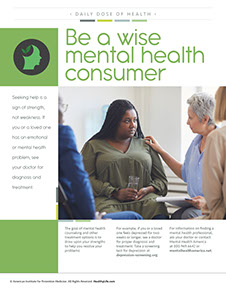
    Women holding glass of water, sitting in circle with others in a support group.

    Seeking help is a sign of strength, not weakness. If you or a loved one has an emotional or mental health problem, see your doctor for diagnosis and treatment.

    The goal of mental health counseling and other treatment options is to draw upon your strengths to help you resolve your problems.

    For example, if you or a loved one feels depressed for two weeks or longer, see a doctor for proper diagnosis and treatment. Take a screening test for depression atdepression-screening.org.

    For information on finding a mental health professional, ask your doctor or contact Mental Health America at 800.969.6642 ormentalhealthamerica.net.

    Minding Your Mental Health Book. Published by the American Institute for Preventive Medicine. www.HealthyLife.com. All rights reserved.

    © American Institute for Preventive Medicine