Category: Financial Health

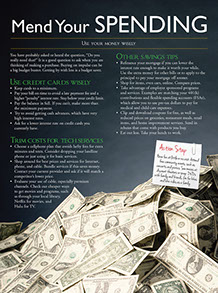
  • Build A Budget

    Financial Health

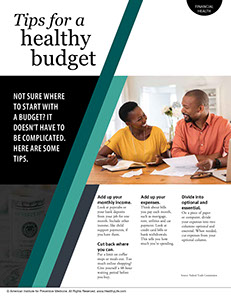
    Make a plan to live within your means.

    No matter what your income, having a budget helps you plan and manage your money. It also helps you get a grip on your spending. You can use a budget-making tool, such as a free one from the websitewww.mint.com. You can write one on your own with a pencil and paper.

    Track your expenses:

    First, list your fixed monthly must-haves − mortgage or rent, phone, cable, Internet access, car payment, or public transit costs. Include other regular set monthly expenses, such as loan payments, tuition and/or student loans, insurance premiums, church donations, and gym and other monthly membership fees. Next, identify your variable expenses. These include what you spend weekly, monthly, two or four times a year, and yearly for:

    *  Groceries

    *  Restaurant meals, snacks, coffee and other drinks

    *  Gas and upkeep for your car

    *  Electric, gas, and water bills

    *  Property taxes

    *  Credit card payments

    *  Entertainment – Movies, DVDs, concerts, golf, toys, and social events

    *  Clothes and shoes

    *  Haircuts, cosmetics, and toiletries

    *  Gifts for birthdays, holidays, weddings, etc.

    *  Household items and home improvements

    *  Vacation

    You can get amounts for many of these from monthly statements for your credit cards, debit cards, and checking and saving accounts. Otherwise, get and keep receipts for everything you pay for. You may be surprised by how much you spend on coffee drinks, food, liquor, and tips when eating out.

    Put some of your income into a savings account. Do this yourself from your take-home pay or have a pre-set amount automatically deposited into a savings account.

    Start by listing your total monthly income:

    Include your take-home pay, alimony, child support, unemployment, social security, and public aid. If you work on commission or freelance, your income can vary from month to month. Just estimate a monthly amount.

    Action Step

    If you are spending more than you earn, cut back on variable expenses. If you still have money left over after paying your bills and putting money into savings, carry over the extra for future expenses.

    Ways to Well-Being book by the American Institute for Preventive Medicine. www.HealthyLife.com. All rights reserved.

    © American Institute for Preventive Medicine

  • Save At The Supermarket

    FINANCIAL HEALTH

    Couple at the grocery store.

    While the cost of food is out of your control, smart shopping habits will help keep your grocery bill more manageable.

    Tips to save on groceries

    Shop with a list

    Grocery stores know just how to tempt you to make impulse purchases. With eye-catching end cap displays and strategically placed snack foods, it’s easy to end up bringing home more than you intended. Instead, make a detailed list before you go and stick to it.

    Check the cabinets

    How many times have you purchased an item only to find you already have it hidden in the back of your pantry? As you make your shopping list, carefully check your current food supply to make sure you really need the ingredients.

    Buy in bulk

    When possible, purchase family-sized or bulk items for your most commonly used ingredients. This works especially well for meats, beans, rice, grains, and pasta. When you get home, promptly freeze or store the extra. You can also join a wholesale club to get better prices on bulk food.

    Eat seasonally

    Fruits and vegetables are cheapest when in season. For example, berries are more expensive in the winter than during peak berry season in the summer. Oranges and other citrus are usually cheapest during the winter months. Opt for in-season produce whenever possible.

    Stock up

    Buy more than one when your favorite foods go on sale. Dry goods generally keep for a long time, and many fresh foods can be frozen for longer storage. Keep in mind that you should only stock up on ingredients you regularly use.

    Low-cost recipes

    How you choose to eat is a major determinant of your food budget. If you like to cook gourmet, you’ll need fancier ingredients that cost more. Instead, find tasty recipes that use inexpensive ingredients. Examples include beans, rice, frozen vegetables, tuna, potatoes, and eggs.

    © American Institute for Preventive Medicine

  • Deal With Debt

    Financial Health

    Get out of debt on your own or with help.

    Whether it’s from living above your means, expensive medical bills, a job loss, or supporting your parents, you can eliminate debt. The first step is to avoid getting deeper in debt. Limit spending to essentials and follow a plan to pay down the debt.

    On your own:

    *  Cut up credit cards or put them away until they are paid off.

    *  Rank order what needs to be paid off – student and other loans, credit cards, etc.

    *  Contact your creditors right away to work out payment plans that you can manage. Do this before debt collectors get involved. If you can’t work out a plan with your mortgage company, contact the local office of the Department of Housing and Urban Development or the housing authority in your state, city, or county for help in finding a legitimate housing counseling agency near you.

    *  Bring in more income from a part time job and selling household items you no longer need at a garage sale or online site, such as Ebay. Consider selling some of your gold and silver jewelry for cash.

    Get professional help from:

    *  A professional financial planner through work

    *  The Financial Planning Association (FPA) at 800.647.6340 orwww.fpanet.org

    *  The National Foundation for Credit Counseling at 800.388.2227 orwww.nfcc.org/FirstStep/firststep_03.cfm.

    Beware of any debt relief service that*:

    *  Charges any fees before it settles your debts

    *  Pressures you to make “voluntary contributions,” another name for fees

    *  Touts a “new government program” to bail out personal credit card debt

    *  Guarantees it can make your debt go away

    *  Tells you it can stop all debt collection calls and lawsuits

    *  Guarantees that your credit card and any other debt not tied to an asset, such as your house, can be paid off for just pennies on the dollar

    *  Offers to enroll you in a debt management program (DMP) without teaching you skills to budget and manage your money

    *  Adapted fromwww.ftc.gov/bcp/edu/pubs/consumer/credit/cre19.shtm

    Action Step

    Pay off the credit card or other debt with the lowest balance first. After this is paid in full, pay down the next debt with the lowest balance.

    Ways to Well-Being book by the American Institute for Preventive Medicine. www.HealthyLife.com. All rights reserved.

    © American Institute for Preventive Medicine

  • Save Money On Prescriptions

    FINANCIAL HEALTH

    Pills dropping into bottle.

    FACT: New drugs are protected by patents. After the patent expires, other companies can make a generic version of the drug.

    Knowing about generic drugs can save you money on prescriptions. Tell your doctor or pharmacist you want a generic drug if possible.

    If your prescription is expensive, speak up. Sometimes there’s an alternative that costs less but is still safe.

    Be wary of places that promise free or cheap prescriptions. It may be a scam. Your doctor or pharmacist can tell you about free or low-cost prescription programs.

    © American Institute for Preventive Medicine

  • Declare Your Independence From Credit Card Overuse

    Financial Health

    Credit cards fanned out on table.

    *  Limit your number of credit cards.

    *  Use 1 or 2 major credit cards that have low interest rates. Individual store and gas cards have very high interest rates.

    *  Only charge what you can pay in full when you get the bill. Or, aim to keep the balance to less than 25 percent of the total amount you can charge.

    *  Pay with cash. If you are an impulse buyer, leave your credit cards at home when you shop. Avoid or limit shopping online and through TV shopping channels.

    Dos

    *  Make payments on time to avoid late fees and a possible increase in your interest rate.

    *  Make more than the minimum payment.

    Don’ts

    *  Don’t open new credit cards to save 10 or more percent. For each new card you open, your credit score could go down 10 points.

    *  Don’t use your credit cards for cash advances.

    ays to Well-Being book by the American Institute for Preventive Medicine. www.HealthyLife.com. All rights reserved.

    © American Institute for Preventive Medicine

  • Save Now For Holiday Gift-Giving

    FINANCIAL HEALTH

    Piggy bank with holiday lights and ornments.

    The holidays have a way of sneaking up on us. Before you know it, the stores will be full of holiday cheer, enticing you to begin what is often a season of overspending.

    Now is the ideal time to start saving so you won’t be caught unprepared. If you enter the holidays with a plan, you will be less likely to impulse-purchase or rack up unwanted credit card debt.

    Three easy steps to make your holidays debt-free

    1.Set a gift-buying budget.Decide in advance how much you can reasonably spend.  For some people, setting a dollar amount per person works well. Or you can set a total amount that feels comfortable for you.

    2.Use your budget to determine how much you need to save each month.Take a hard look at your income versus your bills and see how much money you can set aside. If your gift-buying budget is more than you can save, it’s time to reevaluate. Remember, the goal is to get through the holiday season without racking up debt.

    3.Put the money out of reach.Open a separate savings account so you won’t be tempted to spend your holiday money. When you’re ready to begin buying gifts, using cash can help keep you on budget. Another option is to purchase gift cards you can use for holiday purchases.

    © American Institute for Preventive Medicine

  • Make A Date To Plan Your Estate

    Financial Health

    Prepare for the future well-being of your loved ones.

    If you have a will or other estate plan, great! If you are one of 55-70 percent of adults in the U.S. that do not, put it off no longer. State your wishes, now, to give your family peace of mind instead of reasons for family feuding. When making plans, follow your state’s laws.

    Estate plans include:

    *  A will. This document states who you want your assets and property to be transferred to after you die. It also names person(s) you want to raise your children who are under age 18, (if both parents die). Without a will, probate court can decide how to distribute your estate and name a legal guardian for your children. In your will, you name a person (an executor) to carry out the provisions of the will. You can create a simple will online or with a software program. Examples arewww.usalegalforms.comand Nolo’s Quicken WillMaker® Plus (www.nolo.com). Or, use an attorney, especially if you have a family business, a second marriage, property in more than one state, or your assets are complex.

    *  A trust. This holds your assets for your benefit or that of your spouse or children. You need a lawyer to create a trust.

    *  A revocable living trust. This agreement allows you (the grantor) to transfer ownership of your property in a trust to a trustee (often you and your spouse). The trust is in effect while you are living, if you become mentally disabled, and after you die. You choose beneficiaries to transfer ownership of the trust after you die. Assets in the trust are not subject to probate.

    *  Power of attorney. You sign legal documents to name a person to handle your financial decisions if you are no longer able to do this on your own. Without this, your family may fight over your money and possessions, both in and out of court.

    *  Health Care Advance Directives. You can make your health care wishes known through:

    – A living will. This document states your wishes if you can’t state them yourself and you are dying or have a condition from which you are not expected to survive. A Do Not Resuscitate (DNR) can be included.

    – Durable power of attorney for health care. This document names a person who would state your wishes if you can’t make them yourself. You do not have to be dying or be unconscious to have someone speak on your behalf.

    *  Legal protection for pets. This agreement allows you to name a pet guardian and leave funds to take care of your pets needs.

    *  Social media will. This names someone who will follow your wishes to close out or handle your online content, such as email addresses, social media content, and blogs.

    Once you plan your estate, keep it updated. You may want to make changes if you get married, divorce, remarry, or have a child or grandchild.

    Action Step

    Prepare for estate planning. Start with gathering asset documents and account information. Make an appointment with a lawyer. Or use estate planning software or online resources.

    Ways to Well-Being book by the American Institute for Preventive Medicine. www.HealthyLife.com. All rights reserved.

    © American Institute for Preventive Medicine

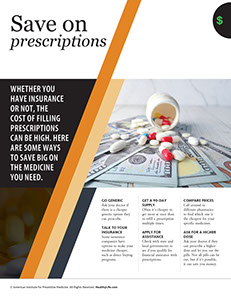
  • Save On Prescriptions

    FINANCIAL HEALTH

    Pills and bottle on top of a money.

    Whether you have insurance or not, the cost of filling prescriptions can be high. Here are some ways to save big on the medicine you need.

    Go generic

    Ask your doctor if there is a cheaper generic option they can prescribe.

    Talk to your insurance

    Some insurance companies have options to make your medicine cheaper, such as direct buying programs.

    Get a 90-day supply

    Often it’s cheaper to get more at once than to refill a prescription multiple times.

    Apply for assistance

    Check with state and local governments to see if you qualify for financial assistance with prescriptions.

    Compare prices

    Call around to different pharmacies to find which one is the cheapest for your specific medicines.

    Ask for a higher dose

    Ask your doctor if they can prescribe a higher dose and let you cut the pills. Not all pills can be cut, but if it’s possible, it can save you money.

    © American Institute for Preventive Medicine

  • Financial Wellness

    Financial Health

    Stacked coins with illustration arrows pointing up with icons of a house, card, credit card, etc...

    Having financial security to meet your needs and enjoy your life is, well, priceless. But if you’re struggling and juggling bills, the stress can make you sick. Your financial well-being is an important part of your overall well-being. Money-related stress can trickle down to affect every area of your life, including your health.

    Making wise financial choices can help you take control of your money, so it doesn’t control you. It’s a small price to pay for peace of mind.

    ays to Well-Being book by the American Institute for Preventive Medicine. www.HealthyLife.com. All rights reserved.

    © American Institute for Preventive Medicine

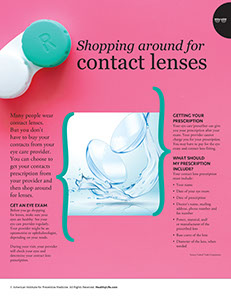
  • Shopping Around For Contact Lenses

    FINANCIAL HEALTH

    Contact case holder.

    Many people wear contact lenses. But you don’t have to buy your contacts from your eye care provider. You can choose to get your contacts prescription from your provider and then shop around for lenses.

    Get an eye exam

    Before you go shopping for lenses, make sure your eyes are healthy. See your eye care provider regularly. Your provider might be an optometrist or ophthalmologist, depending on your needs.

    During your visit, your provider will check your eyes and determine your contact lens prescription.

    Getting your prescription

    Your eye care prescriber can give you your prescription after your exam. Your provider cannot charge you for your prescription. You may have to pay for the eye exam and contact lens fitting.

    What should my prescription include?

    Your contact lens prescription must include:

    *  Your name

    *  Date of your eye exam

    *  Date of prescription

    *  Doctor’s name, mailing address, phone number and fax number

    *  Power, material, and/or manufacturer of the prescribed lens

    *  Base curve of the lens

    *  Diameter of the lens, when needed

    Source: Federal Trade Commission

    © American Institute for Preventive Medicine