Category: Uncategorized

  • Medication Safety

    Medication

    Smiling women holding a glass of water in one hand and a pill in the other hand.

    Knowing all the medicines you take makes it easier to list them on medical forms and to talk to your doctor and pharmacist about them.

    Keep a current list of all of the medicines you take. Include prescribed and over-the-counter ones, vitamins, minerals, herbs, etc. Give a copy of the list to your doctor (and pharmacist), as needed.

    Mixing some medicines with other medicines, alcohol, drugs, foods, etc. can cause harmful side effects. It can also limit or raise the desired effect of a medicine’s action.

    Mixing some “natural” products and foods with prescribed medicines can be harmful or make the medicine less effective.

    Follow warning labels on medicines and over-the-counter products, too.

    A Year of Health Hints book by the American Institute for Preventive Medicine. www.HealthyLife.com. All rights reserved.

    © American Institute for Preventive Medicine

  • Disclaimer_Healthylearn

    Disclaimer

    This Online guide is not meant to substitute for expert medical advice or treatment. The information is given to help you make informed choices about your health. Follow your doctor’s or health care provider’s advice if it differs from what is given in this guide.

    HealthyLearn Online provides links to videos and other Internet sites for additional information for the user. The American Institute for Preventive Medicine (AIPM) is not responsible for the availability or content of these videos and external sites, nor does AIPM endorse, warrant or guarantee the products, services or information described or offered at these videos and other Internet sites. Also, it is the responsibility of the user to examine the copyright and licensing restrictions of linked pages and to secure all necessary permission.

    The content on this Web site is proprietary. YOU MAY NOT MODIFY, COPY, REPRODUCE, REPUBLISH, UPLOAD, POST, TRANSMIT, OR DISTRIBUTE, IN ANY MANNER, THE MATERIAL ON THE SITE.

    By visiting www.healthylearn.com, you are accepting the practices described in this Privacy Policy. This Policy is subject to change without notice and you should revisit this site frequently for the most current version of our policy.

    Our Pledge to You, Our Customer

    www.healthylearn.com respects your privacy. We do not sell, rent, loan or transfer any personal information regarding our customers to any unrelated third parties. Any information you give us about yourself is held with the utmost care and security and will not be used in ways to which you have not consented. Information collected on our Web site is used by www.healthylearn.com and authorized agents for www.healthylearn.com purposes (“www.healthylearn.com”). www.healthylearn.com will not collect any personal information about you except when specifically and knowingly provided by you. Examples of personally identifiable information include full name, home address, e-mail address and phone number. www.healthylearn.com will use reasonable efforts to include accurate and up-to-date information on this site. All users agree that all access to and use of this site and its content is at your own risk. www.healthylearn.com will not be liable for any damage arising out of your access to, use of, or inability to use this site, or any errors or omissions in the content thereof. The materials in this site are provided “AS IS” and without warranties of any kind either expressed or implied.

    Use of Your Information

    Authorized www.healthylearn.com employees internally use information collected on our Web site for two main purposes. First, we collect information to figure out how to improve our site by seeing which areas features and products are most popular. Second, we collect information in order to personalize the site for our customers. For example, in the future, we may recommend products or features you may like based on what you have liked in the past. If we want to collect information for other purposes, we will inform you when we collect the information. Occasionally, www.healthylearn.com may also share non-personal, summary information regarding our customers with unrelated third parties (for example, we publicly disclose the aggregate number of registered users of our Web site). However, www.healthylearn.com does not share any personal information about any particular customer with unrelated third parties. If you do not want to receive e-mail from us and currently do, please reply to an e-mail that we have sent to you and insert “unsubscribe” in the subject line.

    Use of Our Information

    We are certain you understand that www.healthylearn.com must protect its intellectual property, including its patents, trademarks, and copyrights. Therefore, no license to www.healthylearn.com’s intellectual property has been granted by this Internet site.

    Cookies

    www.healthylearn.com uses a feature of your Internet Web browser called a “cookie” to assign a unique identification to your computer. Cookies are files that your Web browser places on your computer’s hard drive. We use these cookie files to track your clicks as you go through the www.healthylearn.com Web site, to tell us whether you have visited www.healthylearn.com previously, and to help us determine whether you came to www.healthylearn.com from a particular Internet link or banner advertisement. www.healthylearn.com does not and cannot use cookies to retrieve personal information about you from your computer. The “help” portion of the toolbar on most browsers will tell you how to prevent your browser from accepting new cookies, how to have the browser notify you when you receive a new cookie, or how to disable cookies altogether. However, you will not be able to use some www.healthylearn.com features if you do not use cookies.

    Maintenance Of Accurate Information

    Procedures have been established to ensure that our product and promotional information is current and accurate in keeping with reasonable standards. We are committed to respond to requests to correct inaccurate information in a timely manner.

    Third-Party Sites

    Our site contains links to other sites whose information practices and privacy policy may be different than our own. Visitors should consult the other sites’ privacy notices, as we have no control over information that is submitted to, or collected by, these third parties.

    Questions and Comments

    © American Institute for Preventive Medicine

  • Caring For Toe Injuries

    SELF-CARE CORNER

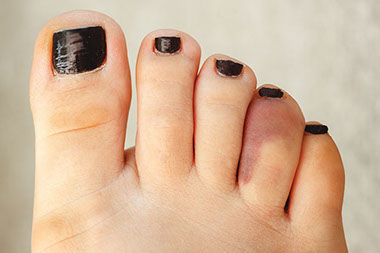
    Close up of injured toe.

    Toes are an important part of walking and balance. And their bones and ligaments are small, so they can be easily injured.

    Many people think doctors won’t do anything about an injured toe. This is not true. A broken or sprained toe may need medical attention. But minor toe injuries may get better with some simple home care.

    What to do if you hurt your toe

    *  If the pain is not severe, try putting ice on it for 10 minutes at a time. Be careful not to get the toe too cold.

    *  If needed, take an over-the-counter pain medicine.

    *  Stay off the foot if possible. Try to elevate it when sitting down.

    *  Look for signs of bruising and swelling, which could mean a possible sprain or broken toe.

    *  If the pain is severe, contact your doctor or seek urgent medical care.

    *  If pain and swelling don’t get better within two days, see a health care provider.

    *  Elevate the affected toe to help with swelling.

    Sprained vs. broken toe

    A sprain means that the ligaments in the toe have been injured. You can usually walk on a sprained toe, but it may still be very sore from swelling and bruising.

    Sprains may happen when you overstretch the toe during sports, running or jumping. “Turf toe” is a sprain of the big toe that is quite common in athletes.

    If you have a broken toe, you may not be able to move the toe or put weight on it. It may have a lot of swelling and bruising. The pain may not get better, even after a couple of days. Broken toes can happen during sports and activities. They also occur with falls and accidents or when you drop something heavy on your foot.

    Should you get medical care?

    Some minor toe injuries can be treated at home. But toe sprains and breaks can be more serious. Don’t ignore toe pain that lasts more than two days. See a health care provider if you think your toe is sprained or broken.

    If you have diabetes

    Always see a health care provider for any kind of foot or toe injury.

    Sources: American College of Foot and Ankle Surgeons, American Podiatric Medical Association

    © American Institute for Preventive Medicine

  • How To Treat Cat & Dog Bites

    SELF-CARE CORNER

    Aggrestive dog barking while owner is holding it back.

    Family pets, stray dogs and cats or neighborhood animals can all bite. Do you know what to do if you or your child gets a bite?

    What to do now

    Right away, you should:

    *  Wash the skin wound with soap and water.

    *  If it’s bleeding, use a clean towel to gently press down on the area.

    *  Once bleeding has stopped, apply a sterile bandage.

    Should I call a doctor?

    Some bites may need medical care. Call your doctor if:

    *  You think it might be infected. Look for fever, redness, swelling, warmth and drainage.

    *  You can’t get the bleeding to stop after pressing on it for 15 minutes.

    *  You think the injury is serious or it looks deep.

    *  You think there might be a broken bone.

    *  You have diabetes or a weakened immune system.

    *  Your last tetanus shot was more than 5 years ago. Or, you don’t remember when you last had a tetanus shot.

    *  You were bit by a wild or stray animal.

    *  The bite was on the face.

    *  The bite happened to a child.

    *  You don’t know if the animal is up to date on all its vaccines (shots).

    Do I need a rabies shot?

    Most cats and dogs in the U.S. don’t have rabies. So most people who get bit by a cat or dog don’t need to get a rabies shot. Many wild animals can have rabies, though. Raccoons, skunks, squirrels, bats and coyotes may have it.

    If you know the owner of the cat or dog that bit you, ask for their health records. Sometimes the pet needs to be isolated so they can look for signs of rabies. If any signs show up, they will test the animal for rabies. If the animal tests positive, then you need a rabies shot.

    If you were bit by a stray animal, call animal control. They will try to find the animal so they can test it for rabies. You may need to report the bite to animal control or your local health department too. Ask your doctor if you’re not sure.

    Source: American Academy of Family Physicians

    © American Institute for Preventive Medicine

  • Take Care Of  Bleeding Gums

    SELF-CARE CORNER

    Man smiling at dentist office with dentist about to start exam.

    Bleeding gums are never a good thing. If you notice small amounts of blood when you brush or floss, it’s a signal there’s a problem. Thankfully, there are effective treatments for many common triggers of gum bleeding.

    The two most common causes are plaque buildup and gum disease. But, whatever the cause, you should address the underlying issue right away to protect the health of your gums and teeth.

    Causes of gum bleeding

    In many cases, gums bleed when there is underlying inflammation of the gum tissue. Inflammation can happen for a variety of reasons.

    *  Plaque buildup

    *  Brushing too hard

    *  Poor flossing

    *  Tooth or gum infection

    *  Pregnancy hormone changes

    *  Gum disease

    *  Ill-fitting dental appliances

    *  Vitamins K or C deficiency

    *  Certain medications

    Occasionally, bleeding gums may be a sign of a more serious underlying problem, such as a bleeding disorder. Visit your primary care doctor for follow-up if your dentist is unable to find a cause for the bleeding.

    What to do

    Visit the dentist. Regular dentist visits and professional cleanings are key to preventing gum disease and plaque buildup. Talk to your dentist about gum bleeding and always follow their recommendations for oral hygiene.

    Brush twice daily. There is no substitute for routine brushing to rid your teeth of plaque. Plaque is made up of sticky bacteria that irritate the gums. If your gums bleed when you brush, be gentle but thorough.

    Floss every day. Floss gets into the tight spaces your toothbrush can’t reach. Lack of flossing or poor technique could result in plaque buildup around the gum line and gingivitis, a major culprit of gum bleeding.

    Healthy habits, healthy gums

    Many daily habits impact the overall health of your gums. For good long-term oral health, follow these healthy lifestyle habits.

    *  Eat lots of fruits and vegetables

    *  Limit added sugar in your diet

    *  Avoid tobacco and drug use

    *  Drink water instead of sugary beverages

    *  Ask your dentist if a mouthwash is right for you

    © American Institute for Preventive Medicine

  • Bike Safety

    BE FIT

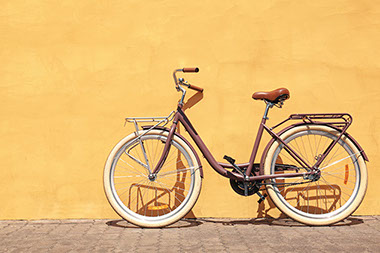
    Bike up against a yellow wall.

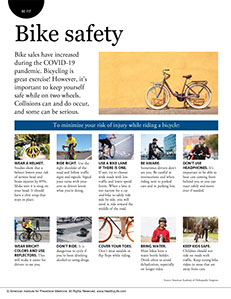
    Bike sales have increased during the COVID-19 pandemic. Bicycling is great exercise! However, it’s important to keep yourself safe while on two wheels. Collisions can and do occur, and some can be serious.

    To minimize your risk of injury while riding a bicycle:

    *Wear a helmet.Studies show that a helmet lowers your risk of serious head and brain injuries by 85%. Make sure it is snug on your head. It should have a chin strap that stays in place.

    *Ride right.Use the right shoulder of the road and follow traffic signs and signals. Signal your turns with your arm so drivers know what you’re doing.

    *Use a bike lane if there is one.If not, try to choose wide roads with less traffic and lower speed limits. When a lane is too narrow for a car and bike to safely ride side by side, you will need to ride toward the middle of the road.

    *Be aware.Sometimes drivers don’t see you. Be careful at intersections and when riding next to parked cars and in parking lots.

    *Don’t use headphones.It’s important to be able to hear cars coming from behind you so you can react safely and move over if needed.

    *Wear bright colors and use reflectors.This will make it easier for drivers to see you.

    *Don’t ride.It is dangerous to cycle if you’ve been drinking alcohol or using drugs.

    *Cover your toes.Don’t wear sandals or flip flops while riding.

    *Bring water.Most bikes have a water bottle holder. Drink often to avoid dehydration, especially on longer rides.

    *Keep kids safe.Children should not ride on roads with traffic. Keep young bike riders in areas that are away from cars.

    Source: American Academy of Orthopaedic Surgeons

    © American Institute for Preventive Medicine

  • Find The Energy To Exercise

    BE FIT

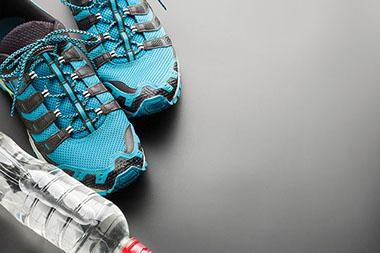
    Image of athletic shoes and a bottle of water.

    Too tired to work out? Try these tips to boost energy and get moving.

    1.  Move around. At work, try to switch between sitting and standing. Doing too much of one or the other may leave you feeling drained.

    2.  Sip lots of water. Starting in the morning, drink water and keep drinking it throughout the day. This can keep energy levels from sinking in the afternoon.

    3.  Eat healthy carbs. Choose whole grains, fruits and vegetables, such as carrots.

    4.  Watch your breathing. Slow, deep breaths can relax and energize you throughout the day.

    © American Institute for Preventive Medicine

  • Stay Fit For Life By Getting Flexible

    BE FIT

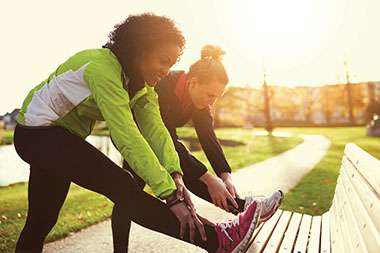
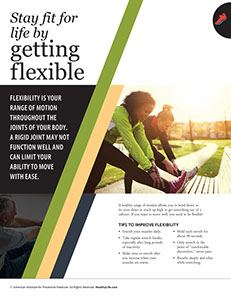
    Two women stretching legs on bench.

    Flexibility is your range of motion throughout the joints of your body. A rigid joint may not function well and can limit your ability to move with ease.

    A healthy range of motion allows you to bend down to tie your shoes or reach up high to get something out of a cabinet. If you want to move well, you need to be flexible!

    Tips to improve flexibility

    *  Stretch your muscles daily.

    *  Take regular stretch breaks, especially after long periods of inactivity.

    *  Make time to stretch after you exercise when your muscles are warm.

    *  Hold each stretch for about 90 seconds.

    *  Only stretch to the point of “comfortable discomfort,” never pain.

    *  Breathe deeply and relax while stretching.

    © American Institute for Preventive Medicine

  • Be Mindful Of…Inspired Fitness

    Fitness

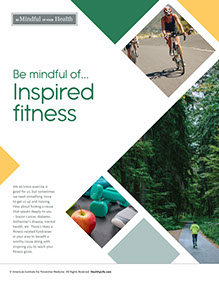
    Person jogging on a nature trail.

    We all know exercise is good for us, but sometimes we need something more to get us up and moving. How about finding a cause that speaks deeply to you – breast cancer, diabetes, Alzheimer’s disease, mental health, etc. There’s likely a fitness-related fundraiser in your area to benefit a worthy cause along with inspiring you to reach your fitness goals.

    Page from HealthyLife Weigh book by the American Institute for Preventive Medicine. www.HealthyLife.com. All rights reserved.

    © American Institute for Preventive Medicine

  • Find Your Fitness Personality

    Fitness

    Body type isn’t the only trait that determines which activities are best for you, though. You’ve probably already given some thought to what you’d like, based on whether you prefer to do activities alone or in a group; competitive or noncompetitive activities, or outdoor or indoor activities.

    Finding a fitness activity that suits your personality is also a big factor in how much you’ll enjoy exercise and stick with it long enough to reap the benefits. Do any of the following descriptions of fitness personalities sound like you? If so, read the “hint for success” that pertains to each one.

    The Weekend Warrior

    The weekend warrior is sedentary throughout the work week and binges on exercise or sports over the weekend. Hint: Add minimal activity (even as little as 15 minutes twice per week) during the week to help condition your heart and lungs, sustain muscular endurance, and prevent strains or injuries on the weekend.

    The Fanatic

    The fanatic thinks that if a moderate exercise is good, then a lot is better. He or she always tries to work out a little more, a lot harder, or more intensely than others, and feels anxious and irritable if he or she misses a workout. Hint: Fitness should be a pleasure, not an addiction or ball and chain.

    The Social Butterfly

    The social butterfly has difficulty sticking with a solo fitness program, and loves to chat and mingle with other participants in a group. Hint: Don’t always depend on group activities or other people to enable you to meet your fitness goals. Be willing to go it alone if you must.

    The Cannonball

    The cannonball jumps into a fitness program with a burst of energy and determination but loses enthusiasm a few weeks later. Hint: Don’t try to do too much, too soon, or you’ll probably burn out after 2 or 3 weeks. It takes 10 to 12 weeks to start to see the results of your efforts.

    The Flipper

    The flipper dabbles in one activity, then quickly abandons it for another, and is related to the cannonball. Sometimes he or she may remain inactive for long intervals between flurries of activity. Hint: Real fitness results from consistent efforts, over the long term.

    The Analyst

    The analyst loves exercise gadgets and equipment. He or she reads lots of fitness books and magazines and likes to talk about the benefits of exercise. Hint: This is not a problem if you actually pursue the activities you’re learning about. But remember, the important thing is to get out and move.

    Page image from A Year of Health Hints book by the American Institute for Preventive Medicine. www.HealthyLife.com. All rights reserved.

    © American Institute for Preventive Medicine