Blood Cholesterol Test (Lipid Profile)
Why you need this:
Blood cholesterol levels play a major role in heart disease. Getting blood cholesterol levels in goal ranges lowers the risk for heart disease. A lipid profile test gives information about total cholesterol, LDL (bad) cholesterol, HDL (good) cholesterol, and triglycerides (another form of fat).
What to do before the test:
It is best to schedule the test in the morning, because you need to have nothing to eat or drink for 9 to 12 hours before the test. Fasting before the test is needed for LDL (bad) cholesterol and triglycerides.
What to expect:
A blood sample is taken, usually from a vein in the arm. A bandage is put on the skin site where your blood was drawn. The blood sample is sent to a lab. Lipids are measured in milligrams per deciliter (mg/dL).
What the results mean:
Total Blood Cholesterol Goal: Less than 200 mg/dL
{Note: Ask your doctor what your LDL-cholesterol goal is. This is based on your risk factors for heart disease and how many you have. Examples are high blood pressure; diabetes; family history of early heart disease; cigarette smoking; and being a man age 45 years and older or being a women age 55 years old and older. Your HDL-cholesterol is also a factor.}
LDL (bad) Cholesterol Goals (Deposits cholesterol in the artery walls.)
Less than 70 mg/dL: If at “very high risk.”
Less than 100 mg/dL: If at “high risk.”
Less than 70 mg/dL: Optional goal for this risk level.
Less than 130 mg/dL: If at “moderate high risk.”
Less than 100 mg/dL: Optional goal for this risk level.
Less than 160 mg/dL: If at “lower/moderate risk.”
HDL (good) Cholesterol Goals (Helps remove cholesterol from the blood.)
40 mg/dL or higher for men
50 mg/dL or higher for women
Triglycerides Goal: Less than 150 mg/dL
Blood Pressure
Why you need this:
High blood pressure (HBP) may not have symptoms. Getting tested is how you find out if you have it. If you do have HBP and it is not controlled, you run the risk of having a heart attack or stroke. Diet, weight control, and exercise can help control HBP.
What to do before the test:
Wear short sleeves so your arm is exposed. Don’t drink coffee or smoke 30 minutes before the test. (Don’t smoke at all!) Go to the bathroom before the test. Right before the test, sit for 5 minutes. When you get tested, keep your back and arm supported and your arm at heart level.
What to expect:
The end of a stethoscope is placed on the inside of your elbow. A blood pressure cuff is wrapped around your arm. A pump attached to the cuff inflates the cuff to stop the blood flow in the artery for a few seconds. You feel tightness in your arm. The technician listens for a thumping sound and when it is no longer heard to measure your blood pressure. A valve by the pump is opened up to let air out of the cuff, which allows blood flow to start again.
What the results mean:
Normal: Systolic < 120 and Diastolic < 80
Pre-hypertension: Systolic 120-139 or Diastolic 80-90
Stage 1 Hypertension: Systolic 140-159 or Diastolic 90-99
Stage 2 Hypertension: Systolic ≥ 160 or Diastolic ≥ 100
Colorectal Cancer Screening – Colonoscopy
Why you need this:
To remove colon polyps and to screen for cancers of the colon and rectum. These cancers can be cured when found and treated early.
What to do before the test:
Follow your doctor’s guidelines for when and how long before the test to stop taking iron supplements and aspirin and other blood thinners. Stop eating solid foods 2 to 3 days before the test. Drink lots of clear liquids. Take what your doctor advises to completely cleanse the colon. Don’t have anything to eat or drink 9 to 12 hours before the test. Arrange for someone to drive you home after the test.
What to expect:
You wear a gown for this test. An IV is used to give a pain reliever and a sedative. You lie on your left side with your knees drawn up to your chest. A long flexible tube with a video camera (colonoscope) is inserted through the anus to examine the entire colon. After the test, you may have a lot of gas because air is inserted through the scope to allow for a better view of the colon. If you had one or more polyps removed, you may have a little bit of blood in your bowel movement for a few days.
What the results mean:
If the test is normal, follow your doctor’s advice for future screenings. A biopsy is done on removed polyps. If cancer is found, your doctor will discuss treatment for it.
Colorectal Cancer Screening – Stool Blood Test
Why you need this:
To find cancers of the colon and rectum. These can be cured when treated early.
What to do before the test:
Follow the doctor’s advice for what foods and medicines to avoid 2 to 3 days before you take a sample of your stool. Examples are red meat, horseradish, and aspirin.
What to expect:
For 3 days in a row, you collect a sample of your stool. Samples from different bowel movements are needed because colon cancers and polyps that precede them do not bleed every day. Have your bowel movement in a clean container. (The stool sample should not be mixed with urine or water.) Follow instructions in the test kit to apply a thin smear of stool on one part of the test card. Let it dry. After you have taken 3 stool samples, return the test card to your doctor’s office.
What the results mean:
A negative result means there is no blood in your stool. A positive result means there is blood in the stool or a substance gave a false positive result. The blood could be from cancer or from a bleeding ulcer or other problem. Your doctor will order follow up tests to check for colon cancer.
Dental Checkup
Why you need this:
To check for tooth decay, infection, and gum disease. Infections, gum disease, and other mouth infections may increase the risk for pneumonia, diabetes, and heart disease. An oral exam can also help your dentist detect other health problems. These include diabetes, eating disorders, heart disease, osteoporosis, and a lack of vitamins.
What to do before the test:
Brush and floss your teeth. If you are not going to the dentist’s office right from home, take a toothbrush and dental floss with you to use at the dentist’s office right before the checkup.
What to expect:
You sit in the dentist’s chair. The dentist or hygienist does these things: Looks at your teeth, gums, cheeks, tongue, and throat for problems. Checks your bite and jaw joints. Takes dental X-rays, as needed, to find cavities and other problems. Removes tartar from your teeth. Cleans and flosses your teeth. Addresses any areas of concern. You are given a new toothbrush and dental floss!
What the results mean:
The dentist will tell you what you need to do to take care of your teeth and gums. The dentist will prescribe follow-up care and treatment, as needed.
Depression / Mental Health Screening
Why you need this:
Depression occurs twice as often in women than in men. Untreated depression affects both mental and physical health. It can make blood sugar and other medical problems worse. It can also lead to suicide. Depression is an illness that is very treatable.
What to do before the test:
Find out if your biological relatives have or have had depression or bipolar disorder.
What to expect:
Your doctor or a mental health care provider will ask you to answer yes or no to a number of questions.
What the results mean:
Your answers help your doctor decide if you have depression or some other physical or mental health problem. He or she will prescribe treatment or further tests, as needed. Treatment for depression is counseling, medicine, or both of these.
Diabetes Screening (Blood Glucose [Sugar] Test)
Why you need this:
Checks for diabetes and pre-diabetes. When diabetes in not treated, hardening of the arteries, stroke, kidney failure, and blindness can result. A woman with diabetes has 4 to 6 times the risk of coronary artery disease than a woman without diabetes. (A man’s risk only doubles.)
What to do before the test:
It is best to schedule the test in the morning, because you need to have nothing to eat or drink for 8 or more hours before the test.
What to expect:
1. A blood test is taken from a vein in your arm. This is a fasting blood test. It is analyzed at a lab.
2. For a 2-hour oral glucose test, you are given a very sweet liquid to drink. Two hours later, a blood test is taken.
What the results mean:
Fasting Blood Glucose Test*
99 mg/dL and below: Normal
100 to 125 mg/dL: Pre-diabetes (impaired fasting glucose)*
126 mg/dL and above Diabetes*
*A diagnosis is confirmed by repeating the test on a different day
2-Hour Glucose Tolerance Test: 200 mg/dL or higher
HIV Screening
Why you need this:
If HIV is present, treatment can lessen chances of infecting others and improve health outcomes. Early treatment of a pregnant female can greatly lessen the chance that her baby will be infected with HIV.
What to do before the test:
Wait 1 to 3 months after possible HIV exposure to get a blood test to check for HIV. This is the average time it takes for HIV antibodies to show up in blood. If you think you have been exposed to HIV, practice “Safer Sex”; do not donate blood; do not share needles; and do not breast-feed.
What to expect:
A blood sample is taken from your arm. (For a home testing kit, a finger prick blood sample is used.) If the blood sample shows a certain reaction, another test is done using the same sample. If the 2nd test confirms the results of the first, HIV is diagnosed. Rapid HIV blood tests give results in 20 minutes. Other tests for HIV are done using a sample of your urine or collecting fluid from inside your mouth.
What the results mean:
Negative means HIV antibodies were not detected. Positive means you are infected with HIV. Get medical care right away. Practice “Safer Sex” to greatly reduce the risk of spreading HIV and of getting infected with other STIs.
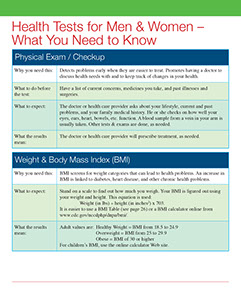
Physical Exam / Checkup
Why you need this:
Detects problems early when they are easier to treat. Promotes having a doctor to discuss health needs with and to keep track of changes in your health.
What to do before the test:
Have a list of current concerns, medicines you take, and past illnesses and surgeries.
What to expect:
The doctor or health care provider asks about your lifestyle, current and past problems, and your family medical history. He or she checks on how well your eyes, ears, heart, bowels, etc. function. A blood sample from a vein in your arm is usually taken. Other tests & exams are done, as needed.
What the results mean:
The doctor or health care provider will prescribe treatment, as needed.
Sexually Transmitted Infection (STI) Screening
Why you need this:
STIs may or may not have symptoms. Left untreated, different STIs can lead to health problems, such as cervical cancer, pelvic inflammatory disease, infertility, liver problems, and even death. Treating STIs lowers the risk of spreading them.
What to do before the test:
Follow your doctor’s advice for the test(s) needed.
What to expect:
For men and women: A blood test screens for hepatitis B, HIV, and syphilis.
For men: The doctor will examine the genital area, as well as the lymph nodes in the groin. A urine sample is taken to test for chlamydia. For gonorrhea, a thin swab is inserted into the urethra just far enough to get a sample of cells.
For women: The doctor examines the genital area and uses a long cotton swab to collect cells from the cervix and/or the walls of the vagina.
What the results mean:
If a test is postive for an STI, your doctor will prescribe treatment, as needed.
Video Exam
Why you need this:
Checks for problems with vision and eye function. Can also help detect diabetes, glaucoma, and other problems.
What to do before the test:
Gather the eyeglasses, sunglasses, contact lenses, etc. you use, so you can show these to the eye doctor. (Take sunglasses with you in case the eye doctor dilates your eyes.)
What to expect:
You sit in the exam chair. The eye doctor and/or technician uses vision testing equipment to check your vision and for problems. To test for glaucoma, you look through a machine that sends a puff of air into one eye at a time. The eye doctor may put drops into your eyes to dilate the pupils of your eyes.
What the results mean:
The eye doctor will prescribe treatment, as needed.
Weight & Body Mass Index (BMI)
Why you need this:
BMI screens for weight categories that can lead to health problems. An increase in BMI is linked to diabetes, heart disease, and other chronic health problems.
What to expect:
Stand on a scale to find out how much you weigh. Your BMI is figured out using your weight and height. This equation is used:
Weight (in lbs) ÷ height (in inches) x 703.
It is easier to use a BMI Table or a BMI calculator online fromwww.cdc.gov/nccdphp/dnpa/bmi/.
What the results mean:
Adult values are: Healthy Weight =
BMI from 18.5 to 24.9
Overweight = BMI from 25 to 29.9
Obese = BMI of 30 or higher
For children’s BMI, use the online calculator Web site.