Blog

  • Dealing With Family Arguments

    FAMILY LIFE

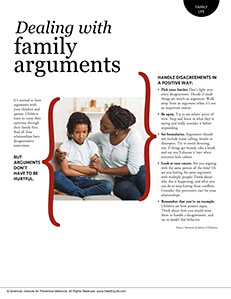
    Mother comforting her young son who's upset.

    It’s normal to have arguments with your children and spouse. Children learn to voice their opinions through their family first. And all close relationships have disagreements sometimes.

    But arguments don’t have to be hurtful.

    Handle disagreements in a positive way:

    *Pick your battles:Don’t fight over every disagreement. Decide if small things are worth an argument. Walk away from an argument when it’s not an important matter.

    *Be open.Try to see others’ point of view. Stop and listen to what they’re saying and really consider it before responding.

    *Set boundaries.Arguments should not include name calling, insults or disrespect. Try to avoid shouting, too. If things get heated, take a break and say you’ll discuss it later when everyone feels calmer.

    *Look at root causes.Are you arguing with the same person all the time? Or are you having the same argument with multiple people? Think about why this is happening, and what you can do to stop having these conflicts. Consider this preventive care for your relationships.

    *Remember that you’re an example.Children see how parents argue. Think about how you would want them to handle a disagreement, and try to model that behavior.

    Source: American Academy of Pediatrics

    © American Institute for Preventive Medicine

  • Dealing With Difficult Personalities

    WORK LIFE

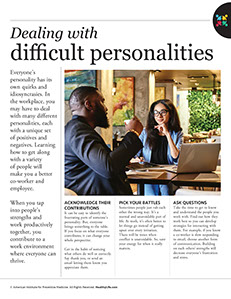
    Two coworkers sitting with laptop, talking and drinking coffee.

    Everyone’s personality has its own quirks and idiosyncrasies. In the workplace, you may have to deal with many different personalities, each with a unique set of positives and negatives. Learning how to get along with a variety of people will make you a better co-worker and employee.

    When you tap into people’s strengths and work productively together, you contribute to a work environment where everyone can thrive.

    Acknowledge their contributions

    It can be easy to identify the frustrating parts of someone’s personality. But, everyone brings something to the table. If you focus on what everyone contributes, it can change your whole perspective.

    Get in the habit of noticing what others do well or correctly. Say thank you, or send an email letting them know you appreciate them.

    Pick your battles

    Sometimes people just rub each other the wrong way. It’s a normal and unavoidable part of life. At work, it’s often better to let things go instead of getting upset over every irritation. There will be times when conflict is unavoidable. So, save your energy for when it really matters.

    Ask questions

    Take the time to get to know and understand the people you work with. Find out how they work best so you can develop strategies for interacting with them. For example, if you know a co-worker is slow responding to email, choose another form of communication. Building on each others’ strengths will decrease everyone’s frustration and stress.

    © American Institute for Preventive Medicine
  • Dating After Divorce

    FAMILY LIFE

    Couple on a date.

    If you’re a divorced parent with kids, you may be wondering how to handle future relationships. Kids often need some time to adjust to their parents’ separation.

    If you’re ready to begin a new romantic relationship after a divorce, keep these tips in mind:

    *  Consider waiting at least six months to help kids adjust to the divorce.

    *  Your child doesn’t need to meet everyone you date. Introduce them only if your relationship is becoming serious.

    *  Prepare for the first meeting with your significant other and child. Don’t expect the first meeting to be perfect.

    *  Help your child deal with negative feelings. Children often hold out hope that their parents will get back together. Seeing a new significant other in your life can be difficult for them. Be sure to tell them that you and your ex-spouse are not getting back together, but that you still love them and will be their parents no matter what.

    *  Understand if your child simply doesn’t like your new partner as much as their other parent. This is normal. With time, your child may develop their own special relationship with this person.

    *  Don’t ask them to keep secrets from their other parent. If you are dating, you may need to tell your ex-spouse about the person in case your child brings it up with them. Your child should not feel uncomfortable when they talk about it with your ex-spouse.

    *  Remember that your child is always watching. Be cautious about your behavior in front of your child, whether it’s public affection or things you say.

    Source: American Academy of Pediatrics

    © American Institute for Preventive Medicine

  • Daily Habits For A Restful Sleep

    SELF-CARE CORNER

    Clock sitting on night stand.

    Your habits during the day have a significant influence on how well you sleep. From the moment you open your eyes in the morning, the choices you make determine whether your body will be ready to rest at bedtime.

    Creating a sleep-minded daily routine will set the stage for a good night’s rest. If you’re struggling to fall asleep or stay asleep, it’s time to reset your daily rhythm so you wake up refreshed and ready to go.

    Get up at the same time each day

    A consistent sleep schedule lets your body know when to be alert and when to settle down for bed. Getting up at the same time each day is essential to establish a sleep rhythm.

    Think of getting up in the morning as step one of your sleep schedule. If step one is consistent, then all the other steps can fall into place. If you’re tired, it’s better to go to bed early than sleep in late.

    Spend time outside

    Natural light is a signal to the body that it’s time to be awake and alert. Being outdoors stimulates hormones related to your circadian rhythm. These hormones help determine how energetic you feel during the day and how well you sleep at night.

    Exposure to early morning sunlight is ideal for regulating your sleep/wake pattern. If you are unable to get outside, use bright lights early in the day to simulate sunlight.

    Exercise in the morning

    Being physically active first thing in the morning can give you a boost of energy. The more active and energetic you feel during the day, the more likely you will wind down at night.

    If exercising first thing isn’t possible, make sure to get your exercise in as early in the day as you can. Avoid exercising within a few hours of bedtime as it may make you too energized to fall asleep.

    Eat consistent meals

    The timing of your meals is an important part of your sleep cycle. When you eat, you are communicating the time of day to your body. Consistent meals also provide energy so you can be alert and productive during your waking hours.

    Avoid skipping meals or snacking late at night. Eating or drinking close to bedtime sends the wrong signal. At night, you want your energy levels to drop and your body to focus on repair and rest.

    Source: National Heart, Lung, and Blood Institute

    © American Institute for Preventive Medicine
  • Cystic Fibrosis Awareness

    MEDICAL NEWS

    Girl in bed with breathing mask on while holding a teddy bear.

    Cystic fibrosis (CF) is an inherited disease that affects 70,000 people worldwide. People who have CF have a gene mutation. This gene mutation causes mucus in the body to become thick and sticky.

    With CF, thick mucus in the lungs can cause infections and make it hard to breathe. The pancreas, which helps digest food, becomes clogged. Then the body can’t absorb nutrients from food. This can cause malnutrition and poor growth. CF affects other organs, too.

    CF and genetics

    People with CF have two copies of the CF gene. They get one copy from each parent. Both parents must have at least one copy of the CF gene.

    People with only one copy of the CF gene are called carriers. They don’t have the disease and may not know that they have the CF gene. Each time two CF carriers have a child, the chances are:

    *  25 percent (1 in 4) the child will have CF

    *  50 percent (1 in 2) the child will be a carrier but will not have CF

    *  25 percent (1 in 4) the child will not be a carrier and will not have CF

    People with CF can also pass copies of their CF genes to their children. If someone with CF and a CF carrier have a child together, the chances are:

    *  50 percent (1 in 2) the child will be a carrier but will not have CF

    *  50 percent (1 in 2) the child will have CF

    Getting tested for the CF gene

    People who are considering pregnancy may wish to get a CF genetic test. This tells you if you have CF or if you could be a carrier. This test looks for the most common CF genes, but it doesn’t test for all of them. If you’re not sure if you need the test, ask your doctor. The decision to get CF testing is a personal one and is different for everyone.

    Longer lives  for CF

    There is no cure for CF. But with proper medical care, people with CF are living longer than ever before. Today, more than half of people who live with CF are over age 18.

    Sources: Cystic Fibrosis Foundation, National Institutes of Health

    © American Institute for Preventive Medicine

  • Curry: A Powerhouse Spice

    HEALTHY EATING

    Curry powder and wooden spoon.

    Curry is a unique, delicious spice commonly found in East Indian cuisine. Curry powder is actually a blend of several ground spices, including turmeric, coriander, pepper, cumin, cinnamon, and chili. Each mixture can be different, and its color ranges from golden yellow to deep orange. The spices that make up curry powder have long been used in traditional Ayurvedic medicine. More recently, modern science is researching some possible health benefits.

    Decreased Inflammation

    One of the main ingredients in curry, turmeric, contains a botanical component called curcumin. It has been studied for its anti-inflammatory ability. Curcumin may be beneficial for people with inflammatory conditions such as arthritis and inflammatory bowel disease.

    Improved Digestion

    Many of the spices in curry powder may help digestion. Turmeric, cinnamon, and cumin are among the spices known for improving digestive health. Some curry blends also contain ginger, which may help reduce nausea and speed digestion.

    Antioxidant Properties

    Antioxidants are abundant in curry powder. These act to help prevent cell damage and protect against early aging. In general, plant foods with rich, deep colors are higher in antioxidants. Curry is no exception. The bright yellows and oranges indicate a variety of potent antioxidants.

    Heart Health

    Curry powder may help decrease blood pressure and lower levels of cholesterol and triglycerides.

    Cancer-Fighting

    Turmeric shows promise as an anti-cancer agent by interfering with cancer cells. The anti-inflammatory and antioxidant properties of curry may also be protective against cancer.

    Ask Your Doctor

    Always check with your doctor before taking turmeric or curcumin as a supplement.

    © American Institute for Preventive Medicine

  • Crossfit Faq

    BE FIT

    Man in gym working out.

    CrossFit is a high-intensity strength and conditioning workout. It emphasizes dynamic exercises such as Olympic lifting, plyometrics, and kettlebells.

    Who can do CrossFit?

    CrossFit can be modified for a variety of ages and fitness levels. There are even CrossFit classes for kids and seniors.

    Is CrossFit safe?

    Because CrossFit is a high-intensity form of exercise, it may not be the best choice for everyone. Check with your doctor to make sure CrossFit is right for you.

    What are the benefits of CrossFit?

    Regular CrossFit workouts can build strength and improve cardiovascular endurance. It counts towards your recommended 150 minutes of moderate to vigorous-intensity exercise.

    Are there risks to CrossFit?

    Any form of high-intensity exercise carries the potential for injury. To reduce your risk, get clearance from your doctor first and remember to increase gradually.

    © American Institute for Preventive Medicine
  • Create A Home Gym

    BE FIT

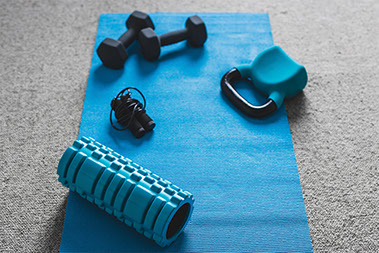
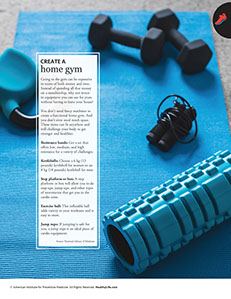
    Workout equipment for the home.

    Going to the gym can be expensive in terms of both money and time. Instead of spending all that money on a membership, why not invest in equipment you can use for years without having to leave your house?

    You don’t need fancy machines to create a functional home gym. And you don’t even need much space. These items can fit anywhere and will challenge your body to get stronger and healthier.

    Resistance bands:Get a set that offers low, medium, and high resistance for a variety of challenges.

    Kettlebells:Choose a 6 kg (13 pounds) kettlebell for women or an 8 kg (18 pounds) kettlebell for men.

    Step platform or box:A step platform or box will allow you to do step-ups, jump-ups, and other types of movements that get you in the cardio zone.

    Exercise ball:This inflatable ball adds variety to your workouts and is easy to store.

    Jump rope:If jumping is safe for you, a jump rope is an ideal piece of cardio equipment.

    Source: National Library of Medicine

    © American Institute for Preventive Medicine

  • Create A Family Mission Statement

    FAMILY LIFE

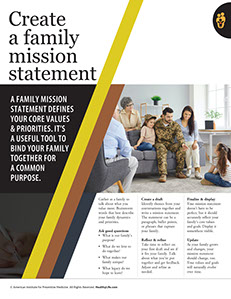
    Family sitting together talking.

    A family mission statement defines your core values & priorities. It’s a useful tool to bind your family together for a common purpose.

    Gather as a family to talk about what you value most. Brainstorm words that best describe your family dynamics and priorities.

    Ask good questions

    *  What is our family’s purpose?

    *  What do we love to do together?

    *  What makes our family unique?

    *  What legacy do we hope to leave?

    Create a draft

    Identify themes from your conversations together and write a mission statement. The statement can be a paragraph, bullet points, or phrases that capture your family.

    Reflect & refine

    Take time to reflect on your first draft and see if it fits your family. Talk about what you’ve put together and get feedback. Adjust and refine as needed.

    Finalize & display

    Your mission statement doesn’t have to be perfect, but it should accurately reflect your family’s core values and goals. Display it somewhere visible.

    Update

    As your family grows and changes, your mission statement should change, too. Your values and goals will naturally evolve over time.

    © American Institute for Preventive Medicine