Blog

  • When In Doubt, Throw It Out

    Home Safety

    Take steps to avoid foodborne illnesses.

    If it looks good, and smells good, it’s safe to eat. Right? Not always. Harmful bacteria that cause foodborne illnesses can hide very well in foods. Keeping foods safe to eat can prevent stomach pain, nausea, diarrhea, and other dire symptoms caused by eating spoiled food.

    Store foods safely:

    *  Separate raw, cooked, and ready-to-eat foods when you shop for and store them. Follow instructions on package labels.

    *  Refrigerate foods that can spoil within two hours (one hour if the room or outdoor temperature is above 90°F).

    *  Keep the refrigerator at 40°F or lower; the freezer at or below 0°F.

    *  Wrap meat and poultry securely to prevent leakage onto other foods. Use foil or freezer wrap.

    *  High-acid canned foods, such as tomatoes and pineapple can be stored for 12 to 18 months. Low-acid canned foods, such as most vegetables will keep two to five years if kept in a cool, dry place.

    Prepare foods safely:

    *  Wash your hands with warm water and soap for at least 20 seconds before and after handling food.

    *  Rinse raw fruits and veggies under running tap water before eating, cutting, or cooking.

    *  Scrub firm produce, such as melons and cucumbers with a clean produce brush.

    *  Use clean utensils and clean surfaces.

    *  Thaw frozen foods in the fridge or in cold water. You can also use the microwave if you are going to cook the food right away.

    *  Cook foods to a safe temperature.

    Leftovers, anyone?

    *  Quickly refrigerate leftovers.

    *  Freeze ones that you do not intend to eat within two to four days.

    *  Reheat leftovers on the stove or in the oven or microwave until an internal temperature reaches 165°F.

    *  Keep hot foods higher than 140°F. Keep cold foods at 40°F or lower. Bacteria grow rapidly in the “danger zone” between 40°F and 140°F.

    Action Step

    Find out about food recalls and alerts from your local news, national news, and from

    www.FoodSafety.gov.

    Ways to Well-Being book by the American Institute for Preventive Medicine. www.HealthyLife.com. All rights reserved.

    © American Institute for Preventive Medicine

  • What To Do If Clothing Catches Fire

    Home Safety

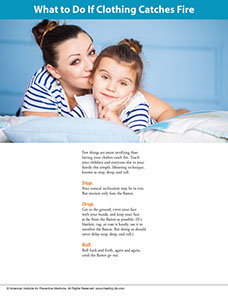
    Image of mother and daughter.

    Few things are more terrifying than having your clothes catch fire. Teach your children and everyone else in your family this simple, lifesaving technique, known as stop, drop, and roll.

    Stop. Your natural inclination may be to run. But motion only fans the flames.

    Drop. Get to the ground, cover your face with your hands, and keep your face as far from the flames as possible. (If a blanket, rug, or coat is handy, use it to smother the flames. But doing so should never delay stop, drop, and roll.)

    Roll. Roll back and forth, again and again, until the flames go out.

    A Year of Health Hints book by the American Institute for Preventive Medicine. www.HealthyLife.com. All rights reserved.

    © American Institute for Preventive Medicine

  • Wellness Gifts 2

    Personal Safety

    Fitness tools shaped into a Christmas tree.

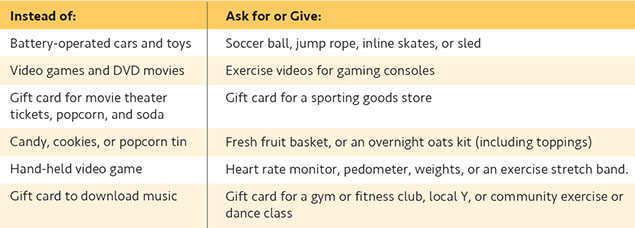
    Give presents that promote a healthy lifestyle. Keep their well-being and self-care in mind when making your list and checking it twice.

    Action Step:There are many thoughtful and joyful gifts to choose from that will enhance well-being, for adults and kids.

    A Year of Health Hints book by the American Institute for Preventive Medicine. www.HealthyLife.com. All rights reserved.

    © American Institute for Preventive Medicine

  • Violence & Abuse

    Mental Health

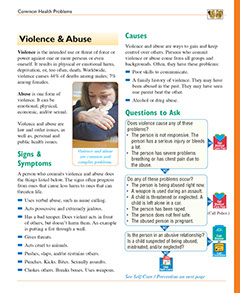
    Violence is the intended use or threat of force or power against one or more persons or even oneself. It results in physical or emotional harm, deprivation, or, too often, death. Worldwide, violence causes 44% of deaths among males; 7% among females.

    Abuse is one form of violence. It can be emotional, physical, economic, and/or sexual.

    Violence and abuse are law and order issues, as well as, personal and public health issues.

    Signs & Symptoms

    A person who commits violence and abuse does the things listed below. The signs often progress from ones that cause less harm to ones that can threaten life.

    *  Uses verbal abuse, such as name calling.

    *  Acts possessive and extremely jealous.

    *  Has a bad temper. Does violent acts in front of others, but doesn’t harm them. An example is putting a fist through a wall.

    *  Gives threats.

    *  Acts cruel to animals.

    *  Pushes, slaps, and/or restrains others.

    *  Punches. Kicks. Bites. Sexually assaults.

    *  Chokes others. Breaks bones. Uses weapons.

    Causes

    Violence and abuse are ways to gain and keep control over others. Persons who commit violence or abuse come from all groups and backgrounds. Often, they have these problems:

    *  Poor skills to communicate.

    *  A family history of violence. They may have been abused in the past. They may have seen one parent beat the other.

    *  Alcohol or drug abuse.

    Treatment

    Treatment for the victim of abuse or violence depends on the situation and includes:

    *  Emergency medical care. Calling the police.

    *  Going to a safe place, such as a shelter for victims of abuse.

    *  Counseling.

    *  Training to be assertive.

    In general, persons who abuse others or commit violence find it hard to change their behavior without professional help.

    Questions to Ask

    Self-Care / Prevention

    To Handle Being in an Abusive Relationship

    *  Get help!

    *  Have a safety plan for times you feel unsafe or in danger.

    – Decide who you will call (e.g., police, neighbors, relatives, a shelter). Make a list of these telephone numbers. Memorize them, too.

    – Decide where you will go. If you have children and pets, develop safety plans. Practice the safety plans with your children. Have a plan for taking them with you. Have plans for where they should go if you can’t get away.

    – Keep extra keys to your car and house in a safe place unknown to the person abusing you.

    – Put some cash in a safe place that you can get quickly in case you need money for transportation to a safe place.

    To Manage Conflict Without Violence

    *  When you communicate, state your needs without putting others down.

    *  Learn to deal with frustration, rejection, ridicule, jealousy, and anger.

    *  Accept differences in others. This includes sexual preferences, ethnic and religious backgrounds, etc. You do not need to change your beliefs, but don’t expect other persons to change theirs, either.

    *  Be an active listener. Focus on what the other person is saying. Try to understand his or her point of view. Or, simply accept it as an opinion.

    *  Take a course that teaches skills to manage conflict.

    *  When you can’t resolve a conflict on your own, get help.

    Resources

    National Center for Victims of Crime

    202.467.8700

    www.ncvc.org

    National Domestic Violence Hotline

    800.799.7233

    www.thehotline.org

    Healthier at Home book by the American Institute for Preventive Medicine. www.HealthyLife.com. All rights reserved.

    © American Institute for Preventive Medicine

  • Various Treatment Approaches

    Mental Health Care

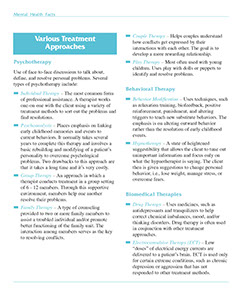
    Psychotherapy

    Use of face-to-face discussions to define and resolve personal problems. Types include:

    *  Individual Therapy – A therapist works one-on-one with the client using a variety of treatment methods to sort out the problems and find resolutions.

    *  Psychoanalysis – Places emphasis on linking early childhood memories and events to current behaviors. It involves a basic rebuilding and modifying of a patient’s personality to overcome psychological problems. Two drawbacks to this approach are that it takes a long time and it’s very costly.

    *  Group Therapy – An approach in which a therapist conducts treatment in a group setting of 6-12 members. Through this supportive environment, members help one another resolve their problems.

    *  Family Therapy – A type of counseling provided to two or more family members to assist a troubled individual and/or promote better functioning of the family unit. The interaction among members serves as the key to resolving conflicts.

    *  Couple Therapy – Helps couples understand how conflicts get expressed by their interactions with each other. The goal is to develop a more rewarding relationship.

    *  Play Therapy – Most often used with young children. Uses play with dolls or puppets to identify and resolve problems.

    Behavioral Therapy

    *  Behavior Modification – Uses techniques, such as relaxation training, biofeedback, positive reinforcement, punishment, and altering triggers to teach new substitute behaviors. The emphasis is on altering outward behavior rather than the resolution of early childhood events.

    *  Cognitive Behavioral Therapy – A therapist helps a person identify unhealthy patterns of thought and how they may be causing self-destructive beliefs and behaviors. The person and therapist work together to develop constructive ways of thinking that will produce healthier behaviors and beliefs.

    *  Hypnotherapy – A state of heightened suggestibility that allows the client to tune out unimportant information and focus only on what the hypnotherapist is saying. The client then is given suggestions to change personal behavior, i.e., lose weight, manage stress, or overcome fears.

    Biomedical Therapies

    *  Drug Therapy – Uses medicines, such as antidepressants and tranquilizers to help correct chemical imbalances, mood, and/or thinking disorders. Drug therapy is often used in conjunction with other treatment approaches.

    *  Electroconvulsive Therapy (ECT) – Low “doses” of electrical energy currents are delivered to a patient’s brain. ECT is used only for certain extreme conditions, such as chronic depression or aggression that has not responded to other treatment methods.

    Minding Your Mental Health Book. Published by the American Institute for Preventive Medicine. www.HealthyLife.com. All rights reserved.

    © American Institute for Preventive Medicine

  • Using Your Health Care Plan

    Medical Care

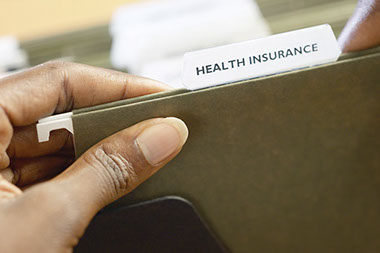
    Image of a folder with the words "Health Insurance" in the tab.

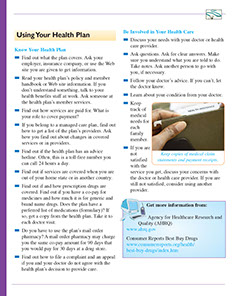
    Know Your Health Plan

    *  Find out what the plan covers. Ask your employer, insurance company, or use the Web site you are given to get information.

    *  Read your health plan’s policy and member handbook or Web site information. If you don’t understand something, talk to your health benefits staff at work. Ask someone at the health plan’s member services.

    *  Find out how services are paid for. What is your role to cover payment?

    *  If you belong to a managed care plan, find out how to get a list of the plan’s providers. Ask how you find out about changes in covered services or in providers.

    *  Find out if the health plan has an advice hotline. Often, this is a toll-free number you can call 24 hours a day.

    *  Find out if services are covered when you are out of your home state or in another country.

    *  Find out if and how prescription drugs are covered. Find out if you have a co-pay for medicines and how much it is for generic and brand name drugs. Does the plan have a preferred list of medications (formulary)? If so, get a copy from the health plan. Take it to each doctor visit.

    *  Learn about using the plan’s mail order pharmacy. This may charge you the same co-pay amount for 90 days that you would pay for 30 days at a drug store.

    *  Find out how to file a complaint and an appeal if you and your doctor do not agree with the health plan’s decision to provide care.

    Be Involved in Your Health Care

    *  Discuss your needs with your doctor or health care provider.

    *  Ask questions. Ask for clear answers. Make sure you understand what you are told to do. Take notes. Ask another person to go with you, if necessary.

    *  Follow your doctor’s advice. If you can’t, let the doctor know.

    *  Learn about your condition from your doctor.

    *  Keep track of medical needs for each family member.

    *  If you are not satisfied with the service you get, discuss your concerns with the doctor or health care provider. If you are still not satisfied, consider using another provider.

    Resources

    Agency for Healthcare Research and Quality (AHRQ)

    www.ahrq.gov

    Consumer Reports Best Buy Drugs

    www.consumerreports.org/health/best-buy-drugs/index.htm

    Page from the Healthier at Home book by the American Institute for Preventive Medicine. www.HealthyLife.com. All rights reserved.

    © American Institute for Preventive Medicine

  • Use Your Benefits Before The Year Runs Out

    Medical Care

    Smiling female doctor.

    *  Schedule office visits, tests, and exams that you need, but have not yet had this year, especially if they are covered expenses or if you have met your deductible.

    *  If you have a flexible spending account (FSA), make sure to use it all by the yearly deadline date. You lose what you do not spend. Find out what your FSA covers. You may be able to use it for:

    –  Over-the-counter medications

    –  Contact lenses and solution

    –  Batteries for hearing aids

    –  A quit tobacco program

    *  Put timing for medical expenses on your side. For example, if the expected costs for dental care exceed your yearly limit, get as many visits this month that this year’s limit will cover. Schedule the rest for the beginning of next year when a new year of dental coverage begins.

    A Year of Health Hints book by the American Institute for Preventive Medicine. www.HealthyLife.com. All rights reserved.

    © American Institute for Preventive Medicine

  • Use Ladders Safely

    Home Safety

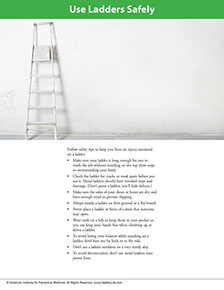
    Image of a ladder.

    Follow safety tips to keep you from an injury sustained on a ladder.

    *  Make sure your ladder is long enough for you to reach the job without standing on the top three steps or overextending your body.

    *  Check the ladder for cracks or weak spots before you use it. Metal ladders should have nonskid steps and footings. (Don’t paint a ladder; you’ll hide defects.)

    *  Make sure the soles of your shoes or boots are dry and have enough tread to prevent slipping.

    *  Always steady a ladder on firm ground or a flat board.

    *  Never place a ladder in front of a door that someone may open.

    *  Wear tools on a belt or keep them in your pocket so you can keep your hands free when climbing up or down a ladder.

    *  To avoid losing your balance while standing on a ladder, don’t lean too far back or to the side.

    *  Don’t use a ladder outdoors on a very windy day.

    *  To avoid electrocution, don’t use metal ladders near power lines.

    A Year of Health Hints book by the American Institute for Preventive Medicine. www.HealthyLife.com. All rights reserved.

    © American Institute for Preventive Medicine

  • Use Credit Cards Carefully

    Financial Health

    Smart use of credit cards can help you control costs and your credit score.

    Using a credit card is safer than carrying cash, makes it easier to track your expenses, and helps you establish credit. And you need a credit card to make purchases online or by phone. But be careful with credit card use to avoid getting into debt.

    Tips to use credit cards wisely:

    *  Make payments on time to avoid: A late fee; a possible increase in your interest rate; having your credit rating go down. According toCreditCards.com, one payment that’s 30 or more days late could lower your score by 60-100 points.

    *  Keep from opening new credit cards. You may save 10 or more percent on a purchase if you sign up for a credit card, but your credit score could go down 10 points for each new card you open.

    *  Limit the number of credit cards you have. Having too many alerts a lender of how much debt you could accrue. But don’t close unused cards, especially ones you have had a long time. A longer credit history helps you have a higher credit score.

    *  Limit individual store and gas cards. These usually have very high interest rates. Opt for two major credit cards (American Express, Discover, Master Card, or VISA). Look for ones with low interest rates and that best meet your needs.

    *  Control credit card use. To avoid interest, only charge what you can pay in full when you get the bill.

    *  To limit interest costs, make more than the minimum payment. Your credit card statements show you how long it will take to pay off your balances if you make only the minimum payments. Aim to keep the balance to less than 25 percent of the total amount you can charge.

    *  Have one or more regular bills billed directly to a credit card. Examples are your monthly electric, gas, and/or cable bill or your mail order prescriptions.

    *  Do not use credit cards for cash advances. You pay a fee for the service and interest rates are very high (often 25 percent or higher).

    *  Read the fine print. Zero-percent interest for balance transfers and purchases can save you money. But you need to pay off the entire balance on the total amount financed by the due date, such as after 6 to 18 months. If not, you may be charged interest on the amount from the original purchase date – not just on the remaining balance. Check for balance transfer fees, too.

    *  Once a year, check your credit score for accuracy. This is a free service from each of the three nationwide credit bureaus – Equifax, Experian and TransUnion. Do this online athttps://annualcreditreport.comor by phone at 1-877-322-8228.

    Credit Scores

    The most common credit score (FICO) range is from 300-850 (the higher the better). Lenders use your payment history on your debts and bills as one of the biggest factors in your credit report and credit score. You are more likely to get lower interest rates and fees for loans, as well as credit cards if you maintain a good credit score – about 700 is good; above 750 is excellent. Lenders consider you a credit risk if your score is below 600.

    Action Step

    If you are an impulse buyer, leave your credit cards at home when you shop. If you are easily tempted to buy items online or while watching shopping channels, switch to a non-shopping website or  TV show, or to a DVD.

    Ways to Well-Being. Published by the American Institute for Preventive Medicine.

    © American Institute for Preventive Medicine