Blog

  • Do Activities You Enjoy

    Healthylife® Weigh

    Part 5

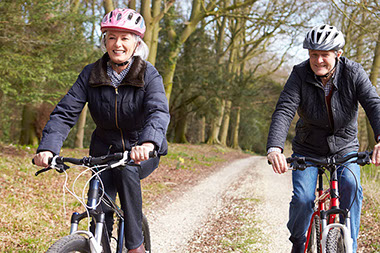
    Older couple riding bikes.

    Answer these questions.

    *  What activities have I been good at before?

    *  What activities do I enjoy doing?

    *  What equipment do I have or can I use?

    *  What outcomes do I want to achieve?

    *  What activities am I physically able to do?

    © American Institute for Preventive Medicine

  • Dispute Unhelpful Thoughts

    Healthylife® Weigh

    Part 4

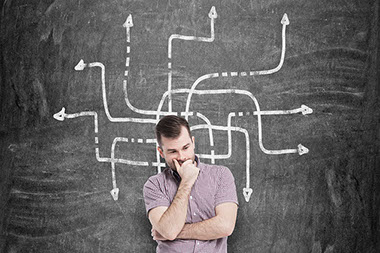
    Man thinking in front of black chalk board with arrows pointing.

    Thinking in all-or-nothing terms using words like “always,” “never,” and “every” can make it difficult to see options. Avoid thinking about people or situations using absolute terms. Logical thinking looks at more than one option. People can act in different ways. Situations can have many outcomes.

    Have you had any of the unhelpful thoughts below:

    *  Gaining weight and moving less is just part of getting older.

    *  Taking care of myself is selfish.

    *  I weigh less than those around me. At least I am doing better than they are.

    *  My spouse does the grocery shopping and cooking so I have very little control over what I eat.

    *  Eating healthy is too expensive.

    Question your unhelpful thoughts. The strategies on the following pages help to break down thoughts that you may be using as excuses not to change. If you notice you are thinking in absolutes, identify alternatives to your black and white thoughts.

    © American Institute for Preventive Medicine

  • Deep Breathing

    Healthylife® Weigh

    Part 6

    Women doing deep breathing exercises outdoors.

    An increased amount of oxygen allows your heart rate to slow down. This produces a calming effect.

    1. Sit in a chair, arms at your sides, with your legs uncrossed. Or, lie down on a comfortable surface, like a bed or couch.

    2. If you are able, close your eyes. Do not close your eyes while driving or operating machinery.

    3. Note any tension in your muscles.

    4. Slowly inhale through your nose, expanding your abdomen first. Fill your lungs next.

    5. Hold your breath for 2 to 4 seconds.

    6. Slowly exhale.

    7. Repeat this exercise for several minutes.

    Your chest should feel less constricted. You should feel less stress and tension physically and mentally. Problems haven’t gone away, but you may feel more ready to tackle them or cope with a negative emotion.

    Practice Deep Breathing: Take a Rest from Your Emotions

    Detach yourself from your thoughts and emotions. Imagine sitting on a hill and viewing your thoughts and feelings at the bottom of the hill. Observe your thoughts as they pass by. Or, you can stop and think about them. Tell yourself: “I have control over when and how I think about a situation.”

    Put your emotional reactions to a situation or issue to rest for awhile. This helps your mind use logical thinking.

    © American Institute for Preventive Medicine

  • Dairy 2

    Healthylife® Weigh

    Menus & Recipes

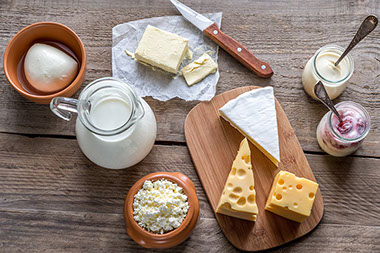
    Dairy products.

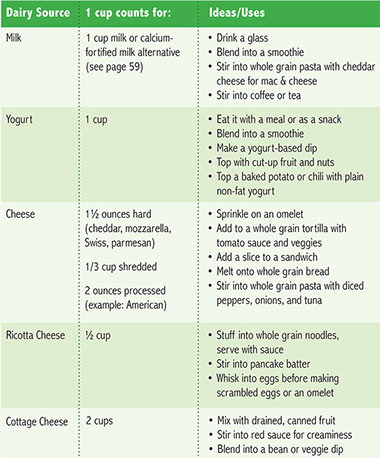
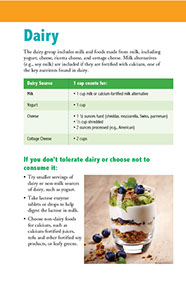
    The dairy group includes milk and foods made from milk, including yogurt, cheese, ricotta cheese, and cottage cheese. Milk alternatives  (e.g., soy milk) are included if they are fortified with calcium, one of the key nutrients found in dairy.

    Chart showing dairy sources and ideas.

    If you don’t tolerate dairy or choose not to consume it:

    *  Try smaller servings of dairy or non-milk sources of dairy, such as yogurt.

    * Take lactose enzyme tablets or drops to help digest the lactose in milk.

    * Choose non-dairy foods for calcium, such as calcium-fortified juices, tofu and other fortified soy products, or leafy greens.

    © American Institute for Preventive Medicine

  • Dairy

    Healthylife® Weigh

    Part 2

    Dairy products.

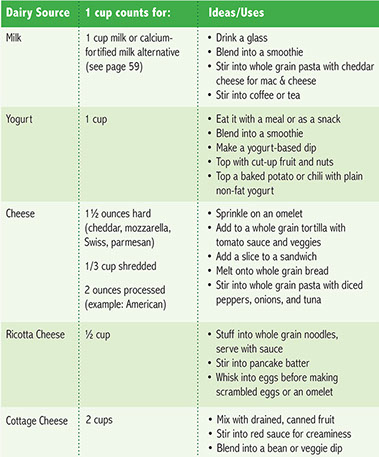
    The dairy group includes milk and foods made from milk. Dairy provides calcium, vitamin D (milk), healthy fats, and protein. Milk alternatives (such as those made from soy) are included if they are fortified with calcium.

    Chart showing dairy sources and ideas.

    Dairy Alternatives

    Many people avoid lactose-containing milk due to an intolerance or preference. Lactose is the sugar in milk that causes digestive problems if you are lactose intolerant. You can obtain many of the nutrients found in milk by eating or drinking lactose-free dairy or fortified dairy alternatives.

    Tips for Reducing Problems with Lactose

    You may be able to consume dairy by having it a different way.

    *  Choose smaller servings of dairy at each meal or snack.

    *  Consume dairy with other foods to slow the digestive process.

    *  Experiment with different dairy products. You may have problems with milk, but are okay with cultured milk products like yogurt.

    *  Take lactase enzyme tablets or drops to help you digest the lactose.

    Dairy alternatives include soy milk, almond milk, rice milk, cashew milk, oat milk, and coconut milk. These milks and products made with them (like yogurt) count toward your daily needs if they are fortified with calcium.

    Calcium

    Calcium is needed for strong bones and teeth. It is also needed for your:

    *  Heart to beat

    *  Nerves to react

    *  Blood to clot

    *  Muscles to flex

    *  Body cells to stick together

    If you cannot tolerate dairy, you can also obtain calcium from these foods:

    *  Calcium-fortified juices, cereals, and breads

    *  Tofu, tempeh, and other fortified soy products

    *  Small bones in canned fish (sardines, salmon with bones)

    *  Leafy greens (collard and turnip greens, kale, bok choy)

    Calcium-fortified foods and beverages may not provide the other nutrients found in dairy products. Try to fulfill your dairy group needs from dairy most of the time.
    © American Institute for Preventive Medicine

  • Create Self-Enhancing Feelings

    Healthylife® Weigh

    Part 4

    Man thinking.

    Take responsibility for your thoughts, feelings, and actions. You will feel better about yourself and your life. Blaming others is a natural, child-like reaction. It is more adult-like to figure out the amount of control you have in a given situation and respond to it in a mature way. You may not have control in every situation, but you can choose how to respond to others.

    One reason to become more accountable for your responses is that a “victim” response forms negative, draining feelings. Self-responsibility creates positive energy. With it you can manage every event in a more positive, self-nurturing manner. One way to do this is to look at your language and see if you use “victim” or “accountability” phrases.

    Example “victim” phrase:I can’t lose weight until my family also tries to lose weight.

    Example “accountability” phrase:I can talk with my family about how they can be supportive of my efforts. I can help with family meal planning so I have more control over the foods kept in the house and served during meals.

    Complete the chart on the next page to practice taking responsibility for your thoughts, feelings, and actions.

    © American Institute for Preventive Medicine

  • Create “If, Then” Plans

    Healthylife® Weigh

    Part 5

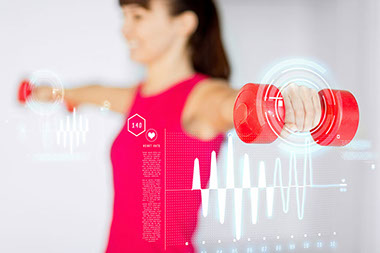
    Woman hands with light red dumbbells.

    Use “If, then” plans to overcome roadblocks. “If, then” plans anticipate a challenge and prepare a response in advance. Create “If, then” statements for each challenge you expect to face. These challenges may be:

    *  How you expect to feel (e.g., self-conscious).

    *  Something you do not know how to do.

    *  Supplies you need (like comfortable shoes).

    *  A comment from a supporter or a non-supporter.

    Practice planning positive, constructive responses to challenges ahead of time.

    Examples:

    *  IF I feel self-conscious at the gym, THEN I will bring a supportive friend to work out with me.

    *  IF my workout buddy bails on our plans, THEN I will go anyway and listen to music while I exercise.

    *  IF I don’t meet my goal this week, THEN I will look at how I can improve my goal for next week.

    Think about challenges you expect with changing your exercise habits. Plan your response using an “If, then” statement.

    © American Institute for Preventive Medicine

  • Control Catastrophic Thinking

    Healthylife® Weigh

    Part 4

    Woman thinking.

    Seeing the worst possible outcome for a situation can lead to anxiety and racing thoughts. Avoid focusing on the negative aspects of a situation or how it could be even worse. The unknown future can seem scary and full of negative potential. Dispute each irrational thought with a rational one. Challenge your “worst case scenario” with a “best case scenario” and options in between.

    *  What is statistically likely in this scenario?

    *  How might this situation turn out better than expected?

    *  What can I do to reduce the chances of the situation getting worse?

    Think of a “mountain” that you build out of a “molehill.” Challenge your thought with rational thinking. Complete the following chart with two examples of your own.

    Catastrophic Thought

    Example: The more weight I lose, the more I am going to gain back later. I am better off staying overweight.

    Alternative Thought

    Losing weight will help my health now and in the future. I can learn tools to maintain my weight loss. Even a small weight loss will have a big impact on my health.

    © American Institute for Preventive Medicine

  • Connect Attitude To Your Values

    Healthylife® Weigh

    Part 1

    Happy woman drinking water with fresh lemon, lime, and mint.

    Look for ways to align your attitudes with your values. How will managing your weight display your values? Consider these two approaches:

    View A: Reducing how much soda I drink is going to be terrible. I want to drink whatever I feel like, whenever I want.

    View B: I value connecting with my family, being a good role model for my kids, and being adventurous. Reducing how much soda I drink may be a challenge, but I really want to manage my weight so I can keep up with my kids. I want to be a role model for making changes. I also want to take a hiking trip and not have to sit out because I’m too out of shape.

    How you frame a challenge matters. Try it out.

    *  List one excuse you’ve given for not managing your weight.

    *  Choose one or two of the values you identified.

    *  Managing my weight may be a challenge, but I want to try so I can.

    © American Institute for Preventive Medicine

  • Coffee And Tea

    Healthylife® Weigh

    Part 3

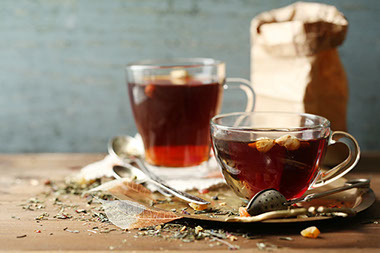
    Herbal tea.

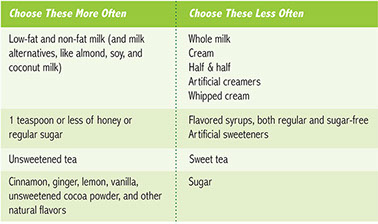
    Coffee and tea drinks made with added ingredients can be a major source of sugar and saturated fat in your diet. The calories can also add up, pushing you over what your body needs for the day and not leaving enough room for nutrient-dense foods. Without anything added, coffee and tea drinks have fewer than 5 calories.

    Example chart of what to choose and not choose.

    If your favorite coffee or tea drink has more add-ins from the column on the right, save this drink for a special treat. Or, start to gradually cut back on how much of these you add to your drink. You can get used to new tastes. You may even like the new version better!

    Different teas can have a lot of natural flavor and sweetness. Experiment with lemon, chai, chamomile, fruit, and herbal teas.

    © American Institute for Preventive Medicine