Blog

  • How Aging Affects Digestion

    Abdominal & Urinary Conditions

    Image of elderly man.

    As you age, your digestive muscles move slower. Your body makes less acid. Other things can hamper the digestive system, too. These include:

    *  Increased use of medicines

    *  Getting less exercise

    *  Changes in eating habits

    *  Dental problems

    *  Loss of muscle tone and elasticity. This could be a factor in hiatal hernias and diverticulosis, which are common in persons as they get older.

    Health at Home Lifetime book by the American Institute for Preventive Medicine. www.HealthyLife.com. All rights reserved.

    © American Institute for Preventive Medicine

  • Housing Options

    Mature Health: Over Age 50

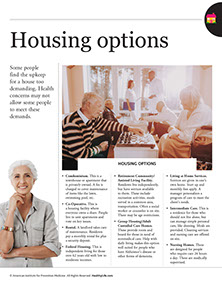
    Some people find the upkeep for a house too demanding. Health concerns may not allow some people to meet these demands. Consider other housing options:

    *  Condominium. This is a townhouse or apartment that is privately owned. A fee is charged to cover maintenance of items like the lawn, swimming pool, etc.

    *  Co-Operative. This is a housing facility where everyone owns a share. People live in unit apartments and vote on key issues.

    *  Rental. A landlord takes care of maintenance. Residents pay a monthly rental fee plus a security deposit.

    *  Retirement Community/Assisted Living Facility. Residents live independently, but have services available to them. These include recreation activities, meals served in a common area, transportation. Often a social worker or counselor is on site. There may be age restrictions.

    *  Federal Housing. This is independent living for those over 62 years old with low to moderate incomes.

    *  Group Housing/Adult Custodial Care Homes. These provide room and board for those in need of nonmedical care. Help with daily living makes this option well suited for Alzheimer’s patients.

    *  Life Care at Home (LCAH). Services are given in one’s own home. Start up and monthly fees apply. A manager personalizes a program of care to meet the client’s needs.

    *  Intermediate Care. This is a residence for those who should not live alone, but can manage simple personal care, like dressing. Meals are provided. Cleaning services and nursing care are offered on site.

    *  Nursing Homes. These are designed for people who require care 24 hours a day. These are medically supervised. Find and compare nursing homes in your area atwww.medicare.gov/NHCompare/home.asp.

    Health at Home Lifetime book by the American Institute for Preventive Medicine. www.HealthyLife.com. All rights reserved.

    © American Institute for Preventive Medicine

  • Hospice Care

    Mature Health: Over Age 50

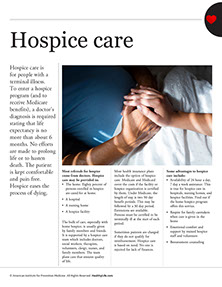
    Hospice care is for people with a terminal illness. To enter a hospice program (and to receive Medicare benefits), a doctor’s diagnosis is required stating that life expectancy is no more than about 6 months. No efforts are made to prolong life or to hasten death. The patient is kept comfortable and pain free. Hospice eases the process of dying. Most referrals for hospice come from doctors. Hospice care may be provided in:

    *  The home. Eighty percent of persons enrolled in hospice are cared for at home.

    *  A hospital

    *  A nursing home

    *  A hospice facility

    The bulk of care, especially with home hospice, is usually given by family members and friends. It is supported by a hospice care team which includes doctors, social workers, therapists, volunteers, clergy, nurses, and family members. The team plans care that ensures quality of life. {Note: VA offers Hospice & Palliative Care.}

    Most health insurance plans include the option of hospice care. Medicare and Medicaid cover the costs if the facility or hospice organization is certified by them. Under Medicare, the length of stay is two 90 day benefit periods. This may be followed by a 30 day period. Extensions are available. Persons must be certified to be terminally ill at the start of each period.

    Sometimes patients are charged if they do not qualify for reimbursement. Hospice care is based on need. No one is rejected for lack of finances.

    Some advantages to hospice care include:

    *  Availability of 24 hour a day, 7 day a week assistance. This is true for hospice care in hospitals, nursing homes, and hospice facilities. Find out if the home hospice program offers this service.

    *  Respite for family caretakers when care is given in the home

    *  Emotional comfort and support by trained hospice staff and volunteers

    *  Bereavement counseling

    Resources

    The National Hospice and Palliative Care Organization

    1-703-837-1500

    www.nhpco.org

    Health at Home Lifetime book by the American Institute for Preventive Medicine. www.HealthyLife.com. All rights reserved.

    © American Institute for Preventive Medicine

  • Hives

    Skin Conditions

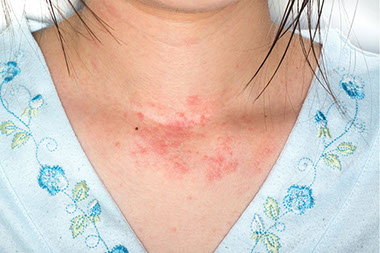
    Image of a hive rash below neck.

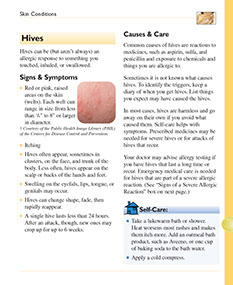
    Hives can be (but aren’t always) an allergic response to something you touched, inhaled, or swallowed.

    Signs & Symptoms

    *  Red or pink, raised areas on the skin (welts). Each welt can range in size from less than 1/8″ to 8″ or larger in diameter.

    *  Itching

    *  Hives often appear, sometimes in clusters, on the face, and trunk of the body. Less often, hives appear on the scalp or backs of the hands and feet.

    *  Swelling on the eyelids, lips, tongue, or genitals may occur.

    *  Hives can change shape, fade, then rapidly reappear.

    *  A single hive lasts less than 24 hours. After an attack, though, new ones may crop up for up to 6 weeks.

    Causes & Care

    Common causes of hives are reactions to medicines, such as aspirin, sulfa, and penicillin and exposure to chemicals and things you are allergic to.

    Sometimes it is not known what causes hives. To identify the triggers, keep a diary of when you get hives. List things you expect may have caused the hives.

    In most cases, hives are harmless and go away on their own if you avoid what caused them. Self-care helps with symptoms. Prescribed medicines may be needed for severe hives or for attacks of hives that recur.

    Your doctor may advise allergy testing if you have hives that last a long time or recur. Emergency medical care is needed for hives that are part of a severe allergic reaction.

    Self-Care

    *  Take a lukewarm bath or shower. Heat worsens most rashes and makes them itch more. Add an oatmeal bath product, such as Aveeno, or one cup of baking soda to the bath water.

    *  Apply a cold compress.

    *  Wear loose-fitting clothes.

    *  Relax as much as you can. Relaxation therapy may help ease the itching and discomfort of hives.

    *  Ask your doctor whether or not you should take an antihistamine and to recommend one. Antihistamines can help relieve itching and suppress hives. Take as directed by your doctor or by directions on the label.

    *  Use calamine lotion on itchy areas.

    *  Don’t take aspirin, ibuprofen, ketoprofen, or naproxen sodium. These may make hives worse.

    When to Seek Medical Care

    Contact Doctor When:

    *  You have constant and severe itching, and/or a fever with hives.

    *  Hives last for more than 6 weeks.

    *  Hives started after taking medicine.

    Get Immediate Care When:

    Hives are present with signs of a severe allergic reaction (anaphylactic shock).

    Signs of a Severe Allergic Reaction

    *  A hard time breathing or swallowing

    *  Severe swelling all over, or of the face, lips, tongue, and/or throat n Obstructed airway

    *  Wheezing

    *  Dizziness, weakness

    *  “Signs & Symptoms” of shock

    Health at Home Lifetime book by the American Institute for Preventive Medicine. www.HealthyLife.com. All rights reserved.

    © American Institute for Preventive Medicine

  • Hiv/Aids 2

    Women’s Health

    HIV stands for human immunodeficiency virus. AIDS is acquired immune deficiency syndrome. It is caused by HIV. The virus destroys the body’s immune system. This leaves a person unable to fight off diseases. The virus also attacks the central nervous system causing mental problems.

    Signs & Symptoms

    When first infected with HIV, many people have no symptoms. Within a month or two, some persons have flu-like symptoms (e.g., fever, fatigue, headache, and swollen glands). These symptoms usually go away within a week to a month. They are often mistaken for other infections. In adults, symptoms of HIV may take months to 10 or more years to appear. In children born with HIV, symptoms appear within 2 years.

    Symptoms of HIV Before the Onset of AIDS

    *  Fatigue. Weight loss.

    *  Swollen glands.

    *  Fever and sweating. These occur often.

    *  Skin rashes that persist. Flaky skin.

    *  Getting sick often.

    *  Short-term memory loss.

    *  Infections. These include herpes, shingles, and yeast infections.

    In Women, Signs that HIV Could be Present Include:

    *  Chronic vaginal yeast infections.

    *  Abnormal Pap test from HPV exposure in the past.

    *  Cervical cancer.

    *  Pelvic inflammatory disease (PID).

    *  Some sexually transmitted infections, such as human papillomavirus (HPV). {Note: HPV can be present without HIV. Testing confirms its presence.}

    AIDS is the most advanced stage of HIV. With AIDS, there is a low level of cells in the blood called T4 cells. Persons with AIDS get many illnesses. These include skin infections, pneumonia, and cancer. These conditions are what lead to death.

    Symptoms of AIDS

    *  Extreme fatigue. Weight loss.

    *  Severe and chronic diarrhea.

    *  Fever. Severe headaches.

    *  Shortness of breath. Coughing. A hard time swallowing.

    *  Abdominal cramps. Nausea. Vomiting.

    *  Lack of coordination. Vision loss.

    *  Mental status changes.

    *  Seizures. Coma.

    Causes

    HIV is spread when body fluids, such as semen or blood, pass from an infected person to another person. This includes having sex without a latex or polyurethane condom and/or sharing drug needles.

    Infected females can give HIV to their babies during pregnancy, delivery, and breast-feeding. The risk of the baby getting HIV is greatly lowered if the mother takes antiviral medicines during the pregnancy and delivery. The baby takes medicine the first six weeks of life, too.

    High Risk Activities for HIV Infection

    *  Anal, oral and/or vaginal sex without a latex or polyurethane condom, unless you limit sexual contact to one person and neither of you is infected with HIV. High risk situations are having sex:

    – When drunk or high. (Judgement is impaired.)

    – With multiple or casual sex partners or with a partner who has had multiple sex partners.

    – With a partner who has used drugs by  injection or is a bisexual male.

    – When you or your partner has signs and symptoms of a genital tract infection.

    *  Sharing needles and/or “the works” when injecting any kind of drugs.

    *  Having had blood transfusions, especially before 1985, unless tested negative for HIV.

    *  Prolonged, open-mouth kissing with a person infected with HIV.

    Blood screening tests are also done on donated blood which makes it highly unlikely that you’d get HIV from current blood transfusions. You cannot get HIV from:

    *  Donating blood.

    *  Casual contact, such as touching, holding hands, hugging, and dry kissing.

    *  A cough, sneeze, tears, or sweat.

    *  An animal or insect bite.

    *  A toilet seat. Using a hot tub or swimming.

    Treatment

    There is no cure for AIDS. Treatment includes:

    *  Medications. Multi-drug combinations are used.

    *  Measures to reduce the risk of infections and diseases (e.g., rest, proper nutrition, and vitamin supplements, as advised).

    *  Emotional support.

    *  Medical treatment for infections and chronic problems.

    Questions to Ask

    Self-Care / Prevention

    Someday, a cure for HIV/AIDS may exist. For now, prevention is the best protection. Take these steps:

    *  Unless you are in a monogamous relationship in which you and your partner are HIV free, use male latex or polyurethane condoms every time you have sex.

    *  Don’t have sex with people who are at high risk for HIV. These are:

    – Persons with multiple sex partners.

    – Persons who inject illegal drugs.

    – Partners of persons infected or exposed to HIV.

    – Persons who have had multiple blood transfusions, especially before 1985, unless tested negative for HIV.

    *  Ask specific questions about your partner’s sexual past (e.g., have they had many partners or unprotected (no condom) sex?). Ask if they have been tested for HIV and if the results were positive or negative. Be aware, though, that the response may not be an honest one. You need to protect yourself! Get tested for HIV. Ask your partner to get tested, too. If you have been exposed to HIV, use prevention measures or avoid sex until you get tested for it.

    *  If you’ve had sex with someone you suspect is HIV positive, see your doctor.

    *  Don’t share needles with anyone. This includes illegal drugs, such as heroin, as well as, steroids, insulin, etc.

    *  Don’t share personal items that have blood on them, such as razors.

    *  Plan ahead for safer sex. Decide what you’ll say and be willing to do ahead of time with a potential sex partner.

    *  Keep a supply of condoms handy (e.g., in your purse, by the bed, in your pocket, etc.). Know the correct way to use them. Putting the condom on your partner can be a part of foreplay.

    *  Don’t have sex when your judgement is impaired, such as while under the influence of drugs or alcohol.

    *  Avoid sex if either partner has signs and symptoms of a genital tract infection.

    Detection

    A rapid oral HIV test and blood tests detect antibodies to HIV. Get tested for HIV at doctors’ offices, clinics, and health departments or use a home test and counseling service, such as Home Access. You can buy this over-the-counter, by phone at 800.HIV.TEST (448.8378), or online atwww.homeaccess.com.

    Resources

    National AIDS Hotline

    800.CDC.INFO (232.4636)

    AIDS Info

    800.HIV.0440 (448.0440)

    www.aidsinfo.nih.gov

    Women's Self-Care book by the American Institute for Preventive Medicine. www.HealthyLife.com. All rights reserved.

    © American Institute for Preventive Medicine

  • Hiv/Aids

    Sexual Health

    HIV stands for human immunodeficiency virus. AIDS is acquired immune deficiency syndrome. It is caused by HIV. The virus destroys the body’s immune system. This leaves a person unable to fight off diseases. The virus also attacks the central nervous system causing mental problems. One million people in the U.S. have HIV, but about 25% of them do not know they have it. People ages 15 to 65 are advised to be screened for HIV.

    Signs & Symptoms

    Many people have no symptoms when first infected with HIV. Within a month or two, some people have flu-like symptoms. These include fever, fatigue, headache, and swollen glands in the neck and groin. These symptoms usually go away within a week to a month. They are often mistaken for other infections.

    In adults, symptoms of HIV may take a few months to 10 or more years to appear. In children born with HIV, symptoms appear within 2 years.

    Symptoms of HIV Before the Onset of AIDS

    *  Swollen glands.

    *  Fatigue. Weight loss.

    *  Fever and sweating that occur often.

    *  Skin rashes that persist. Flaky skin.

    *  Infections. These include herpes, shingles, and yeast infection.

    *  Short-term memory loss.

    *  Getting sick often. Slow growth in children.

    AIDS is the most advanced stage of HIV. With AIDS, a low level of cells in the blood called T4 cells occurs. Persons with AIDS get many illnesses. These include skin infections, pneumonia, and cancer.

    Symptoms of AIDS

    *  Extreme fatigue. Weight loss.

    *  Severe and chronic diarrhea.

    *  Fever. Severe headaches.

    *  Shortness of breath. Coughing. A hard time swallowing.

    *  Abdominal cramps. Nausea. Vomiting.

    *  Lack of coordination. Vision loss.

    *  Mental status changes. Seizures. Coma.

    Causes

    HIV is spread when body fluids, such as semen and blood, pass from an infected person to another person. This includes having unprotected sexual contact and/or sharing drug needles.

    Infected females can give HIV to their babies during pregnancy, birth, or breast-feeding. The risk of the baby getting HIV is lowered a great deal if the female takes antiviral medicines during the pregnancy and delivery. The baby takes medicine the first six weeks of life, too.

    HIV is not spread from donating blood, touching, hugging, or (dry) kissing a person with HIV. A cough, a sneeze, tears, sweat, or using a hot tub, or public restroom does not spread HIV either.

    Treatment

    A rapid oral HIV test and blood tests detect antibodies to HIV. There is no cure for AIDS, but treatment helps the immune system fight HIV, infections, and cancers that can occur with it. Treatment includes medications (often used in multidrug combinations) and treating infections.

    Questions to Ask

    Self-Care / Prevention

    *  Take medication as prescribed.

    *  Take steps to reduce the risk of getting infections and diseases. Get enough rest. Eat healthy foods. Take vitamins and minerals as advised by your doctor.

    *  Get emotional support. Join a support group for persons infected with HIV. Let your family and friends know how they can help you.

    To Reduce the Risk for HIV

    *  Follow Safer Sex.

    *  Don’t share needles with anyone. Don’t have sex with people who use or have injected illegal drugs.

    *  Don’t share personal items that have blood on them, such as razors.

    *  Don’t have sex with people who are at high risk for HIV:

    – Persons with multiple sex partners or who inject illegal drugs.

    – Partners of persons infected or exposed to HIV.

    – Persons who have had multiple blood transfusions, especially before 1985, unless tested negative for HIV.

    Resources

    AIDSinfo

    800.HIV.0440 (448.0440)

    www.aidsinfo.nih.gov
    CDC National AIDS Hotline (NAH) and National STD Hotline

    800.CDC.INFO (232.4636)

    www.cdc.gov/std

    Healthier at Home book by the American Institute for Preventive Medicine. www.HealthyLife.com. All rights reserved.

    © American Institute for Preventive Medicine

  • High Blood Pressure 2

    Pregnancy & Prenatal Care

    A blood pressure reading concerns the blood in the arteries. The top number in the reading is the systolic pressure. That’s the pressure when the heart muscle contracts. The bottom number is the diastolic pressure. That’s the pressure when the heart muscle relaxes.

    An example of a blood pressure reading is 120/80. This is measured in millimeters of mercury (mm Hg). A blood pressure reading should be taken before pregnancy or at its start. This is called a baseline blood pressure. The baseline reading shows what is normal for that woman. During the first several months of pregnancy, blood pressure may drop a little. It often rises slightly later in the pregnancy. That’s because of the extra work the mother’s body is doing. A slight rise is normal then. High blood pressure in pregnancy is when there is an increase of 30 or more in the systolic pressure (top number). An increase of 15 or more in the diastolic pressure (bottom number) is also a sign of high blood pressure.

    Causes

    Preeclampsia

    A common cause of high blood pressure in pregnancy is preeclampsia. This used to be called toxemia. Three things usually come with preeclampsia:

    *  High blood pressure

    *  Swelling of the face, hands, fingers, or feet

    *  Protein in the urine

    Other symptoms of preeclampsia are:

    *  Sudden weight gain or gaining more than 2 pounds a week

    *  Headaches

    *  Vision problems like spots before the eyes or blurry vision

    *  Pain in upper belly

    *  Severe indigestion that doesn’t go away

    Preeclampsia affects about 7 out of 100 pregnant women. It happens most often during a first pregnancy, but can occur again, especially with a new partner. And, it only happens during pregnancy. It goes away after delivery. Preeclampsia can lead to eclampsia. That’s when convulsions also occur. Eclampsia can result in a coma for the mother.

    Risk Factors

    The cause of preeclampsia is not known. High blood pressure does not have to be present before pregnancy. The things listed below may increase the risk for preeclampsia:

    *  First pregnancy or first pregnancy with a new partner

    *  Chronic high blood pressure or kidney disease

    *  Diabetes or lupus before the pregnancy

    *  Being overweight

    *  Being African American

    *  Pregnancy before age 20 or after age 35

    *  Being pregnant with more than one baby

    *  Preeclampsia in a past pregnancy or in a mother or sister

    Pregnancy Induced Hypertension (PIH)

    High blood pressure can develop during pregnancy without other symptoms. This is called pregnancy induced hypertension (PIH). This type of high blood pressure often happens after the 20th week. After delivery, blood pressure usually goes back to normal.

    Treatment

    High blood pressure and preeclampsia can range from mild to severe. They can be treated with medical help and home care. But if serious symptoms are present, medicine and/or hospital care may be needed. The health care provider may induce labor (bring on labor). Or a Cesarean section (C-section) may be done.

    When blood pressure remains high, not enough blood reaches the placenta. The fetus doesn’t get enough oxygen and nutrients. That can cause:

    *  Growth problems for the fetus

    *  Placenta abruptio.

    *  A baby that is born preterm, that has mental problems, is underweight, or stillborn

    Questions to Ask

    Self-Care

    *  Get a lot of rest. Sleep 8 to 12 hours at night. Take 2 naps during the day, if you can. When you sleep or rest, lie on your left side, as much as you can. This helps blood flow to the placenta. When you tire of lying on your left side, lie on your right side.

    *  Take medicine for high blood pressure as prescribed. If told to do so, take regular blood pressure readings at home. Ask your health care provider how to get a home test kit.

    *  Follow your health care provider’s advice about exercise.

    *  Do things to relax. Examples: listen to soft music, put your feet up, take a nap. Watch a TV show that makes you laugh. Put your hand on your belly to feel your baby move.

    *  Don’t take any medicine without your health care provider’s okay. That includes cold or sinus medicines and antacids.

    Prenatal Self-Care book by the American Institute for Preventive Medicine. www.HealthyLife.com. All rights reserved.

    © American Institute for Preventive Medicine

  • Hiccups In Children

    Children’s Health

    Signs, Symptoms & Causes

    Hiccups happen when the diaphragm tightens up. (The diaphragm is a muscle used in breathing. It sits like a cap on top of the stomach.)

    Babies usually get hiccups because they swallow air when feeding. The stomach gets bigger and squeezes the diaphragm. Sucking hard or eating too much can make hiccups worse. It helps to burp the baby often when feeding.

    Older children get hiccups from drinking too much soda pop or eating too much too fast. An upset or too-full stomach can lead to hiccups. Hiccups can hurt, but they are usually harmless. And they don’t last very long.

    Questions to Ask

    Self-Care

    *  Give your child 1 teaspoon of sugar. Have him or her swallow it fast. Do it 3 or more times, once every 2 minutes, if the hiccups don’t stop right away. (Note: For younger children, use 1 teaspoon of corn syrup.)

    *  Give babies a swallow of water.

    *  If all that doesn’t work, try this: Gently push down the back of your child’s tongue with the handle of a spoon. Do it 3 or 4 times.

    *  Don’t scare the child to try to make the hiccups stop.

    *  Have your child drink water with their head forward and down.

    *  Here are some old folk cures you can try:

    – Hold your child’s tongue with your clean thumb and index finger. Gently pull on the tongue.

    – Give your child a little cracked ice to swallow.

    – Have your child drink a glass of water fast.

    Children's Self-Care book by the American Institute for Preventive Medicine. www.HealthyLife.com. All rights reserved.

    © American Institute for Preventive Medicine

  • Hiccups

    Respiratory conditions

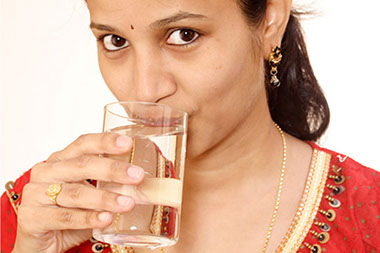
    Image of women drinking a glass of water.

    Hiccups are simple to explain. The diaphragm (the major muscle which sits like a cap over the stomach) goes into spasms. The vocal cords close rapidly. This causes the “hiccup” sound.

    Causes

    *  Eating too fast. Swallowing air with the food.

    *  Drinking carbonated beverages. Drinking too much alcohol.

    *  Doing things to make the stomach full enough to irritate the diaphragm, such as eating a lot of fatty foods in a short period of time.

    Treatment

    Hiccups seldom cause harm. Usually, they don’t last very long. Self-Care treats most cases of hiccups. Hiccups that persist could be a sign of a nervous system problem. A doctor needs to diagnose and treat this.

    Questions to Ask

    Self-Care / Prevention

    Common Remedies for Hiccups

    *  Swallow 1 teaspoon of dry table sugar. If this doesn’t stop the hiccups right away, repeat it 3 times, at 2-minute intervals. {Note: For young children (that do not have diabetes), use a teaspoon of corn syrup.}

    *  Hold your tongue with your thumb and index finger and gently pull it forward.

    *  Drink a glass of water rapidly. {Note: Young children should drink a glass of milk slowly.}

    Healthier at Home book by the American Institute for Preventive Medicine. www.HealthyLife.com. All rights reserved.

    © American Institute for Preventive Medicine

  • Hiatal Hernia

    Abdominal & Urinary Conditions

    With a hiatal hernia, the normal action that closes off the top of the stomach does not work well. Food or stomach acids back up into the esophagus. This is known as Gastroesophageal reflux disease (GERD).

    Signs & Symptoms

    Many people have no symptoms with a hiatal hernia. Others have one or more of these problems:

    *  Acid reflux. Stomach acid backs up into the esophagus.

    *  Chest pain. {Note: Don’t assume that chest pain is due to a hiatal hernia.}

    *  Pain in the esophagus. Heartburn.

    *  Hiccups. Belching after meals.

    *  A hard time swallowing.

    Causes

    The actual cause is not known. Risk factors are obesity, being a woman, or being middle aged. Smoking, lifting, strong coughing, and straining with bowel movements also increase the risk.

    Treatment

    Hiatal hernias are usually not serious problems. Often they can be treated with self-care. If not, surgery is an option.

    Questions to Ask

    Self-Care / Prevention

    *  Don’t smoke. If you smoke, quit.

    *  Get regular exercise. This helps keep abdominal muscles in shape.

    *  Lose weight if you are overweight.

    *  Eat 5 to 6 small meals a day instead of 3 larger meals.

    *  Avoid alcohol, caffeine, and spicy foods.

    *  Don’t lie down after eating. Wait 2 to 3 hours.

    *  Raise the head of the bed 6 inches. Put 6 inch blocks under the legs of the head of the bed or put a 6 inch wedge between the mattress and box springs at the head portion. Don’t prop your head up with pillows. Doing this puts pressure on your stomach area and can help force acid up into the esophagus.

    *  Don’t strain to pass stool.

    *  Take over-the-counter antacids or acid controllers, such as Pepcid AC or Tagamet HB. {Note: Read the labels before taking. Check with your doctor, too. Adverse side effects are more likely and more severe in older persons who take some acid controllers, such as Tagamet HB.}

    *  If you take aspirin, ibuprofen, or naproxen sodium, take it with food.

    Healthier at Home book by the American Institute for Preventive Medicine. www.HealthyLife.com. All rights reserved.

    © American Institute for Preventive Medicine