Blog

  • Healthy Eating Tips

    Children’s Health

    Image of young boy eating oranges.

    *  Make half your grains whole. Choose whole-grain food, like whole-wheat bread, oatmeal, and brown rice more often.

    *  Vary your veggies. Go dark green and orange with your vegetables. Eat spinach, broccoli, carrots and sweet potatoes.

    *  Focus on fruits. Eat them at meals. Eat them at snack times, too. Choose fresh, frozen, canned or dried fruits. Go easy on fruit juices.

    *  Go lean with protein. Eat lean or low-fat meat, chicken, turkey, and fish. Also, choose dry beans and peas more often. Add chick peas, nuts, or seeds to a salad. Add pinto beans to a burrito. Add kidney and/or other beans to soup.

    *  Get calcium-rich foods. Have low-fat and fat-free milks, yogurts, and cheeses. If you have soy milks and yogurts, choose ones with calcium. Have broccoli, kale and collard greens. Calcium helps to build strong bones.

    *  Change your oil. Get yours from fish, nuts, and liquid oils, like canola, corn, olive, and soybean. Avoid foods with trans fat. Read food labels.

    *  Don’t sugarcoat it. Choose foods and beverages that do not list sugar, corn syrup and other sugars as one of the first ingredients. Added sugars give calories, but have few, if any, nutrients.

    Page from Children's Self-Care book by the American Institute for Preventive Medicine. www.HealthyLife.com. All rights reserved.

    © American Institute for Preventive Medicine

  • Healthy Aging

    Mature Health: Over Age 50

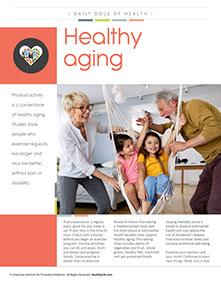
    Grandparents playing with 2 young grandkids.

    Physical activity is a cornerstone of healthy aging. Studies show people who exercise regularly live longer and may live better, without pain or disability.

    If you exercise on a regular basis, good for you! Keep it up! If not, now is the time to start. Check with a doctor before you begin an exercise program. Choose activities you can do and enjoy. Start out slowly and progress slowly. Some exercise is better than no exercise.

    Research shows that eating a Mediterranean-style diet has both physical and mental health benefits that support healthy aging. This eating style includes plenty of vegetables and fruit, whole grains, healthy fats, more fish and less processed foods.

    Staying mentally active is linked to physical and mental health and may reduce the risk of Alzheimer’s disease. Find ways to lower stress and increase emotional well-being.

    Exercise your memory and your mind. Continue to learn new things. Read. Join a club.

    Health at Home Lifetime book by the American Institute for Preventive Medicine. www.HealthyLife.com. All rights reserved.

    © American Institute for Preventive Medicine

  • Health Tests For Women

    Women’s Health

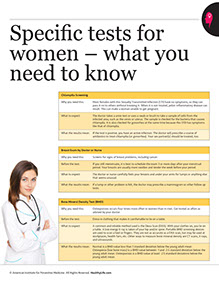
    Bone Mineral Density Test (BMD)

    Why you need this:

    Osteoporosis occurs four times more often in women than in men. Get tested as often as advised by your doctor.

    What to do before the test:

    Dress in clothing that makes it comfortable to lie on a table.

    What to expect:

    A common and reliable method used is the Dexa-Scan (DXA). With your clothes on, you lie on a table. A low energy X-ray is taken of your hip and/or spine. Portable BMD screening devices are used to scan a heel or fingers. They are not as accurate as a DXA scan, but may be used at workplaces, health fairs, etc. Other ways to measure bone mineral density are CT scans, X-rays, and ultrasounds.

    What the results mean:

    Normal is a BMD value less than 1 standard deviation below the young adult mean. Osteopenia (low bone mass) is a BMD value between -1 and -2.5 standard deviation below the young adult mean. Osteoporosis is a BMD value at least -2.5 standard deviations below the young adult mean.

    Breast Exam by Doctor or Nurse

    Why you need this:

    Screens for signs of breast problems, including cancer.

    What to do before the test:

    If you still menstruate, it is best to schedule the exam 3 or more days after your menstrual period. Your breasts are usually more swollen and tender the week before your period.

    What to expect:

    The doctor or nurse carefully feels your breasts and under your arms for lumps or anything else that seems unusual.

    What the results mean:

    If a lump or other problem is felt, the doctor may prescribe a mammogram or other follow up tests.

    Cervical Cancer Screening – Pap Test and Human Papilliomavirus (HPV) Test

    Why you need this:

    HPV test checks for DNA of high-risk types of human papillomavirus that can cause abnormal cells and cervical cancer. HPV test results are of value only with your Pap test results. Having a Pap test and an HPV test is an option for women ages 30 and older. If both tests are negative, the risk for cervical cancer is very low and women can opt to wait five years before another screening. Note: More than 40 types of HPV infect the vulva, cervix, anus, and penis. HPV testing for cervical cancer does not screen for other forms of cancers linked to HPV. It does not screen for genital warts and  other sexually transmitted infections, either.

    What to do before the test:

    You do not need any special preparation before an HPV test, but follow the same procedures as for Pap test, listed on this page, if both tests are done at the same time. HPV testing can also be done to provide more information when a Pap test’s results are not clear.

    What to expect:

    An HPV test is done the same way as a Pap test. The test can be done at the same time as the Pap test, using the same swab or a second swab.

    What the results mean:

    A negative HPV test means you do not have an HPV type that is linked to cervical cancer.

    A positive HPV test means you do have an HPV type that may be linked to cervical cancer. This does not mean you have cervical cancer now. But it could be a warning.

    Treatment depends on results your HPV and Pap test results. This includes:

    *  Having repeat tests to monitor changes

    *  Taking a closer look at your cervix (a colposcopy)

    *  Removing abnormal cells

    *  Treating for cancer, if present

    Cervical Cancer Screening – Pap Test (or Pap Smear)

    Why you need this:

    Checks for cell changes on the cervix that might become cervical cancer if they are not properly treated. Regular screening and follow-up can help prevent cervical cancer or find it early. Cervical cancer is the most preventable type of female cancer. Note: The Pap test does not screen for ovarian, uterine, vaginal, or vulvar cancers.

    What to do before the test:

    If you still menstruate, schedule the test for a time you will not be having a menstrual period. Don’t douche, tub-bathe, or use vaginal creams for 48 to 72 hours before the test. Avoid sex within 24 hours of the test.

    What to expect:

    You need to undress below the waist. You lie down on the exam table and put your feet in the stirrups attached to the bottom of the table. A device called a speculum is inserted into the vagina. A long cotton swab is used to take a sample of cells from the cervical area. This does not usually hurt. You may feel a brief pinch. The sample is analyzed for abnormal cells.

    What the results mean:

    Results come back as:

    *  Negative (normal). Negative (normal) – No cell changes were found on your cervix. Continue to get regular Pap tests in the future.

    *  Unclear – This means the cells on the cervix could be abnormal. Or, the cells could not be clearly identified. Cell changes could be due to an infection, menopause, or other life changes. The changes could also be related to human papillomavirus (HPV) types that have a high risk for cervical cancer. Your doctor can order a test to check for HPV.

    *  Abnormal – Cell changes were found on your cervix. A likely cause is HPV, but this does not mean you have cervical cancer. Abnormal cells can be: Low-grade changes are minor and could go back to normal on their own. Your doctor can order a test to check for HPV types that have a high risk for cervical cancer. High-grade changes are serious. They could turn into cancer if they are not removed. Cancer may be found, but other tests need to confirm this.

    Chlamydia Screening

    Why you need this:

    Three fourths of females with this STI have no symptoms, so they can pass it on to others without knowing it. When it is not treated, pelvic inflammatory disease can result. This can make a woman unable to get pregnant.

    What to expect:

    The doctor takes a urine test or uses a swab or brush to take a sample of cells from the infected area, such as the cervix or uterus. The sample is checked for the bacteria that causes chlamydia. It is also checked for gonorrhea at the same time because this STI has symptoms like that of chlamydia.

    What the results mean:

    If the test is positive, you have an active infection. The doctor will prescribe a course of antibiotics to treat chlamydia (or gonorrhea). Your sex partner(s) should be treated, too.

    Mammogram

    Why you need this:

    Screens for signs of breast problems, including cancer.

    What to do before the test:

    Schedule the test at an approved testing facility. Find out from the National Cancer Institute at 800.4.CANCER (422.6237) orwww.cancer.gov. If you still menstruate, try not to schedule the test during the week before a period. On the day of the test, don’t wear lotions, powders, perfumes or deodorant. They can cause shadows on the X-ray pictures. Wear slacks or a skirt with a blouse or top, so you only need to undress from the waist up.

    What to expect:

    You will need to undress above the waist. You put on a gown that covers your front and back. The test is quick and easy: You stand up in front of the X-ray machine. The person who takes the X-rays places one breast between two plastic plates. The plates press your breast and make it flat. This can feel uncomfortable, but it lasts only seconds. The machine has an automatic release. The same test is done on the other breast. Then side images are taken for both breasts for a total of 4 X-rays.

    What the results mean:

    A radiologist reads the X-rays and sends the results to your doctor. A report is sent to you within 30 days. A normal result means the radiologist did not find anything that needs follow up. Continue to get screening mammograms. If the result is abnormal, it means the radiologist saw:

    *  A change from a past mammogram.

    *  A change that needs follow up.

    *  Your doctor will order follow up tests, as needed, such as an ultrasound or an MRI. If one of these shows a solid mass, your doctor may prescribe a biopsy of the mass.

    The good news is that about 80% of lumps are NOT cancerous.

    Pelvic Exam

    Why you need this:

    Checks for problems on the outside of the vaginal area and inside the vagina and cervix.

    What to do before the test:

    Follow guidelines for Pap smear.

    What to expect:

    The doctor does a physical exam of the vaginal area. A Pap smear is usually done with a pelvic exam. The doctor may also insert a gloved and lubricated finger into the rectum. This can feel uncomfortable, but does not usually cause pain.

    What the results mean:

    If no problems are found, continue to have pelvic exams yearly or as advised by your doctor. If a problem is found, your doctor will prescribe follow-up tests or exams.

    Men's and Women's Self-Care Book. Published by the American Institute for Preventive Medicine. www.HealthyLife.com. All rights reserved.

    © American Institute for Preventive Medicine

  • Headaches 3

    Women’s Health

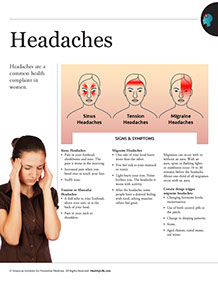
    Headaches are a common health complaint in women.

    Signs, Symptoms & Causes

    For Tension or Muscular Headaches

    *  A dull ache in your forehead, above your ears, or at the back of your head.

    *  Pain in your neck or shoulders.

    Common causes are tense or tight muscles in the face, neck, or scalp, concentrating hard for long periods of time, stress, and lack of sleep.

    For Sinus Headaches

    *  Pain in your forehead, cheekbones, and nose. The pain is worse in the morning.

    *  Increased pain when you bend over or touch your face.

    *  Stuffy nose.

    A sinus headache occurs when fluids in the nose aren’t able to drain well and a buildup of pressure occurs in the sinuses. A cold, allergies, dirty or polluted water, and airplane travel can cause a sinus headache.

    For Migraine Headaches

    *  One side of your head hurts more than the other.

    *  You feel sick to your stomach or vomit.

    *  Light hurts your eyes. Noise bothers you. The headache is worse with activity.

    *   After the headache, some people have a drained feeling with tired, aching muscles; others feel great.

    Migraines can occur with or without an aura. With an aura, spots or flashing lights or numbness occur 10 to 30 minutes before the headache. Ten percent of all migraines are this type; 90% occur without an aura.

    Migraine headaches happen when blood vessels in your head open too wide or close too tight. They tend to run in families and affect nearly 30% of women at some time during their lives. They occur more often in women than in men.

    Migraines occur less often during pregnancy (especially the second half) and often disappear during menopause. Some women, though, may get migraines for the first time during menopause.

    Certain things trigger migraine headaches:

    *  Changing hormone levels. Menstruation.

    *  Use of birth control pills or the patch.

    *  Change in sleeping patterns.

    *  Stress.

    *  Aged cheeses. Cured meats. Red wines.

    Other Causes of Headaches

    *  Analgesic rebound from regular or repeated use of over-the-counter or prescribed pain relievers.

    *  Eating or drinking something very cold, such as ice cream. {Note: To prevent ice cream headaches, warm the ice cream for a few seconds in the front of your mouth.}

    *  Caffeine withdrawal.

    *  Low blood sugar, hunger, or sensitivity to certain foods and drinks.

    *  A symptom of a health problem. Examples are allergies, depression, high blood pressure, dental problems, and a pinched nerve in the neck.

    *  Cigarette smoke, pollution, etc.

    *  Uncorrected vision problems.

    Treatment

    Self-care can treat headaches caused by tension, fatigue, and/or stress. Certain over-the-counter medicines and prescribed medicines can treat sinus headaches and migraine headaches.

    Biofeedback has helped many people who have suffered from headaches.

    Headaches that are symptoms of health problems are relieved when the condition is treated with success.

    Questions to Ask

    Self-Care / Prevention

    *  Don’t smoke. If you smoke, quit!

    *  Try to stop the headache when it starts.

    *  Take an over-the-counter (OTC) medicine for pain as directed on the label.

    *  Rest in a quiet, dark room with your eyes closed.

    *  Massage the back of your neck with your thumbs. Work from the ears toward the center of the back of your head. Also, rub gently along the sides of your eyes. Gently rub your shoulders, neck, and jaw. Get a massage.

    *  Place a cold or warm washcloth or hot or cold pack, whichever feels better, over the area that aches.

    *  Take a warm bath or shower.

    *  Relax. Picture a calm scene in your head. Meditate or breathe deeply.

    *  Keep a diary of when, where, and why headaches occur.

    *  Get enough rest.

    *  Eat 5 to 6 small meals instead of 3 large meals. To ward off low blood sugar, don’t skip meals. Avoid sweets.

    *  Keep regular sleeping times as much as you can.

    *  When lying down, use a pillow that supports the neck. Sleep on your back.

    *  Avoid scents, foods, and beverages that trigger headaches.

    *  To help prevent headaches and nausea caused by a hangover, try an OTC product, such as Chaser-Freedom From Hangovers.

    *  For a hangover: After drinking alcohol, take an OTC pain reliever. Eat solid foods. Rest or sleep. Have 2 or more glasses of water before you go to sleep. Drink 2 or more glasses of water when you wake up.

    Foods and Drinks that May Cause Headaches

    *  Alcoholic beverage, especially red wine

    *  Aspartame (the artificial sweetener in NutraSweet®)

    *  Bananas (if more than 1/2 banana a day)

    *  Caffeine from coffee, tea, cola soft drinks, chocolate, or some medications

    *  Lack of caffeine if abruptly stopped, such as stopping coffee intake

    *  Citrus fruits (if more than 1/2 cup a day)

    *  Cured meats, such as frankfurters

    *  Food additives, such as monosodium glutamate (MSG)

    *  Hard cheeses, such as aged cheddar or provolone

    *  Nuts and peanut butter

    *  Onions

    *  Sour cream

    *  Soy sauce

    *  Vinegar

    Resources

    National Headache Foundation

    888.NHF.5552 (643.5552)

    www.headaches.org

    Women's Self-Care book by the American Institute for Preventive Medicine. www.HealthyLife.com. All rights reserved.

    © American Institute for Preventive Medicine

  • Headaches 2

    General Health Conditions

    Causes

    *  Anxiety, stress, caffeine withdrawal, or depression

    *  Lack of sleep. Poor sleep position.

    *  A sensitivity to certain foods and drinks.

    *  Reading a lot, especially in dim light

    *  Missing or delaying a meal

    *  Doing boring work

    *  Being in one position for a long time, like at a computer

    *  Hormone changes that come  with menstruation, while taking birth control pills, etc.

    *  Exposure to chemicals and/or pollution

    *  Side effects from some medications

    *  Dirty or polluted air

    *  Airplane travel

    *  Alcohol

    *  Poison

    *  Poor posture

    *  Cigarette smoke

    *  Too much physical activity

    *  Bright lights. This includes watching TV.

    *  Movement, such as riding in a car or elevator

    *  Loud noises

    *  Strong odors

    *  Eating or drinking something very cold, such as ice cream

    Types

    You can have cancer for years without having symptoms. There is usually no pain at the onset of cancer. As different types of cancers grow, warning signs may occur. See your doctor for a proper diagnosis.

    For Tension or Muscular Headaches

    About 90 percent of all headaches are tension or muscular headaches. These headaches respond well to self-care, without causing ongoing problems. Symptoms include:

    *  You have a dull ache in your forehead, above your ears, or at the back of your head.

    *  You feel pain in your neck or shoulders.

    Tense or tight muscles in the face, neck, or scalp result in these headaches. Common causes are:

    *  An illness

    *  Fever

    *  Tiredness

    *  Stress

    *  Worry

    *  Concentrating hard for long periods of time

    For Sinus Headaches

    Symptoms

    *  The pain is in your forehead, cheekbones, and nose.

    *  The pain is worse in the morning.

    *  It hurts more if you bend over or touch your face.

    *  Your nose is stuffy.

    Sinuses are behind your cheeks, around your eyes, and in your nose. You may get a sinus headache from:

    *  A cold or upper respiratory infection

    *  Allergies, like hay fever

    *  Other breathing problems

    *  Swimming in dirty or polluted water

    *  Airplane travel

    These things interfere with fluid drainage in the nose, causing a buildup of pressure. Pain results.

    For Cluster Headaches

    Cluster headaches usually start at night, can last from 15 minutes to 3 hours, and can interrupt sleep. They can also start during the hours a person is awake. These headaches come once or twice a year, usually in older men, and tend to run in families.

    Cluster headaches are much less common than migraines. Spring and autumn are the most common times of the year for them. Symptoms include:

    *  The pain is on one side of your head.

    *  The pain is in or on the sides of your eyes.

    *  Your eyes are watery.

    *  The pain is sharp, burning, and intense.

    *  Your pupils look smaller.

    *  One or both of your eyelids droop.

    *  You get headaches in groups (clusters), everyday for a week or longer.

    For Children’s Headaches

    Children’s headaches that come once in a while can be treated with ibuprofen or acetaminophen. Make sure you use the right type and dose for your child’s weight. Don’t give aspirin to anyone younger than 19 years of age due to its link to Reye’s Syndrome. Reye’s Syndrome is a rare disease that can cause death. It usually occurs 7 to 10 days after the onset of the flu or chicken pox. If the child complains of head pain on a regular basis, take the child to his or her doctor. Symptoms:

    *  The headaches tend to be shorter than ones in adults.

    *  Sometimes, an upset stomach and vomiting are also present.

    *  Headaches come in groups, then are gone for months.

    For Migraine Headaches

    Migraines happen when blood vessels in your head open too wide or close too tight. At least one in eight adults suffer from migraines. Women have migraines more often than men. Migraines tend to run in families, too. Symptoms include:

    *  One side of your head hurts more than the other.

    *  You feel sick to your stomach or throw up.

    *  You may see spots or zigzag flashes of light.

    *  Light hurts your eyes.

    *  Noise bothers you.

    *  Your ears ring.

    *  Your face is pale.

    *  After the headache, some people have a drained feeling with tired, aching muscles. Others feel great after the headache goes away.

    Types of Migraine Headaches

    *  Migraines with an aura. An aura is when a person sees spots or flashing lights for 10 to 15 minutes or his or her face becomes numb. (Ten percent of migraines are this type.)

    *  Migraines without an aura. They start more slowly and tend to last longer than migraines with an aura. They don’t begin with changes in a person’s vision or numbness. (Ninety percent of migraines are this type.)

    Prevention

    Keep a headache diary. Write down when, where, and why the headaches seem to start. Try to avoid things that trigger headaches.

    Be aware of early symptoms. Try to stop the headache as it begins.

    *  Exercise on a regular basis.

    *  Keep regular sleep hours, even on weekends.

    *  Don’t smoke. If you smoke, quit.

    *  Cut down on salt.

    *  Avoid excess alcohol. Alcohol can lead to a “hangover” headache.

    *  Don’t have foods and drinks known to trigger headaches in sensitive people.

    Foods and Drinks That May Cause Headaches

    *  Alcohol, especially red wine

    *  Bananas (if more than 1/2 banana daily)

    *  Beans: Broad, lima, fava, snow peas

    *  Brewer’s yeast

    *  Caffeine (from coffee, tea, cola soft drinks, some medications, chocolate) or caffeine withdrawal

    *  Chicken livers, paté

    *  Citrus fruits (if more than 1/2 cup daily)

    *  Cured meats (hot dogs, luncheon meats, etc.)

    *  Figs, raisins, papayas, avocados, red plums (no more than 1/2 cup daily)

    *  Foods with MSG (monosodium glutamate), such as soy sauce, meat tenderizers, seasoned salt

    *  Hard cheeses (aged cheddar, provolone, etc.)

    *  Herring, pickled or dried

    *  Nuts and peanut butter

    *  Onions

    *  Pickled, preserved, or marinated foods

    *  Sauerkraut

    *  Sour cream

    *  Sourdough bread

    *  Vinegar

    Treatment

    Usually, headaches are not linked to serious health problems. Self-care treats most headaches.

    Self-Care

    *  Rest in a quiet, dark room with your eyes closed.

    *  Rub the base of your skull with your thumbs. Work from the ears toward the center of the back of your head. Also, rub gently along the sides of your eyes, your shoulders, neck, and jaw.

    *  Take a warm bath or shower.

    *  Place a cold or warm washcloth, whichever feels better, over the area that aches.

    *  Take an over-the-counter (OTC) medicine (that your provider recommends) for pain. Take it right away.

    *  Relax. Imagine a calm scene. Meditate or breathe deeply.

    Medication

    *  Over-the-counter (OTC) pain medications. Examples are aspirin, ibuprofen, naproxen sodium and ketoprofen. Most tension and muscular headaches go away with OTC medications. Some OTC medicines (e.g., Excedrin Migraine® and Motrin Migraine Pain®) are FDA approved for migraine headaches.

    *  Prescribed medicines. Examples are:

    – Triptan drugs, such as sumatriptan

    – Ergotamines, with or without caffeine

    – Antihistamines

    – Beta-blockers

    – Calcium channel blockers

    – Tricyclic antidepressants

    Take medicines as prescribed.

    Biofeedback

    Biofeedback is a process of learning how to control internal functions to relieve pain. Biofeedback training has helped many people who have suffered from headaches.

    These things occur with biofeedback:

    *  A biofeedback therapist explains how the muscles react to stress and cause tension headaches.

    *  Most of the time, you sit in a comfortable chair in a dimly lit room.

    *  A headband, connected to a machine, is fastened across your forehead. The machine emits a steady sound that changes if muscles in the head or neck are tensed.

    *  A small thermometer is attached to one of your fingers. Another machine keeps track of your temperature.

    *  You learn how to use these biofeedback machines.

    *  You learn to control the automatic response of your muscles and blood vessels that cause headaches.

    *  Then you learn to do the same thing without the machines to control headaches on your own.

    Medical Care

    Reasons to Get Medical Care Fast

    *  A headache due to a serious head injury or a blow to the head causes severe pain, enlarged pupils, vomiting, confusion, or feeling sleepy.

    *  Severe pain occurs in and around one eye.

    *  A severe, persistent headache occurs with a stiff neck or a red or purple rash that doesn’t fade when pressure is applied to the skin.

    *  The headache came on suddenly and hurts much more than any headache you have ever had.

    Call 9-1-1 if signs of a stoke occur:

    *  A sudden and severe headache with no known cause

    *  Sudden numbness or weakness of the face, arm or leg, especially on one side of the body

    *  Sudden confusion, trouble speaking or understanding

    *  Sudden trouble seeing in one or both eyes

    *  Sudden trouble walking, dizziness, loss of balance or coordination

    Reasons to Call Doctor or Health Care Provider

    *  The headache has lasted more than 2 to 3 days and keeps getting worse.

    *  Migraine headaches (intense, throbbing, one-sided, often with nausea or vomiting) occur often. Flashing lights or spots may precede the pain.

    *  A headache persists or recurs and is present with nausea or vomiting.

    *  A headache started after taking a new medicine (prescribed or over-the-counter).

    Work with Your Health Care Provider

    For headaches that do not need medical care fast, contact your primary care provider first. Most likely, he or she will be able to figure out the type of headache you have. If not, he or she can refer you to a specialist. Tips on working with your doctor or health care provider:

    *  Make notes before your office visit.

    *  List every symptom, even if it seems minor.

    *  Be honest with your health care provider. The facts you give could be important in finding out why you have headaches.

    *  Follow your doctor’s advice. Let him or her know if the prescribed treatment helps. Tell your doctor if you have any side effects from treatment.

    *  Answer these questions before your office visit:

    – When did your headaches begin (days, weeks, months, years ago)?

    – How long does your headache last (minutes, hours, days)?

    – How often do you have these headaches (once a day, once a week, etc.)?

    – Where does it hurt (both sides, one side, etc.)?

    – How does the pain feel (dull, sharp, throbbing, nonstop)? How does the pain usually start (dull or sharp)?

    – Is there a pattern to your headaches? Are they gone for months at a time then come back several times a day? Are they worse lately?

    – Are your headaches different from each other? (You may have more than one kind.)

    – When does the pain usually start (at night, in the morning)?

    – Are there any symptoms just before the headache begins (stuffy nose, pain elsewhere, flashing lights)?

    – Do any other symptoms occur with the headache (upset stomach, pain elsewhere)?

    – What helps the headache go away (rest, medicine, hot or cold treatment, massage)?

    – Does anything make the pain worse (moving the head, standing or lying)?

    – Does an activity or situation bring on headaches (after exercise or eating a certain food)?

    – Are you taking any other medicines or drugs?

    – Is another health care provider treating you for anything else?

    Resources

    National Headache Foundation

    800.843.2256

    www.headaches.org

    Headaches brochure by the American Institute for Preventive Medicine. www.HealthyLife.com. All rights reserved.

    © American Institute for Preventive Medicine

  • Headaches

    Brain & Nervous System

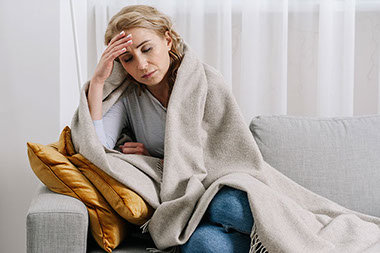
    Women sitting with blanket and holding forehead.

    Persons who suffer from headaches should see a doctor for proper diagnosis and treatment.

    Common causes of headaches are tension, sinus problems, tobacco smoke, low blood sugar, and things in your diet like red wine, aged cheese, and MSG.

    Keep a diary of when headaches occur, how long they last, and where and how severe the pain is. Keep track of other symptoms, such as nausea, too. Show this diary to your doctor to help them identify which type of headache you have and the most beneficial treatments.

    The most common treatments for headaches are rest and over-the-counter pain relievers. It is best to treat headaches when they begin or when they are still mild. Prescription medication may also be prescribed by your doctor.

    In addition to medicine, self-care practices can also help manage your symptoms and prevent headaches. Examples include putting a heat or ice pack on your head or neck, getting enough quality sleep, and drinking plenty of water.

    Health at Home Lifetime book by the American Institute for Preventive Medicine. www.HealthyLife.com. All rights reserved.

    © American Institute for Preventive Medicine

  • Head/Neck/Spine Injuries

    First Aid

    Signs & Symptoms

    For a Severe Injury

    *  The scalp, neck, or back bleeds.

    *  It looks like the head, neck, or back is in an odd position.

    *  Pain is felt in the back, neck, and/or head. The pain can be severe.

    *  Stiff neck.

    *  Abdominal pain. Vomiting.

    *  Blood or fluid comes from the mouth, nose, or an ear.

    *  Loss of vision. Blurred or double vision. Pupils of uneven size.

    *  Inability to move any part of the body. Weakness in an arm or leg. Walking is difficult.

    *  New feelings of numbness occur in the legs, arms, shoulders, or any other part of the body.

    *  New loss of bladder or bowel control occurs.

    *  Confusion. Drowsiness. Personality changes.

    *  Convulsions.

    *  Loss of consciousness.

    Watch for signs and symptoms for the first 24 hours after the injury. Symptoms may not occur for as long as several weeks, though. Problems can occur even if no injury is seen on the outside.

    For a Whiplash Injury

    *  Neck pain and stiffness.

    *  Having a hard time raising the head off of a pillow.

    Causes

    Anything that puts too much pressure or force on the head, neck, or back can result in injury. Common causes are falls, accidents, and hard blows. A concussion occurs when the brain is shaken. A contusion occurs when the brain is bruised.

    Treatment

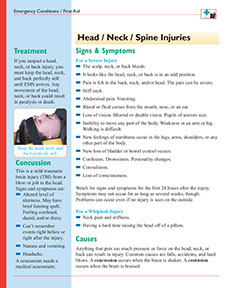
    If you suspect a head, neck, or back injury, you must keep the head, neck, and back perfectly still until EMS arrives. Any movement of the head, neck, or back could result in paralysis or death.

    Questions to Ask

    Self-Care / Prevention

    First Aid for a Severe Injury

    *  Do not move the person unless his or her life is in danger. If so, log roll the person, place tape across the forehead, and secure the person to a board to keep the head, neck, and back areas from moving at all.

    *  Call 9-1-1!

    *  CHECK for a response. If giving rescue breaths, do not tilt the head backward. Pull the lower jaw open instead.

    To Immobilize the Head, Neck, and/or Back

    *  Tell the person to lie still and not move his or her head, neck, back, etc.

    *  Log roll as listed above or place rolled towels, etc. on both sides of the neck and/or body. Tie in place, but don’t interfere with the person’s breathing. If necessary, use both of your hands, one on each side of the person’s head to keep the head from moving.

    *  Monitor for Bleeding and Shock. Keep the person warm with blankets, coats, etc.

    Move Someone You Suspect Has Injured His or Her Neck in a Diving or Other Water Accident

    Before emergency care arrives:

    *  Protect the neck and/or spine from bending or twisting. Place your hands on both sides of the neck. Keep it in place until help arrives.

    *  If the person is still in the water, help the person float until a rigid board can be slipped under the head and body, at least as far down as the buttocks.

    *  If no board is available, get several people to take the person out of the water. Support the head and body as one unit. Make sure the head does not rotate or bend in any way.

    First Aid For Traffic Accidents

    *  If the person was in a motorcycle accident, do not remove the helmet. Call 9-1-1 to do this.

    *  Don’t move the person. He or she may have a spinal injury. Call 9-1-1 to do this.

    First Aid for Minor Head Injuries

    *  Put an ice pack or bag of frozen vegetables in a cloth. Apply this to the injured area. Doing this helps reduce swelling and bruising. Change it every 15 to 20 minutes for 1 to 2 hours. Do not put ice directly on the skin. Cover an open, small cut with gauze and first- aid tape or an adhesive bandage.

    *  Once you know there is no serious head injury, do normal activities again. Avoid strenuous ones.

    *  Take an over-the-counter medicine for pain as directed.

    *  Don’t drink alcohol or take any other sedatives or sleeping pills.

    *  During the next 24 hours, monitor the person. While asleep, wake the person every 2 hours to check alertness. Ask something the person should know, such as a pet’s name, an address, etc. If the person can’t be roused or respond normally, get immediate medical care.

    First Aid for Bleeding from the Scalp

    *  To control bleeding, put pressure around the edges of the wound. Make a ring pad (shaped like a doughnut) out of long strips of cloth to apply pressure around the edges of the wound. If this doesn’t control bleeding, put direct pressure on the wound. Don’t poke your hand into the person’s brain, though.

    *  Don’t wash the wound or apply an antiseptic or any other fluid to it.

    *  If blood or pink-colored fluid is coming from the ear, nose, or mouth, let it drain. Do not try to stop its flow.

    If You Suspect a Whiplash Injury

    *  See your doctor, as soon as you can, to find out the extent of injury. If your arm or hand is numb, tell your doctor.

    *  For the first 24 hours, apply ice packs to the injured area for up to 20 minutes every hour.

    *  After 24 hours, use ice packs or heat, whichever works best, to relieve the pain. There are many ways to apply heat. Take a hot shower for 20 minutes a few times a day. Use a hot-water bottle, heating pad (set on low), or heat lamp directed to the neck for 10 minutes, several times a day. (Use caution not to burn the skin.)

    *  Wrap a folded towel around the neck to help hold the head in one position during the night.

    Concussion

    This is a mild traumatic brain injury (TBI) from a blow or jolt to the head. Signs and symptoms are:

    *  Altered level of alertness. May have brief fainting spell. Feeling confused, dazed, and/or dizzy.

    *  Can’t remember events right before or right after the injury.

    *  Nausea and vomiting.

    *  Headache.

    A concussion needs a medical assessment.

    Healthier at Home book by the American Institute for Preventive Medicine. www.HealthyLife.com. All rights reserved.

    © American Institute for Preventive Medicine

  • High Blood Pressure

    Heart & Circulation Problems

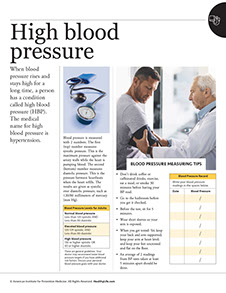
    The medical name for high blood pressure is hypertension (hy-puhr-TEHN-shun). High blood pressure (HBP) is when blood moves through the arteries at a higher pressure than normal. The heart strains to pump blood through the arteries.

    Signs & Symptoms

    High blood pressure (HBP) is a “silent disease.” Often there are no signs or symptoms. A lot of adults with HBP do not know they have it. So, get your blood pressure checked at each doctor’s office visit, at least every 2 years, or as often as your doctor advises. When blood pressure is 180 or higher (top number) or 120 or higher (bottom number), these signs of a hypertensive crisis may occur:

    *  Severe chest pain

    *  Severe headache with confusion and blurred vision

    *  Severe anxiety

    *  Shortness of breath

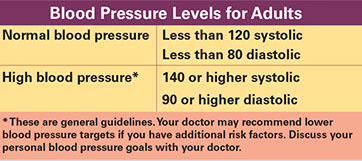
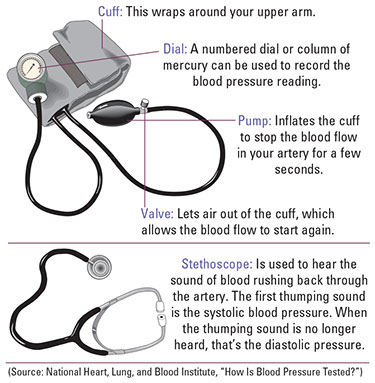
    Blood pressure is measured with 2 numbers. The first (top) number measures systolic pressure. This is the maximum pressure against the artery walls while the heart is pumping blood. The second (bottom) number measures diastolic pressure. This is the pressure between heartbeats when the heart refills. The results are given as systolic over diastolic pressure, such as 120/80 millimeters of mercury (mm Hg).

    Tips When You Have Your BP Measured

    *  Don’t drink coffee or smoke 30 minutes before having your BP read. (Don’t smoke at all!)

    *  Go to the bathroom before you get it checked.

    *  Before the test, sit for 5 minutes.

    *  Wear short sleeves so your arm is exposed.

    *  When you get tested: Sit; keep your back and arm supported; and keep your arm at heart level.

    *  An average of 2 readings from BP tests taken at least 5 minutes apart should be done.

    Causes, Risk Factors & Care

    The exact cause is not known.

    Risk factors include:

    *  Family history of HBP

    *  Aging. More than half of older adults have HBP.

    *  Smoking cigarettes

    *  Race. African Americans are more likely to have HBP than Caucasians.

    *  Gender. Men are more likely to have HBP than women (until women reach menopause).

    *  Being inactive. Obesity. Sleep apnea.

    *  Drinking too much alcohol

    *  Too much sodium intake in some persons

    *  Emotional distress

    High blood pressure could be caused by another medical problem or be a side effect of some medicines. This is called secondary hypertension. This can usually be reversed when the problem is treated.

    Diagnosis

    Blood pressure readings tell if your blood pressure is high. A health care professional measures blood pressure during an office visit with a manual or automated device called a sphygmomanometer (sfig’-mo-ma-nom-e-ter). The numbers on the gauge measure your blood pressure in millimeters of mercury (mm Hg).

    You should get 2 or more readings at different times. To confirm a diagnosis of HBP, your doctor may have you wear a device that records your blood pressure every 20-30 minutes over a period of 24 to 48 hours. This is called ambulatory blood pressure monitoring (ABPM).

    Note: Sometimes just being at the doctor’s office is enough to raise some people’s blood pressure. This is called “white-coat hypertension.” If you think this affects you, tell your doctor. You may be advised to check your blood pressure with a home testing device. Your doctor may have you wear a device that records your blood pressure for 24 hours. This will give accurate readings of your blood pressure.

    Health Problems Related to HBP

    High blood pressure plays a major role in these health problems:

    *  Stroke. Dementia. Brain damage.

    *  Heart disease. A person with HBP is 5 times more likely to have a heart attack than a person without HBP. It can also cause the heart to enlarge. This could cause (congestive) heart failure.

    *  Chronic kidney disease

    *  Kidney failure

    *  Vision loss. This includes blindness.

    Why is ambulatory blood pressure monitoring (ABPM) done?

    During an office visit, a short-term rise in blood pressure can be due to:

    *  Emotions or stress

    *  Pain or physical activity

    *  Caffeine or nicotine

    *  “White-coat hypertension.” With this, just being at a doctor’s office or in the presence of medical staff is enough to raise blood pressure.

    Getting blood pressure readings over 1-2 days during normal activity and sleep gives a more accurate measurement of your blood pressure.

    Self-Care / Prevention

    For blood pressure control, follow a healthy lifestyle.

    *  Get your blood pressure checked at each office visit, at least every 2 years, or as often as your doctor advises.

    *  Get to and/or stay at a healthy weight. Aim for a body mass index (BMI) between 18.5 and 24.9. Find your BMI using the table below or from:www.nhlbisupport.com/bmi.

    *  Don’t smoke. If you smoke, quit.

    *  Limit alcohol to 2 drinks or less a day if you are male and 1 drink or less a day if you are female or age 65 or older.

    *  Limit caffeine.

    *  Exercise. Try to do at least 60 minutes a day.

    *  Learn to handle stress. Take classes. Learn relaxation techniques, etc.

    *  Take medicine as prescribed. Tell your doctor if you have any side effects, such as dizziness, faintness, or a dry cough without having a cold. Don’t stop taking your prescribed medicine or change the dose(s) unless your doctor tells you to.

    *  Talk to your doctor or pharmacist before you take antihistamines and decongestants. Discuss all prescribed and over-the-counter medicines with your doctor and pharmacist before you take them to avoid harmful drug interactions. Find out about drug and food interactions, too. Ask if grapefruit juice can cause harmful effects with the medicine(s) you take.

    *  Keep track of your blood pressure using a home testing device. Do this if advised by your doctor.

    Medical Care

    High blood pressure usually lasts a lifetime, but can be treated and controlled. If you are diagnosed with high blood pressure, follow your doctor’s advice. Medical treatment includes:

    *  A physical exam and lab tests. These check for damage to your heart, kidneys, and other organs. They also identify risk factors you have for heart, kidney, and other diseases. Your treatment plan is based on your needs.

    *  Follow-up blood pressure checks and other tests as needed.

    *  Healthy lifestyle changes.

    *  Medications. Most persons need more than 1 medicine to treat high blood pressure.

    Your doctor will decide if and what medication(s) you need. This is based on your blood pressure level, age, race, other conditions you have, heart disease risk factors, etc. Common medicines used to treat HBP are:

    *  Diuretics (water pills)

    *  Calcium channel blockers

    *  ACE inhibitors

    *  Angiotensin II receptor blockers

    *  Beta-blockers

    *  Alpha blockers. Alpha-beta blockers.

    *  Nervous system inhibitors

    *  Vasodilators

    Reasons to Get Medical Care

    *  You have signs or symptoms of a hypertensive crisis. Get medical care right away.

    *  You need to schedule office visit appointments to get your blood pressure checked. Do this as often as your doctor advises.

    *  You have adverse side effects from taking medicine(s) to lower blood pressure. Examples are:

    – You feel lightheaded or dizzy.

    – You feel weak, sleepy, and/or drowsy.

    – Your heart races.

    – You get a skin rash.

    Resources

    American Heart Association

    800.242.8721

    www.heart.org

    National Heart, Lung, and Blood Institute

    www.nhlbi.nih.gov

    High Blood Pressure brochure by the American Institute for Preventive Medicine. www.HealthyLife.com. All rights reserved.

    © American Institute for Preventive Medicine

  • Hay Fever

    Ear, Nose & Throat Conditions

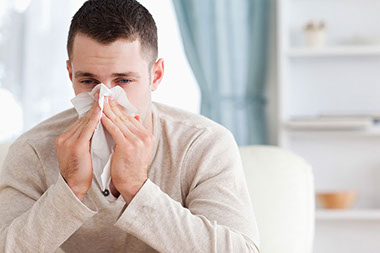
    Image of man blowing nose with tissue.

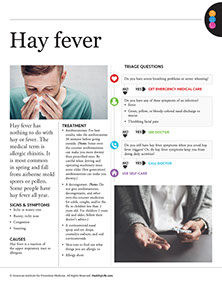
    Hay fever has nothing to do with hay or fever. The medical term for hay fever is allergic rhinitis. It is most common in spring and fall when a lot of ragweed is in the air. Some people have hay fever all year, though.

    Signs & Symptoms

    *  Itchy or watery eyes.

    *  Runny, itchy nose.

    *  Congestion.

    *  Sneezing.

    Causes

    Hay fever is a reaction of the upper respiratory tract to allergens.

    Treatment

    Talk to your doctor if self-care measures do not help. He or she may prescribe:

    *  Antihistamines. For best results, take the antihistamine 30 minutes before going outside. {Note: Some over-the-counter antihistamines can make you more drowsy than prescribed ones. Be careful when driving and operating machinery since some antihistamines can make you drowsy.}

    *  A decongestant. {Note: Do not give antihistamines, decongestants, and other over-the-counter medicines for colds, coughs, and/or the flu to children less than 2 years old. For children 2 years old and older, follow their doctor’s advice.

    *  A corticosteroid nasal spray and eye drops, cromolyn sodium, and oral corticosteroids.

    *  Skin tests to find out what things you are allergic to.

    *  Allergy shots.

    It is best to take what your doctor advises instead of testing over-the-counter products on your own.

    Questions to Ask

    Self-Care / Prevention

    *  If you are allergic to pollen and molds, let someone else do outside chores. Mowing the lawn or raking leaves can make you very sick.

    *  Keep windows and doors shut and stay inside when the pollen count or humidity is high. Early morning is sometimes the worst.

    *  Avoid tobacco smoke and other air pollutants.

    *  Don’t have pets. If you have a pet, keep it out of the bedroom. When you can, keep the pet outdoors.

    *  Use an air conditioner or air cleaner in your house, especially in the bedroom. Electronic air filters are better than mechanical ones. Clean the filter often. Or, try a doctor-approved air purifier, especially in the bedroom. Devices with HEPA filters can be very effective in cleaning indoor air.

    To limit dust, mold, and pollen:

    *  Put a plastic cover on your mattress or cover it completely with an allergen-free mattress cover.

    *  Sleep with no pillow or with the kind your doctor or health care provider recommends. If you use a pillow, cover it with an allergen-free cover.

    *  Don’t dry sheets and blankets outside.

    *  Try not to have stuffed animals kept in the bedroom. If you must, have only one that can be washed. Wash it in hot water once a week.

    *  Use curtains and rugs that can be washed often. Don’t use carpeting.

    *  Dust and vacuum often. Wear a dust filter mask when you do.

    *  Put an electronic air filter on your furnace or use portable air purifiers.

    *  Shower or bathe and wash your hair after heavy exposure to pollen, dust, etc.

    Resources

    Asthma and Allergy Foundation of America

    800.7.ASTHMA (727.8462)

    www.aafa.org

    Healthier at Home book by the American Institute for Preventive Medicine. www.HealthyLife.com. All rights reserved.

    © American Institute for Preventive Medicine