Blog

  • Have Fun While Staying Safe In The Sun

    Skin Conditions

    Open bottle of sun screen with lotion making smiling face.

    *  Wear sunscreen with a sun protection factor (SPF) of 30 or higher that blocks both UVB and UVA radiation.

    *  Limit your time in the sun, especially during peak sunlight hours. These are 10 a.m. to 3 p.m. standard time, and 11 a.m. to 4 p.m. daylight saving time.

    *  Wear long sleeves, pants, and wide-brimmed hats to help block the sun’s harmful rays.

    *  Wear clothing with sunscreen protection.

    *  Spend outdoor time in shaded areas, such as under a large umbrella or a pavilion.

    *  Wear sunglasses that protect against both UVB and UVA rays.

    *  Ask your doctor if any medicines you take make your skin more sensitive when you are in the sun.

    *  Drink plenty of water. Limit alcohol. Be sober when you drive a boat or other vehicle.

    *  Find out and follow safety rules for water activities you plan to take part in. Wear personal flotation devices.

    *  Take CPR and water safety courses. Learn about these from theamericanheart.organdredcross.org.

    Health at Home Lifetime book by the American Institute for Preventive Medicine. www.HealthyLife.com. All rights reserved.

    © American Institute for Preventive Medicine

  • Plan For A Healthier, Happier Menopause

    Women’s Health

    Image of two mature women laughing.

    Some women dread menopause, associating the change of life with hot flashes, painful intercourse, mood swings, and the specter of old age. As with menstruation and childbearing, menopause is a rite of passage that has some discomforts. But you can help to prevent or alleviate many of them.

    *  To maintain a positive outlook, share your feelings with friends, stay active, and take an interest in others in your community.

    *  To lessen mood swings, cut down on caffeine, alcohol, and sweets.

    *  To help maintain hormonal balance, do regular exercise. Lose weight if you are overweight.

    Kegel exercises (named for the individual who invented them) can help to keep your pelvic and vaginal muscles toned, preventing a prolapsed uterus or poor bladder control, both of which sometimes accompany menopause. To feel these muscles at work, stop and start your urine flow in midstream the next time you use the toilet. Then practice the two exercises that follow.

    *  Squeeze the pelvic/vaginal muscles for 3 seconds, then relax them for 3 seconds. Do this ten times, three times a day.

    *  Squeeze and relax the same muscles as quickly as possible. Repeat ten times, three times a day.

    A Year of Health Hints book by the American Institute for Preventive Medicine. www.HealthyLife.com. All rights reserved.

    © American Institute for Preventive Medicine

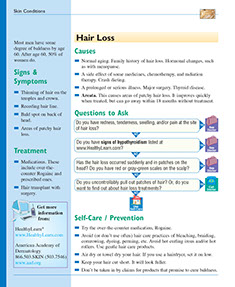
  • Hair Loss

    Skin Conditions

    Most men have some degree of baldness by age 60. After age 60, 50% of women do.

    Signs & Symptoms

    *  Thinning of hair on the temples and crown.

    *  Receding hair line.

    *  Bald spot on back of head.

    *  Areas of patchy hair loss.

    Causes

    *  Normal aging. Family history of hair loss. Hormonal changes, such as with menopause.

    *  A side effect of some medicines, chemotherapy, and radiation therapy. Crash dieting.

    *  A prolonged or serious illness. Major surgery. Thyroid disease.

    *  Areata. This causes areas of patchy hair loss. It improves quickly when treated, but can go away within 18 months without treatment.

    Treatment

    *  Medications. These include over-the- counter Rogaine and prescribed ones.

    *  Hair transplant with surgery.

    Questions to Ask

    Self-Care / Prevention

    *  Try the over-the-counter medication, Rogaine.

    *  Avoid (or don’t use often) hair care practices of bleaching, braiding, cornrowing, dyeing, perming, etc. Avoid hot curling irons and/or hot rollers. Use gentle hair care products.

    *  Air dry or towel dry your hair. If you use a hairdryer, set it on low.

    *  Keep your hair cut short. It will look fuller.

    *  Don’t be taken in by claims for products that promise to cure baldness.

    Resources

    American Academy of Dermatology

    866.503.SKIN (503.7546)

    www.aad.org

    Healthier at Home book by the American Institute for Preventive Medicine. www.HealthyLife.com. All rights reserved.

    © American Institute for Preventive Medicine

  • When To See A Gynecologist

    Women’s Health

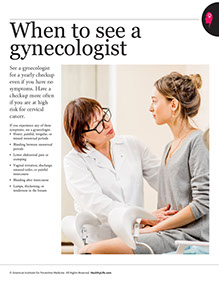
    Image of female doctor with female patient.

    If you experience any of these symptoms, see a gynecologist.

    *  Heavy, painful, irregular, or missed menstrual periods. Bleeding between menstrual periods.

    *  Lower abdominal pain or cramping.

    *  Vaginal irritation, discharge, or painful intercourse. Bleeding after intercourse.

    *  Lumps, thickening, or tenderness in the breasts.

    Also see a gynecologist for a yearly checkup even if you have no symptoms. Have a checkup more often if you are at high risk for cervical cancer.

    A Year of Health Hints book by the American Institute for Preventive Medicine. www.HealthyLife.com. All rights reserved.

    © American Institute for Preventive Medicine

  • Gum (Periodontal) Disease

    Dental & Mouth Concerns

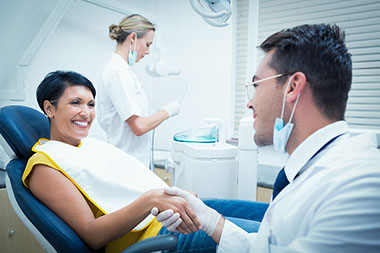
    Image of women sitting in dental chair shaking hands with the dentist.

    Signs, Symptoms & Causes

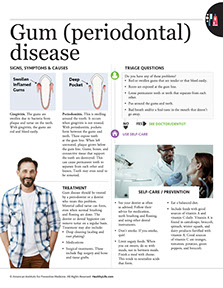
    Gum (periodontal) diseases include:

    Gingivitis. The gums are swollen due to bacteria from plaque and tartar on the teeth. With gingivitis, the gums are red and bleed easily.

    Periodontitis. This is swelling around the tooth. It occurs when gingivitis is not treated. With periodontitis, pockets form between the gums and teeth. These expose teeth at the gum line. When left untreated, plaque grows below the gum line. Gums, bones, and connective tissue that support the teeth are destroyed. This can cause permanent teeth to separate from each other and loosen. Teeth may even need to be removed.

    Treatment

    Gum disease should be treated by a periodontist or a dentist who treats this problem. Material called tartar can form, even when normal brushing and flossing are done. The dentist or dental hygienist can remove tartar on a regular basis. Treatment may also include:

    *  Deep cleaning (scaling and root planing).

    *  Medications.

    *  Surgical treatments. These include flap surgery and bone and tissue grafts.

    Questions to Ask

    Self-Care / Prevention

    *  See your dentist as often as advised. Follow his or her advice for medication, teeth brushing and flossing and using other dental instruments.

    *  Don’t smoke. If you smoke, quit.

    *  Eat a balanced diet.

    *  Limit sugary foods. When you eat sweets, do so with meals, not in between meals. Finish a meal with cheese. This tends to neutralize acids that form.

    *  Include foods with good sources of vitamin A and vitamin C daily. Vitamin A is found in cantaloupe, broccoli, spinach, winter squash, and dairy products fortified with vitamin A. Good sources of vitamin C are oranges, tomatoes, potatoes, green peppers, and broccoli.

    Healthier at Home book by the American Institute for Preventive Medicine. www.HealthyLife.com. All rights reserved.

    © American Institute for Preventive Medicine

  • Guard Against Macular Degeneration

    Mature Health: Over Age 50

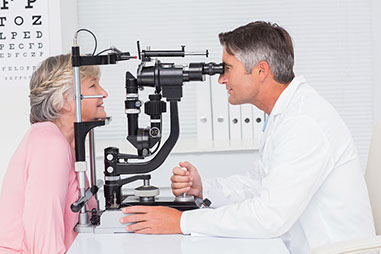
    Image of mature women receiving an eye exam.

    Macular degeneration is the leading cause of central vision loss for those over 55 years of age. The central part of the retina (the macula) deteriorates, leading to loss of “straight ahead” vision. One or both eyes can be affected. If you are 50 years of age or older, ask your eye doctor to check for macular degeneration at routine vision exams. Ask, too, for a simple home screening device that lets you check for signs of macular degeneration on your own.

    To reduce the risk for macular degeneration:

    *  Keep your blood pressure at a normal level.

    *  Maintain a healthy weight.

    *  Don’t smoke. If you smoke, quit.

    *  Protect your eyes from the sun’s harmful ultraviolet rays. Wear sunglasses with UV block. Wear a wide-brimmed hat.

    *  Talk to your doctor about taking a high dose vitamin and mineral supplement to reduce the risk of advanced age-related macular degeneration.

    A Year of Health Hints book by the American Institute for Preventive Medicine. www.HealthyLife.com. All rights reserved.

    © American Institute for Preventive Medicine

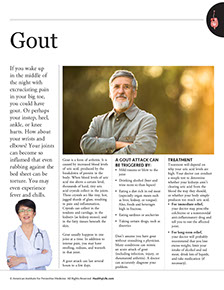
  • Gout: Relief At Last

    Abdominal & Urinary Conditions

    If you wake up in the middle of the night with excruciating pain in your big toe, you could have gout. Or perhaps your instep, heel, ankle, or knee hurts. How about your wrists and elbows? Your joints can become so inflamed that even rubbing against the bed sheet can be torture. You may even experience fever and chills.

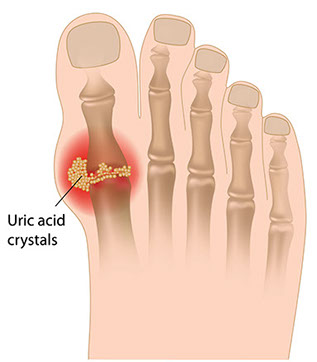
    Gout is a form of arthritis most common in men in their fifties. It is caused by increased blood levels of uric acid, produced by the breakdown of protein in the body. When blood levels of uric acid rise above a critical level, thousands of hard, tiny uric acid crystals collect in the joints. These crystals act like tiny, hot, jagged shards of glass, resulting in pain and inflammation. Crystals can collect in the tendons and cartilage, in the kidneys (as kidney stones), and in the fatty tissues beneath the skin.

    A gout attack can last several hours to a few days and can be triggered by:

    *  Mild trauma or blow to the joint.

    *  Drinking alcohol (beer and wine more so than distilled alcohol).

    *  Eating a diet rich in red meat (especially organ meats such as liver, kidney, or tongue).

    *  Eating sardines or anchovies.

    *  Taking certain drugs, such as diuretics.

    Illustration of gout.

    Don’t assume you have gout without consulting a physician. Many conditions can mimic an acute attack of gout (including infection, injury, or rheumatoid arthritis). A doctor can accurately diagnose your problem.

    If you do have gout, treatment will depend on why your uric acid levels are high. Your doctor can conduct a simple test to determine whether your kidneys aren’t clearing uric acid from the blood the way they should, or whether your body simply produces too much uric acid.

    The first goal, then, is to relieve the acute gout attack. The second goal is to normalize the uric acid levels to prevent a recurrence.

    *  For immediate relief, your doctor may prescribe colchicine or a nonsteroidal anti-inflammatory drug and tell you to rest the affected joint.

    *  For long-term relief, your doctor will probably recommend that you lose excess weight, limit your intake of alcohol and red meat, drink lots of liquids, and take medication (if necessary).

    A Year of Health Hints book by the American Institute for Preventive Medicine. www.HealthyLife.com. All rights reserved.

    © American Institute for Preventive Medicine

  • Tips For Good Digestion

    Mature Health: Over Age 50

    Image of mature couple eating at home.

    Around the age of 40, people begin to notice that they can’t tolerate certain foods as well as they used to. As you get older, your stomach produces a smaller volume of digestive enzymes and other secretions, and your body may not digest or absorb foods as easily as it did when you were younger.

    If you are prone to digestive problems, follow these tips.

    *  See a dentist if you are having trouble with your teeth or dentures. Poorly fitting dentures, sensitive teeth, and diseased gums can make chewing difficult.

    *  Eat smaller, lighter meals, spaced throughout the day, instead of heavy meals. As a person ages, the blood supply to the small intestine declines, hindering the absorption of nutrients from a sudden, large delivery of food.

    *  To prevent gas and bloating, don’t gulp liquids or talk while chewing food.

    *  Limit the amount of gas-producing foods you eat. Cabbage, onions, and cooked dried beans are common offenders.

    *  Eliminate milk products from your diet if they cause bloating, intestinal gas, or diarrhea, but be sure to supplement your diet with calcium. (You may be able to tolerate small amounts of milk products if you treat them with Lactaid, a digestive aid sold in many health food stores.

    *  Avoid wearing tight clothing around your waist at mealtime.

    *  Don’t lie down for at least 2 hours after you’ve finished a meal, and don’t eat right before bedtime.

    A Year of Health Hints book by the American Institute for Preventive Medicine. www.HealthyLife.com. All rights reserved.

    © American Institute for Preventive Medicine

  • Gonorrhea

    Sexual Health

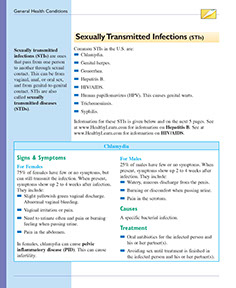
    Sexually transmitted infections (STIs) are ones that pass from one person to another through sexual contact. This can be from vaginal, anal, or oral sex, and from genital-to-genital contact. STIs are also called sexually transmitted diseases (STDs).

    Signs & Symptoms

    For Females

    Sixty to 80% of females have no symptoms. If present, they appear in 2 to 10 days and include:

    *  Mild vaginal itching and burning. Thick, yellow-green vaginal discharge.

    *  Burning when passing urine.

    *  Severe pain in the lower abdomen.

    For Males

    Males may have no symptoms, but usually have:

    *  Pain at the tip of the penis. Thick, yellow, cloudy, penile discharge.

    *  Pain and burning when passing urine.

    Causes

    A specific bacterial infection. If it is not treated, it can spread to joints, tendons, or the heart. In females, it can cause pelvic inflammatory disease (PID). This can cause infertility.

    Treatment

    *  Antibiotics.

    *  Pain relievers.

    *  Treating sexual partner(s) to avoid getting infected again.

    *  Follow-up test to find out if the treatment worked.

    Questions to Ask

    Self-Care / Prevention

    Safer Sex To Help Prevent STIs

    *  The only sure way to avoid STIs is not having sex. This includes intercourse, oral sex, anal sex, and genital-to-genital contact. Caressing, hugging, dry kissing, and masturbation are no risk or extremely low-risk practices. So is limiting your sexual contact to one person your entire life. This is if your partner does not have an STI and has sex only with you.

    *  Latex and polyurethane condoms can help reduce the risk of spreading HIV and other STIs (i.e., chlamydia, gonorrhea, and trichomoniasis). To do this, they must be used the right way for every sex act. They do not get rid of the risk entirely. Barriers made of natural membranes, such as from lamb, do not give good protection against STIs.

    *  Females and males should use latex or polyurethane condoms every time they have genital-to-genital contact and/or oral sex. Use polyurethane condoms if either partner is allergic to latex. You don’t need condoms to prevent STIs if you have sex only with one partner and neither of you has an STI.

    *  For oral-vaginal sex and oral-anal sex, use latex dams (“doilies”). These are latex squares.

    *  Latex condoms with spermicides, such as nonoxynol-9 (N-9) are no better than other lubricated condoms for preventing HIV/STIs. Spermicides with N-9 do not prevent chlamydia, cervical gonorrhea, or HIV. on’t use spermicides alone to prevent HIV/STIs. Using spermicides with N-9 often has been linked with genital lesions which may increase the risk of spreading HIV. Also, N-9 may increase the risk of spreading HIV during anal intercourse.

    *  Use water-based lubricants, such as K-Y Brand Jelly. Don’t use oil-based or “petroleum” ones, such as Vaseline. They can damage latex barriers.

    *  To lower your risk for HPV, use latex or polyurethane condoms. These work best at covering areas of the body that HPV is most likely to affect. A diaphragm does not prevent the spread of HPV.

    *  Don’t have sex while under the influence of drugs or alcohol. You are less likely to use “safer sex” measures.

    *  Limit sexual partners. Sexual contact with many persons increases the risk for STIs, especially if no protection is used.

    *  Discuss a new partner’s sexual history with him or her before you start having sex. Know that persons are not always honest about their sexual past.

    *  Avoid sexual contact with persons whose health status and health practices are not known.

    *  Follow your doctor’s advice to check for STIs.

    Resources

    American Social Health Association (ASHA)

    www.ashastd.org

    CDC National STD Hotline

    800.CDC.INFO (232.4636)

    www.cdc.gov/STD
    Healthier at Home book by the American Institute for Preventive Medicine. www.HealthyLife.com. All rights reserved.

    © American Institute for Preventive Medicine

  • Glaucoma

    Eye Conditions

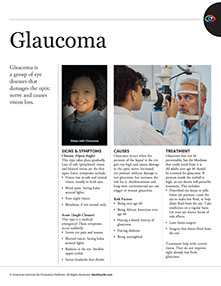
    Glaucoma is a group of eye diseases that damages the optic nerve and causes vision loss.

    Signs & Symptoms

    For Chronic (Open-Angle) Glaucoma

    This type takes place gradually, and causes no symptoms early on. Loss of side (peripheral) vision and blurred vision are the first signs.

    Later, symptoms include:

    *  Vision loss in side and central vision, usually in both eyes.

    *  Blind spots. Seeing halos around lights.

    *  Poor night vision.

    *  Blindness, if not treated early.

    For Acute (Angle-Closure) Glaucoma

    This type is a medical emergency! These symptoms occur suddenly:

    *  Severe eye pain and nausea.

    *  Blurred vision. Seeing halos around lights.

    *  Redness in the eye. Swollen upper eyelid.

    *  Severe headache that throbs.

    Causes

    Glaucoma occurs when the pressure of the liquid in the eye gets too high and causes damage to the optic nerve. Increased eye pressure without damage is not glaucoma, but increases the risk for it. Antihistamines and long-term corticosteroid use can trigger or worsen glaucoma.

    Risk Factors for Glaucoma

    *  Being over age 60, especially Mexican Americans.

    *  Being African American over age 40.

    *  Having a family history of glaucoma.

    *  Having diabetes.

    *  Being nearsighted.

    Treatment

    Treatments help with current vision. They do not improve sight already lost from glaucoma. Glaucoma may not be preventable, but the blindness that could result from it is. Get tested for glaucoma when you get regular vision exams. If pressure inside the eyeball is high, an eye doctor will prescribe treatment. This includes:

    Medicines used for acute glaucoma are prescribed for life. If medicines do not control the pressure, your doctor may advise:

    *  Laser beam surgery.

    *  Surgery that drains fluid from the eye.

    *  Medicines. These are the most common early form of treatment.

    – Prescribed eye drops or pills lower eye pressure, cause the eye to make less fluid, or help drain fluid from the eye.

    – Take medicines on a regular basis.

    – Let your eye doctor know of side effects.

    Questions to Ask

    Self-Care / Prevention

    *  Don’t smoke. If you smoke, quit.

    *  Do not take any medicine, including over-the-counter ones, without first checking with your doctor or pharmacist. Most cold medications and sleeping pills, for example, can cause the pupil in the eye to dilate. This can lead to increased eye pressure.

    *  If prescribed eye drops for glaucoma, use them as directed.

    *  Ask your eye doctor about low vision services and devices.

    *  Try not to get upset and fatigued. These can increase pressure in the eye.

    Resources

    National Eye Institute (NEI)

    www.nei.nih.gov

    Healthier at Home book by the American Institute for Preventive Medicine. www.HealthyLife.com. All rights reserved.

    © American Institute for Preventive Medicine