Blog

  • Eating Disorders 2

    Women’s Health

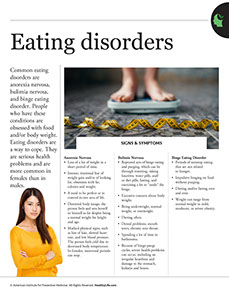
    Image of women sitting alone.

    Common eating disorders are anorexia nervosa, bulimia nervosa, and binge eating disorder. People who have these conditions are obsessed with food and/or body weight. Eating disorders are a way to cope. They are serious health problems and are more common in females than in males.

    Signs & Symptoms

    Anorexia Nervosa

    *  Loss of a lot of weight in a short period of time.

    *  Intense, irrational fear of weight gain and/or of looking fat, obsession with fat, calories and weight.

    *  A need to be perfect or in control in one area of life.

    *  Distorted body image; the person feels and sees herself or himself as fat despite being a normal weight for height and age.

    *  Marked physical signs, such as loss of hair, slowed heart rate, and low blood pressure. The person feels cold due to decreased body temperature. In females, menstrual periods can stop.

    Bulimia Nervosa

    *  Repeated acts of binge eating and purging, which can be through vomiting, taking laxatives, water pills, and/or diet pills, fasting, and exercising a lot to “undo” the binge.

    *  Excessive concern about body weight.

    *  Being underweight, normal weight, or overweight.

    *  Dieting often.

    *  Dental problems, mouth sores, chronic sore throat.

    *  Spending a lot of time in bathrooms.

    *  Because of binge-purge cycles, severe health problems can occur, including an irregular heartbeat and damage to the stomach, kidneys and bones.

    Binge Eating Disorder

    *  Periods of nonstop eating that are not related to hunger.

    *  Impulsive binging on food without purging.

    *  Dieting and/or fasting over and over.

    *  Weight can range from normal weight to mild, moderate, or severe obesity.

    Causes & Risk Factors

    An exact cause has not been found. Persons from all backgrounds, ages and genders are affected. Risk factors include:

    *  A family history of eating disorders.

    *  Pressure from society to be thin.

    *  Personal and family pressures.

    *  Sexual, physical, or alcohol abuse in the past.

    *  Fear of starting puberty.

    *  Fear of having sex.

    *  Pressure for athletes to lose weight or to be thin for competitive sports.

    *  Chronic dieting.

    Treatment

    *  Counseling. This can be individual, family, group, and/or behavioral therapy.

    *  Support groups.

    *  Medication.

    *  Nutrition therapy.

    *  Outpatient treatment.

    *  Hospitalization, if needed.

    Treatment varies with the disorder and how severe it is. The earlier the condition is diagnosed and treated, the better the outcome.

    Questions to Ask

    Self-Care

    Eating disorders need professional treatment.

    Prevent an Eating Disorder

    *  Learn to accept yourself and your body. You don’t need to look like anyone else. Spend time with people who accept you as you are, not people who focus on “thinness.”

    *  Know that self-esteem does not have to depend on body weight.

    *  Eat nutritious foods. Focus on whole grains, beans, fresh fruits and vegetables, low-fat dairy foods, and lean meats.

    *  Commit to a goal of normal eating. Realize that this will take time. It will also take courage to fight fears of gaining weight.

    *  Don’t skip meals. If you do, you are more likely to binge when you eat.

    *  Limit white flour, sugar and foods high in sugar and fat, such as cakes, cookies and pastries. People who have bulimia tend to binge on junk food. The more they eat, the more they want.

    *  Get regular, moderate exercise at least 3 to 4 times a week. If you exercise more than your doctor advises, do more non-exercise activities with family and friends.

    *  Find success in things you do. Hobbies, work, school, etc. can promote self-esteem.

    *  Discuss with family and friends how TV, movies and social media can send the message that only a certain body type is acceptable.

    *  Learn as much as you can about eating disorders from reputable websites, books and organizations that deal with them.

    *  To help children avoid eating disorders, parents should promote a balance between their child’s competing needs for independence and family involvement.

    Treat an Eating Disorder

    *  Follow your treatment plan from your health care provider. To be successful, you need to be actively involved in your treatment.

    *  Attend counseling sessions and/or support group meetings as scheduled.

    *  Set small goals that you can easily reach. Congratulate yourself for every success. This is a process. Accept set backs. Learn from them.

    *  Talk to someone instead of turning to food.

    *  Work toward the point where weight is no longer a way you rate your success. Think about your accomplishments, positive personal qualities, and valued relationships.

    *  Learn to express your rights. You have the right to say no and the right to express your feelings and your opinions. You have the right to ask that your needs are met.

    *  Keep a journal of your progress, feelings, thoughts, etc., but not about what you eat. The journal is just for you, not for others to read or judge. This is a safe place to be honest with yourself. The journal can also help you identify your “triggers” so that you can deal with them in the future.

    *  Don’t let the scale run your life. Better yet, throw out the scale!

    Resources

    National Eating Disorders Association (NEDA)Information and Referral Helpline

    800.931.2237
    www.nationaleatingdisorders.org

    Women's Self-Care book by the American Institute for Preventive Medicine. www.HealthyLife.com. All rights reserved.

    © American Institute for Preventive Medicine
  • Eating Disorders

    Student Health

    Five to 10 million adolescent girls and women have an eating disorder. About 1 million males do. The 3 most common eating disorders are anorexia nervosa, bulimia nervosa, and binge eating disorder. These eating disorders are a coping mechanism. They result in an obsession with food and/or weight; anxiety around eating; guilt; and severe and adverse effects on psychological and physical health. Eating disorders are very serious health problems.

    Signs & Symptoms

    For Anorexia Nervosa

    *  Loss of a lot of weight in a short period of time.

    *  Intense, irrational fear of weight gain and/or of looking fat. Obsession with fat, calories, and weight.

    *  A need to be perfect or in control in one area of life.

    *  Distorted body image. The person feels and sees herself or himself as fat despite being a normal weight for height and age.

    *  Marked physical signs. These include loss of hair, slowed heart rate, and low blood pressure. The person feels cold due to decreased body temperature. In females, menstrual periods can stop.

    For Bulimia Nervosa

    *  Repeated acts of binge eating and purging. Purging can be through vomiting; taking laxatives, water pills, and/or diet pills; fasting; and exercising a lot to “undo” the binge.

    *  Excessive concern about body weight.

    *  Being underweight, normal weight, or overweight.

    *  Dieting often.

    *  Dental problems. Mouth sores. Chronic sore throat.

    *  Spending a lot of time in bathrooms.

    *  Because of binge-purge cycles, severe health problems can occur. These include an irregular heartbeat and damage to the stomach, kidneys,  and bones.

    For Binge Eating Disorder

    *  Periods of nonstop eating that are not related to hunger.

    *  Impulsive binging on food without purging.

    *  Dieting and/or fasting over and over.

    *  Weight can range from normal weight to mild, moderate, or severe obesity.

    Causes

    An exact cause has not been found. Persons from all backgrounds, ages, and genders are affected. Risk factors include:

    *  A family history of eating disorders.

    *  Pressure from society to be thin.

    *  Personal and family pressures.

    *  Sexual, physical, or alcohol abuse in the past.

    *  Fear of starting puberty.

    *  Fear of having sex.

    *  Pressure for athletes to lose weight or to be thin for competitive sports.

    *  Chronic dieting.

    Treatment

    *  Counseling. This can be individual, family, group, and/or behavioral therapy.

    *  Support groups.

    *  Medication.

    *  Nutrition therapy.

    *  Outpatient treatment.

    *  Hospitalization, if needed.

    Treatment varies with the disorder and how severe it is. The earlier the condition is diagnosed and treated, the better the outcome.

    Questions to Ask

    Self-Care

    Eating disorders need professional treatment.

    To Help Prevent an Eating Disorder

    *  Learn to accept yourself and your body. You don’t need to look like anyone else. Spend time with people who accept you as you are, not people who focus on “thinness.”

    *  Know that self-esteem does not have to depend on body weight.

    *  Eat nutritious foods. Focus on whole grains, beans, fresh fruits and vegetables, low-fat dairy foods, and low-fat meats.

    *  Commit to a goal of normal eating. Realize that this will take time. It will also take courage to fight fears of gaining weight.

    *  Don’t skip meals. If you do, you are more likely to binge when you eat.

    *  Avoid white flour, sugar and foods high in sugar and fat, such as cakes, cookies, and pastries. Bulimics tend to binge on junk food. The more they eat, the more they want.

    *  Get regular, moderate exercise 3 to 4 times a week. If you exercise more than your doctor advises, do non-exercise activities with family and friends.

    *  Find success in things you do. Hobbies, work, school, etc. can promote self-esteem.

    *  Learn as much as you can about eating disorders from books and organizations that deal with them.

    *  To help their children avoid eating disorders, parents should promote a balance between their child’s competing needs for independence and family involvement.

    To Treat an Eating Disorder

    *  Follow your treatment plan.

    *  Attend counseling sessions and/or support group meetings as scheduled.

    *  Identify feelings before, during, and after you overeat, binge, purge, or restrict food intake. What is it that you are hoping the food will do?

    *  Set small goals that you can easily reach. Congratulate yourself for every success. This is a process. Accept set backs. Learn from them.

    *  Talk to someone instead of turning to food.

    *  Work toward the point where weight is no longer a way you rate your success. Think about your accomplishments, positive personal qualities, and valued relationships.

    *  Learn to express your rights. You have the right to say no and the right to express your feelings and your opinions. You have the right to ask that your needs are met.

    *  Keep a journal of your progress, feelings, thoughts, etc., but not about what you eat. The journal is just for you, not for others to read or judge. This is a safe place to be honest with yourself. The journal can also help you identify your “triggers” so that you can deal with them in the future.

    *  Don’t let the scale run your life. Better yet, throw out the scale!

    Resources

    Your school’s Student Health Service, Student Counseling or Mental Health Service

    National Eating Disorders Association (NEDA)Information and Referral Helpline

    800.931.2237

    www.nationaleatingdisorders.org

    Student Self-Care book by the American Institute for Preventive Medicine. www.HealthyLife.com. All rights reserved.

    © American Institute for Preventive Medicine
  • Earwax

    Ear, Nose & Throat Conditions

    Earwax coats and protects the lining of the ear canal. It filters dust and helps keep the ears clean. Normally, earwax is soft and drains by itself. Sometimes it hardens and forms a plug.

    Signs & Symptoms

    Signs and symptoms of earwax buildup are:

    *  Blocked or plugged feeling in the ear

    *  Partial hearing loss (temporary)

    *  Ringing in the ear

    *  Ear discomfort or pain

    Causes

    *  Exposure to excessive dust or dirt

    *  A family history of earwax buildup

    Simple earwax build-up can be treated using self-care. If self-care doesn’t take care of the problem, a doctor can clear the earwax with a special vacuum, scoop, or water-pik-like device.

    Prevention

    *  Wear earplugs when exposed to excessive dust or dirt.

    *  Don’t use cotton swabs in the ear. They tend to pack the earwax down more tightly.

    *  Don’t push objects into the ear canal.

    Self-Care

    {Note: Use only if you know that your eardrum is not ruptured or infected. See signs of a ruptured eardrum and ear infection under “When to Seek Medical Care” on this page.}

    *  Don’t try to scrape out earwax. You could put a hole in your eardrum or damage the skin of your ear canal.

    *  Use an over-the-counter product, such as Murine Ear Drops, Debrox, etc. Follow package directions.

    *  Hold a warm, wet washcloth on the blocked ear or, take a warm shower. Let the water gently flow into the ear. Use the tip of a warm washcloth to remove the softened wax. Don’t use cold water. This may cause dizziness.

    *  Lie on your side or tilt your head sideways. Using a clean medicine dropper, carefully squeeze a few drops of lukewarm water into your ear. Leave the water there for about 10 minutes. Tilt your head to let the water drain out of the ear. After several minutes, do the same thing again. If the ear wax has not cleared in 3 hours, repeat this entire procedure. {Note: Instead of just warm water, you can use a mixture of 1 part warm water and 1 part hydrogen peroxide. Keep the drops in the ear for 3, not 10 minutes, though.}

    *  Rest a hot water bottle on the affected ear for a few minutes. Afterward, use a washcloth to remove the softened wax.

    When to Seek Medical Care

    Contact Doctor When:

    *  You have sudden or total hearing loss in one or both ears.

    *  Earwax has not cleared after using self-care for several days.

    *  You have signs of a ruptured eardrum:

    – Ear pain

    – Blood or other ear discharge

    – Partial hearing loss

    – Ringing or burning in the ear

    *  You have ear pain with any of these signs of an ear infection:

    – Feeling of fullness in the ear that leads to ear pain

    – Fever of 101°F or higher

    – Blood, pus, or fluid from the ear

    – Temporary hearing loss

    – Redness and swelling of the skin of the ear canal

    – Nausea, vomiting, and/or dizziness

    Health at Home Lifetime book by the American Institute for Preventive Medicine. www.HealthyLife.com. All rights reserved.

    © American Institute for Preventive Medicine
  • Earaches In Children

    Children’s Health

    Signs, Symptoms & Causes

    An earache is when the ear hurts. Children get earaches a lot. They get them most often between 6 months and 2 years old. But earaches can be a problem up to age 10. The pain can be minor or very bad.

    Earaches are a sign that something is wrong. The most common cause of an earache is plugged Eustachian tubes. These tubes go from the back of the throat to the middle ear. Most earaches in children come from infections in the middle ear. They happen a lot after a cold or other infection in the head or throat.

    Here are some other things that can cause earaches:

    *  Changes in air pressure on a plane.

    *  Something stuck in the ear.

    *  Tooth problems. Ear injuries.

    *  Allergies.

    Your child’s doctor should treat very bad ear pain. He or she may tell you to give your child acetaminophen or ibuprofen. Make sure you give the right kind and dose for your child’s weight. The doctor may also have you give your child medicines to dry up or clear a blocked ear. Let the doctor decide if an antibiotic is needed.

    You can use self-care on your child if the pain isn’t bad, and if there are no other symptoms. One example is a mild case of “swimmer’s ear.”

    To Prevent Earaches

    *  Don’t put things in your child’s ears like cotton swabs, bobby pins, or your fingers. You can hurt the eardrums.

    *  Don’t smoke. Don’t let your child smoke. Keep your child away from secondhand smoke.

    Questions to Ask

    Self-Care

    To help with pain

    *  Put a warm washcloth next to the sore ear. Or put an ice bag or ice in a wet washcloth over the ear for 20 minutes.

    *  Give your child acetaminophen or ibuprofen. Make sure you give the right kind and dose for your child’s weight. (Note: Do not give aspirin. Aspirin and other medicines that have salicylates have been linked to Reye’s Syndrome.)

    For “swimmer’s ear”

    Swimmer’s ear is when you get water stuck in your ears after swimming. This can lead to an infection. To treat this:

    *  Have your child shake his or her head.

    *  Dry the ear canal with a tissue. Twist each corner of the tissue into a tip. Stick each tip into the ear canal for 10 seconds. Use a clean tissue on the other ear.

    *  Use a product like Swim-Ear®. Drop it into the ears to fight the infection.

    To get a bug out of your child’s ear

    *  Put the child in a dark room. Shine a light near the ear for a few minutes. (The bug may fly out.)

    *  Pour a little warm olive oil, baby oil, or mineral oil in the ear to make the bug float out. Pull the earlobe gently back and up as you pour. If this doesn’t work, call your child’s doctor.

    To open up and drain the Eustachian tubes

    Have your child do these things:

    *  Sit up.

    *  Sleep with his or her head raised.

    *  Yawn. Yawning moves the muscles that open the tubes.

    *  Hold his or her nose closed and have your child blow gently through the nose until he or she hears a pop. This can be done many times a day. It can also be done on a plane when it starts to land.

    *  Stay awake during airplane take-offs and landings. (If your child is an infant, nurse or bottle-feed him or her as the plane takes off, gets ready to land, and when it lands.)

    *  Chew gum or suck hard candy. This helps a lot on an airplane, too. It can also help when your child wakes up at night with ear pain. But only let your child do this if he or she is more than 5 years old.

    And try these tips

    *  Don’t let your child swim in dirty water. Have your child wear a bathing cap when he or she swims.

    *  Use a cool-mist vaporizer, especially at night. Clean it every day.

    *  Give your child lots of liquids to drink.

    *  Hold a baby upright when you bottle-feed.

    Children's Self-Care book by the American Institute for Preventive Medicine. www.HealthyLife.com. All rights reserved.

    © American Institute for Preventive Medicine
  • Earaches

    Ear, Nose & Throat Conditions

    Signs & Symptoms

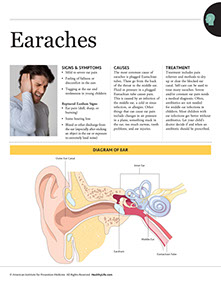
    *  Mild to severe ear pain.

    *  Feeling of fullness or discomfort in the ears.

    *  Tugging at the ear and restlessness in young children.

    *  Ear pain.

    *  Some hearing loss.

    *  Blood or other discharge from the ear (especially after sticking an object in the ear or exposure to extremely loud noise).

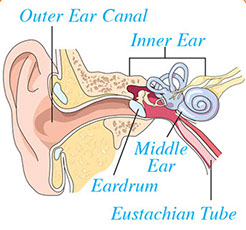
    Illustration of ear.

    Causes

    The most common cause of earaches is plugged Eustachian tubes. These go from the back of the throat to the middle ear. Fluid or pressure in a plugged Eustachian tube causes pain. This is caused by an infection of the middle ear, a cold or sinus infection, or allergies. Other things that can cause ear pain include changes in air pressure in a plane, something stuck in the ear, too much earwax, tooth problems, and ear injuries.

    Treatment

    Treatment includes pain relievers and methods to dry up or clear the blocked ear canal. Self-care can be used to treat many earaches. Severe and/or constant ear pain needs a medical diagnosis. Often, antibiotics are not needed for middle ear infections in children. About 8 in 10 children with ear infections get better without antibiotics. Let your child’s doctor decide if and when an antibiotic should be prescribed.

    Questions to Ask

    Self-Care / Prevention

    To Help Prevent Ear Pain

    *  Don’t put cotton-tipped swabs, bobby pins, etc., in your ears. This could damage the eardrum.

    *  Don’t blow your nose with too much force.

    *  If you can, avoid places that have very loud noises (construction sites, etc.). Wear earplugs when exposed to loud noises.

    *  Keep the volume on low when using stereos, compact discs (CDs), etc. If someone else can hear the music when you are listening to one of these devices with earphones, the volume is too loud.

    To Avoid Getting “Swimmer’s Ear”

    *  Wear wax or silicone earplugs.

    *  Wear a bathing cap.

    *  Don’t swim in dirty water. Swim on the surface not underneath the water.

    *  Use an over-the-counter product, such as Swim-Ear, as directed.

    To Reduce Ear Pain

    *  Place a warm washcloth next to the ear. Some health professionals recommend putting an ice bag or ice in a wet washcloth over the painful ear for 20 minutes.

    *  Take an over-the-counter medicine for pain as directed on the label.

    To Open Up the Eustachian Tubes and Help Them Drain

    *  Sit up. Prop your head up when you sleep.

    *  Yawn. This helps move the muscles that open the Eustachian tubes.

    *  Chew gum or suck on hard candy. (Do not give to children under age 5.) This tip is especially helpful during pressure changes that take place during air travel, but can also help if you wake up with ear pain.

    *  When traveling by air, stay awake when the plane takes off and lands. Wear ear plugs.

    *  Take a steamy shower.

    *  Use a cool-mist vaporizer, especially at night.

    *  Drink plenty of cool water.

    *  Gently, but firmly, blow through your nose while holding both nostrils closed until you hear a pop. This can be done several times a day.

    *  If okay with your doctor, take a decongestant to help relieve the swelling that causes the pain. (Don’t use a nasal spray decongestant for more than 3 days unless directed by your doctor.)

    *  When you give a baby a bottle, hold the baby in an upright position.

    To Treat a Mild Case of “Swimmer’s Ear”

    The goal is to clean and dry the outer ear canal without doing further damage to the top layer of skin.

    *  Shake the head to expel trapped water.

    *  Dry the ear canal. Get a clean facial tissue. Twist each corner into a tip and gently place each tip into the ear canal for 10 seconds. Repeat with the other ear using a new tissue.

    *  Use an over-the-counter product, such as Swim-Ear. Drop it into the ears to fight infection. Follow package directions.

    *  Do not remove earwax. This protects the ear canal.

    For an Insect in the Ear

    Shine a flashlight into the ear. Doing this may cause the insect to come out.

    Resources

    National Institute on Deafness and Other Communication Disorders (NIDCD)

    800.241.1044

    www.nidcd.nih.gov

    Healthier at Home book by the American Institute for Preventive Medicine. www.HealthyLife.com. All rights reserved.

    © American Institute for Preventive Medicine
  • Dry Skin

    Skin Conditions

    Signs & Symptoms

    *  Itchy skin. The skin can be red from scratching it.

    *  Chapped skin.

    *  Skin cracks, peels, and/or flakes.

    Causes

    *  Aging. The body naturally produces less oil and moisture.

    *  Cold winter weather. Dry air or heat.

    *  Washing the skin often. Using harsh skin products.

    *  Chronic and excessive sun exposure.

    *  Allergies. An underactive thyroid gland. Diabetes. Kidney disease. Other skin conditions, such as psoriasis.

    Treatment

    Dry skin is not a serious health risk. It can be managed with self-care. When dry skin is a symptom of a health problem, treating the problem treats the dry skin.

    Questions to Ask

    Self-Care / Prevention

    *  Drink 8 or more glasses of water a day.

    *  Apply an oil- based lotion daily.

    *  Wear rubber gloves when you wash dishes.

    *  Take showers instead of baths. Use warm (not hot) water. Try sponge baths.

    *  Apply a moisturizing cream while your skin is damp. Use products with lanolin.

    *  If you do bathe, do so for only 15 to 20 minutes in lukewarm water. Pat yourself dry. Do not rub.

    *  Put soap on a washcloth, not right on the skin.

    *  Use a mild liquid soap, like Cetaphil lotion or use a fatted soap. Avoid deodorant, medicated, or alkaline soaps.

    *  Don’t use moisturizers with fragrances, preservatives, or alcohol.

    *  Use a night cream for the face.

    *  Stay out of the strong sun. Do not use tanning salons. When in the sun, use a sunblock with a sun protection factor (SPF) of at least 15.

    *  Don’t scratch or rub dry skin.

    Resources

    American Academy of Dermatology

    866.503.SKIN (503.7546)

    www.aad.org

    Healthier at Home book by the American Institute for Preventive Medicine. www.HealthyLife.com. All rights reserved.

    © American Institute for Preventive Medicine
  • Aging Dry Skin

    Skin Conditions

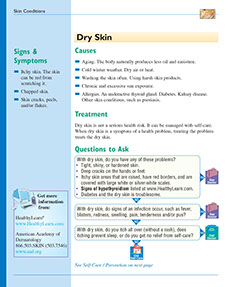
    The skin naturally becomes drier with age. The body produces less oil and moisture. The skin also becomes thinner and less elastic.

    Signs & Symptoms

    *  Itchy skin. The skin can be red from scratching it.

    *  Chapped skin

    *  Skin that cracks, peels, and/or flakes

    Causes, Risk Factors & Care

    *  Aging

    *  Cold winter weather

    *  Dry air or heat

    *  Harsh skin products

    *  Washing the skin often

    *  Some medications

    *  Allergies

    *  An underactive thyroid gland; diabetes; and/or kidney disease

    *  Other skin conditions, such as psoriasis

    Dry skin is not a serious health risk. With self-care, it can be easily managed. When it is a symptom of a health condition, treating the condition treats the dry skin.

    Self-Care / Prevention

    *  Drink 8 or more glasses of water a day.

    *  Moisturize your skin daily. Use an oil-based lotion.

    *  Don’t overexpose your skin to water, such as with washing dishes. Wear rubber gloves when you wash dishes.

    *  Take a shower instead of a bath. Use warm (not hot) water. Apply a moisturizing cream while your skin is damp. Use products with lanolin.

    *  If you prefer to bathe, bathe for only 15 to 20 minutes in lukewarm water. Pat yourself dry. Do not rub. Use a bath oil on your skin after bathing.

    *  Try sponge baths.

    *  Use a washcloth instead of soaping the skin directly.

    *  Use a mild liquid soap, like Cetaphil Lotion, or a fatted soap. Avoid deodorant, medicated, or alkaline soaps.

    *  Don’t use moisturizers with fragrances, preservatives, or alcohol.

    *  Use a night cream for the face.

    *  Stay out of the strong sun.

    *  Do not use tanning salons.

    *  Use a sunblock with a sun protection factor (SPF) of 15 or higher.

    *  If you get symptoms of dry skin:

    – Don’t scratch or rub the skin.

    – Apply oil-based moisturizers often.

    – Lessen exposure of the affected area to water.

    When to Seek Medical Care

    Contact Doctor When:

    *  You have any of these problems with dry skin:

    – Deep cracks on the hands or feet

    – Tight, shiny, or hardened skin

    – Itchy skin areas that are raised, have red borders, and are covered with large white or silver-white scales

    *  You have signs of an infection (fever; increased redness, swelling, pain, or tenderness; pus; blisters; red streaks from the affected area).

    *  You have diabetes and the dry skin is troublesome.

    *  You have symptoms of low thyroid.

    *  You have dry skin without a rash and you itch all over.

    *  Severe itching keeps you from sleeping.

    *  Self-care brings no relief.

    Health at Home Lifetime book by the American Institute for Preventive Medicine. www.HealthyLife.com. All rights reserved.

    © American Institute for Preventive Medicine
  • Dry Mouth

    Dental & Mouth Concerns

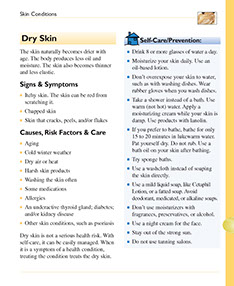
    Dry mouth is an abnormal dryness of the mucus membranes in the mouth. This happens when there isn’t enough saliva or the composition of the saliva changes. Dry mouth is common in the elderly.

    Signs & Symptoms

    *  Dry, parched feeling in the mouth

    *  Lack of saliva

    *  Problems with talking and/or swallowing

    *  Lessened taste

    *  Bad breath

    *  Burning sensation in the mouth

    *  Dry mouth is worse after sleeping

    Causes, Risk Factors & Care

    Dry mouth can be due to a side effect of many medications. These include antidepressants, antihistamines, water pills, and medicines for high blood pressure.

    Dry mouth can also result from many health conditions. These include nasal congestion, gum disease, diabetes, stroke, and Sjögren’s syndrome, an autoimmune disorder.

    Treatment is aimed at relief and/or treating the underlying cause. If not treated, dry mouth may lead to severe tooth decay, infection, and poor nutrition.

    Self-Care

    *  Try an over-the-counter artificial saliva, such as Xerolube.

    *  Avoid caffeine and alcohol.

    *  Have regular dental checkups.

    *  Drink at least 8 glasses of water each day. Avoid drinks with sugar.

    *  Avoid salty, spicy, or acidic foods.

    *  Don’t use tobacco products.

    *  Take a multivitamin that your doc- tor recommends.

    *  Use a humidifier in the bedroom.

    *  Keep your lips moist with lip balm.

    *  Breathe through your nose, not your mouth.

    *  Do not use mouthwashes with alcohol.

    *  Read about the side effects of medicines.

    Medical Care

    Contact Doctor When:

    *  The dry mouth is a chronic problem or there are marked changes on the tongue.

    *  You have any of these problems with dry mouth:

    – Dry, burning eyes

    – Chewing or swallowing problems

    – Sore throat

    – Signs of an infection, such as fever and/or redness, or pus in the mouth

    Health at Home Lifetime book by the American Institute for Preventive Medicine. www.HealthyLife.com. All rights reserved.

    © American Institute for Preventive Medicine
  • Don’t Be Too Macho For Your Own Good

    Men’s Health

    Image of 30 year old male.

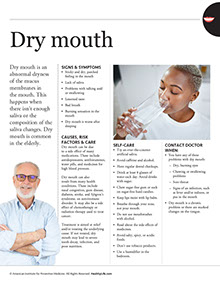
    Men typically suffer more serious illnesses and die at a younger age than women. You wouldn’t know it by looking at the average doctor’s waiting room, though. Men don’t report as many symptoms as women do, and they let a problem go further before they seek medical help.

    If you have a tendency to ignore or downplay physical or emotional problems, or exhibit other kinds of self-destructive, “macho” behavior, make a conscious effort to change. Here’s how:

    *  Pay attention to pain and discomfort. If you’re sick or injured, see a doctor.

    *  Take safety precautions at work, home, or when you drive.

    *  Balance work and play.

    *  Don’t stifle feelings of compassion and sensitivity.

    *  Learn to express your feelings without losing your temper. Don’t feel compelled to compete all the time.

    *  If you experience emotional problems, consult a professional counselor.

    A Year of Health Hints book by the American Institute for Preventive Medicine. www.HealthyLife.com. All rights reserved.

    © American Institute for Preventive Medicine

  • Don’t Pull That Tooth

    Dental & Mouth Concerns

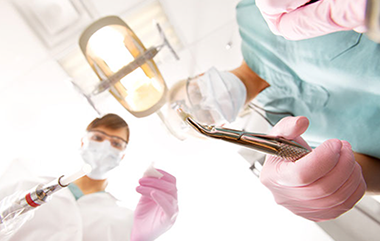
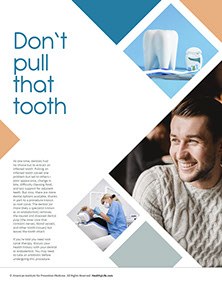
    Image of dentist.

    At one time, dentists had no choice but to extract an infected tooth.  Pulling an infected tooth solved one problem but led to others-poor appearance, change in bite, difficulty chewing food, and less support for adjacent teeth. But tooth extraction is rarely necessary now, thanks to a procedure known as root canal. The dentist (or more likely a specialist known as an endodontist) removes the injured and diseased dental pulp (the inner core that contains nerves, blood vessels, and other tooth tissues) but leaves the tooth intact.

    If you’re told you need root canal therapy, be sure to let your dentist or endodontist know if you have a heart murmur, history of rheumatic heart disease, or mitral valve prolapse. If so, you may need to take an antibiotic before undergoing this procedure.

    A Year of Health Hints book by the American Institute for Preventive Medicine. www.HealthyLife.com. All rights reserved.

    © American Institute for Preventive Medicine