Blog

  • Fractured Jaw

    Dental & Mouth Concerns

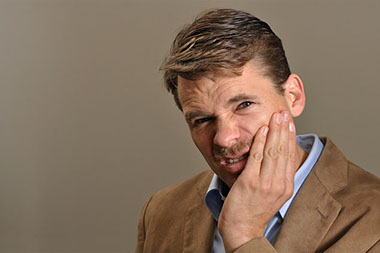
    Image of man holding jaw in pain.

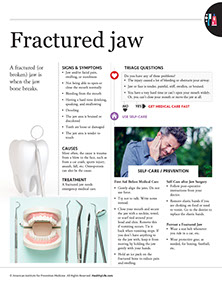
    A fractured (or broken) jaw is when the jaw bone breaks.

    Signs & Symptoms

    *  Jaw and/or facial pain, swelling, or numbness.

    *  Not being able to open or close the mouth normally.

    *  Bleeding from the mouth.

    *  Having a hard time drinking, speaking, and swallowing.

    *  Drooling.

    *  The jaw area is bruised or discolored.

    *  Teeth are loose or damaged.

    *  The jaw area is tender to touch.

    Causes

    Most often, the cause is trauma from a blow to the face, such as from a car accident, sports injury, assault, etc. Osteoporosis can also be the cause.

    Treatment

    A fractured jaw needs emergency medical care.

    Questions to Ask

    Self-Care / Prevention

    First Aid Before Medical Care

    *  Gently align the jaws. Do not use force.

    *  Try not to talk. Write notes instead.

    *  Close your mouth and secure the jaw with a necktie, towel, or scarf tied around your head and chin. Remove this if vomiting occurs. Tie it back when vomiting stops. If you don’t have anything to tie the jaw with, keep it from moving by holding the jaw gently with your hands.

    *  Hold an ice pack on the fractured bone to reduce pain and swelling.

    Self-Care after Jaw Surgery

    *  Follow post-operative instructions from your doctor.

    *  Remove elastic bands if you are choking on food or need to vomit. Go to the dentist to replace the elastic bands.

    To Help Prevent a Fractured Jaw

    *  Wear a seat belt whenever you ride in a car, etc.

    *  Wear protective gear, as needed, for boxing, football, etc.

    Healthier at Home book by the American Institute for Preventive Medicine. www.HealthyLife.com. All rights reserved.

    © American Institute for Preventive Medicine

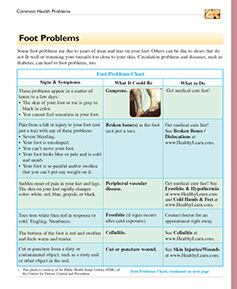
  • Foot Problems

    Bone & Muscle Problems

    Some foot problems are due to years of wear and tear on your feet. Others can be due to shoes that do not fit well or trimming your toenails too close to your skin. Circulation problems and diseases, such as diabetes, can lead to foot problems, too.

    {Note: If you have diabetes or circulation problems, contact your doctor for any foot problems.}

    To Help Prevent Foot Problems

    *  Maintain a healthy weight to avoid excess strain on your feet.

    *  Wear shoes that fit well. Don’t wear shoes with pointed toes or ones that fit too tightly.

    *  Wash and dry your feet daily.

    *  Keep your feet moisturized.

    *  Inspect your feet daily for signs of problems.

    *  Rest your feet by elevating them.

    *  Persons with diabetes and/or circulation problems need to take special care of their feet. Good foot care can prevent some foot infections. It may be necessary for a health care professional to cut the toenails.

    R.I.C.E.

    *  Rest the injured area for 24 to 48 hours.

    *  Ice the area as soon as possible. Keep doing this for 10 minutes every 2 hours for the first 48 hours. Use an ice pack, ice in a heavy plastic bag with a little water, a bag of frozen vegetables, etc. Put a thin towel between the ice pack and the skin.

    *  Compress the area. Wrap with an elastic bandage. Do not cut off circulation. Remove the bandage every 3 to 4 hours, for 15 to 20 minutes each time.

    *  Elevate the area above heart level, if possible. Place it on a pillow, folded blanket, stack of newspapers, etc.

    Athlete’s Foot

    Signs & Symptoms

    Moist, soft, red, or gray-white scales on the feet, especially between the toes. Cracked, peeling, dead skin area. Itching. Sometimes small blisters on the feet.

    What to Do

    SeeAthlete’s Foot.

    Blisters

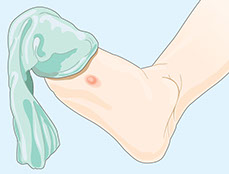
    Illusration of a blister on the foot.

    Signs & Symptoms

    Red, sometimes fluid-filled sores caused by shoes that rub the foot.

    Self-Care / Prevention

    *  Don’t break a blister. If it breaks on its own, apply an antibacterial spray or ointment and cover with a bandage or sterile dressing.

    *  Don’t cut away or pull off the broken blister’s loose skin. This protects the new skin below it.

    Broken Bone(s) in the foot (not just a toe).

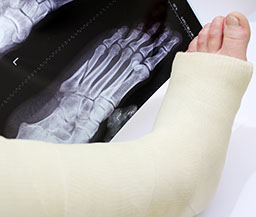
    Image of broken foot.

    Signs & Symptoms

    Pain from a fall or injury to your foot (not just a toe) with any of these problems:

    *  Severe bleeding.

    *  Your foot is misshaped.

    *  You can’t move your foot.

    *  Your foot looks blue or pale and is cold and numb.

    *  Your foot is so painful and/or swollen that you can’t put any weight on it.

    What to Do

    Get medical care fast!

    Broken or Sprained Toe

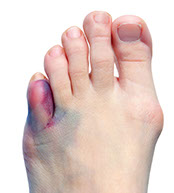
    Image of a broken or sprained toe.

    Signs & Symptoms

    Pain in only one toe after an injury to the toe.

    Buerger’s Disease

    Signs & Symptoms

    Open sores (ulcers) on the toes. Pain on the instep and cold, pale skin color which improves with rest.

    What to Do

    See doctor.

    Bunion

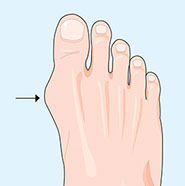
    Illustration of a bunion.

    Signs & Symptoms

    The big toe points inward or outward. A bony bulge at side of the big toe. Thickened skin. Possible fluid build-up near the big toe. Stiffness or pain.

    Self-Care / Prevention

    *  Don’t wear high heels or shoes with narrow toes.

    *  Wear sandals.

    *  Use moleskin or padding to separate overlapped toes.

    *  Try arch supports to reduce pressure.

    *  Use ring-shaped pads over a bunion.

    *  Cut out an old pair of shoes to wear in the house.

    *  Soak your feet in warm water.

    *  If needed, take an over-the-counter pain reliever as directed.

    Callus

    Signs & Symptoms

    Thickened skin on the ball or heel of the foot. Usually no pain.

    Cellulitis

    Signs & Symptoms

    The bottom of the foot is red and swollen and feels warm and tender.

    What to Do

    SeeCellulitis.

    Corn

    Signs & Symptoms

    Thickened skin on tops of and between toes where rubbing is constant. Feels hard to the touch and looks round. Small, clear spot (hen’s eye) may appear in the center.

    Cut or Puncture Wound

    Signs & Symptoms

    Cut or puncture from a dirty or contaminated object, such as a rusty nail or other object in the soil.

    Foot Cramp

    Signs & Symptoms

    Charley horse or muscle spasm in the foot. Often, this occurs at bedtime.

    Self-Care / Prevention

    *  Stretch the foot muscles.

    *  Pull the foot back into a flexed position.

    *  Push the foot into the floor.

    Frostbite (if signs occurs after cold exposure).

    Signs & Symptoms

    Toes turn white then red in response to cold. Tingling. Numbness.

    What to Do

    Contact doctor for an appointment right away.

    Gangrene

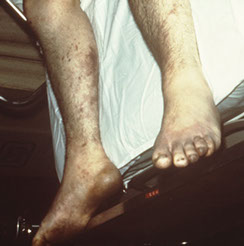
    Image of gangrene.

    Signs & Symptoms

    These problems appear in a matter of hours to a few days:

    *  The skin of your foot or toe is gray to black in color.

    *  You cannot feel sensation in your foot.

    What to Do

    Get medical care fast!

    Gout

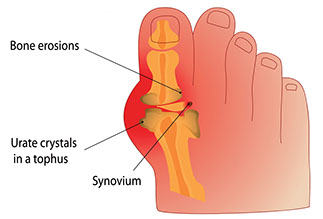
    Illustration of gout.

    Signs & Symptoms

    Severe pain in foot joint, often the big toe. The pain is not due to an injury. The joint hurts a lot when anything touches it. The area is red, swollen, and tender.

    What to Do

    See doctor.

    Hammertoe

    Illustration of a hammertoe.

    Signs & Symptoms

    Curled or claw-like position in a toe (usually the 2nd toe). A corn forms on the top of the toe. Pain.

    Self-Care / Prevention

    *  Wear wide, roomy shoes.

    *  Massage the toes or get a foot rub.

    *  Change shoes during the day. Try athletic shoes.

    *  Use small pads over the center of the toe to lessen pressure.

    Heel Spur

    Signs & Symptoms

    Tenderness and pain under the heel bone.

    What to Do

    See doctor.

    Self-Care / Prevention

    *  Use a cushion or heel cup under the heel.

    *  Do not jog or run. Avoid prolonged standing.

    *  Lose weight, if overweight.

    *  Roll a tennis ball under ball of the foot.

    *  Put ice on the heel for 10 minutes. Remove it for 10 minutes. Repeat many times.

    *  If needed, take an over-the-counter pain reliever as directed.

    Infection

    Signs & Symptoms

    A foot wound with: Fever; redness, tenderness, or warmth; swelling; pain; and/or pus.

    What to Do

    See doctor.

    Self-Care / Prevention for Minor Infections

    *  Soak the foot in warm, soapy water for 20 minutes, 4 to 6 times a day. Pat the infected area dry. Use extra care if you have peripheral vascular disease. Make sure the water is not hot.

    *  Apply an over-the-counter antibiotic ointment, such as Neosporin. Cover with a sterile cloth or bandage.

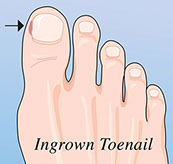
    Ingrown Toenail

    Illustration of ingrown toenail.

    Signs & Symptoms

    Discomfort, pain, tenderness, and/or redness under the corner of a toenail and nearby skin.

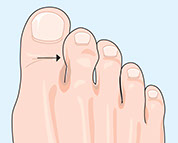
    Morton’s Neuroma

    This is thickening of nerve tissue, usually between the third and fourth toes.

    Signs & Symptoms

    Sharp and burning pain on the ball of the foot.

    Self-Care / Prevention

    *  Wear wide shoes with soft insoles.

    *  Put pads or arch supports in your shoes. These help take pressure off the area.

    *  Take an over-the-counter medicine for pain as directed.

    *  See your doctor if the above measures don’t bring relief.

    Peripheral Vascular Disease

    Signs & Symptoms

    Sudden onset of pain in your feet and legs. The skin on your feet rapidly changes color: white, red, blue, grayish, or black.

    What to Do

    Get medical care fast!

    Planter Fasciitis

    This is a problem with ligaments and tissues in the foot arch.

    Signs & Symptoms

    Pain between the heel and the ball of the foot. Often this is due to walking, running, or putting weight on the foot.

    Self-Care / Prevention

    *  Rest the foot as much as you can.

    *  Use R.I.C.E.

    *  Take an over-the-counter medicine for pain and swelling as directed.

    *  Wear shoes with a solid arch support.

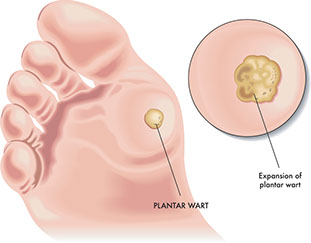
    Planter Wart

    Illustration of plantar wart.

    Signs & Symptoms

    Painful growth on the ball or heel of the foot. Black pinholes or spots in the center.

    Self-Care / Prevention

    *  Try salicylic acid plasters or other over-the- counter products, such as Wart-Off. Follow package directions.

    *  Use cushions in shoes.

    *  Wash your hands after touching warts to avoid re-infection.

    *  Wear sandals in the shower or public areas, such as pools.

    *  Do not pick at plantar warts.

    Rheumatoid Arthritis

    Signs & Symptoms

    Joint pain and morning stiffness in joints that lasts more than 1 hour. Fatigue.

    What to Do

    See doctor.

    Toenail Fungus

    Signs & Symptoms

    White, brown, or yellow toenail. The nail can thicken, then get soft and weak. It may tear away from the nail bed or look deformed.

    What to Do

    See doctor.
    Healthier at Home book by the American Institute for Preventive Medicine. www.HealthyLife.com. All rights reserved.

    © American Institute for Preventive Medicine

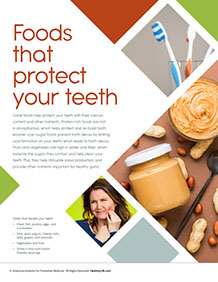
  • Foods That Fight Cavities

    Dental & Mouth Concerns

    Image of a dish with food fighting items to fight cavities.

    Now you know how sticky sweets promote tooth decay. What you may not realize is that some foods prevent tooth decay. Research studies show that certain foods, like cheese and peanut butter, counteract the acids in the mouth that wear down the tooth enamel. (Be careful to buy plain, all-natural peanut butter, without added sugar of any kind.) Other tooth-saving foods include:

    *  Nuts and seeds.

    *  Meat, fish, poultry, and eggs.

    *  Olives and dill pickles.

    *  Milk, plain yogurt, and cheese.

    A Year of Health Hints book by the American Institute for Preventive Medicine. www.HealthyLife.com. All rights reserved.

    © American Institute for Preventive Medicine

  • Food Poisoning

    Abdominal & Urinary Conditions

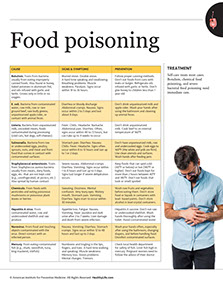
    Self-care treats most cases. Botulism, chemical food poisoning, and severe bacterial food poisoning need immediate care.

    Botulism

    Cause

    Toxin from bacteria usually from eating improperly canned foods. Also found in honey and oils infused with garlic. Grows only in little or no oxygen.

    Signs & Symptoms

    Blurred vision. Double vision. A hard time speaking and swallowing. Breathing problems. Muscle weakness. Paralysis. Signs occur within 4 to 36 hours.

    Prevention

    Follow proper canning methods. Boil home-canned food for 10 or more minutes. Don’t eat foods from cans with leaks or bulges. Refrigerate oils infused with garlic or herbs. Don’t give honey to children less than 1 year old.

    E. coli

    Cause

    Bacteria from contaminated water, raw milk, raw or rare ground beef, unpasteurized apple juice or cider, or contact with contaminated animal feces.

    Signs & Symptoms

    Diarrhea or bloody discharge. Abdominal cramps. Nausea. Signs occur within 2 to 5 days and last about 8 days.

    Prevention

    Don’t drink unpasteurized milk and apple cider. Wash your hands after using the bathroom and cleaning up animal feces.

    Listeria

    Cause

    Bacteria from unpasteurized milk, uncooked meats, foods contaminated during processing (cold cuts, hot dogs, soft cheeses).

    Signs & Symptoms

    Fever. Chills. Headache. Backache. Abdominal pain. Diarrhea. Often, signs occur within 48 to 72 hours, but can take up to 3 weeks to occur.

    Prevention

    Don’t drink unpasteurized milk. Cook beef to an internal temperature of 160ºF.

    Salmonella

    Cause

    Bacteria from raw or undercooked eggs, poultry, and meat and from food that comes in contact with contaminated surfaces.

    Signs & Symptoms

    Stomach pain. Diarrhea. Nausea. Chills. Fever. Headache. Signs occur within 8 to 12 hours and last up to 1 or 2 days.

    Prevention

    Don’t have unpasteurized milk, raw and undercooked eggs. Cook eggs to 160ºF (the white and yolk are firm). Use clean utensils and surfaces.

    Staphylococcal enterotoxin

    Cause

    Toxin from bacteria usually from meats, dairy foods, eggs, etc. that are not kept cold (e.g., unrefrigerated, at picnics, etc.) Also spread by human contact.

    Signs & Symptoms

    Severe nausea. Abdominal cramps. Diarrhea. Vomiting. Signs occur within 1 to 6 hours and last up to 3 days. Signs last longer if severe dehydration occurs.

    Prevention

    Keep foods that can spoil cold (40ºF or below) or hot (140ºF or higher). Don’t eat foods kept for more than 2 hours between 40ºF and 140ºF. Don’t eat foods that look or smell spoiled. Wash your hands often. Use clean utensils and surfaces.

    Chemicals

    Cause

    From foods with pesticides and eating poisonous mushrooms or poisonous plant leaves or berries.

    Signs & Symptoms

    Sweating. Dizziness. Mental confusion. Very teary eyes. Watery mouth. Stomach pain. Vomiting. Diarrhea. Signs start to occur within 30 minutes.

    Prevention

    Wash raw fruits and vegetables before eating them. Don’t store food or liquids in containers with lead- based paints. Don’t store alcohol in lead crystal containers.

    Hepatitis A virus

    Cause

    From contaminated water, raw and undercooked shellfish, oysters, clams, mussels, scallops, etc.

    Signs & Symptoms

    Appetite loss. Nausea. Vomiting. Fever. Jaundice and dark urine after 3 to 10 days. Liver damage and death from severe infection.

    Prevention

    Hepatitis A vaccine. Don’t eat raw or undercooked shellfish, oysters, etc.

    Norwalk-like viruses

    Cause

    From food and touching objects contaminated with the virus. Direct contact with an infected person.

    Signs & Symptoms

    Nausea. Vomiting. Diarrhea. Stomach cramps. Signs occur within 12 to 48 hours and last up to 2 days.

    Prevention

    Wash your hands often, especially after using the bathroom, changing diapers, and before handling food. Disinfect contaminated surfaces.

    Mercury

    Cause

    From eating contaminated fish (e.g., shark, swordfish, tuna, king mackerel, tilefish).

    Signs & Symptoms

    Numbness and tingling in the lips, fingers, and toes. A hard time walking and speaking. Muscle weakness. Memory loss. Mental changes. Tremors.

    Prevention

    Check local health department for safety of fish. Limit fish high in mercury. Pregnant women need to follow the advice of their doctor.

    Questions to Ask

    Self-Care / Prevention

    *  For chemical food poisoning, call the Poison Control Center (800.222.1222).

    *  Heed warnings for food products that could be harmful. News reports list these items. So does the FDA atwww.fda.gov.

    Healthier at Home book by the American Institute for Preventive Medicine. www.HealthyLife.com. All rights reserved.

    © American Institute for Preventive Medicine

  • Floaters & Flashes

    Eye Conditions

    Signs & Symptoms

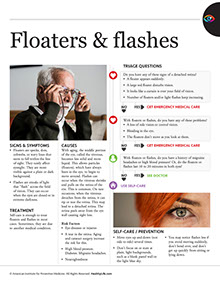
    *  Floaters are specks, dots, cobwebs, or wavy lines that seem to fall within the line of sight. They rarely affect eyesight. They are more visible against a plain or dark background.

    *  Flashes are streaks of light that “flash” across the field of vision. They can occur when the eyes are closed or in extreme darkness.

    Causes

    With aging, the middle portion of the eye, called the vitreous, becomes less solid and more liquid. This allows particles (floaters), which have always been in the eye, to begin to move around. Flashes can occur when the vitreous shrinks and pulls on the retina of the eye. This is common. On rare occasions, when the vitreous detaches from the retina, it can rip or tear the retina. This may lead to a detached retina. The retina peels away from the eye wall causing sight loss.

    Risk Factors for Floaters and Flashes

    *  Eye diseases or injuries.

    *  A tear in the retina. Aging and cataract surgery increase the risk for this.

    *  High blood pressure.

    *  Migraine headaches.

    *  Nearsightedness.

    Treatment

    Self-care is enough to treat floaters and flashes unless they are due to another medical condition.

    Questions to Ask

    Self-Care / Prevention

    *  Move your eyes up and down (not side to side) several times.

    *  Don’t focus on or stare at plain, light backgrounds, such as a blank pastel wall or the light blue sky.

    *  You may notice flashes less if you avoid moving suddenly, don’t bend over, and don’t get up quickly from sitting or lying down.

    Healthier at Home book by the American Institute for Preventive Medicine. www.HealthyLife.com. All rights reserved.

    © American Institute for Preventive Medicine

  • Flatulence (Gas)

    Abdominal & Urinary Conditions

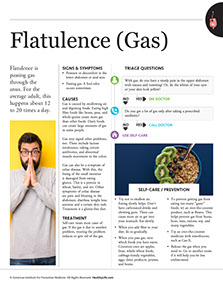
    Image of man plugging his nose with hand.

    Flatulence is passing gas through the anus. For the average adult, this happens about 6 to 20 times a day.

    Signs & Symptoms

    *  Pressure or discomfort in the lower abdomen or anal area.

    *  Passing gas. A foul odor occurs sometimes.

    Causes

    Gas is caused by swallowing air and digesting foods. Eating high fiber foods like beans, peas, and whole-grains create more gas than other foods. Dairy foods can create large amounts of gas in some people.

    Gas may signal other problems, too. These include lactose intolerance, taking certain antibiotics, and abnormal muscle movement in the colon.

    Gas can also be a symptom of celiac disease. With this, the lining of the small intestine is damaged from eating gluten. This is a protein in wheat, barley, and rye. Other symptoms of celiac disease are pain and bloating in the abdomen; diarrhea; weight loss; anemia; and a certain skin rash. Treatment is a gluten-free diet. Find out about celiac disease fromwww.celiac.nih.gov.

    Treatment

    Self-care treats most cases of gas. If the gas is due to another problem, treating the problem reduces or gets rid of the gas.

    Questions to Ask

    Self-Care / Prevention

    *  Try not to swallow air. Don’t have carbonated drinks and chewing gum. These can cause more air to get into your stomach.

    *  When you add fiber to your diet, do so gradually.

    *  When you pass gas, note which foods you have eaten. Eat less of the foods that often cause gas. Common ones are apples, bran, whole-wheat foods, cabbage-family vegetables, eggs, dairy products, prunes, and beans.

    *  To prevent getting gas from many “gassy” foods, try an over-the-counter product, such as Beano. This helps prevent gas from beans, bran, nuts, onions, soy, and many vegetables.

    *  Try an over-the-counter medicine with simethicone, such as Gas-X.

    *  Release the gas when you need to. Go to another room if it will help you be less embarrassed.

    Healthier at Home book by the American Institute for Preventive Medicine. www.HealthyLife.com. All rights reserved.

    © American Institute for Preventive Medicine

  • Fishhook Removal

    First Aid

    A fishhook can nick or cut the skin, get stuck in the skin near its surface, or get deeply embedded in the skin. First aid treats most fishhook accidents.

    Questions to Ask

    Self-Care / First Aid

    For a Fishhook Deeply Embedded in the Skin

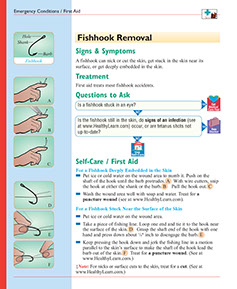
    *  Put ice or cold water on the wound area to numb it. Push on the shaft of the hook until the barb protrudes. See image A. With wire cutters, snip the hook at either the shank or the barb. See image B. Pull the hook out. See image C.

    *  Wash the wound area well with soap and water. Treat for a puncture wound.

    For a Fishhook Stuck Near the Surface of the Skin

    *  Put ice or cold water on the wound area.

    *  Take a piece of fishing line. Loop one end and tie it to the hook near the surface of the skin. See image D. Grasp the shaft end of the hook with one hand and press down about 1/8th inch to disengage the barb. See image E.

    *  Keep pressing the hook down and jerk the fishing line in a motion parallel to the skin’s surface to make the shaft of the hook lead the barb out of the skin. See image F. Treat for a puncture wound.

    {Note: For nicks or surface cuts to the skin, treat for a cut.

    Healthier at Home book by the American Institute for Preventive Medicine. www.HealthyLife.com. All rights reserved.

    © American Institute for Preventive Medicine

  • First Aid Precautions

    First Aid

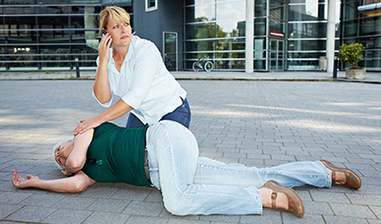
    Image of women on phone beside someone who is unresponsive.

    First Aid Safety Steps

    1.  LOOK around. Is it safe to help? If not, call  9-1-1, have someone else call, or seek medical help. If it is safe to help, stay calm and go to step 2.

    2.  CHECK for a response.

    *  Gently tap the person. Ask, “Are you okay?” Ask loudly. Call the person by name if you know it.

    *  If the person responds or moves, attend to his or her problem, as needed. If the person is injured or the problem is serious, call for emergency medical care. Give first aid as needed, until medical help arrives.

    *  If the person does not respond or move, begin CPR.

    3.  PROTECT yourself from hepatitis B virus and HIV, the virus that causes AIDS. You can get these from an infected person’s blood or other body fluids if they enter your body. These organisms can enter through cuts or breaks in your skin or through the lining of your mouth, nose, and eyes. When you give first aid or do CPR, take these steps, especially if you don’t know the person:

    *  Use plastic wrap or a plastic bag that you can throw away whenever you touch another person’s body fluids, blood, or other objects that may be soiled with his or her blood. If possible, have the person apply pressure to the wound with his or her own hand.

    *  Cover the person’s open wounds with dressings, extra gauze, or waterproof material.

    *  Using a mouth-to-mouth barrier device when you give rescue breaths may or may not protect you from picking up an infection. You do not need to give rescue breaths with Hands-Only CPR.

    *  Within 1 to 2 hours, report every incident that exposes you to another person’s blood or other body fluids to your doctor and EMS personnel.

    4.  FIND out if the person has certain medical needs.

    *  Ask if he or she has prescribed medicine, such as nitroglycerin, to take for a heart condition. Ask where he or she keeps the medicine. Find out how much to give. Ask the person or read the directions on the medicine’s label, if there is one.

    *  Ask the person if you can give the medicine to him or her.

    *  Look for a medical alert tag to find out about health problems the person has.

    *  Find out if the person is allergic to any medicine.

    Healthier at Home book by the American Institute for Preventive Medicine. www.HealthyLife.com. All rights reserved.

    © American Institute for Preventive Medicine

  • First Aid For Choking

    First Aid

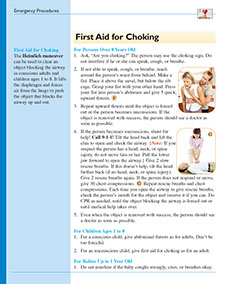
    The Heimlich maneuver can be used to clear an object blocking the airway in conscious adults and children ages 1 to 8. It lifts the diaphragm and forces air from the lungs to push the object that blocks the airway up and out.

    Persons Over 8 Years Old

    1. Ask, “Are you choking?”

    The person may use the choking sign. Do not interfere if he or she can speak, cough, or breathe.

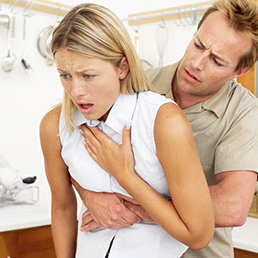
    2. If not able to speak, cough, or breathe, reach around the person’s waist from behind.

    Make a fist. Place it above the navel, but below the rib cage. Grasp your fist with your other hand. Press your fist into person’s abdomen and give 5 quick, upward thrusts. See image A.

    Image of giving a person first aid for choking.

    Image A

    3. Repeat upward thrusts until the object is forced out or the person becomes unconscious.

    If the object is removed with success, the person should see a doctor as soon as possible.

    4. If the person becomes unconscious, shout for help! Call 9-1-1!

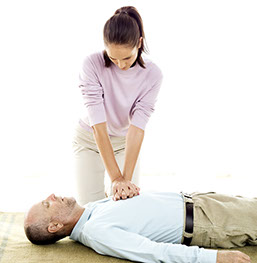
    Tilt the head back and lift the chin to open and check the airway. {Note: If you suspect the person has a head, neck, or spine injury, do not move him or her. Pull the lower jaw forward to open the airway.} Give 2 slow rescue breaths. If this doesn’t help, tilt the head further back (if no head, neck, or spine injury). Give 2 rescue breaths again. If the person does not respond or move, give 30 chest compressions. See image B. Repeat rescue breaths and chest compressions. Each time you open the airway to give rescue breaths, check the person’s mouth for the object and remove it if you can. Do CPR as needed, until the object blocking the airway is forced out or until medical help takes over.

    Image of adult chest compressions.

    Image B

    5. Even when the object is removed with success, the person should see a doctor as soon as possible.

    Children Ages 1 to 8

    1.  For a conscious child, give abdominal thrusts as for adults. Don’t be too forceful.

    2.  For an unconscious child, give first aid for choking as for an adult.

    Babies Up to 1 Year Old

    1.  Do not interfere if the baby coughs strongly, cries, or breathes okay.

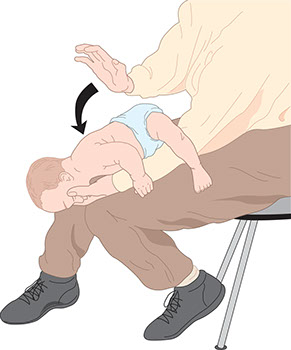
    2.  If the baby is conscious, hold the baby’s head (face down) in one hand. Straddle the baby over your forearm. Rest your forearm on your leg for support. Keep the baby’s head lower than the rest of his or her body.

    3.  With the heel of your free hand, give up to 5 quick, forceful blows on the baby’s back between the shoulder blades. See image C. If the object still blocks the airway, go to step 4.

    4.  Turn the baby over (face up). Cradle the baby on your forearm. Support the head with one hand. Keep the baby’s head lower than the rest of his or her body. Rest your arm on your leg for support. Place 2 fingers 1/2 inch below and in between the nipples on the baby’s chest. Give 5 quick downward thrusts. Depress the sternum about 1-1/2 inches with each thrust.

    5.  Repeat steps 3 and 4 until the object is removed or the baby is unconscious.

    6.  If the baby is unconscious, shout for help. Have someone call 9-1-1! If no one calls 9-1-1, give first aid for 1 minute, stop to call 9-1-1, then resume rescue efforts.

    7.  Put the baby on his/her back. Keep the head tilted back with one hand and give 30 chest compressions using 2 fingers on your other hand. Give 2 slow rescue breaths. If the object is expelled, stop. If not, give cycles of 30 compressions and 2 slow rescue breaths until the object is removed or help arrives.

    8.  Check for and remove the object in the airway, if visible. Repeat steps 7 and 8 as needed.

    9.  Don’t give up! Give CPR until medical help takes over or until the object is removed. Even if it is, get medical care right away.

    Illustration on giving a baby first aid when choking.

    Image C

    Healthier at Home book by the American Institute for Preventive Medicine. www.HealthyLife.com. All rights reserved.

    © American Institute for Preventive Medicine