Blog

  • A Beautiful Brain

    Brain & Nervous System

    A pink paper brain with 2 dumb bells next to it.

    Like a great conductor, our brain directs our every movement, sound, and emotion. It never stops working and thinking for us, but we rarely return the favor and think about the health of our brain. A healthy brain can concentrate, analyze, plan, learn, remember, feel, and so much more.

    While a healthy lifestyle supports a healthy brain, a happy brain also stays engaged. Feed your brain by playing games, learning new things, and staying connected with friends and family.

    Health at Home Lifetime book by the American Institute for Preventive Medicine. www.HealthyLife.com. All rights reserved.

    © American Institute for Preventive Medicine

  • 7 Daily Health Habits

    General Health Conditions

    A wooden bowl filled with berries.

    1.  Drink at least 6 to 8 glasses of water or other unsweetened fluids.

    2.  Spend 2 hours or less of non-work screen time (laptops, video games, cell phones, etc.).

    3.  Be physically active for 30 or more minutes.

    4.  Wash your hands often to lower your risk of picking up and spreading germs.

    5.  Eat 5 or more servings of vegetables and fruits. Fill half of your plate with these foods.

    6.  Limit sodium from salt and foods to 2,300 mg per day. Omit salt at the table. Eat less processed foods. Read food labels.

    7.  Sleep 7 to 9 hours a night.

    Take Action: Fight Decay the 2-1-2 Way

    *  2 times a day, brush your teeth

    *  1 time a day, floss your teeth

    *  2 times a year, get a dental cleaning and checkup

    Health at Home Lifetime book by the American Institute for Preventive Medicine. www.HealthyLife.com. All rights reserved.

    © American Institute for Preventive Medicine

  • Six Ways To Build Better Brainpower

    Mature Health: Over Age 50

    Image of adults writing and using a computer.

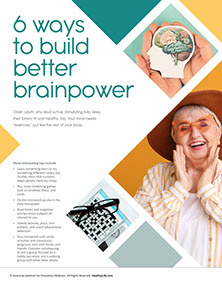
    Research shows that older adults who lead active, stimulating lives keep their brains fit and healthy, too. Your mind needs “exercise,” just like the rest of your body.

    Some mind-stimulating tips include:

    *  Learn something new-or try something different-every day. Studies show that curiosity keeps people mentally sharp.

    *  Play mind-stretching games such as Scrabble, chess, and cards.

    *  Do the crossword puzzle in the daily newspaper.

    *  Read books and magazine articles about subjects of interest to you.

    *  Attend lectures, plays, and exhibits, and watch educational television.

    *  Use memory aids, such as appointment calendars, “to do” lists, and Post-it notes.

    Also, concentrate on what people say, repeat what you want to remember out loud, and associate an action with an object (like leaving your tote bag near the door so you remember to take it with you when you leave).

    A Year of Health Hints book by the American Institute for Preventive Medicine. www.HealthyLife.com. All rights reserved.

    © American Institute for Preventive Medicine

  • 6 Healthy Heart Numbers

    Heart & Circulation Problems

    Women smiling while making hands into a heart shape.

    To lower your risk of heart disease, aim for these target numbers*:

    1.  Blood pressure – less than 120/80

    2.  Body mass index (BMI) – 18.6 to 24.9. Find your BMI atcdc.gov/healthyweight/assessing/bmi/index.html.

    3.  Fasting blood glucose – less than 100

    4.  Fasting blood triglycerides – less than 150

    5.  Total blood cholesterol – less than 200

    6.  Waist measurement of:

    – 40 inches or less if you are a man

    – 35 inches or less if you are a woman

    * Discuss your target heart numbers with your doctor. Together, develop a plan to reach your goals.

    Take Action: Lower Your Heart Disease Risk

    1.  If you smoke, quit. Don’t give up trying!

    2.  Eat healthy foods, including fruits and vegetables and limit others, such as saturated fats and added sugars.

    3.  Do regular exercise. Aim for at least 150 minutes of moderate activity and two sessions of strength training each week.

    4.  Take your medications as prescribed to reach and maintain your target numbers.

    Health at Home Lifetime book by the American Institute for Preventive Medicine. www.HealthyLife.com. All rights reserved.

    © American Institute for Preventive Medicine

  • 5 Ways To Protect Against Infections

    General Health Conditions

    Parents with child all smiling showing upper arm with vaccine bandage.

    As part of your community, be responsible to prevent getting and spreading infections.

    1.  Wash your hands often.

    2.  Get a yearly flu vaccine. Stay up to date with COVID-19 booster shots. Get complete lists of vaccines atcdc.gov/vaccinesthat you and your children need. Follow your doctor’s advice for vaccines. Getting recommended vaccines save millions of lives and prevent millions of illnesses.

    3.  Stay home when you are sick.

    4.  Keep foods safe to eat. Use clean hands, surfaces, and utensils. Store food that can spoil below 40° F and higher than 140° F.

    5.  Practice safer sex to help prevent sexually transmitted infections.

    Take Action: Proper Handwashing

    1.  Use clean water and soap. Lather your hands all over and under your nails.

    2.  Spend 20 seconds each time. (Hum “Happy Birthday” twice.)

    3.  Rinse your hands with clean running water.

    4.  Dry your hands with an air drier or clean towel.

    Health at Home Lifetime book by the American Institute for Preventive Medicine. www.HealthyLife.com. All rights reserved.

    © American Institute for Preventive Medicine

  • Four Ingredients For A Happy Retirement

    Mature Health: Over Age 50

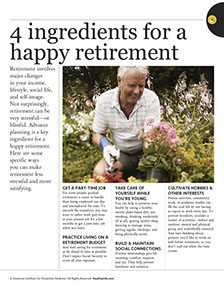
    Image of retired man gardening.

    Retirement involves major changes in your income, lifestyle, social life, and self-image. Not surprisingly, retirement can be very stressful-or blissful. Advance planning is a key ingredient for a happy retirement. A survey conducted by researchers at the University of Michigan found that 75 percent of those who had planned for retirement enjoyed it. Here are some specific ways you can make retirement less stressful and more satisfying.

    Get a part-time job.

    For some people, gradual retirement is easier to handle than being employed one day and unemployed the next. To smooth the transition, you may want to either work part-time at your present job for a few months or get a part-time job at another firm when you leave.

    Practice living on a retirement budget before you retire.

    And start saving for retirement as far ahead of time as possible. Don’t expect Social Security to cover all your expenses.

    Take care of yourself while you’re young.

    You can help to preserve your health by eating a low-fat diet, not smoking, drinking moderately (if at all), learning to manage stress, getting regular checkups, and being physically active.

    Cultivate hobbies and other outside interests.

    Fitness activities, community work, or academic studies can fill the void left by not having to report to work every day. To prevent boredom, consider a variety of activities-indoor and outdoor, mental and physical, group and individually oriented. And start thinking about projects you’d like to work on well before retirement, so you don’t stall out when the time comes.

    A Year of Health Hints book by the American Institute for Preventive Medicine. www.HealthyLife.com. All rights reserved.

    © American Institute for Preventive Medicine
  • 20 Questions To Diagnose Back Problems

    Bone & Muscle Problems

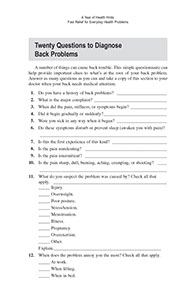
    A number of things can cause back trouble. This simple questionnaire can help provide important clues to what’s at the root of your back problem. Answer as many questions as you can and take a copy of this section to your doctor when your back needs medical attention.

    1.  Do you have a history of back problems?

    2.  What is the major complaint?

    3.  When did the pain, stiffness, or symptoms begin?

    4.  Did it begin gradually or suddenly?

    5.  Were you sick in any way when it began?

    6.  Do these symptoms disturb or prevent sleep (awaken you with pain)?

    7.  Is this the first experience of this kind?

    8.  Is the pain unrelenting?

    9.  Is the pain intermittent?

    10. Is the pain sharp, dull, burning, aching, cramping, or shooting?

    11. What do you suspect the problem was caused by? Check all that apply.

    – Injury.

    – Overweight.

    – Poor posture.

    – Stress/tension.

    – Menstruation.

    – Illness.

    – Pregnancy.

    – Overexertion.

    – Other. Explain.

    12. When does the problem annoy you the most? Check all that apply.

    – At work.

    – When lifting.

    – When in bed.

    – When bending.

    – When stressed.

    – When fatigued.

    – When coughing or sneezing.

    – When sitting.

    – When standing.

    – When driving.

    – When carrying.

    – In the morning.

    – In the afternoon.

    – In the evening.

    – Other. Explain.

    13. Does the pain radiate or move in a particular direction? If yes, explain.

    14. Do you experience muscle spasms?

    15. Do you sleep on a soft mattress or a hard one?

    16. Have you been under nervous or emotional strain lately?

    17. Is there any redness, tenderness, or swelling?

    18. Is there a daily pattern to the pain?

    19. What helps relieve the pain? Check all that apply.

    – Heat.

    – Ice packs.

    – Exercise.

    – Bed rest.

    – Hot baths.

    – Muscle relaxants.

    – Massage.

    – Brace.

    – Walking.

    – Painkillers.

    – Nothing.

    – Haven’t tried anything.

    20. Are there any other factors that the doctor should be aware of?

    A Year of Health Hints book by the American Institute for Preventive Medicine. www.HealthyLife.com. All rights reserved.

    © American Institute for Preventive Medicine

  • Ten Ways To Get Rid Of Winter Itch

    Skin Conditions

    Image of lotion on hand.

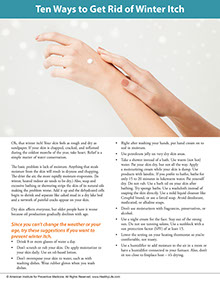
    Oh, that winter itch! Your skin feels as rough and dry as sandpaper. If your skin is chapped, cracked, and inflamed during the coldest months of the year, take heart. Relief is a simple matter of water conservation.

    The basic problem is lack of moisture. Anything that steals moisture from the skin will result in dryness and chapping. The drier the air, the more rapidly moisture evaporates. (In winter, heated indoor air tends to be dry.) Also, soap and excessive bathing or showering strips the skin of its natural oils making the problem worse. Add it up and the dehydrated cells begin to shrink and separate like caked mud in a dry lake bed and a network of painful cracks appear on your skin.

    Dry skin affects everyone, but older people have it worse because oil production gradually declines with age.

    Since you can’t change the weather or your age, try these suggestions if you want to prevent winter itch.

    *  Drink 8 or more glasses of water a day.

    *  Don’t scratch or rub your skin. Do apply moisturizer to your skin daily. Use an oil-based lotion.

    *  Don’t overexpose your skin to water, such as with washing dishes. Wear rubber gloves when you wash dishes.

    *  Right after washing your hands, put hand cream on to seal in moisture.

    *  Use petroleum jelly on very dry skin areas.

    *  Take a shower instead of a bath. Use warm (not hot) water. Pat your skin dry, but not all the way. Apply a moisturizing cream while your skin is damp. Use products with lanolin. If you prefer to bathe, bathe for only 15 to 20 minutes in lukewarm water. Pat yourself dry. Do not rub. Use a bath oil on your skin after bathing. Try sponge baths. Use a washcloth instead of soaping the skin directly. Use a mild liquid cleanser like Cetaphil brand, or use a fatted soap. Avoid deodorant, medicated, or alkaline soaps.

    *  Don’t use moisturizers with fragrances, preservatives, or alcohol.

    *  Use a night cream for the face. Stay out of the strong sun. Do not use tanning salons. Use a sunblock with a sun protection factor (SPF) of at least 15.

    *  Lower the setting on your heating thermostat so you’re comfortable, not toasty.

    *  Use a humidifier to add moisture to the air in a room or have a humidifier connected to your furnace. Also, don’t sit too close to fireplace heat – it’s drying.

    A Year of Health Hints book by the American Institute for Preventive Medicine. www.HealthyLife.com. All rights reserved.

    © American Institute for Preventive Medicine