Blog

  • Medication Basics

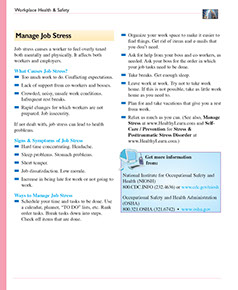
    Medication

    Image of female pharmacist.

    Tell Your Doctor

    Before medicine is prescribed for you, let your doctor know the names and doses of all of the medicines and dietary supplements you take. Let your doctor know if you have medicine allergies or have had bad side effects from a medicine. Be prepared to discuss other concerns, too.

    *  Bring all of your prescribed and over-the-counter (OTC) medicines, vitamins, and herbs, in their original containers, with you to office visits.

    *  Ask your health insurance plan for a printout of the prescribed medicines you take.

    *  Make an easy-to-use “pill card” at the Web site:www.ahrq.gov/qual/pillcard/pillcard.htm.

    *  Use the “Medicine Record Form” below. Fill in the lines and check boxes as needed. Add new medicines when you get them. Make copies of the blank form so you can use it again.

    *  If it is hard for you to swallow pills

    *  If cost is a factor. There may be a generic or lower-cost medicine.

    *  If you use alcohol, tobacco, or “street” drugs

    *  If your health plan has a list of medicines they use. This is called a formulary. Your health plan provides a list. Take the list with you.

    *  If your health plan lets you order 3 months worth of prescriptions by mail. Your doctor will have to write the prescription for a 3-month supply.

    *  If another health provider is treating you for any problem, such as high blood pressure

    *  If you are or could be pregnant or if you are breast-feeding

    Questions to Ask

    When prescribed medicines, get answers to the below questions.

    *  What is the name of the medicine? What will it do? When should it be taken?

    *  How long should it be taken?

    – Do I need to get one or more refills?

    – Will I need more or less of this medicine as time goes on?

    – Will I need this medicine the rest of my life?

    – Is there a way to measure if what I take is enough or too much? Are any tests needed to show if the medicine is helping?

    – How often should we review my use of this medicine?

    *  Are there side effects? What do I do about side effects, if I have any? Which side effects should I let you know about?

    *  Should I take it with a lot of fluids? If so, how many ounces of fluid per day?

    *  Should I take it with food or on an empty stomach?

    *  Is there anything I should avoid while taking it (e.g., alcohol, grapefruit juice, sunlight, etc.)?

    *  Is there a generic form?

    *  How should I store the medicine? Is the medicine less potent once the container is opened?

    *  Will it interact or interfere with other medicines I am taking?

    *  Should I stop taking it if I feel better?

    *  What should I do if I miss a dose? Should I take it as soon as I remember or should I wait until the next scheduled dose? If I miss a dose (or more), how will this affect other medicines I take? Do I need to change how I take any of them?

    *  Do you have any written information on the medicine? (You can ask your pharmacist for this, too.)

    Dos and Don’ts

    Dos for Safe Use

    *  Use the same pharmacy for all prescribed medicines. Your pharmacist can check for harmful interactions.

    *  Check with your doctor or pharmacist before taking OTC medicines, herbal products, and supplements.

    *  When you get your medicine, read the label and look at the medicine. If you have any concerns, tell your pharmacist.

    *  Keep medicines in their original containers and out of the reach of children.

    *  Throw away all expired medicines. Crush pills. Dissolve them in water. Mix this with used coffee grounds or kitty litter and put it in the trash in a sealable bag.

    *  Try to reduce the need for medicines, such as sleeping pills and laxatives. Check with your doctor on ways, other than medicines, to help treat your problems.

    Don’ts for Safe Use

    *  Don’t stop taking medicines your doctor has prescribed, even if you feel better. Check with your doctor first.

    *  Don’t drink alcohol while on a medicine if you don’t know its effect. Some medicines, such as sedatives, can be deadly when used with alcohol. Read medicine labels for warnings.

    *  Never take someone else’s prescribed medicine. Don’t give your prescribed medicine to others.

    *  Don’t take medicine in the dark. Make sure the light is on so you can read the label. Wear your glasses or contact lenses, if you need to.

    *  Don’t buy an OTC medicine if the package is damaged or has been tampered with.

    Tips to Make Sure You Take Your Medicine(s)

    *  Follow your treatment plan. Keep a current Medicine Record Form. Check it regularly.

    *  Use products called compliance aids:

    – Check-off calendars

    – Containers with sections for daily doses. Some have 4 separate sections for each day; one each for Breakfast, Lunch, Dinner, and Bedtime.

    – Caps (or wristwatches) that beep when it is time to take a dose

    *  Ask family members or friends to remind you to take a dose and check that you took it.

    *  Talk to your doctor if you don’t take your medicines as prescribed. It’s okay to feel guilty or embarrassed. But don’t let this stop you from talking to your doctor.

    OTC Medicines

    Over-the-Counter (OTC) Medicines

    Over-the-counter (OTC) medicines are ones that you can get without a prescription. In general, they are less potent than prescribed ones.

    Use OTC Medicines Wisely

    *  Ask your doctor what OTC products you should avoid and which ones are safe for you to use. These include herbal products and supplements. Find out what your doctor prefers you take for pain and fever. Ask your pharmacist if an OTC medicine is safe for you to take with your prescribed medicines.

    *  Do not exceed the dose on a label or take OTC medicines on a regular basis unless your doctor tells you to.

    *  If you have an allergy to a medicine, check for it in the list of ingredients on all medicines.

    *  Read information and warnings on the label to help you decide whether or not the product is safe for you to take. Check with your doctor or pharmacist, too. For information on reading OTC medicine labels, accesswww.fda.gov. Search for “Over-the-Counter Medicine Label.”

    *  Don’t take an OTC medicine if you are pregnant or nursing a baby unless your doctor says it is okay.

    *  Be sure to store medicines in a convenient dry place, out of children’s reach.

    *  Don’t ever tell children that medicine is candy.

    *  Before you take an OTC medicine, check the expiration date. Replace items as needed.

    Your Home Pharmacy
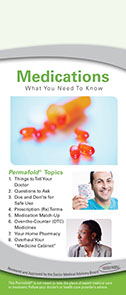
    Medication brochure by the American Institute for Preventive Medicine. www.HealthyLife.com. All rights reserved.

    © American Institute for Preventive Medicine

  • Medication Safety

    Medication

    Smiling women holding a glass of water in one hand and a pill in the other hand.

    Knowing all the medicines you take makes it easier to list them on medical forms and to talk to your doctor and pharmacist about them.

    Keep a current list of all of the medicines you take. Include prescribed and over-the-counter ones, vitamins, minerals, herbs, etc. Give a copy of the list to your doctor (and pharmacist), as needed.

    Mixing some medicines with other medicines, alcohol, drugs, foods, etc. can cause harmful side effects. It can also limit or raise the desired effect of a medicine’s action.

    Mixing some “natural” products and foods with prescribed medicines can be harmful or make the medicine less effective.

    Follow warning labels on medicines and over-the-counter products, too.

    A Year of Health Hints book by the American Institute for Preventive Medicine. www.HealthyLife.com. All rights reserved.

    © American Institute for Preventive Medicine

  • Medication Interactions

    Medication

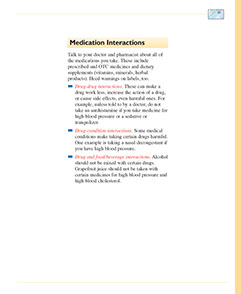
    Talk to your doctor and pharmacist about all of the medications you take. These include prescribed and OTC medicines and dietary supplements (vitamins, minerals, herbal products). Heed warnings on labels, too.

    Drug-drug interactions

    These can make a drug work less, increase the action of a drug, or cause side effects, even harmful ones. For example, unless told to by a doctor, do not take an antihistamine if you take medicine for high blood pressure or a sedative or tranquilizer.

    Drug-condition interactions

    Some medical conditions make taking certain drugs harmful. One example is taking a nasal decongestant if you have high blood pressure.

    Drug and food/beverage interactions

    Alcohol should not be mixed with certain drugs. Grapefruit juice should not be taken with certain medicines for high blood pressure and high blood cholesterol.

    Page from the Healthier at Home book by the American Institute for Preventive Medicine. www.HealthyLife.com. All rights reserved.

    © American Institute for Preventive Medicine
  • Medicare

    Medical Care

    Image of older couple talking to agent.

    Medicare is health insurance funded by the federal government. There is a lot to know about Medicare. For information, call the Medicare Choices Helpline at 1-800-MEDICARE (633-4227). Ask that a copy of the Medicare guide be mailed to you. You can also find out about Medicare on the Internet atwww.medicare.gov.

    To be “eligible” for Medicare means:

    *  You are 65 years or older. You must also be eligible for Social Security or Railroad Retirement Benefits, or

    *  You must be disabled for life and you have received Social Security Disability Insurance payments for at least 24 months, or

    *  You have end stage renal disease needing transplant or dialysis.

    To apply for medicare, call the Social Security Administration. The number is 1-800-772-1213. Call 3 months before you turn age 65. Don’t wait any longer than 3 months after your 65th birthday to call. If you receive social security payments, you should automatically get a Medicare card, but don’t take a chance. Call the Social Security Administration as mentioned above.

    Page from the Health at Home Lifetime book by the American Institute for Preventive Medicine. www.HealthyLife.com. All rights reserved.

    © American Institute for Preventive Medicine

  • Medical History Chart

    Medical History

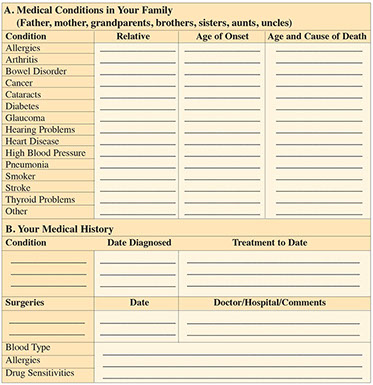
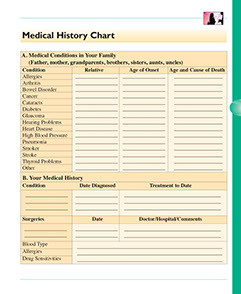
    Medical history chart.
    Page from the Health at Home Lifetime book by the American Institute for Preventive Medicine. www.HealthyLife.com. All rights reserved.

    © American Institute for Preventive Medicine

  • Making Medical Decisions

    Medical Care

    Describe the Problem

    Be Able to Answer These Questions About Your Current Problem and Complaints

    *  What do you think the problem is?

    *  Are you in pain? If yes:

    – What does the pain feel like? Is it a sharp, dull, and/or throbbing pain?

    – Where is the pain?

    *  When did the problem(s) start? Has it changed since then?

    *  What makes it go away?

    *  Have you felt like this before? Is so, when? What made it go away then?

    *  Have you had any other symptoms or signs lately? Examples are:

    – Fever.

    – Blood in the urine.

    – Shortness of breath.

    – Anxiety.

    – Insomnia.

    Be Able to Give This Information About Your Health

    *  Your medical history and your family’s medical history.

    *  Allergies you have.

    *  Medications you take.

    *  Your daily habits.

    *  Your work.

    *  Pressures you are under.

    Ask for a Diagnosis

    Your Doctor or Health Care Provider Makes a Diagnosis From

    *  Symptoms (things you feel, such as pain).

    *  Signs (things that can be seen or measured, such as swelling).

    *  Exams and tests.

    When Your Doctor or Health Care Provider Gives You A Diagnosis

    *  Ask him or her to explain the diagnosis in detail.

    *  Ask questions if you don’t understand. If you need to, bring a trusted family member or friend with you to help ask questions.

    *  Find out if your condition is chronic or acute. A chronic one lasts a long time. An acute one comes on suddenly and doesn’t last long. If your condition is chronic, find out how it will affect your life.

    *  Ask if the diagnosis increases your risk for any other problems. If so, find out what they are and what you can do to prevent them.

    Other Things to Ask

    *  Is my condition contagious? If so, how do I not spread it?

    *  Is my condition genetic? If so, what does this mean for others in my family?

    *  How certain are you about this diagnosis? Are there are other symptoms to look for that would help confirm or disprove the diagnosis?

    *  What books, pamphlets, and computer Web sites can I use to find out more about my condition? What organizations can I contact? Is there a support group in my area for this condition?

    Find Out About Treatment

    Ask your doctor or health care provider to state clearly and simply what the proposed treatment is. If medication is prescribed, ask these questions:

    *  What is the name of the medicine? Write down the name and dose.

    *  What will the medicine do?

    *  Is there a less expensive, generic form?

    *  When, how often, and for how long, should I take the medicine?

    *  Do I take this medicine until I feel better or until it is used up?

    *  When will the medicine start to work?

    *  Could there be side effects? What should I do if they occur? What side effects should I let you know about?

    *  Is this medicine okay to use with other medications I take?

    *  Is there anything else I should or should not do while taking the medicine?

    – Should I take this medicine with or without food?

    – Is there anything I should not eat or drink when I take this medicine? Can I take this medicine with grapefruit juice?

    – Can I have alcohol?

    – Do I need to stay out of the sun?

    *  What should I do if I miss a dose?

    If Surgery is Prescribed

    *  Find out about the alternatives to surgery.

    *  Consider getting a second opinion. Your health insurance may require this.

    *  Find out if your health insurance plan will pay for the surgery.

    *  Ask what types of surgery there are for your condition.

    *  Ask for a step-by-step account of the procedure. Find out what you need to do before surgery. Find out what is done during and after surgery. This includes anesthesia and recovery.

    Questions to Ask if A Test is Prescribed

    *  What is the test called? How will it help tell what is wrong?

    *  Will it give specific or general information?

    *  If the answer is general, where do we go from here?

    *  How accurate and reliable is the test?

    *  Is the test invasive or noninvasive? Invasive means something, such as a catheter, chemical dye, etc., is inserted into the body. Nothing is inserted into the body with an noninvasive test. Examples are blood pressure readings and simple chest x-rays.

    *  What will I have to do to prepare for the test?

    *  Where do I go for the test?

    *  How and when will I get the test’s results?

    *  Will more tests be needed?

    Ask About Benefits

    Medical treatments change over time as researchers learn more and technology improves. Make certain that you and your health care provider have access to the latest and best information.

    *  Find out how the proposed treatment will improve your condition.

    – Will it cure the problem?

    – Will it help with symptoms?

    – Can it lead to other problems?

    *  Discuss with your health care provider what you expect the proposed treatment will do. Make sure you are being realistic about what you expect.

    *  Find out what will happen if you don’t have the treatment.

    A good rule of thumb is to make sure one strong reason can stand alone to justify going ahead with the treatment. In many cases, two or more not-so-strong reasons may not be enough. Discuss your concerns with your health care provider and loved ones.

    Ask About Risks

    If surgery is prescribed, ask about the risks for these things, during and after surgery:

    *  Pain.

    *  Anesthesia.

    *  Infection.

    *  Accidental injury.

    *  Heavy bleeding (hemorrhage).

    *  Another unplanned operation.

    *  Death.

    *  Weigh the risks versus the benefits before you decide to proceed with treatment. Discuss your concerns with your health care provider and others close to you.

    *  With your health care provider, chart the risks and benefits. On a sheet of paper, draw a line down the center. List the risks on one side. List the benefits on the other. Weigh each item on a scale from 1 to 5 (1 = not so important; 5 = very important). Add up the columns to see which one has a higher score.

    *  Ask about risks before you get any test or X-ray, no matter how minor it may be. If you are not asked about allergies, state them ahead of time. If you are female, tell your health care provider if you are or may be pregnant. If so, you should not get X-rays unless they are absolutely necessary.

    Find Out Costs

    *  What is the cost of the proposed treatment?

    *  Does this include the cost for follow-up? If so, how much is covered?

    *  Check with your insurance plan to see what it will pay and how much you will have to pay.

    *  Ask what you need to do to get maximum benefits. An example is pre-authorization for surgery. Find out if your health care provider and hospital accept your insurance.

    *  What related costs do I need to consider? Look into costs of medication, costs for time off work and child care and transportation costs.

    Find Out Success Rates

    The success rate is how often a treatment works compared to how many times it is done. For example, if a certain surgery has been done 100 times and was successful 80 times, it has a success rate of 80%.

    If surgery is prescribed, ask your health care provider and the medical facility where you will have the surgery these questions:

    *  What is the national success rate?

    *  What is the success rate at the hospital/medical facility where my treatment is planned?

    *  What is the surgeon’s success rate and experience with the surgery?

    *  How many procedures are the above success rates based on?

    *  Are there any personal factors that will affect my odds either way?

    *  How long will the results of my surgery/treatment last?

    According to several studies, you are less likely to die or suffer complications from surgery or other procedures if you go to an accredited hospital that performs a large number of that procedure each year. Some experts advise at least 200 surgeries. If you are given a success rate percentage, find out how many procedures the percentage is based on. A success rate of 80% doesn’t mean much if it is based on only 5 surgeries. For more information on hospital surgical success rates, read the book Best Medicine by Bob Arnot, M.D.

    Ask About Other Options

    Discuss other options that can diagnose and/or treat your condition. There is usually more than one option. Sometimes, the best choice at the time may be no choice. This is called “wait and see.” If this doesn’t work for you, make a list of other options. Ask your doctor or health care provider these questions:

    *  What might happen if I decide to do nothing?

    *  What are my other options?

    – Ask about options that don’t need surgery, such as lifestyle changes (diet, exercise, stopping smoking, etc.).

    – If surgery is proposed, ask about outpatient surgery, laser treatment, laporascopic surgery, and the newest ways to treat your condition.

    *  If you are not satisfied with your options, discuss this with your provider. If you are still not satisfied, consider consulting another health care provider.

    *  Look into every option in depth.

    Ask When Treatment Should Begin

    When you decide to go ahead with a treatment plan, ask these questions:

    *  When is the best time to get started with the plan?

    *  Do I have to undergo treatment right away? If not, how long can I safely wait? Don’t assume that it has to be done as soon as possible. You may be able to delay the treatment until a time that best fits your schedule.

    *  Decide the best time for you to begin the treatment.

    Make a Decision

    After you get the answers from steps 1 to 9, decide what to do.

    *  You can also decide to refuse treatment, but you should ask your health care provider what can happen if you do this.

    *  If you feel rushed or uncomfortable when you discuss your decision with your doctor or health care provider, tell him or her how you feel.

    *  Read about “Informed Consent” and “Advanced Directives” on the last 2 panels. If you have not already done so, consider writing a living will or signing a durable power of attorney for health care.

    Informed Consent

    Informed consent is a legal issue in medicine. It means that you agree to treatment only after it has been explained to you and that you understand it. You should know:

    *  The nature of the treatment.

    *  Its benefits and risks.

    *  The likelihood of the treatment’s success.

    *  If your treatment is experimental in nature.

    The physician should review any options you can get instead of surgery or other procedures. There are no guaranteed outcomes in medicine, but informed consent enables YOU to make a rational and educated decision about your treatment. It also promotes greater understanding and joint decision making between you and your health care provider. With informed consent:

    *  You cannot demand services that go beyond what are considered “acceptable” practices of medicine or that violate professional ethics.

    *  You must recognize that you may be faced with some uncertainties or unpleasantness.

    *  You should, if competent, be responsible for your choices. Don’t have others make decisions for you.

    *  You should also know about “Advance Directives.”

    Advance Directives

    Advance directives are a legal way for you to state your wishes to choose or refuse medical treatment. There are two types of advance directives:

    *  Durable Power of Attorney for Health Care – This document names a person(s) who would make treatment decisions for you if you are not able to make them yourself. This person would state your wishes. Your condition does not have to be terminal or irreversible to have someone speak on your behalf.

    *  Living Will – This written document states what medical treatment you would want or not want. A living will applies only when you can’t express your wishes on your own and you suffer from a terminal illness or condition and aren’t expected to survive.

    In writing, you may choose or refuse:

    *  Measures to Support Life, such as a respirator (a machine to breathe for you).

    *  Measures to Sustain Life, such as tube feedings and kidney dialysis (a machine that does the work of your kidneys).

    *  Measures to Enhance Life. These keep you comfortable, but don’t prolong life. Examples are pain medications and hospice care.

    Each state has its own laws on advance directives. Get forms for them from your lawyer, local hospital or library, or from your state’s Web site. You can also get forms and information from these Web sites:www.putitinwriting.organdwww.uslivingwillregistry.com.

    After you complete advance directives, discuss them with your family and close friends. Give your doctor a copy, too.

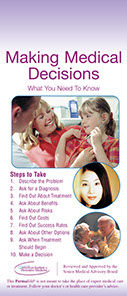
    Cover image to the Making Medical Decision brochure by the American Institute for Preventive Medicine. www.HealthyLife.com. All rights reserved.

    © American Institute for Preventive Medicine
  • Manage Job Stress

    Work Life

    Job stress causes a worker to feel overly taxed both mentally and physically. It affects both workers and employers.

    What Causes Job Stress?

    *  Too much work to do. Conflicting expectations.

    *  Lack of support from co-workers and bosses.

    *  Crowded, noisy, unsafe work conditions. Infrequent rest breaks.

    *  Rapid changes for which workers are not prepared. Job insecurity.

    If not dealt with, job stress can lead to health problems.

    Signs & Symptoms of Job Stress

    *  Hard time concentrating. Headache.

    *  Sleep problems. Stomach problems.

    *  Short temper.

    *  Job dissatisfaction. Low morale.

    *  Increase in being late for work or not going to work.

    Ways to Manage Job Stress

    *  Schedule your time and tasks to be done. Use a calendar, planner, “TO DO” lists, etc. Rank order tasks. Break tasks down into steps. Check off items that are done.

    *  Organize your work space to make it easier to find things. Get rid of items and e-mails that you don’t need.

    *  Ask for help from your boss and co-workers, as needed. Ask your boss for the order in which your job tasks need to be done.

    *  Take breaks. Get enough sleep.

    *  Leave work at work. Try not to take work home. If this is not possible, take as little work home as you need to.

    *  Plan for and take vacations that give you a rest from work.

    *  Relax as much as you can.

    Resources

    National Institute for Occupational Safety and Health (NIOSH)

    800.CDC.INFO (232.4636)

    www.cdc.gov/niosh

    Occupational Safety and Health Administration (OSHA)

    800.321.OSHA (321.6742)

    www.osha.gov

    Healthier at Home book by the American Institute for Preventive Medicine. www.HealthyLife.com. All rights reserved.

    © American Institute for Preventive Medicine
  • Manger Anger

    Mental Health

    Don’t let mental wrath create physical problems.

    “Holding on to anger is like grasping a hot coal with the intent of throwing it at someone else; you are the one who gets burned.” – Buddha

    Too much or chronic anger can lead to depression, headaches, heart disease, high blood pressure, or problems with alcohol or drugs. It can also trigger domestic violence, property damage, or road rage.

    Learn to manage anger.

    Managing your anger can enhance emotional well-being and lead to a happier, healthier life.

    *  Share your anger with a trusted friend, family member, teacher, etc.

    *  Express your feelings in ways that don’t offend or  accuse others.

    *  Keep a record of reasons and times you have too much anger. You may start to see patterns that can be changed.

    *  Channel your energy in positive ways. Write poetry, clean out your cabinets, or take a walk.

    *  Distract yourself. Play music.

    *  Learn to accept things that you cannot change, such as traffic jams.

    *  Lighten up. Look for humor in situations that result  in anger.

    *  Meditate or do yoga.

    *  Think before you act or speak.

    *  Eat healthy foods and don’t skip meals.

    Signs of anger:

    *  Feeling restless

    *  Clenched teeth

    *  Trembling lips or hands

    *  Increased heart rate or blood pressure

    *  Yelling. Slamming doors.

    *  Being less productive

    *  Sleeping problems

    *  Violent outbursts

    Action Step

    If anger interferes with your day-to-day life or has caused physical or emotional harm to you or someone else, seek help from your doctor or a mental health care provider.

    ays to Well-Being book by the American Institute for Preventive Medicine. www.HealthyLife.com. All rights reserved.

    © American Institute for Preventive Medicine
  • Make Thrifty Count

    Financial Health

    Money sign standing on top of coins.

    Building personal wealth starts with making wise financial decisions. Be strategic about where you save money, so it is sustainable. Make it fun and economical, such as cooking a gourmet meal at home with your family and then turning off the lights to have a “candlelit” dinner. Or, get an annual state or national park pass and plan outdoor weekend adventures with your family, saving money while also making memories!

    Be More Earth-Friendly

    Many products we use regularly consume more energy than is needed. Choose energy-efficient products, such as ENERGY STAR certified LED light bulbs, which use up to 90% less energy than standard bulbs and last 15 times longer.

    ays to Well-Being book by the American Institute for Preventive Medicine. www.HealthyLife.com. All rights reserved.

    © American Institute for Preventive Medicine

  • How To Make The Most Of A Doctor Visit

    Medical Care

    Image of doctor and patient talking.

    When a doctor knows how to really communicate well with a patient, it can make a big difference in how that patient responds. But communication is a two-way process. Listening as well as speaking to one another is something both doctor and patient must work on together. Being honest and open with each other is also important.

    What Your Doctor Should Know about You

    Aside from a general health history, it is important that your doctor ask certain questions about the following:

    *  Dietary habits (Are you a frequent junk-food eater? Are you especially fond of cheesecake, sour cream, or other fatty foods?)

    *  Your occupation (Do you work in a high-stress job? Are you exposed to nickel, nuclear power radiation, or other toxic substances?)

    *  Sleep habits (Do you frequently awaken before dawn or have problems getting to sleep?)

    *  Family problems (Are you currently going through a divorce?)

    *  Lifestyle (Do you get any exercise?)

    *  Stress (Do you work in a noisy environment?)

    *  Health attitude (Are you serious about quitting smoking?)

    *  History of family illness (Does heart disease, high blood pressure, diabetes, kidney problems, or cancer run in your family?)

    *  Major life events (Have you recently retired from work?)

    *  Living arrangements (Do you live alone?)

    Quizzing Your Doctor

    Often, patients feel rushed or uneasy during a doctor visit. And when you’re sick, there is a tendency to feel vulnerable and passive. But by heeding these suggestions, you can still make the most of your doctor-patient communications.

    *  Repeat back in your own words what the doctor has told you.

    *  Use simple phrases like “Do I hear you say that…  ?” or “My understanding of the problem is. . .”

    *  Plan ahead of time what you will say to your doctor about your problem. Your observations about a health problem can be invaluable in making a diagnosis.

    *  Take notes on what is wrong and what you need to do.

    *  If you are confused by medical terms, ask for simple definitions. There is no need to be embarrassed by this.

    *  When a medication is prescribed, ask about its possible side effects, its effectiveness, and how long it must be taken.

    *  If your doctor discusses surgery, ask about alternatives, risks, and a second opinion.

    *  Be frank with the doctor if any part of the office visit is annoying, such as lengthy waiting time or discourteous staff. Be tactful, but honest.

    *  Don’t be afraid to voice your fears or apprehensions about what you’ve heard. The doctor may be able to clarify any misconceptions.

    *  Discuss any self-care practices you’ve used that have relieved symptoms.

    *  Find out the best time for the doctor to receive your phone calls should any questions arise.

    Page from A Year of Health Hints book by the American Institute for Preventive Medicine. www.HealthyLife.com. All rights reserved.

    © American Institute for Preventive Medicine