Blog

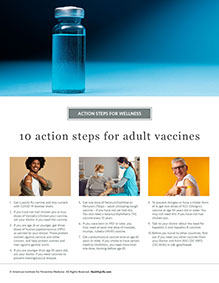
  • 10 Action Steps For Adult Vaccines

    Medical Exams

    A vaccine bottle.

    1.  Get a yearly flu vaccine and stay current with COVID-19 booster shots.

    2.  If you have not had chicken pox or two doses of Varicella (chicken pox) vaccine, ask your doctor if you need this vaccine.

    3.  If you are age 26 or younger, get three doses of human papillomavirus (HPV) as advised by your doctor. These protect women against cervical and other cancers, and help protect women and men against genital warts.

    4.  If you are younger than age 55 years old, ask your doctor if you need vaccines to prevent meningococcal disease.

    5.  Get one dose of Tetanus/Diphtheria/Pertussis (Tdap) – adult whooping cough vaccine – if you have not yet had this. You also need a tetanus/diphtheria (Td) vaccine every 10 years.

    6.  If you were born in 1957 or later, you may need at least one dose of measles, mumps, rubella (MMR) vaccine.

    7.  Get a pneumcoccal vaccine once at age 65 years or older. If you smoke or have certain medical conditions, you need more than one dose, starting before age 65.

    8.  To prevent shingles or have a milder form of it, get two doses of RZV (Shingrix) vaccine at age 50 years old or older. You may not need this if you have not had chicken pox.

    9.  Talk to your doctor about the need for hepatitis A and  hepatitis B vaccines.

    10. Before you travel to other countries, find out if you need any other vaccines from your doctor and from 800.CDC.INFO (232.4636) orcdc.gov/travel.
    ays to Well-Being book by the American Institute for Preventive Medicine. www.HealthyLife.com. All rights reserved.

    © American Institute for Preventive Medicine

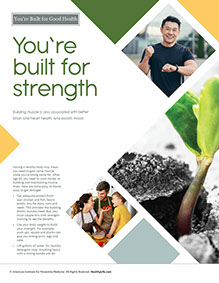
  • You’re Built For Strength

    Fitness

    Young family cooking together in kitchen.

    Building muscle is also associated with better brain and heart health, and boosts mood.

    Having a healthy body may mean you need to gain some muscle while you’re losing some fat. After age 30, you need to work harder at building and maintaining muscle mass. Here are some easy, at-home ways to get stronger:

    *  Get adequate protein from lean chicken and fish, beans, lentils, low fat dairy, nuts and seeds. This provides the building blocks muscles need. But, you must couple this with strength-training to see the benefits.

    *  Use your body weight to build your strength. For example, push ups, squats and planks can give you strong arms, legs and core.

    *  Lift gallons of water. Or, laundry detergent soap. Anything heavy with a strong handle will do.

    Page from HealthyLife Weigh book by the American Institute for Preventive Medicine. www.HealthyLife.com. All rights reserved.

    © American Institute for Preventive Medicine
  • You’re Built For Moving

    Fitness

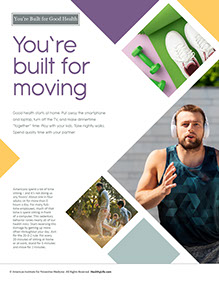
    Father playing soccer with his young son.

    Good health starts at home. Put away the smartphone and laptop, turn off the TV, and make dinnertime “together” time. Play with your kids. Take nightly walks. Spend quality time with your partner.

    Americans spend a lot of time sitting – and it’s not doing us any favors! About one in four adults sit for more than 8 hours a day. For many full-time employees, much of that time is spent sitting in front of a computer. This sedentary behavior raises nearly all of our health risks. Start reversing this damage by getting up more often throughout your day. Aim for the 20-8-2 rule: For every 20 minutes of sitting at home or at work, stand for 8 minutes and move for 2 minutes.

    Page from HealthyLife Weigh book by the American Institute for Preventive Medicine. www.HealthyLife.com. All rights reserved.

    © American Institute for Preventive Medicine

  • You’re Built For Eating

    Nutrition

    Colorful salad.

    Plan out all your meals for the week ahead of time. That includes any snacks. Then, you’ll be less likely to make unhealthy food choices.

    When you’re hungry, you eat. Problem solved, right? Even if you can quiet your grumbling stomach, that doesn’t mean your body got the nutrition it needs to function well. Here’s what you should do when hunger strikes:

    *  Stay away from junk food with lots of saturated fat, sugar, salt and calories, but few nutrients.

    *  Focus on whole-grain and fiber-rich foods. Fill half your plate with vegetables.

    *  Eat dark leafy greens – they are a good source of vitamins A, C, potassium, folate and calcium.

    *  Eat lean protein foods, such as beans, lentils, chicken and fish.

    *  Keep dried fruit, nuts and seeds on hand for a quick snack.

    Page from HealthyLife Weigh book by the American Institute for Preventive Medicine. www.HealthyLife.com. All rights reserved.

    © American Institute for Preventive Medicine
  • You’re Built For Adventure

    Healthy Travel

    Women standing on rock in middle of a creek.

    Setting up daily routines can help you rest your brain so that your creative side can blossom. It’s much easier to plan new ventures and reach goals when your mind isn’t overly taxed with daily problem-solving.

    Do you ever get the itch to do something extraordinary? That may be your inner adventurer calling. People are often drawn to challenges that excite them. When you combine the outdoors with adventure, that can also be a recipe for better mental and physical health.

    *  Activities like biking, hiking or kayaking require mental focus similar to meditation.

    *  Outdoor adventures done with others help you develop better empathy skills.

    *  Outdoor activity offers great cardiovascular benefits, but take precautions to avoid injury.

    *  Being outdoors can help you get the vitamin D you need. But after 15 minutes, cover up or put on an SPF 30 or higher sunblock to protect your skin from the sun.

    Page from HealthyLife Weigh book by the American Institute for Preventive Medicine. www.HealthyLife.com. All rights reserved.

    © American Institute for Preventive Medicine

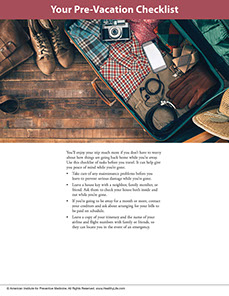
  • Your Pre-Vacation Checklist

    Healthy Travel

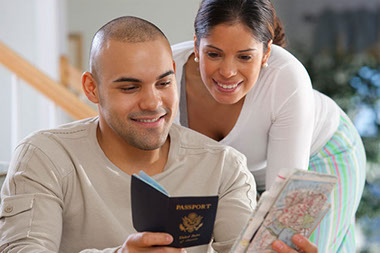
    Image of couple looking at passport and map.

    You’ll enjoy your trip much more if you don’t have to worry about how things are going back home while you’re away. Use this checklist of tasks before you travel. It can help give you peace of mind while you’re gone.

    *  Take care of any maintenance problems before you leave to prevent serious damage while you’re gone.

    *  Leave a house key with a neighbor, family member, or friend. Ask them to check your house both inside and out while you’re gone.

    *  If you’re going to be away for a month or more, contact your creditors and ask about arranging for your bills to be paid on schedule.

    *  Leave a copy of your itinerary and the name of your airline and flight numbers with family or friends, so they can locate you in the event of an emergency.

    Page image from A Year of Health Hints book by the American Institute for Preventive Medicine. www.HealthyLife.com. All rights reserved.

    © American Institute for Preventive Medicine

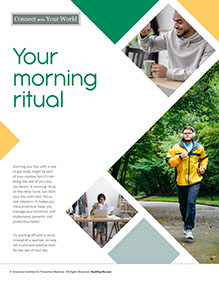
  • Your Morning Ritual

    Stress Management

    Man on a morning jog.

    Starting your day with a race to get ready might be part of your routine, but it’s not doing the rest of your day any favors. A morning ritual, on the other hand, can start your day with calm, focus, and intention. It makes you more proactive, helps you manage your emotions, and implements powerful and productive habits.

    Try starting off with a ritual, instead of a reaction, to help set a calm and positive tone for the rest of your day.

    Page from HealthyLife Weigh book by the American Institute for Preventive Medicine. www.HealthyLife.com. All rights reserved.

    © American Institute for Preventive Medicine

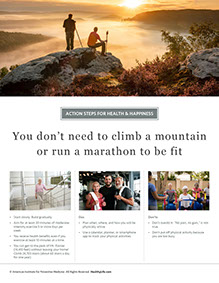
  • You Don’t Need To Climb A Mountain Or Run A Marathon To Be Fit

    Fitness

    Two men standing on edge of cliff at sunset.

    *  Start slowly. Build gradually.

    *  Aim for at least 30 minutes of moderate-intensity exercise 5 or more days per week.

    *  You receive health benefits even if you exercise at least 10 minutes at a time.

    *  You can get to the peak of Mt. Rainier (14,410 feet) without leaving your home! Climb 24,703 stairs (about 68 stairs a day for one year).

    Dos

    *  Plan when, where, and how you will be physically active.

    *  Use a calendar, planner, or smartphone app to track your physical activities.

    Don’ts

    *  Don’t overdo it. “No pain, no gain,” is not true.

    *  Don’t put off physical activity because you are too busy.

    Page from HealthyLife Weigh book by the American Institute for Preventive Medicine. www.HealthyLife.com. All rights reserved.

    © American Institute for Preventive Medicine

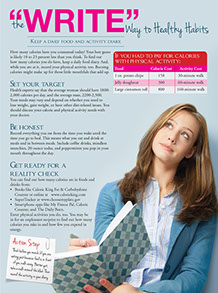
  • The “Write” Way To Healthy Habits

    Weight Control

    Keep a daily food and activity diary.

    How many calories have you consumed today? Your best guess is likely 10 to 25 percent less than you think. To find out how many calories you do have, keep a daily food diary. And, while you are at it, record your physical activity, too. Burning calories might make up for those little mouthfuls that add up.

    Set your target.

    Health experts say that the average woman should have 1800-2,000 calories per day, and the average man, 2200-2,500. Your needs may vary and depend on whether you need to lose weight, gain weight, or have other diet-related issues. You should discuss your caloric and physical activity needs with your doctor.

    Be honest.

    Record everything you eat from the time you wake until the time you go to bed. This means what you eat and drink at meals and in between meals. Include coffee drinks, mindless munchies, 20-ounce sodas, and peppermints you pop in your mouth throughout the day.

    Get ready for a reality check.

    You can find out how many calories are in foods and drinks from:

    *  Books like Calorie King Fat & Carbohydrate Counter or online atwww.calorieking.com

    *  SuperTracker atwww.choosemyplate.gov

    *  Smartphone apps like My Fitness Pal, Calorie Counter, and The Daily Burn.

    Enter physical activities you do, too. You may be in for an unpleasant surprise to find out how many calories you take in and how few you expend in energy.

    If you had to pay for calories with physical activity:

    Food

    1 oz. potato chips

    Jelly doughnut

    Large cinnamon roll

    Calorie Cost

    150

    300

    800

    Activity Cost

    30-minute walk

    60-minute walk

    160-minute walk

    Action Step

    Think before you munch. If you are eating just because food is in front of you, walk away. Better yet, take a walk around the block. Then record the activity in your diary.

    Page from Ways to Well-Being book by the American Institute for Preventive Medicine. www.HealthyLife.com. All rights reserved.

    © American Institute for Preventive Medicine
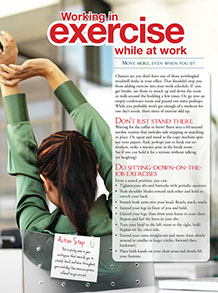
  • Working In Exercise While At Work

    Fitness

    Move more, even when you sit.

    Chances are you don’t have one of those newfangled treadmill desks in your office. That shouldn’t stop you from adding exercise into your work schedule. If you get breaks, use them to march up and down the stairs or walk around the building a few times. Or, go into an empty conference room and pound out some pushups. While you probably won’t get enough of a workout for one day’s needs, short stints of exercise add up.

    Don’t just stand there.

    Waiting for the coffee to brew? Burst into a 60-second aerobic routine that includes side stepping or marching in place. Or, squat and stand as the copy machine spits out your papers. And, perhaps just to freak out co-workers, strike a warrior pose in the break room. See if you can hold it for a minute without talking (or laughing).

    Do sitting-down-on-the-job exercises.

    Women sitting at desk, stretching arms above her head.

    From a seated position, you can:

    *  Tighten your abs and buttocks with periodic squeezes.

    *  Push shoulder blades toward each other and hold to stretch your back.

    *  Stretch both arms over your head. Reach, reach, reach.

    *  Extend your legs in front of you and hold.

    *  Extend your legs, than draw your knees to your chest. Repeat and feel the burn in your abs.

    *  Turn your head to the left, torso to the right, hold. Repeat on the other side.

    *  Extend your arms straight out and move them slowly around in smaller to larger circles, forward then backward.

    *  Place both hands on your chair arms and slowly lift your bottom.

    Action Step

    Put a sticky note in your workspace that reminds you to stretch, bend, and move throughout your workday. Use exercise options offered to you at work.

    Page image from Ways to Well-Being book by the American Institute for Preventive Medicine. www.HealthyLife.com. All rights reserved.

    © American Institute for Preventive Medicine