Blog

  • Do Your Chores

    Fitness

    Image of father and daugher cleaning.

    Burn calories while you clean.

    Who needs a gym when you can burn calories by doing household chores. The faster you move and the more you bend, stretch, and reach, the more your body will benefit. For example, a 150-lb person burns about 130 calories during a 30-minute 3.5 mph walk around the block or about 150 calories by washing the car. Not bad, especially for people who seem to think they have no time to exercise. Are you ready to get out the cleaning supplies?

    Bend and dust and turn and wipe and . . .

    Everything from washing windows to grocery shopping burns calories. The following numbers apply to a 150-lb person doing 30 minutes of activity. If you weigh less, you’ll burn slightly fewer calories. If you weigh more, you will burn slightly more calories. And the more muscle you put into it, the more calories you’ll burn.

    *  Climbing stairs – 306

    *  Rearranging furniture – 225

    *  Shoveling snow – 214

    *  Doing laundry – 210

    *  Walking the dog – 147

    *  Raking leaves – 144

    *  Mopping the floor – 140

    *  Vacuuming – 119

    *  Weeding – 115

    *  Washing dishes – 75

    *  Ironing – 70

    *  Surfing the Internet – 60

    Other calorie – burning tips

    *  Take the stairs instead of the elevator – 306

    *  Park the car farther from your destination and walk – 227

    *  Carry your grocery bags to the car – 190

    Action Step

    If you want to burn even more calories, move as much as you can throughout the day. Stand up and do side steps while you are on the phone. Squat while you are waiting for the washing machine to finish its spin cycle.

    Page image from Ways to Well-Being book by the American Institute for Preventive Medicine. www.HealthyLife.com. All rights reserved.

    © American Institute for Preventive Medicine

  • How To Dispute Beliefs

    Systematic Stress Management Program

    Step 5: Thinking Differently Section

    Introduction

    Match the Self-Talk to the Theory

    Catch Questionable Comparisons

    Thought Habits Become Language Patterns

    How to Dispute a Belief

    Thought Control Techniques

    The Power of Creative Imagination

    Steps for Developing the Most Effective Creative Imagery

    General Stress Management Guidelines

    We may find, in our own self-talk language, thoughts or beliefs that we want to repeat less often. They seem difficult to modify because they have become like a habit or what feels like an automatic reflex. The first step in successful modification is making it a personal responsibility to take the time to examine your own self-talk. The second step is to be honest! The third step is to use techniques that have helped others. And remember, even Albert Ellis tells us that it is irrational to think rational all the time.

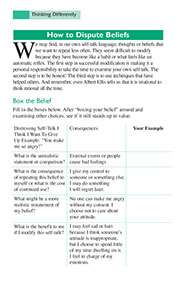
    Box the Belief

    After “boxing your belief” around and examining other choices, see if it still stands up in value.

    Distressing Self-Talk I Think I Want To Give Up

    Example: “You make me so angry!”

    *  What is the unrealistic statement or comparison?

    *  What is the consequence of repeating this belief to myself or what is the cost of continued use?

    *  What might be a more realistic restatement of my belief?

    *  What is the benefit to me if I modify this self-talk?

    Consequences

    *  External events or people cause bad feelings

    *  I give my control to someone or something else. I may do something I will regret later.

    *  No one can make me angry without my consent. I choose not to care about your attitude.

    *  I may feel sad or hurt because I think someone’s attitude is inappropriate, but I choose to spend little of my time dwelling on it. I feel in charge of my emotions.

    Read Into the Reality Roots

    Sometimes stretching a point to the limit can help us to think about a different point of view. Take a belief that you would like to change. Then ask yourself the questions listed below as they relate to this belief. You may find that some questions seem ridiculous. Try to find humor in the ridiculous and you may also find that the belief may not have deep roots in reality.

    The belief I’d like to give up _______________

    *  Does the belief make sense?

    *  What evidence exists for it being false or true?

    *  Is there a legal reason for the belief?

    *  Is there any alternative to the belief?

    *  Will it kill me to let go of the belief?

    *  Do other people survive without this belief?

    *  What is the worst possible thing that could happen if I give up the belief?

    *  I am telling myself this belief is true what percent of the time?

    *  Would it be to my benefit to lessen this percentage?

    *  Is there now enough doubt about this belief to consider new thinking?

    ABCDE Model

    If an event produces stress, question the beliefs held about that event. Are the beliefs valid? Are they reasonable? Are they rational? This ABCDE Model identifies how beliefs influence stress. Once identified, beliefs that don’t make sense can be disputed or changed.

    Instructions: Remember a recent event that made you anxious, tense, or worried. Close your eyes and imagine it for 30 seconds. Using the ABCDE Model, learn to think differently to improve outcomes. See how you could have changed the emotional consequences.

    How the ABCDE Model Works

    Activating Event: What event made you anxious, tense, or worried? Example: Getting stuck in a traffic jam on the way to work. What’s your example?

    Beliefs: What thoughts did you have about the past event? Examples:

    1. “It is my fault for not leaving earlier.”

    2. “This is a waste of time.”

    3. “My boss will be angry about this.”

    4. “I’m stupid.”

    What’s your example?

    Consequence

    How did you feel because of your beliefs? Examples: Tense, feeling anxious, irritable, and having negative thoughts. What’s your example?

    Dispute

    Challenge the negative thought you identified in “B.” Start with a phrase like, “That’s not right…” and add a positive statement. Examples: “That’s not right, this happens to everyone at one time or another. I’ll use this time for some planning of my day’s activities. If I get anxious now, it may affect me when I do get to work.” What’s your example?

    Effect

    How do you feel now having challenged your negative thoughts? Examples: Relaxed, positive, in a good mood. Made good use of time spent in traffic jam. What’s your example?

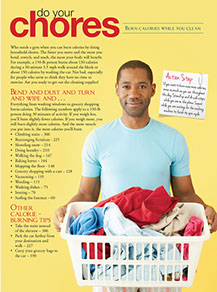
    Page from the Systematic Stress Management book by the American Institute for Preventive Medicine. www.HealthyLife.com. All rights reserved.

    © American Institute for Preventive Medicine

    Step 1: Understanding Stress

    Step 3: Type A & B Behavior Patterns

    Step 5: Thinking Differently

    Step 7: Communication & Stress

    Step 2: Stress Management at Work

    Step 4: Biofeedback Training & Relaxation

    Step 6: Time Management

    Steps to Systematic Stress Management™

    RELATED ARTICLES

    © American Institute for Preventive Medicine  –  All Rights Reserved.Disclaimer|www.HealthyLife.com

  • Dilled Fish Fillets

    Nutrition

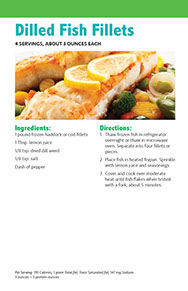
    4 Servings, about 3 ounces each

    Ingredients:

    1 pound frozen haddock or cod fillets

    1 Tbsp. lemon juice

    1/8 tsp. dried dill weed

    1/8 tsp. salt

    Dash of pepper

    Directions:

    1.  Thaw frozen fish in refrigerator overnight or thaw in microwave oven. Separate into four fillets or pieces.

    2.  Place fish in heated frypan. Sprinkle with lemon juice and seasonings.

    3.  Cover and cook over moderate heat until fish flakes when tested with a fork, about 5 minutes.

    Microwave Directions:

    Place fish in a glass baking dish. Cover with wax paper. Cook at “medium” power for 3 minutes. Remove cover, turn fish over, and sprinkle with lemon juice and seasonings. Cover and continue cooking at “medium” power for 3 minutes or until fish flakes with a fork.

    Per Serving:

    Calories – 195

    Total fat – 1 gram

    Saturated fat – Trace

    Sodium – 147 mg

    Page from HealthyLife Weigh Recipe book by the American Institute for Preventive Medicine. www.HealthyLife.com. All rights reserved.

    © American Institute for Preventive Medicine

  • Dietary Fiber

    Nutrition

    A variety of foods high in fiber.

    Diets high in dietary fiber may help reduce the risk of colon cancer, heart disease, diabetes, and heartburn.

    Choose whole-grain foods over white, enriched ones. Eat plenty of vegetables, fruits, beans, lentils, nuts and seeds.

    Health experts advise adults getting 22 to 34 grams of dietary fiber a day. Most adults in the U.S. get only about 15 to 18 grams a day.

    Choose whole-grain breads, cereals, and pasta instead of white and refined ones. Have legumes (beans, etc.) in salads, soups, chili, etc. Choose whole fruits over juices. Snack on vegetables.

    Page from HealthyLife Weigh book by the American Institute for Preventive Medicine. www.HealthyLife.com. All rights reserved.

    © American Institute for Preventive Medicine

  • Develop Supermarket Savvy

    Weight Control

    A successful weight-control effort begins with smart food purchases. Here’s how to maneuver your way through the supermarket and also stay in control of your weight.

    *  Plan your low-fat meals and snacks in advance, then, using a list, shop only for what you need.

    *  Stay away from the aisles where pastries, potato chips, candies, or other potential problem foods are located.

    *  Shop for food after you’ve eaten, not when you’re hungry. You’ll choose food based on clear thinking, not hunger pangs.

    *  Choose fresh foods and vegetables over processed foods, which can deliver unwanted calories in the form of sauces and thickeners.

    *  Don’t try to rationalize buying high-calorie snack foods for others in the household. Having them around may very well undermine your weight-control efforts.

    *  Beware of high-calorie foods that, although advertised as “specials,” don’t do your diet any special favor.

    Selecting Snacks under 100 Calories

    Snacking seems to be an integral part of many people’s lifestyles, but when you’re trying to lose weight, your choices need to be prudent. Whether you crave crunchy, salty, fresh, or sweet foods, there’s a variety of food that will satisfy you yet help you lose weight. The table below lists 25 snacks that are all less than 100 calories each!

    Page from A Year of Health Hints book by the American Institute for Preventive Medicine. www.HealthyLife.com. All rights reserved.

    © American Institute for Preventive Medicine

  • Steps To Developing The Most Effective Creative Imagery

    Systematic Stress Management Program

    Step 5: Thinking Differently Section

    Introduction

    Match the Self-Talk to the Theory

    Catch Questionable Comparisons

    Thought Habits Become Language Patterns

    How to Dispute a Belief

    Thought Control Techniques

    The Power of Creative Imagination

    Steps for Developing the Most Effective Creative Imagery

    General Stress Management Guidelines

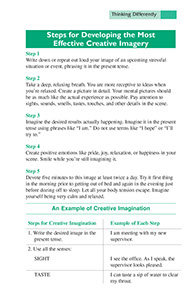
    Step 1

    Write down or repeat out loud your image of an upcoming stressful situation or event, phrasing it in the present tense.

    Step 2

    Take a deep, relaxing breath. You are more receptive to ideas when you’re relaxed. Create a picture in detail. Your mental pictures should be as much like the actual experience as possible. Pay attention to sights, sounds, smells, tastes, touches, and other details in the scene.

    Step 3

    Imagine the desired results actually happening. Imagine it in the present tense using phrases like “I am.” Do not use terms like “I hope” or “I’ll try to.”

    Step 4

    Create positive emotions like pride, joy, relaxation, or happiness in your scene. Smile while you’re still imagining it.

    Step 5

    Devote five minutes to this image at least twice a day. Try it first thing in the morning prior to getting out of bed and again in the evening just before dozing off to sleep. Let all your body tension escape. Imagine yourself being very calm and relaxed.

    Page from the Systematic Stress Management book by the American Institute for Preventive Medicine. www.HealthyLife.com. All rights reserved.

    © American Institute for Preventive Medicine

    Step 1: Understanding Stress

    Step 3: Type A & B Behavior Patterns

    Step 5: Thinking Differently

    Step 7: Communication & Stress

    Step 2: Stress Management at Work

    Step 4: Biofeedback Training & Relaxation

    Step 6: Time Management

    Steps to Systematic Stress Management™

    RELATED ARTICLES

    © American Institute for Preventive Medicine  –  All Rights Reserved.Disclaimer|www.HealthyLife.com

  • Destination: Fun

    Healthy Travel

    Couple smiling, sitting in front of eiffel tower.

    Taking a break from it all is good for your health and happiness. Planning ahead, packing smart, and knowing your destination will help you relax and enjoy. Use these tips for a safe and healthy vacation.

    *  Find out what to expect at your destination – weather, construction areas, and health concerns.

    *  If you are going outside the U.S., find out if you need any vaccines. Ask your doctor or visitcdc.gov/travel.

    *  Don’t carry large amounts of cash.

    *  Make sure you have enough of your medicines. Pack them in your carry-on bag.

    *  Pack a first-aid kit with over-the-counter (OTC) medicines, sunscreen, and bandages.

    *  During airplane travel, stretch your arms and legs at least every hour.

    *  Leave valuables at home. Don’t become a target for theft.

    *  Stay hydrated. If the drinking water is unsafe, choose bottled water. Limit alcohol and caffeine.

    *  Wash your hands often. Take alcohol-based hand sanitizers that contain least 60% alcohol.

    *  Talk to your family about safety concerns. Don’t let kids wander.

    *  Supervise your children at all times.

    Action Step:Use a sunscreen with a sun protection factor (SPF) of 15 or higher to protect your skin from the sun’s ultraviolet rays.

    Page from HealthyLife Weigh book by the American Institute for Preventive Medicine. www.HealthyLife.com. All rights reserved.

    © American Institute for Preventive Medicine

  • Destination: Healthy Vacation

    Healthy Travel

    Image of father and child playing in the pool.

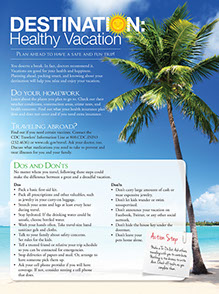
    Plan ahead to have a safe and fun trip!

    You deserve a break. In fact, doctors recommend it. Vacations are good for your health and happiness. Planning ahead, packing smart, and knowing about your destination will help you relax and enjoy.

    Do your homework.

    Learn about the places you plan to go to. Check out their weather conditions, construction areas, crime rates, and health concerns. Find out what your health insurance plan does and does not cover and if you need extra insurance. No matter where you travel, following these steps could make the difference between a great and a dreadful vacation.

    Dos

    *  Pack a basic first-aid kit.

    *  Pack all prescriptions and other valuables, such as jewelry in your carry-on luggage.

    *  Stretch your arms and legs at least every hour during travel.

    *  Stay hydrated. If the drinking water could be unsafe, choose bottled water.

    *  Wash your hands often. Take travel-size hand sanitizer gels and cloths.

    *  Talk to your family about safety concerns. Set rules for the kids.

    *  Tell a trusted friend or relative your trip schedule so you can be contacted for emergencies.

    *  Stop deliveries of papers and mail. Or, arrange to have someone pick them up.

    *  Ask your cell phone provider if you will have coverage. If not, consider renting a cell phone that does.

    Don’ts

    *  Don’t carry large amounts of cash or wear expensive jewelry.

    *  Don’t let kids wander or swim unsupervised.

    *  Don’t announce your vacation on Facebook, Twitter, or any other social network.

    *  Don’t hide the house key under the doormat.

    *  Don’t leave your pets home alone.

    Traveling abroad?

    Find out if you need certain vaccines. Contact the CDC Travelers’ Information Line at 800.CDC.INFO (232.4636) orwww.cdc.gov/travel. Ask your doctor, too. Discuss what medications you need to take to prevent and treat illnesses for you and your family.

    Action Step

    Make a To-Do list. Ask others traveling with you to contribute. Nothing is too obvious to write down. Check off tasks as you complete them.

    Page image from Ways to Well-Being book by the American Institute for Preventive Medicine. www.HealthyLife.com. All rights reserved.

    © American Institute for Preventive Medicine