Introduction
The Mind/Body Bridge
Biofeedback Training Record
Breathing Exercises
The Relaxation Response
The Relaxation Reflex
Mental Imagery
Personal Mental Imagery
Auto-Suggestion
Stretching the Stress Triangle
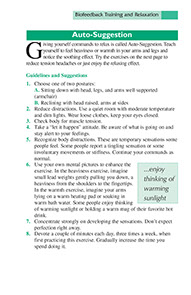
Giving yourself commands to relax is called Auto-Suggestion. Teach yourself to feel heaviness or warmth in your arms and legs and notice the soothing effect. Try the exercises below to reduce tension headaches or just enjoy the relaxing effect.
Guidelines and Suggestions
1. Choose one of two postures: A. Sitting down with head, legs, and arms well supported (armchair). B. Reclining with head raised, arms at sides.
2. Reduce distractions. Use a quiet room with moderate temperature and dim lights. Wear loose clothes, keep your eyes closed.
3. Check body for muscle tension.
4. Take a “let it happen” attitude. Be aware of what is going on and stay alert to your feelings.
5. Recognize body distractions. These are temporary sensations some people feel. Some people report a tingling sensation or some involuntary movements or stiffness. Continue your commands as normal.
6. Use your own mental pictures to enhance the exercise. In the heaviness exercise, imagine small lead weights gently pulling you down, a heaviness from the shoulders to the fingertips. In the warmth exercise, imagine your arms lying on a warm heating pad or soaking in warm bath water. Some people enjoy thinking of warming sunlight or holding a warm mug of their favorite hot drink.
7. Concentrate strongly on developing the sensations. Don’t expect perfection right away.
8. Devote a couple of minutes each day, three times a week, when first practicing this exercise. Gradually increase the time you spend doing it.
Auto-Suggestion Exercises
Choose a correct posture. Check for body tension.
* Speak slowly (5 seconds for 5 words) or at a comfortable pace.
* Pause about 3 to 5 seconds between each phrase.
* Repeat each phrase 3 times before going on to the next one.
* If you are right-handed, begin with the right side. Start with the left side if you are left-handed.
Step 1- Breathing
Begin with a few slow, deep breaths. Inhale through the nose. Hold it. Slowly exhale. (3 times)
Step 2 – Heaviness exercise
* My right arm is heavy (3x)
* My left arm is heavy (3x)
* Both my arms are heavy (3x)
* My right leg is heavy (3x)
* My left leg is heavy (3x)
* Both my legs are heavy (3x)
Step 3 – Warmth exercise
* My right arm is warm (3x)
* My left arm is warm (3x)
* Both my arms are warm (3x)
* My right leg is warm (3x)
* My left leg is warm (3x)
* Both my legs are warm (3x)
Step 4 – End of exercise phrase
Take a deep breath and upon the inhale, say, “I am,” exhale, and say, “calm.” Repeat 3 times.
OR
Take a few deep breaths and say, “When I open my eyes, I will be refreshed and alert.” Slowly open your eyes and gradually resume normal activity.
Special Note on Relaxation Exercises
Read all instructions completely for each exercise. One effective way to use the relaxation exercises is to record them on a cassette tape. Follow the steps while listening to the tape. A second method is to have another person read the steps to you as you perform the exercise.