Blog

  • Prevent  Overscheduling

    FAMILY LIFE

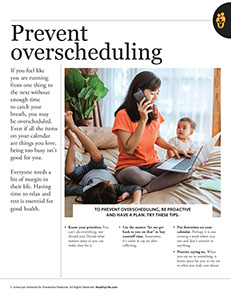
    Mother on phone while using computer with 2 young children next to her.

    If you feel like you are running from one thing to the next without enough time to catch your breath, you may be overscheduled. Even if all the items on your calendar are things you love, being too busy isn’t good for you.

    Everyone needs a bit of margin in their life. Having time to relax and rest is essential for good health.

    To prevent overscheduling, be proactive and have a plan. Try these tips:

    *  Know your priorities. You can’t do everything, nor should you! Decide what matters most so you can make time for it.

    *  Use the answer “let me get back to you on that” to buy yourself time. Sometimes it’s easier to say no after reflecting.

    *  Put downtime on your calendar. Perhaps it is one evening a week where you rest and don’t commit to anything.

    *  Practice saying no. When you say no to something, it leaves space for you to say yes to what you truly care about.

    © American Institute for Preventive Medicine

  • Prevent Firework Injuries

    WELL-BEING

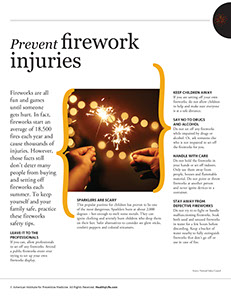
    Two hands holding sparklers.

    Fireworks are all fun and games until someone gets hurt. In fact, fireworks start an average of 18,500 fires each year and cause thousands of injuries. However, those facts still don’t deter many people from buying and setting off fireworks each summer. To keep yourself and your family safe, practice these fireworks safety tips.

    Leave it to the professionals

    If you can, allow professionals to set off any fireworks. Attend a public fireworks event over trying to set up your own fireworks display.

    Keep children away

    If you are setting off your own fireworks, do not allow children to help and make sure everyone is at a safe distance.

    Say no to drugs and alcohol

    Do not set off any fireworks while impaired by drugs or alcohol. Or, ask someone else who is not impaired to set off the fireworks for you.

    Handle with care

    Do not hold the fireworks in your hands or set off indoors. Only use them away from people, houses and flammable material. Do not point or throw fireworks at another person and never ignite devices in a container.

    Stay away from defective fireworks

    Do not try to re-light or handle malfunctioning fireworks. Soak both used and unused fireworks in water for a few hours before discarding. Keep a bucket of water nearby to fully extinguish fireworks that don’t go off or use in case of fire.

    Sparklers are scary

    This popular pastime for children has proven to be one of the most dangerous. Sparklers burn at about 2,000 degrees – hot enough to melt some metals. They can ignite clothing and severely burn children who drop them on their feet. Safer alternatives to consider are glow sticks, confetti poppers and colored streamers.

    Source: National Safety Council

    © American Institute for Preventive Medicine

  • Prevent Child Abuse With Strong Families

    FAMILY LIFE

    Young child cuddled up with teddy bear.

    Child abuse affects hundreds of thousands of children each year. Even if you don’t know someone affected by child abuse, you can help prevent it. It starts with knowing its causes and risk factors.

    Why does abuse happen?

    If a parent or caregiver has these risk factors, child abuse is more likely to happen:

    *  Low self-esteem

    *  Poor impulse or temper control

    *  Untreated mental health conditions like depression or anxiety

    *  Substance abuse

    *  Lack of education or knowledge about child development

    *  Unemployment or poverty

    In addition, if a child has special needs or a challenging temperament, they are more likely to be abused. Babies and young children, because they require constant care, are also more likely to be abused than older children. Teens are at a higher risk of sexual abuse than younger children.

    Protective factors

    Protective factors are things that lower the risk of child abuse or neglect. Protective factors include:

    *  Having resources for things everyone needs, like food, transportation and housing

    *  Access to safe schools and health care

    *  Parents who have ways to cope with stress

    *  A strong family support system of family and friends

    *  Children who have self-esteem, confidence and independence

    *  Parents and children who communicate well with each other

    What to do if you suspect abuse

    If you suspect that someone is abusing or neglecting a child, there are resources to help.

    *State child abuse and neglect agencies:Contact your local child protective services office or law enforcement agency.

    *Childhelp National Child Abuse Hotline:1.800-4-A-CHILD  (1-800-422-4453). Professional crisis counselors are available 24 hours a day, 7 days a week, in over 170 languages. All calls are confidential. The hotline offers crisis intervention, information and referrals to thousands of emergency, social service and support resources.

    Sources: Centers for Disease Control and Prevention, Child Welfare Information Gateway

    © American Institute for Preventive Medicine

  • Preparing For College Move-In

    FAMILY LIFE

    Female college student carring in a full bin of stuff.

    It’s time to send your young adult off for their first semester of college. Here are some tips to be sure they’re ready for move-in day.

    *Pack light.Only pack the basics you know they will use and plan to order additional items when needed.

    *Bring cleaning supplies.Have them handy when you first arrive.

    *Limit who helps with the move.College move-in can be chaotic, and the fewer people, the better.

    *Pack seasonally.Your college student won’t need a winter coat in August. Use vacuum seal bags for items that will be needed later.

    *Find the nearest drugstore, grocery store, and restaurants.Make sure your student knows how to access transportation to get there.

    *Bring lots of snacks.Move-in day can be physically as well as emotionally taxing. Make sure everyone stays well hydrated and fed so you can enjoy the day together.

    © American Institute for Preventive Medicine

  • Potatoes: Diet Friend Or Foe?

    HEALTHY EATING

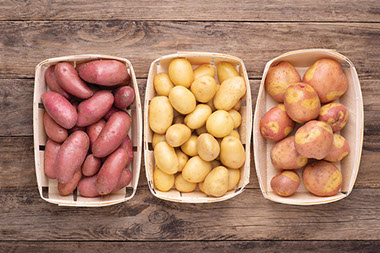
    Three baskets filled with potatoes.

    Perhaps you’ve heard the old saying that a potato isn’t a vegetable, it’s a starch. Actually, a potato is a starchy vegetable, so it’s both!

    Are potatoes healthy?

    Potatoes are higher in starch and calories than other vegetables. But that doesn’t mean you should never eat them. Like any food, enjoy potatoes in moderation. Try to eat a variety of fruits and vegetables each day.

    Potatoes supply a good amount of nutrients and can help you feel full. One medium potato has 110 calories and is a good source of:

    *  Potassium (more than a banana)

    *  Vitamin C

    *  Vitamin B6

    *  Fiber

    Eat them all-natural

    Potatoes may get an unhealthy reputation because they’re often fried or dressed with high-fat toppings like butter and sour cream. Enjoy potatoes baked or microwaved with a small amount of butter or olive oil and  salt-free seasoning or herbs.

    Source: United States Department of Agriculture

    © American Institute for Preventive Medicine

  • Potassium: Why You Need It

    HEALTHY EATING

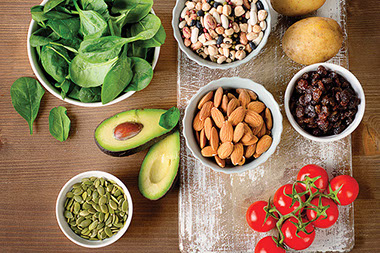
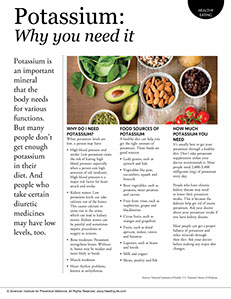
    A varity of foods high in potassium.

    Potassium is an important mineral that the body needs for various functions. But many people don’t get enough potassium in their diet. And people who take certain diuretic medicines may have low levels, too.

    Why do I need potassium?

    When potassium levels are low, a person may have:

    *  High blood pressure and stroke: Low potassium raises the risk of having high blood pressure, especially when a person eats high amounts of salt (sodium). High blood pressure is a major risk factor for heart attack and stroke.

    *  Kidney stones: Low potassium levels can take calcium out of the bones. This causes calcium to come out in the urine, which can lead to kidney stones. Kidney stones can be painful and sometimes require procedures or surgery to remove.

    *  Bone weakness: Potassium strengthens bones. Without it, bones may be weaker and more likely to break.

    *  Muscle weakness

    *  Heart rhythm problems, known as arrhythmias

    Food sources of potassium

    A healthy diet can help you get the right amount of potassium. These foods are good sources:

    *  Leafy greens, such as spinach and kale

    *  Vegetables like peas, cucumbers, squash and broccoli

    *  Root vegetables, such as potatoes, sweet potatoes and carrots

    *  Fruit from vines, such as raspberries, grapes and blackberries

    *  Citrus fruits, such as oranges and grapefruit

    *  Fruits, such as dried apricots, melon, raisins and bananas

    *  Legumes, such as beans and lentils

    *  Milk and yogurt

    *  Meats, poultry and fish

    How much potassium you need

    It’s usually best to get your potassium through a healthy diet. Don’t take potassium supplements unless your doctor recommends it. Most people need 2,600-3,400 milligrams (mg) of potassium every day.

    People who have chronic kidney disease may need to lower their potassium intake. This is because the kidneys help get rid of excess potassium. Ask your doctor about your potassium intake if you have kidney disease.

    Most people can get a proper balance of potassium and other minerals through their diet. Ask your doctor before making any major diet changes.

    Sources: National Institutes of Health, U.S. National Library of Medicine

    © American Institute for Preventive Medicine

  • Positive Parenting Hacks

    FAMILY LIFE

    Parents with son, smile.

    Don’t focus on mistakes or bad behavior. Catch your child doing good things and point them out.

    Chores don’t have to be a punishment. Chores at home can help children learn life skills and independence.

    Spend a little time connecting each day. Take a few minutes to talk to your child without phones or screens.

    © American Institute for Preventive Medicine

  • Popcorn: A Healthy Corn Option

    HEALTHY EATING

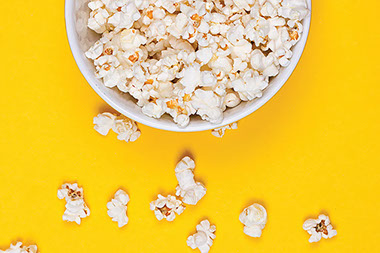
    Popcorn in a bowl on a yellow background.

    Fresh corn is healthy, but there’s another great way to enjoy corn: popcorn.

    When you think of popcorn, you might think of movie theatres and lots of butter. But popcorn is a naturally healthy food without all the extra butter, oil and salt.

    Popcorn is whole grain corn. It’s made from a specific type of corn that pops open when it’s heated. It can be a healthy alternative to higher-calorie snacks like potato chips and crackers. One cup of air-popped corn has just 31 calories and over one gram of fiber.

    To keep it healthy, go light on the butter, oil and salt.

    Source: United States Department of Agriculture

    © American Institute for Preventive Medicine